

News
10 African Millionaires Under 40

Nothing beats being young and rich. While most people attain multi-million dollar and billion dollar fortunes in their 40s and 50s, a few savvy entrepreneurs hit the big time while in their 20s and 30s.
Mfonobong Nsehe, who contributes for Forbes reported that there are a handful of young African entrepreneurs who’ve legitimately built multi-million dollar companies while in their 20s and 30s.
A few of them have taken the helm of small companies and spun them into companies with valuations of $1 billion or more.
All aged 39 and under, they are worth watching closely.
Mohammed Dewji, Tanzania: Manufacturing
Dewji, 38, a Tanzanian businessman and politician, is the CEO and leading shareholder of Mohammed Enterprise Limited (METL), one of the largest industrial conglomerates in East Africa.
His father, Gulam Dewji, founded the conglomerate decades ago as a trading company but ‘Mo’ as he is popularly called, now calls the shots.
He was solely responsible for engineering the group’s transformation from a trading house to a manufacturing powerhouse.
METL, which records an annual turnover of close to $2 billion, owns 21st Century Textiles, one of the largest textile mills in sub-Saharan Africa by volume.
The group also manufactures soap, beverages, edible oils and other food products as well as bicycles and motorcycles.
Other assets include an insurance firm, a petroleum marketing outfit and a container depot in Tanzania’s capital city of Dar Es Salaam.
The group employs over 24,000 full-time employees. Mo Dewji is a World Economic Forum Young Global Leader and a Member of Parliament for Tanzania’s Singida Urban constituency.
(I met with Dewji in Tanzania recently and will be writing a detailed piece on Dewji’s business holdings).
Igho Sanomi, Nigeria: Oil Trading
In 2004, Igho Sanomi founded the Taleveras Group, a Nigerian energy trading company. Taleveras trades over 100 million barrels of crude oil as well as several million tons of gasoline, LPG and jet fuel.
In April 2012, Taleveras acquired production sharing contracts (PSCs) for three offshore oil blocks in Ivory Coast.
In June 2013, Taleveras sold a 65% stake in one of its Ivorian offshore upstream projects to Lukoil of Russia for an undisclosed price. Taleveras also owns a stake in a power distribution firm in Nigeria. Sanomi is 38 years old.
Quinton van der Burgh, South Africa: Mining
The 36 year-old South African coal magnate is the founder and chairman of Quinton van der Burgh Investments, a diversified holding company that is the controlling shareholder in Eyethu Coal, a company that mines coal in South Africa’s Mpumalanga region. Eyethu owns two operational mines and is a major supplier of coal to Eskom, South Africa’s dominant power provider.
Van der Burgh’s portfolio also includes Iyanga Coal- a company that owns a mine with proven reserves of 18 million tons of coal and Burgh Plant Hire- a company that leases earth-moving equipment to clients like BHP Billiton, Xstrata and Anglo-American.
Van der Burgh is also a TV personality. He stars in Clifton Shores, an American/South African reality show filmed in Cape Town.
Gerald Wamalwa, Kenya: Engineering & Construction
In 2003, at age 28, Gerald Wamalwa quit his job as a field civil engineer and went on to start Mellech, an engineering outfit.
Today, Mellech Engineering & Construction is now one of East Africa’s leading construction and infrastructure engineering company.
The company offers services in the construction of building projects, roads, and water & sewer projects and related civil engineering infrastructure projects in Kenya, Southern Sudan and Uganda and grosses over $11 million a year revenues.
Wamalwa also owns ACP Telecoms, a company that provides turnkey telecommunication network infrastructure solutions.
Sibongile Sambo, South Africa: Private Aviation
Sibongile Sambo, 39, is the founder of SRS Aviation, a successful South African private aviation company. SRS started off in 2004 by brokering contracts between aviation services and those with air-transport needs. Later in the year, when the South African government invited aviation service companies to bid on a lucrative contract for cargo transport, SRS won the bid. Over time, SRS morphed from its cargo business into an integrated provider of private aviation services. SRS now offers clients from Southern Africa professional and personal flight options to international destinations including VIP Charter, tourist charter and helicopter services. The company also provides maintenance, sales and fleet management services to private jet owners. SRS refused to disclose revenues, but a source in the company says annual revenues are several million dollars.
Khanyi Dhlomo, South Africa: Publishing
The Harvard MBA grad and South African media mogul began her career as a news presenter at SABC, the television station owned by the South African government, at age 20 while she was still a journalism student at the University of Witwatersrand.
She went on to become the editor of True Love, a popular South African women’s magazine at age 22. In 2007, she founded Ndalo Media, a 50-50 joint venture with Media 24, the publishing arm of Naspers, Africa’s largest media company.
Ndalo Media publishes Destiny and Destiny Man, two of South Africa’s most popular lifestyle magazines. Ndalo also publishes Sawubona, the in-flight publication for South African Airways, which is distributed on all local and international SAA flights.
She also owns Luminance, a startup high-end fashion and lifestyle store in South Africa.
Patrick Ngowi, Tanzania: Alternative Energy
Ngowi, a 28 year-old Tanzanian, is the founder of Helvetic Solar, East Africa’s leading renewable energy company. Companies in the group are involved in the handling, supply, installation and maintenance of hydro turbines, solar power and thermal systems in East Africa.
According to Ngowi, Helvetic’s revenues are expected to hit $7 million before the end of this year and the company is extremely profitable.
The company’s major clients include the United Nations, World Vision and the Tanzanian Army. An emerging philanthropist, he offers basic lighting facilities to Tanzania’s rural poor through his Light For Life foundation.
Ken Njoroge, Kenya: Mobile technology
Njoroge, 37, is the founder of Cellulant, a leading Pan-African mobile commerce company that manages, delivers and bills for content and commerce services over mobile networks.
Cellulant provides mobile banking, mobile payments, music, information services and other mobile related services.
Njoroge founded the company in 2004 along with a Nigerian partner, Goke Akinboro. It now has a presence in 8 African countries and boasts a clientele of African blue-chips like Barclays Bank, Standard Chartered, MTN and other companies. Cellulant’s revenues for 2012 exceeded $120 million.
Colin Thornton, South Africa: Computer Services
In 1998, when he was 20, South African computer whiz Colin Thornton dropped out of the University of Witwatersrand where he was pursuing a BSc in Computer science.
He raised $1,000 (R5, 000) from friends and family to print out flyers and other marketing material promoting his startup company which would fix computers.
Today, that company is Dial-A-Nerd, a company that provides computer support services dedicated to homes and businesses.
Dial a Nerd’s team of mobile technicians are able to repair, build, upgrade or even replace PCs at your premises. The company has annual revenues of close to $10 million, 14 branches and 150 staff.
Alan Knott-Craig Jr., South Africa: Technology, Investments
The 36 year-old South African entrepreneur is the founder of World Of Avatar (WOA), the private investment holding company that acquired MXit from Namibian founder Herman Heunis and Naspers for $50 million in August 2011.
Mxit is a mobile instant messaging services which offers social networking, mobile voice clips, music & entertainment, banking access and other community-based applications.
It currently has over 20 million users. Alan also has stakes in popular South African online publication Daily Maverick; advertising network Shinka, which sells ad space on MXit; and market research company Pondering Panda. Alan is a 2009 World Economic Forum Young Global Leader.


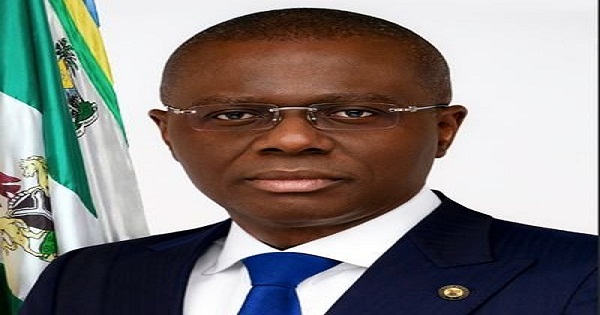
Lagos State has dragged 45 individuals and firms, including Bi-Courtney Aviation, DAAR Communications and Leaders & Company, to revenue court for tax debts running into billions of naira.

Lagos Govt
Bi-Courtney, operators of Murtala Muhammed Airport Terminal Two, faces N38.7 million claim; DAAR, behind Africa Independent Television, owes N22.4 million; ThisDay publishers Leaders & Company allegedly skip N67.1 million.
GMT Energy Resources tops corporates at N145.8 million, followed by Sheriff Deputies at N132.1 million; others like Heyden Petroleum, AA Rescue, BRT operator Primero also listed.
Individuals owe N13.5 million to N35 million each.
Attorney-General Lawal Pedro said suits followed ignored notices, aiming to enforce laws and fund infrastructure.
More defendants: IENG Nigeria, James Fisher, V Care Diagnostics, Venture Garden, Saro Africa, Barry Callebaut, Native Media, First Consulting, Eyowo Payments.
Compliant taxpayers post-notice escaped prosecution; defaulters risk penalties, interest, jail.
Pedro urged prompt filings and payments.


National Agency for Food and Drug Administration and Control (NAFDAC) has alerted Nigerians on counterfeit and unregistered Cerelac Mixed Fruits and Wheat products being sold in Lagos.

NAFDAC said Nestle Nigeria, the genuine Marketing Authorisation Holder of the product, received a complaint of suspected counterfeit purportedly manufactured by Nestlé Spain, bearing Batch Code 308002910.
It said that Nestle Nigeria reported that the complainant described that the counterfeit product emitted an odour suggestive of possible contact with fuel.
NAFDAC said that preliminary review of the product by Nestle Nigeria indicated that it had expired, in spite of the container displaying an expiry date of 10-2026, which suggested that the date coding had been tampered with (revalidated).
Nestle Cerelac Mixed Fruits and Wheat is a nutritious infant cereal, designed to be a delicious first food for infants.
NAFDAC said that its post-marketing surveillance’s directorate officers in Lagos conducted a surveillance visit to Maxland Shopping Centre, 193 Ago Palace, Okota, where the product was purchased by the complainant.
It added that the suspected counterfeit and unregistered Cerelac were found on sale at the premises and subsequently mopped up, while Nestle assisted in identifying the distinguishing features between registered and unregistered product.
According to the regulatory agency, Nestle revealed that the unregistered product used a hyphen (-) to separate the day from the year, while the registered product used a slash (/) to separate the day from the year.
“It is important to note that Nestle Nigeria is not aware of the channels through which the products are supplied into the country.
“Healthcare professionals and consumers are advised to report any suspicion of the sale of substandard and falsified regulated products to the nearest NAFDAC office, call 0800-162-3322, or send an email to [email protected],” NAFDAC said.
The agency warned that counterfeit formula often lacked essential nutrients, vitamins and minerals, leading to stunted growth or developmental issues.
It said that such formula might also contain contaminants that might lead to severe health consequences to infants or even death.
NAFDAC reiterated its commitment to safeguarding public health adding that it would continue surveillance activities to ensure the quality, safety, and efficacy of all NAFDAC-regulated products circulating in Nigeria.
It said that all zonal directors of the agency and state coordinators had been directed to carry out surveillance and mop up the revalidated product, if found within the zones and states.
The agency urged distributors, retailers, healthcare professionals, and caregivers to exercise caution and vigilance within the supply chain, to avoid the distribution, sale, and use of fake products.

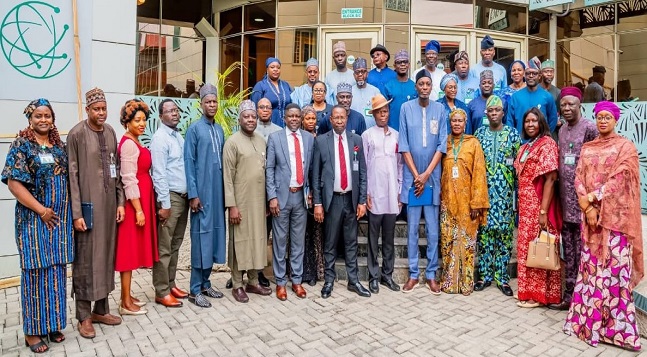
The National Information Technology Development Agency (NITDA) has reinforced its commitment to advancing Nigeria’s digital transformation agenda through strengthened collaboration with key strategic institutions, as it hosted the Director General of the National Institute for Policy and Strategic Studies (NIPSS), Professor Ayo Omotayo, alongside participants of the Senior Executive Course (SEC) 48, 2026.

The visit, which builds on an earlier strategic study tour, provided a platform for in-depth engagement on the role of digital innovation in driving sustainable economic growth, with particular focus on the Orange Economy.
Representing the Director General of NITDA, Kashifu Inuwa CCIE, the Director of Stakeholder Management and Partnerships, Dr Aristotle Onumo, highlighted the Agency’s commitment to fostering a vibrant digital ecosystem through inclusive policies, strategic partnerships, and capacity development initiatives.
“NITDA is committed to creating an enabling environment where innovation can thrive by bringing together government, private sector, academia, and creatives to drive Nigeria’s digital economy,” he stated.
Inuwa underscored the growing importance of the Orange Economy, describing it as a critical driver of innovation and economic value through intellectual property. He identified sectors such as digital content creation, film, animation, and digital art as key contributors to national development.
“The Orange Economy represents a powerful opportunity to transform our rich cultural heritage and creativity into sustainable economic growth,” he noted.
He further highlighted Nigeria’s unique advantage, particularly its youthful and creative population, while calling for stronger collaboration among stakeholders to fully harness the sector’s potential.
“With our youthful population and rich cultural assets, Nigeria is well-positioned to become a global leader in the Orange Economy if we deepen collaboration and investment across the ecosystem,” he added.
During the engagement, NITDA also presented its strategic initiatives aimed at supporting the digital and creative sectors, including digital infrastructure development, promotion of digital literacy, and implementation of policies that enable startups and innovators to scale.
Addressing challenges facing the sector, Inuwa pointed to issues such as limited access to funding, infrastructure gaps, weak intellectual property protection, and ecosystem fragmentation, while emphasising the need for coordinated action.
“Addressing challenges such as funding gaps, infrastructure deficits, and intellectual property protection is critical to unlocking the full potential of Nigeria’s creative economy,” he said.
The Agency reiterated its target of achieving 70 per cent digital literacy by 2027, noting that ongoing programmes are equipping millions of Nigerians with essential digital skills, including those in underserved and informal sectors.
In his remark, Professor Omotayo described the visit as an important opportunity to deepen understanding of how digital technologies are reshaping economic sectors, particularly the creative industry. He noted that the insights gathered would contribute significantly to policy recommendations aimed at strengthening Nigeria’s economic framework.
Participants of the SEC 48 programme engaged actively during the session, raising questions on capacity development, access to tools, and frameworks for protecting digital content. NITDA highlighted its ongoing collaborations with industry stakeholders to provide training, innovation hubs, and access to digital tools for young Nigerians.
The engagement concluded with a renewed commitment from both NITDA and NIPSS to strengthen collaboration in research, policy development, and capacity building, aimed at positioning Nigeria as a globally competitive force in the digital and creative economy.

Multichoice Bleeds Customers in South Africa, Loses 580,000 Subscribers

FG Asks MDAs to Halt New Policies Until Full Compliance with RIA

Broadcast Station Owners Reject IBAN’s Threat to Boycott Wike’s Media Engagements

BVN Database hits 68.6m – NIBSS

How Unethical Deals Triggered CBN Takeover of Union Bank -Forensic Report

Spotify’s Loud & Clear Report Reveals Over ₦60Bn Revenue for Nigerian Artists in 2025

Madonna University Taps Tech Guru Adote for Strategic Board Role

China Threatens to Shut Nigeria’s Satellite Over $11.44m Unpaid Debt

Healthcare Under Attack: Why Cybersecurity is Now Critical Care

Why JustMarkets Is a Strong Choice for Gold Trading




 E-Business3 days ago
FG to Strengthen Cybersecurity Coordination as NDPC Probes Alleged Data Breach

 Telecom3 days ago
Compensation for Poor Service Quality is Automatic- NCC

 E-Business3 days ago
Offset Communications Slams N50m Suit against Qore Technologies for Alleged Copyright Infringement

 Telecom3 days ago
FG Moves to Strengthen Cybersecurity Coordination as NDPC Probes Alleged Data Breach

 General News3 days ago
Tinubu Approves N3.3 Trillion Payment Plan to Boost Power Supply

 News3 days ago
Beware of Fake Cerelac Products – NAFDAC

 General News3 days ago
SERAP Sues CCB over Electoral Act, New Tax law

 E-Business2 days ago
Nigeria Cyberattacks: Stronger Collaboration as a Panacea