

News
11 Interesting Things You Should Know About Africa

Africa Day was celebrated on 25 May, and YouTube and ViacomCBS Networks Africa organized the “Africa Day Benefit Concert At Home”, which was streamed on the MTV Base Africa YouTube channel.
The concert gave fans across the globe an opportunity to experience the beauty of music from across the continent while raising funds to support food and health needs for children and families affected by the COVID-19 pandemic.
In a world of social distancing, quarantine, curfews and lockdowns, the Africa Day Benefit Concert At Home also reminded us of the mellifluous and lively rhythms that African music is known for. Music is just one of the things that reflects Africa’s vibrant culture and fascinating peoples. Here are eleven others.

- Language
Over 25% of the world’s languages are spoken only in Africa, which is home to an estimated 2000 languages. With a population of over one billion people, Africa has the highest linguistic diversity in the world. Nigeria alone is known to have over 250 languages. Arabic is the most widespread official language, other widely spoken languages are Berber, Igbo, Swahili, Hausa, Zulu, Portugese, Amharic and Yoruba.
- Heritage sites
Have you heard of the ‘smoke that thunders’, ‘iSimangaliso– a place of miracle and wonder’, ‘Mosi-oa-Tunya’, or ‘Kilimanjaro?’ These are just a few of the UNESCO world heritage sites in Africa. Africa has a total of 89 cultural world heritage sites – places that represent the combined works of nature and of man. They reveal Africa’s beauty and diversity. Some other heritage sites to check out are the Okavango Delta in Botswana, Namib Sand Sea in Namibia and Osun Osogbo Sacred Grove in Nigeria.
- Travel destinations
Africa is still one of the best travel destinations in the world. The continent welcomes visitors to its clear beaches, wondrous vistas and a rich history. From the National Museums of Kenya to the Arab Republic of Egypt- considered to be the cradle of civilization – Africa offers truly memorable experiences. Other popular tourist locations include São Tomé e Principe, Seychelles, Zanzibar, Rwanda, Reunion Island and Morocco.
- Mineral resources
Around 30% of the earth’s remaining mineral resources are in Africa. These include uranium, platinum, diamonds, cobalt, gold, oil and gas reserves. Nigeria is the fifth largest exporter of oil, ahead of Iraq and Kuwait. Nickel and uranium can be found in Burundi, titanium in Gambia, and diamonds in Angola, Botswana, Central African Republic and Democratic Republic of Congo. It is interesting to note that almost half of the gold ever mined on earth has come from a single place – the Witwatersrand, in South Africa.
- Early African art
Art has always been synonymous with Africans. The earliest form of African art is rock art. The oldest rock art images – scientifically dated from 27,000 years ago – are in Namibia. The petroglyphs, rock carvings that depict animals like giraffes that no longer exist in the area, are preserved in the Saharan sands in Niger and date back to 6500BC. The earliest known sculptures are the remarkable terracotta pottery heads from the Nok culture of Nigeria and are dated around 500 BC through to 200 AD. Metal sculptures, wood carvings and textiles also make up some of the early African art.
- Young population
Africa has been home to some of the world’s oldest civilizations and now, it is the home to a very young growing population. The African population is much younger than the rest of the world with over 50% of Africans under the age of 20. This has enabled the continent to record growth in industries that fit this young demography such as fintech, entertainment, transportation, technology, real estate, fashion and food processing.
- Fashion
African fashion has come a long way to where it is now – bold, diverse and original. Notable celebrities like Beyoncé, Jidenna, Chimamanda Adichie Ngozi and Erykah Badu have been spotted wearing African prints as fashion choices. African fashion designers like Nigeria’s Deola Sagoe or South African’s Sindiso Khumalo have been able to build recognizable brands not just in Africa but across the world.
- African heroes
Africa also has its long list of heroes. These are notable personalities that have been identified for their admirable courage, nobility, or exploits. From Nelson Mandela, South African statesman to Kofi Annan, Ghanaian and the first African to be elected as Secretary-General from the ranks of UN staff; Chinua Achebe, Nigerian novelist; Desmond Tutu, South African cleric and Nobel Peace Prize winner; Ellen Johnson Sirleaf, Liberian stateswoman; Paul Kagame, Rwandan statesman and Wangari Maathai, Kenyan human rights and environmental conservation advocate, Africa has a wealth of heroes who are celebrated worldwide.
- Food
Africa presents diverse culinary options. Preparing iconic dishes from Africa needs a unique set of skills and preparation techniques. From jollof rice from Nigeria, Piri piri chicken from Mozambique, Waakye from Ghana, Cachupa from Cape Verde, Yassa from Senegal to Superkanja from Gambia, African cuisine leaves a lasting impression on your palette. In Nigeria, to really enjoy your meals, you must explore the art of eating with your fingers. This is the norm in most African countries.
- Architectural wonders
The Pyramids of Giza in Egypt date back to 2500BC. Pyramids in Sudan were originally built by the Kush under the ruling of Nubian Kings in the 4th century BC. Africa is known for its architectural wonders. The Corinthia Hotel Khartoum in Sudan, Aksum’s Giant Stelae in Ethiopia, the Reunification Monument in Cameroon, the Walls of Great Zimbabwe, Alice Lane Towers in South Africa and the Great Mosque of Djenne in Mali, all showcase Africa’s ingenious creativity.
- Tribal ceremonies
African tribal ceremonies pay homage to the rituals that mark important occasions in tribal life. The Maasai people of Kenya and Northern Tanzania view spitting as a form of blessing and a sign of respect. The Mursi tribe of Ethiopia is one of the last tribes in Africa where it’s the norm for women to wear large pottery or wooden plates in their lower lips and the courtship dance for young men of the Wodaabe tribe in Niger is an annual ritual competition where the winner is then eligible for marriage.
Africa is arguably considered the cradle of the world’s civilization. It’s rich culture is visible in its languages, food, tourist attractions and most especially, its people. The second largest continent in the world is distinctively unique and offers an unparalleled experience for those willing to visit or know more about its heritage.


Africa Prudential Plc has reaffirmed its commitment to sustainable growth and digital transformation after posting another strong half-year financial performance, driven by robust growth in its core registrar business, technology-driven solutions and increased activity in Nigeria’s capital market.

Speaking during the company’s H1 2026 Investor Call on Tuesday, the management outlined plans to deepen revenue diversification and accelerate innovation as part of efforts to reduce reliance on interest income and strengthen long-term profitability.
The company reported gross earnings of ₦4.28 billion for the first half of 2026, representing a 27 per cent increase from ₦3.34 billion recorded in the corresponding period of 2025.
Profit before tax rose by 22 per cent to ₦2.41 billion, while profit after tax climbed 18 per cent to ₦1.59 billion.
Net operating income also increased by 27 per cent to ₦4.21 billion, while total assets grew by 13 per cent to ₦46.53 billion. Shareholders’ funds similarly rose by 13 per cent to ₦12.52 billion.
According to the company, the impressive performance was driven by sustained growth in its registrar business, increased corporate actions across the Nigerian capital market, stronger treasury earnings supported by the prevailing interest rate environment and rising adoption of its technology-enabled products and services.African Mineral Wealth
Managing Director and Chief Executive Officer, Dr. Catherine Nwosu, said Africa Prudential is steadily evolving from a traditional share registrar into a diversified technology and business solutions provider serving the broader capital market ecosystem.
Addressing concerns from investors about the sustainability of earnings if interest rates decline, Nwosu said the company was deliberately expanding its non-interest income sources.
“Interest rates influence our treasury income positively, but that is why we are deliberately diversifying our revenue streams. Our strategy is to grow recurring fee-based business lines such as our digital solutions, Know Your Customer (KYC) services, AGM technology, probate services and the SabiVest mobile app. Over time, this will reduce our reliance on interest income and create a more balanced and resilient earnings mix,” she said.
She noted that increasing activity in the Nigerian capital market presents fresh opportunities for technology-driven solutions.
“With capital market activity nearly doubling over the past year, demand for seamless digital investor experiences, improved market efficiency and stronger compliance standards continues to grow. We are investing in technology-enabled solutions that position us to capitalise on these opportunities while delivering sustainable value to our shareholders,” she added.
Looking ahead, the company identified five strategic priorities for the second half of 2026, including driving sustainable growth through its core registrar business and new revenue streams, accelerating technology-led product innovation, strengthening brand leadership, investing in talent development and reinforcing corporate governance.
The investor call attracted institutional investors, shareholders, analysts, regulators and other capital market stakeholders, reflecting strong interest in Africa Prudential’s earnings outlook, revenue diversification strategy and long-term growth plans.
News
IHS Nigeria Donates Business-Support Equipment to Empower People with Disabilities in Abuja Community

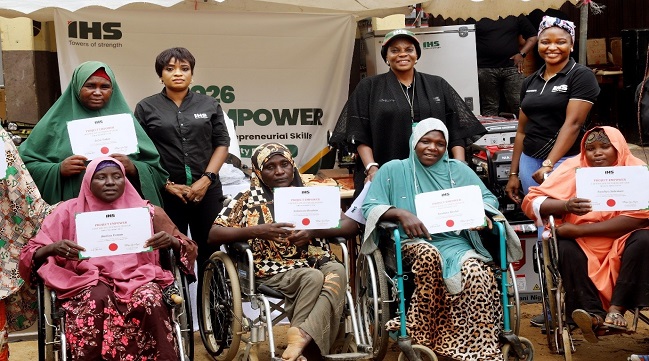
Communications infrastructure company, IHS Nigeria, has donated business support equipment to empower people with disabilities within the Karonmajiji community in the Federal Capital Territory, Abuja. This is part of the company’s commitment to drive inclusive community development and sustainable livelihood support under its Project Empower initiative.

The equipment was distributed to beneficiaries during a ceremony held in the community on Monday, July 27. The initiative was conceived following a community needs assessment and is designed to empower active traders by providing them with business tools rather than cash grants, thereby strengthening their businesses and ensuring long-term economic impact and accountability.
Speaking at the event, Director, Sustainability, IHS Nigeria, Titilope Oguntuga, described the initiative as a reflection of the company’s commitment to advancing inclusive development by equipping persons with disabilities with the tools and opportunities needed to build resilient livelihoods.
She explained that rather than providing short-term financial assistance, IHS Nigeria adopted an asset-based approach by donating 50 pieces of business support equipment, including sewing machines, freezers, generators and hairdressing kits, to the selected beneficiaries.
According to her, the intervention is designed to create lasting value by supporting entrepreneurship, promoting self-reliance and strengthening household incomes, while contributing to the achievement of the United Nations Sustainable Development Goals, particularly SDG 1 (No Poverty), SDG 8 (Decent Work and Economic Growth) and SDG 10 (Reduced Inequalities).
In his opening remarks, the Chief of the Karonmajiji Disabled Community, Alhaji Sulaiman Muhammed Katsina, represented by the Secretary of the Community, Alhaji Mohammed Dantani commended IHS Nigeria for its commitment to empowering persons with disabilities through practical and sustainable interventions.
He described the initiative as a demonstration of genuine partnership with the community and expressed appreciation for the company’s continued engagement with the Association, noting that the donation of the equipment was a significant investment in improving the livelihoods of persons with disabilities and would create meaningful economic opportunities for the beneficiaries and their families.
The event brought together traditional rulers, government representatives, leaders and members of the Karonmajiji Disabled Community Association, implementing partners, including Field of Skills and Dreams Vocational Technical and Entrepreneurship (FSD VTE) Training Institute and other community stakeholders, reaffirming a shared commitment to promoting inclusion and sustainable community development.
Project Empower reinforces IHS Nigeria’s commitment to advancing sustainable development through strategic partnerships that promote economic inclusion, strengthen community resilience and create opportunities for underserved communities.
The Chartered Institute of Bankers (CIBN) and the Association of Corporate Communication and Marketing Professionals in Banks (ACAMB) have enjoined banks to further deepen and prioritize financial inclusion, women’s empowerment and sustained growth through strategic mandates and frameworks, aimed at closing the financial gap and empowering more small, and medium enterprise (MSME) owners.

Both organisations made this call during a courtesy visit to the newly invested 24th President and Chairman of Council of the Chartered Institute of Bankers of Nigeria (CIBN), Dr. Dele Alabi, Ph.D, FCIB, as part of plans to congratulate him on his investiture as well as seek a stronger alliance between both bodies.
The visit followed Alabi’s investiture where he unveiled his “IMPACT” Vision, themed “Consolidating Our Local Impact, Enhancing Our Global Relevance.”
The vision rests on six pillars: Inclusion across geographic, gender, and generational lines; Membership growth and quality; Professionalism and ethics; Accountability; Competencies and skills development; Technology, automation, and innovation. Other areas of shared interest, include women empowerment, financial inclusion and literacy, as well as MSME clinics, all of which are top on his agenda.
Alabi explained that under him, the institute will be prioritising financial inclusion and women empowerment, because of its realisation that women are often the primary financial managers and caregivers in families. Access to savings, micro-credit, and insurance acts as a safety net during crisis and allows them to significantly improve living conditions.
He added that CIBN would be happy to drive joint knowledge sharing and exchange sessions with CBN and ACAMB across various platforms. “Educating the public through public awareness programmes, with ACAMB as the rallying point, is central to what we do,” he noted.
ACAMB President, Jide Sipe, who led the delegation, spoke in unison with the CIBN president, as he noted that, closing the inbalances in financial access help economies grow faster, reduces inequality, and encourages greater civic participation by all.

Nwokolo, Nollywood Actor Claims Internet Fraud is “Keeping Economy Afloat’

SEC Begins Full e-Registration for Capital Market Operators

Elon Musk Launches Invite-only X Money with Visa Debit Card

CBN Fines Banks N430m for Ignoring Customers’ Complaints

Kaspersky Uncovers New Mirage Kitten Malware Used in Cyber-espionage Campaign Across Africa, Others

NRC, Ponzi Scheme Collapses Resulting Loss of Billions of Naira

EFCC Busts NIS Visa Overstay Racket, Uncovers N700m in an Account

From Scarcity to Scale: What Africa Can Learn from India’s Agricultural Transformation

Tokenization, Blockchain Technology will Transform Financial Institutions – IMF

BON Establishes Six Ad Hoc Committees to Modernize Broadcasting




 Telecom2 days ago
Fact-Check: Elon Musk’s “Tesla Pi Phone” is Internet Rumor

 News3 days ago
History as Lagos Becomes First Nigerian State to Launch Greenhouse Gas Registry

 E-Business3 days ago
UNN to Partner Firm on AI, Smart Mobility Innovation Centre

 Telecom3 days ago
AI Investment Gap Threatens Africa’s Future Growth

 Telecom3 days ago
AMCON Puts ntel Up for Sale, Seeks Investors

 E-Financial3 days ago
Remita Raises Alarm Over Nigeria’s Digital Divide, Calls for More Investment

 E-Financial2 days ago
Malpass, Ex World Bank Chief Raises Alarm over Nigeria’s Secretive Debt Structures

 Telecom2 days ago
How and Why Apps Deplete Data – ALTON