

General News
2023 Elections: SERAP Gives Buhari 48 Hours to Withdraw Threat to Shut Down Broadcast Stations

Socio-Economic Rights and Accountability Project (SERAP) has urged President Muhammadu Buhari to “instruct Mr Lai Mohammed, Minister of Information and Culture, and the National Broadcasting Commission (NBC) to urgently withdraw the ‘last warning’ and threat to revoke the licenses of broadcast stations and shut them down over their coverage of elections and post-election matters.”

The NBC had last week threatened to revoke the licenses of broadcast stations and shut them down “if they continue to allow unpatriotic individuals on their platforms to make utterances that are subversive, hateful, and inciting, and negative conversations particularly in the post-2023 Presidential Election.”
But in a letter dated 11 March, 2023 and signed by SERAP deputy director Kolawole Oluwadare, the organization said, “The ‘last warning’ and threat by the NBC if not immediately withdrawn would limit freedom of expression and the ability of broadcast stations to cover important issues around the 2023 general elections.”
According to SERAP, “Threatening to shut down and revoke the licences of broadcast stations simply for carrying out their ‘watchdog role’ is clearly incompatible with Nigeria’s constitutional and international human rights obligations.”
The letter, read in part: “Political expression is a fundamental right. The threat by the NBC creates a significant risk that legitimate expression may be prohibited.”
“Such unlawful prohibition may prevent transparency and dissemination of information on legitimate issues of public interest around the 2023 general elections.”
“We would be grateful if the requested action is taken within 48 hours of the receipt and/or publication of this letter. If we have not heard from you by then, SERAP shall take all appropriate legal actions to compel your government to comply with our request in the public interest.”
“The threat may produce a direct impact on the work of broadcast stations in ways that are inconsistent with the right to freedom of expression, access to information and media freedom.”
“Your government has a legal responsibility to ensure an environment in which a diverse range of political opinions and ideas around the general elections can be freely and openly expressed and debated.”
“The threat by the NBC is neither necessary nor proportionate, as it would unduly intrude upon Nigerians’ right to freedom of expression, access to information, and media freedom.”
“The use of vague and undefined phrases such as ‘unpatriotic individuals’ ‘subversive, hateful, and inciting utterances, particularly post-election’, as grounds to threaten to shut down broadcast stations is inconsistent and incompatible with human rights requirements.”
“The Nigerian Constitution and human rights treaties impose legal obligations on your government to refrain from imposing restrictions which are not consistent with human rights requirements, including on discussion of political and election-related issues.”
“It is also inconsistent with constitutional and international human rights requirements to threaten broadcast stations solely for their coverage of the issues around the general elections on the basis of vague phrases such as ‘unguarded statements, divisive and dangerous comments’, ‘negative conversations’ used by the NBC.”
“The threat may stifle reporting on political and election-related issues, as well as have a deterrent effect on the public’s exercise of their right to freedom of expression on political and election-related issues, in particular issues deemed controversial or critical.”
“The threat also represents a serious hindrance to the exercise of journalism, media diversity and media freedom, and participation.”
“This kind of threat to journalism has furthermore serious implications on the public’s right to information, in particular in the context of the general elections where the role of the media is of particular importance.”
“SERAP notes that Section 39(1) of the Nigerian Constitution 1999 (as amended), Article 9 of the African Charter on Human and Peoples’ Rights and article 19 of the International Covenant on Civil and Political Rights, to which Nigeria is a state party protect everyone’s right to maintain an opinion without interference and to seek, receive and impart information and ideas of all kinds, regardless of frontiers.”
“Under the Constitution and these human rights treaties, restrictions on the right to freedom of expression must be ‘provided by law’, and necessary for ‘the rights or reputations of others’ or ‘for the protection of national security or of public order (ordre public), or of public health and morals’.”
“Similarly, the Nigerian Constitution and human rights treaties provide for the rights of individuals to be protected, inter alia, against unlawful or arbitrary interference, and provide that everyone has the right to the protection of the law against such interference.”
“‘Unlawful’ means that no interference may take place except in cases envisaged by the law which in itself must comply with the requirements of human rights and the rule of law.”
“Media coverage of the general elections and post-election matters, and media freedom are closely connected, as access to information is an essential requirement for the realization of the rights to freedom of expression and participation.”
“Similarly, phrases such as ‘unguarded statements, divisive and dangerous comments’, ‘negative conversations’ used by the NBC lack sufficient clarity and can be arbitrarily or discriminatorily applied and enforced.”
“The ‘last warning’ and threat by the NBC would seem not to meet the strict requirements of the Nigerian Constitution and the country’s international human rights obligations. In particular, it is unclear the scope or object of what these wordings seek to prohibit.”
“Under the constitutional and international requirement of legality, it is not enough that restrictions on freedom of expression, access to information and media freedom are formally stated in press releases and regulations.”
“The NBC legislation and codes do not confer unfettered discretion for the restriction of freedom of expression on those charged with their implementation.”
“The requirement of legality also serves to define the scope of legal discretion conferred on implementing authorities in order to provide adequate protection against arbitrary implementation.”
“General prohibitions on the dissemination of information based on vague and ambiguous ideas, including ‘unguarded statements, divisive and dangerous comments’, ‘negative conversations’ are incompatible with legal requirements and should be immediately withdrawn.”
“According to our information, Mall. Balarabe Shehu Ilelah, Director-General of the National Broadcasting Commission (NBC) on Tuesday 7 March 2023 reportedly made the NBC’s ‘last warning to broadcast stations’. The NBC ‘will not hesitate to shut down any station or revoke its licence once it is convinced that the activities of the station is capable of undermining the peaceful co-existence of the country.”



Justice Mojisola Dada of the Lagos State Special Offences Court in Ikeja has remanded, Andrew Odekina, an alleged hacker, who is part of a fraud syndicate that stole N3.09 billion from First City Monument Bank (FCMB).

Justice Dada ordered that Odekina be kept behind bars after he was arraigned before her by the Economic and Financial Crimes Commission (EFCC).
The EFCC informed the judge that the defendant was among the suspects who allegedly carried out a major cyber-enabled fraud that resulted in over N3 billion being siphoned from the bank’s customer accounts.
The anti-graft agency also accused the defendant of retaining proceeds linked to the large-scale hacking operation that targeted some FCMB customers.
The Commission stated that its investigation found cybercriminals had unlawfully accessed the bank’s applications, allowing them to transfer N3.09 billion from various accounts.
Odekina was specifically charged with receiving and retaining N9.87 million, believed to be part of the stolen N3.09 billion, in his FCMB account in 2025.
The offence, according to the EFCC, contravenes the provisions of the EFCC (Establishment) Act, 2004.
The charge states that the defendant, alongside accomplices still at large, knowingly retained control of funds traced to fraudulent digital transactions carried out on the bank’s platform.
The defendant, however, pleaded not guilty to the charge.
Based on his plea, Babatunde Sonoiki, prosecutor, urged the court to fix a trial date and remand the defendant in the custody of the Nigerian Correctional Service pending the conclusion of the trial.
The defendant appeared in court without legal representation.
After listening to the lawyer, Justice Dada adjourned the case to May 11 for trial and ordered that Odekina be remanded to the Kirikiri Correctional Facility.
South East Development Commission (SEDC) has launched the South East Venture Capital Programme (SEVCP), to expand access to capital for startups and strengthen Nigeria’s investment landscape.

The Commission said the programme represents a direct institutional response to the federal government’s commitment to expand access to local funding and attract sustained investment into high- growth sectors across South East Nigeria.
It also said that it is part of the developmental initiative by the SEDC as contained in the road map for the region that was presented to the House of Representatives Committee on South East Development.
A statement issued by the commission says the SEVCP is a funded, coordinated, and time- bound intervention designed to catalyse the region’s digital, innovation, and technology ecosystem.
“As part of its initial rollout, the first phase of the program, the South East Pitch Competition, is now officially open for applications. At the core of the program is the South East Venture Capital Fund, a blended finance vehicle designed to mobilise up to $50 million in public, institutional, development finance, diaspora, and private capital into the region.
“SEDC anchors the Fund through the South East Investment Company, its wholly owned investment vehicle, which participates as a Limited Partner. This structure ensures professional fund management, institutional accountability, and alignment with global investment standards,” the statement said.
The commission also said that SEVCP is built as an integrated platform comprising five interlinked workstreams: fund operationalisation, a flagship Pitch Competition, a structured incubation and acceleration programme, a financing partnerships strategy to complete the fund raise, and a network of implementing partners across the region.
“Each component is designed to reinforce the others and ensure continuity from deal sourcing to investment and growth.The South East Pitch Competition serves as the primary entry point into the Fund’s investment pipeline. Thirty startups will be selected across the five states, with twenty placed in the Accelerator Track and ten in the Incubation Track.
“These startups will receive SAFE investments totalling 450,000 dollars in the first cohort. Accelerator participants will receive 20,000 dollars each, while incubation participants will receive 5,000 dollars each. Investments will be milestone-based and structured to balance founder flexibility with investor protection.
“The Pitch Competition Finals is scheduled to take place on 13 May 2026, followed by an Investment Ceremony on 14 May 2026. Selected startups will participate in a structured hybrid incubation and acceleration programme delivered across key locations in the region.
“The South East has long demonstrated strong entrepreneurial capacity, commercial depth, and human capital, the statement indicated. It noted that what has been missing is a coordinated system to channel capital into that capacity at scale, with the structure and governance required by serious investors. The SEVCP provides that system, and the Pitch Competition establishes the first layer of access,” it said.
According the tstatement, applications opened on 13 March 2026 and were originally scheduled to close on 27 March 2026.
“It indicated that the deadline has now been extended to 3 April 2026 to enable broader participation across the region, adding that this will be the final extension.
“The Accelerator Track is open to startups with demonstrable product market fit, active users, and revenue traction. The Incubation Track is open to founders with validated ideas and a minimum viable product. Eligible startups must be based in, operating in, or delivering clear impact within the South East, or be founded by individuals of South East origin with a defined regional focus. All applications must demonstrate a meaningful technology component,” it said.
The commission said that SEVCP represents a long-term commitment to building a structured and investable startup ecosystem in the South East.
“The inaugural cohort will form the foundation of a pipeline that the Commission intends to scale over successive cycles. Founders building within the region, and those looking to build within it, are encouraged to apply before the deadline,” the statement added.
General News
PIAFo Drives Urgent Call for National Dig-Once Policy to Boost Nigeria’s 125,000km Fibre Network
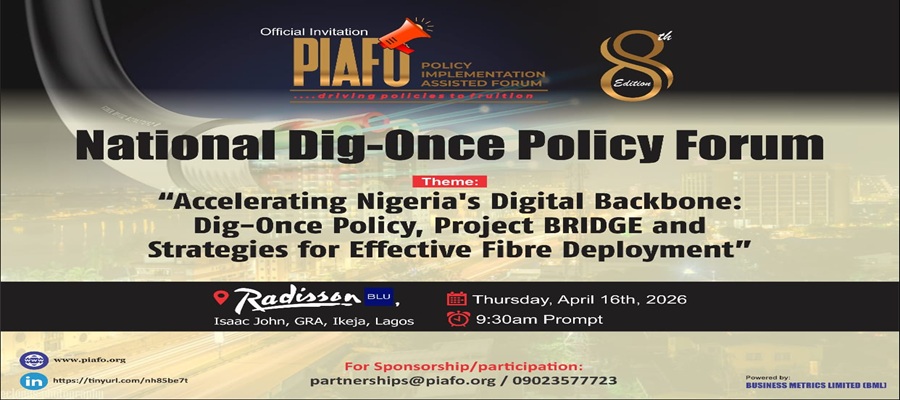
Key players across Nigeria’s digital economy, telecommunications, and infrastructure ecosystem are set for the National Dig-Once Policy Forum to champion a new course towards increasing Nigeria’s digital backbone network to 125,000km of fibre-optic infrastructure.

PIAFo
The event, which marks the 8th edition of Policy Implementation Assisted Forum (PIAFo), is a high-level industry dialogue aimed at accelerating the formulation and adoption of a National Dig-Once Policy as a critical enabler of safe, coordinated and cost-effective fibre infrastructure deployment in the country.
The forum, themed “Accelerating Nigeria’s Digital Backbone: Dig Once Policy, Project BRIDGE and Strategies for Effective Fibre Deployment,” is slated for Thursday April 16, 2026 at Radisson Blu Hotel, Ikeja GRA, Lagos.
According to the organisers, Business Metrics Limited (BML), the introduction of $2 billion Project BRIDGE initiative by the Federal Government to expand fibre infrastructure by additional 90,000km from 35,000km to 125,000km by 2030 requires some new measures to ensure successful implementation of the ambitious target and avoid mistakes of the past.
Industry stakeholders have identified that the success of a national connectivity backbone rollout depends largely on institutionalising a Dig Once Policy framework, which encourages the installation of fibre ducts and conduits whenever roads, railways, and other major public infrastructure are being constructed or rehabilitated.
According to industry data shared by the Nigerian Communications Commission, lack of such a framework is taking a toll on the telecoms sector and broadband drive as operators recorded over 50,000 fibre cut incidents across the country in 2024, with more than 60 per cent occurring during road construction and rehabilitation activities. These disruptions have resulted in billions of naira in repair costs, network outages, and service degradation.
Telecom operators in Lagos State alone said they spent over N5 billion in 2024 to repair and replace damaged fibre infrastructure in the state, while lamenting that the development continues to slow down network upgrade and expansion drive.
Beyond infrastructure damage, telecom operators also face challenges such as high Right of Way (RoW) charges, uncoordinated civil works, and repeated excavation of roads for fibre deployment.
PIAFo 8.0 aims to address these challenges by fostering collaboration among stakeholders responsible for planning, financing, constructing, and maintaining Nigeria’s digital infrastructure.
Specifically, the forum seeks to align federal, state, and local infrastructure planning around a unified Dig-Once framework; strengthen collaboration between telecom operators, infrastructure companies, and public works authorities; translate policy intentions into actionable guidelines and implementation timelines; and build stakeholder support for Project BRIDGE and complementary national fibre initiatives.
Speaking about the event, Team Lead at Business Metrics Limited, Omobayo Azeez, said Nigeria is being denied access to robust connectivity it should derive from up to eight high-capacity undersea cable networks landed on its shores because of difficulties around terrestrial fibre infrastructure expansion.
“The Project BRIDGE initiative should excite everyone because of ambitious targets. But for those who understand the operating terrain, and why it took the industry over 20 years to achieve around 35,000km of fibre network that the country currently operates for broadband connectivity, the project calls for a major shift in execution approach with the adoption of a National Dig-Once Policy as the starting point.
“PIAFo, now in its 8th edition, is again serving as the viable platform for representatives from government ministries and agencies, senior telecom executives, infrastructure companies, data centre operators, equipment manufacturers, state governments, and industry associations to chart the way forward.”
The forum will feature keynote addresses, expert panel discussions, and strategic networking sessions designed to drive pragmatic outcomes that will accelerate Nigeria’s journey toward a resilient and inclusive digital economy.

Mobile Money Transactions Accounted for $2 trillion in 2025

MoneyMaster Enhances App, Rewards Users with Data and Airtime Bonuses

Nigeria, Finland Sign Cybersecurity Pact

Firm Shares Tips for Updating Your Digital Habits for an AI-driven World

EU Pumps €290m into Nigeria’s Digital, Health, Agri Sectors

Kaspersky Discovers New Phishing Campaign Exploiting Google Tasks Notifications to Steal Corporate Credentials

esentry 2025 Report Shows Healthcare, Financial Services and Telecoms as Staging Grounds for Increased Cyberattacks in Africa

AfDB, UNDP Launch $10Bn AI Initiative for Africa

MultiChoice Suspends Yearly DStv Price Hike as Canal+ Pushes Growth

Spotify’s Loud & Clear Report Reveals Over ₦60Bn Revenue for Nigerian Artists in 2025




 E-Financial3 days ago
DLM SPV PLC Lists ₦9.00bn AAA-Rated Medium-Term Notes on FMDQ Exchange, Sets Benchmark in Corporate Bond Market

 News3 days ago
Metaverse Collapses, Horizon Worlds Shuts Down on Quest

 E-Financial2 days ago
CBN Directs IMTOs to Open Naira Settlement Accounts

 Telecom3 days ago
Legend Internet, Spectranet in Merger Talks

 Telecom2 days ago
Nigerians Lose N12.5Bn to AI-Driven Scams- PwC

 General News2 days ago
Court Remands Hacker for Allegedly Stealing N3.09Bn from FCMB

 News3 days ago
NITDA Reaffirms Commitment to Advancing Creative Economy with Digital Initiatives

 E-Financial3 days ago
SEC Issues Six-Week Ultimatum to Market Operators to Submit Recapitalisation Plan