

General News

Mohammed Rudman is the managing director of Internet Exchange Point of Nigeria (IXPN).
In his over a decade experience in the information and communications technology, Rudman has worked as network administrator in Independent National Electoral Commission (Inec) from where he moved to Galaxy Backbone.
He spoke to chike onwuegbuchi on how IXPN will help stimulate growth in internet service delivery and local content.
Exchange Point and Nigerian Economy
Our role is to interconnect service providers, Telcos, Universities, financial sectors and virtually almost every organization that deals with information technology so that they can exchange local traffic locally within Nigeria.
This will benefit the economy tremendously, because it will have multiple effects. Apart from the direct benefit; there are other indirect benefits to the economy. When you look at all our service providers, they interconnect right now outside the country and therefore their traffic is being exchanged outside the country, on the process they pay for that interconnection outside the country in foreign currency, so that is capital flight, for traffic that suppose to be exchanged within the country, you now export it for you to bring it back. So, to save the country that capital flight, it means that local traffic should be made local which is the reason behind the establishment of Internet Exchange of Nigeria.
And if you look at issue of our security, because our traffic is no longer going outside the country, it remains local within the country; it means that we are secured to some extent because we are communicating within ourselves. By the time you push those Email outside Nigeria to come back it is possible for somebody to see your own email, it means we are a bit vulnerable, but by the time we are all interconnected such email will not be taken away.
Also if you look at our educational institution, they can interconnect with us, and right now we are working with University of Lagos to have what is called Eko Connect, which is higher educational connectivity project to interconnect higher educational institutions within Lagos towards national research and educational network, so this also will have multiple effect on the economy, because they are training our graduates, and they should be able to collaborate for research. It also promotes local content development, because with us you can start posting content locally, so with this you can promote culture and heritage.
Value Added Services
First, because exchange points are very suitable for centralized infrastructure within the country, we decided to discuss with one of the thirteen global root server operators in the world for them to keep their servers in Nigeria. This will make local translations of names in the internet possible in Nigeria and our discussions have reach advanced level and within the next one month, the root servers will be active in Nigeria, which will be the first root server in West Africa.
Secondly, we are also trying to put time server within Nigeria so that one can synchronize his or her time with us, like if you have a computer at home or in your office you can synchronize it with us so that their timing will be exactly the same because right now there is no public time server for Nigeria, so with that, different network can now synchronize their time from one source. We have already implemented what is called Community DNS in Nigeria. It has been implemented 100% and it is working.
So we are doing other things like that so as to promote local content and provide centralized infrastructure.
ISPs with Foreign Partners
This will not affect our services because this site is very important, we put them in remote places where people can have access to the internet and it will continue because we have so many remote areas that needs internet access.
Also some of them are already thinking in this direction and are relocating their hubs back into the country. They want to localize their traffic and have brought back their hub from US back to the country, for them to be interconnected to the exchange point. By the time all of them bring back their hub, it means that local content within Nigeria remains local and it will also save them some satellite bandwidth.
New Undersea Cable Initiative as Boost to ISPs in Nigeria
This will help to lower the cost of internet access generally, and will promote reliability because it is more than one cable, formally we have only one submarine cable, SAT 3, now Glo 1 is coming Main One is coming and WACS will come maybe next year, so with this, it means that we have multiple redundancy. Because internet is becoming our ways of life, it is becoming also a critical infrastructure just like water, power and so on. It is very good that we are having this many cables coming in so that, we will now have reliability incase one cable fails, and normally when it happens we have back ups because competitors are coming in and because they are many. I believe that due to competition the prices of internet will really drop and it will be available to the common man as long as the distributing channels are there. As they all are coming in through the sea to the landing stations in Lagos, just like you have containers coming in ships to Lagos, now if we don’t have the road to distribute these containers then there is a problem. The distribution network is in terms of fiber network connecting to the most remote part of the country like Sokoto, Maidugri etc., if such infrastructure exists in these locations, I think it will really lower the cost.
Success Made so Far
Formally the progress and the success were a bit small because we are new and people don’t want to change. We are telling them to change, instead of having one direct path to the internet, to start having two interconnections, one to the left and the other one to the right, if you are going to the internet, you go to the left and if you are going to the Nigerian content, you go right. So this means a change from the one single direction to two directions. It was difficult trying to bring competitors to cooperate for the common interest of both parties. It has been difficult, but eventually we have broken that barrier and it is now happening. The service providers are now cooperating. Though they are competing outside publicly, but they are collaborating privately trying to save the country and to promote efficient services to their customers.
The traffic has increased from very small to more than few thousand percent from the time we started. I think we have made a reasonable progress and we are right now at what is called the tipping point, where things will eventually start changing so fast because we have made the progress to this level and there will be tremendous progress because international organization are even coming to join us like Google now is coming to connect to us very soon.
Force on Operators to Interconnect
The answer could be yes or could be no, because there is a say that you will take the horse to the river but cannot force it to drink water. You can force them to interconnect but you cannot force them to exchange traffic, and on the other hand when you force them to interconnect, you might awaken them to see the actual benefit that formally they were not seeing, so it has a good side for the regulators to force them and it also has a bad side.
Required Capacity to Carry theTraffic
We have more than what is required. Right now, we are using less than 5% of our capacity; we have excess capacity that we can accommodate. We can easily handle all the traffics, so I think we have the capacity to handle almost everybody.
Expansion of Operations
We intend to be in six geopolitical zones, and we are partnering with National Information Technology Development Agency (NITDA) to add two additional exchange points before the end of this year in two regions within Nigeria.
The Way Forward
We have a program right now; we are trying to move to a better modern facility, and this is where we are going to have the switching equipment, the browsing equipment and this is all because of the support from Nigeria Communication Commission (NCC). They are funding the movement and I want to also use this opportunity to thank them for this; and with this infrastructure we will be able to provide quality service because the international organizations are coming in and they wouldn’t want to compromise on quality. That is why we are providing a high standard world class facility for them and for the entire Nigerian service providers to connect.
IP Version Six
IP version 6 is a new standard protocol for IP communication, right now we are using IP version 4. Because of limitation on size of IP version 4, it is almost going into extinction and it is anticipated that in the next one year it will no longer be available for use that is why globally people are moving into IP version 6. Unfortunately, Nigeria is left behind and that is why we are battling with original internet registry for them to start training in Nigeria for IP version 6.
The first training is going to take place in September, first week of September most likely in Lagos and on the second week in Abuja and we intend to continue this training so we can make the impact, so that the networks here can move from IP version 4 to IP version 6.



Justice Mojisola Dada of the Lagos State Special Offences Court in Ikeja has remanded, Andrew Odekina, an alleged hacker, who is part of a fraud syndicate that stole N3.09 billion from First City Monument Bank (FCMB).

Justice Dada ordered that Odekina be kept behind bars after he was arraigned before her by the Economic and Financial Crimes Commission (EFCC).
The EFCC informed the judge that the defendant was among the suspects who allegedly carried out a major cyber-enabled fraud that resulted in over N3 billion being siphoned from the bank’s customer accounts.
The anti-graft agency also accused the defendant of retaining proceeds linked to the large-scale hacking operation that targeted some FCMB customers.
The Commission stated that its investigation found cybercriminals had unlawfully accessed the bank’s applications, allowing them to transfer N3.09 billion from various accounts.
Odekina was specifically charged with receiving and retaining N9.87 million, believed to be part of the stolen N3.09 billion, in his FCMB account in 2025.
The offence, according to the EFCC, contravenes the provisions of the EFCC (Establishment) Act, 2004.
The charge states that the defendant, alongside accomplices still at large, knowingly retained control of funds traced to fraudulent digital transactions carried out on the bank’s platform.
The defendant, however, pleaded not guilty to the charge.
Based on his plea, Babatunde Sonoiki, prosecutor, urged the court to fix a trial date and remand the defendant in the custody of the Nigerian Correctional Service pending the conclusion of the trial.
The defendant appeared in court without legal representation.
After listening to the lawyer, Justice Dada adjourned the case to May 11 for trial and ordered that Odekina be remanded to the Kirikiri Correctional Facility.
South East Development Commission (SEDC) has launched the South East Venture Capital Programme (SEVCP), to expand access to capital for startups and strengthen Nigeria’s investment landscape.

The Commission said the programme represents a direct institutional response to the federal government’s commitment to expand access to local funding and attract sustained investment into high- growth sectors across South East Nigeria.
It also said that it is part of the developmental initiative by the SEDC as contained in the road map for the region that was presented to the House of Representatives Committee on South East Development.
A statement issued by the commission says the SEVCP is a funded, coordinated, and time- bound intervention designed to catalyse the region’s digital, innovation, and technology ecosystem.
“As part of its initial rollout, the first phase of the program, the South East Pitch Competition, is now officially open for applications. At the core of the program is the South East Venture Capital Fund, a blended finance vehicle designed to mobilise up to $50 million in public, institutional, development finance, diaspora, and private capital into the region.
“SEDC anchors the Fund through the South East Investment Company, its wholly owned investment vehicle, which participates as a Limited Partner. This structure ensures professional fund management, institutional accountability, and alignment with global investment standards,” the statement said.
The commission also said that SEVCP is built as an integrated platform comprising five interlinked workstreams: fund operationalisation, a flagship Pitch Competition, a structured incubation and acceleration programme, a financing partnerships strategy to complete the fund raise, and a network of implementing partners across the region.
“Each component is designed to reinforce the others and ensure continuity from deal sourcing to investment and growth.The South East Pitch Competition serves as the primary entry point into the Fund’s investment pipeline. Thirty startups will be selected across the five states, with twenty placed in the Accelerator Track and ten in the Incubation Track.
“These startups will receive SAFE investments totalling 450,000 dollars in the first cohort. Accelerator participants will receive 20,000 dollars each, while incubation participants will receive 5,000 dollars each. Investments will be milestone-based and structured to balance founder flexibility with investor protection.
“The Pitch Competition Finals is scheduled to take place on 13 May 2026, followed by an Investment Ceremony on 14 May 2026. Selected startups will participate in a structured hybrid incubation and acceleration programme delivered across key locations in the region.
“The South East has long demonstrated strong entrepreneurial capacity, commercial depth, and human capital, the statement indicated. It noted that what has been missing is a coordinated system to channel capital into that capacity at scale, with the structure and governance required by serious investors. The SEVCP provides that system, and the Pitch Competition establishes the first layer of access,” it said.
According the tstatement, applications opened on 13 March 2026 and were originally scheduled to close on 27 March 2026.
“It indicated that the deadline has now been extended to 3 April 2026 to enable broader participation across the region, adding that this will be the final extension.
“The Accelerator Track is open to startups with demonstrable product market fit, active users, and revenue traction. The Incubation Track is open to founders with validated ideas and a minimum viable product. Eligible startups must be based in, operating in, or delivering clear impact within the South East, or be founded by individuals of South East origin with a defined regional focus. All applications must demonstrate a meaningful technology component,” it said.
The commission said that SEVCP represents a long-term commitment to building a structured and investable startup ecosystem in the South East.
“The inaugural cohort will form the foundation of a pipeline that the Commission intends to scale over successive cycles. Founders building within the region, and those looking to build within it, are encouraged to apply before the deadline,” the statement added.
General News
PIAFo Drives Urgent Call for National Dig-Once Policy to Boost Nigeria’s 125,000km Fibre Network

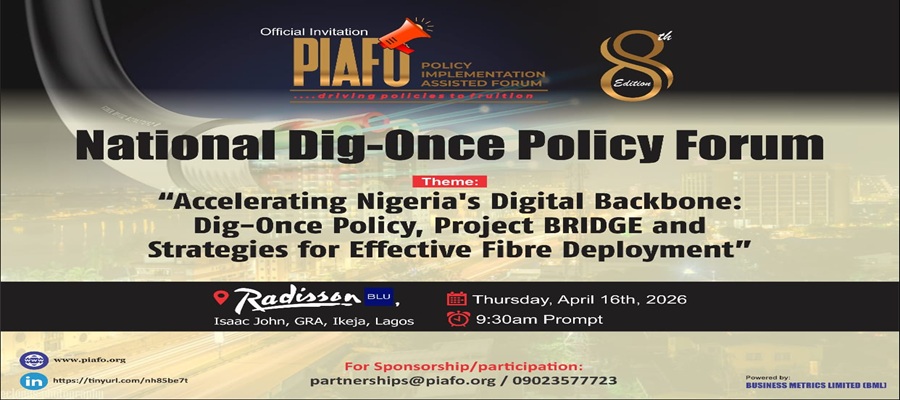
Key players across Nigeria’s digital economy, telecommunications, and infrastructure ecosystem are set for the National Dig-Once Policy Forum to champion a new course towards increasing Nigeria’s digital backbone network to 125,000km of fibre-optic infrastructure.

PIAFo
The event, which marks the 8th edition of Policy Implementation Assisted Forum (PIAFo), is a high-level industry dialogue aimed at accelerating the formulation and adoption of a National Dig-Once Policy as a critical enabler of safe, coordinated and cost-effective fibre infrastructure deployment in the country.
The forum, themed “Accelerating Nigeria’s Digital Backbone: Dig Once Policy, Project BRIDGE and Strategies for Effective Fibre Deployment,” is slated for Thursday April 16, 2026 at Radisson Blu Hotel, Ikeja GRA, Lagos.
According to the organisers, Business Metrics Limited (BML), the introduction of $2 billion Project BRIDGE initiative by the Federal Government to expand fibre infrastructure by additional 90,000km from 35,000km to 125,000km by 2030 requires some new measures to ensure successful implementation of the ambitious target and avoid mistakes of the past.
Industry stakeholders have identified that the success of a national connectivity backbone rollout depends largely on institutionalising a Dig Once Policy framework, which encourages the installation of fibre ducts and conduits whenever roads, railways, and other major public infrastructure are being constructed or rehabilitated.
According to industry data shared by the Nigerian Communications Commission, lack of such a framework is taking a toll on the telecoms sector and broadband drive as operators recorded over 50,000 fibre cut incidents across the country in 2024, with more than 60 per cent occurring during road construction and rehabilitation activities. These disruptions have resulted in billions of naira in repair costs, network outages, and service degradation.
Telecom operators in Lagos State alone said they spent over N5 billion in 2024 to repair and replace damaged fibre infrastructure in the state, while lamenting that the development continues to slow down network upgrade and expansion drive.
Beyond infrastructure damage, telecom operators also face challenges such as high Right of Way (RoW) charges, uncoordinated civil works, and repeated excavation of roads for fibre deployment.
PIAFo 8.0 aims to address these challenges by fostering collaboration among stakeholders responsible for planning, financing, constructing, and maintaining Nigeria’s digital infrastructure.
Specifically, the forum seeks to align federal, state, and local infrastructure planning around a unified Dig-Once framework; strengthen collaboration between telecom operators, infrastructure companies, and public works authorities; translate policy intentions into actionable guidelines and implementation timelines; and build stakeholder support for Project BRIDGE and complementary national fibre initiatives.
Speaking about the event, Team Lead at Business Metrics Limited, Omobayo Azeez, said Nigeria is being denied access to robust connectivity it should derive from up to eight high-capacity undersea cable networks landed on its shores because of difficulties around terrestrial fibre infrastructure expansion.
“The Project BRIDGE initiative should excite everyone because of ambitious targets. But for those who understand the operating terrain, and why it took the industry over 20 years to achieve around 35,000km of fibre network that the country currently operates for broadband connectivity, the project calls for a major shift in execution approach with the adoption of a National Dig-Once Policy as the starting point.
“PIAFo, now in its 8th edition, is again serving as the viable platform for representatives from government ministries and agencies, senior telecom executives, infrastructure companies, data centre operators, equipment manufacturers, state governments, and industry associations to chart the way forward.”
The forum will feature keynote addresses, expert panel discussions, and strategic networking sessions designed to drive pragmatic outcomes that will accelerate Nigeria’s journey toward a resilient and inclusive digital economy.

Court Remands Hacker for Allegedly Stealing N3.09Bn from FCMB

CBN Directs IMTOs to Open Naira Settlement Accounts

Nigerians Lose N12.5Bn to AI-Driven Scams- PwC

SEDC Launches SEVCP to Expand Access to Capital for Startups

Kaspersky, AFRIPOL Conduct Joint Cybersecurity Training for African law Enforcement

Kaspersky Discovers New Phishing Campaign Exploiting Google Tasks Notifications to Steal Corporate Credentials

esentry 2025 Report Shows Healthcare, Financial Services and Telecoms as Staging Grounds for Increased Cyberattacks in Africa

AfDB, UNDP Launch $10Bn AI Initiative for Africa

MultiChoice Suspends Yearly DStv Price Hike as Canal+ Pushes Growth

MTN Nigeria Posts Record N1.70 Trillion Pre‑Tax Profit, Declares N20 Dividend for 2025




 E-Financial2 days ago
DLM SPV PLC Lists ₦9.00bn AAA-Rated Medium-Term Notes on FMDQ Exchange, Sets Benchmark in Corporate Bond Market

 E-Financial3 days ago
CBN Wins Central Bank of the Year Title @13th Global Awards

 General News3 days ago
Tech Firms Sack over 45,000 so Far in 2026

 News3 days ago
Morney Launches in Nigeria as E-invoicing Drives Finance Digitisation

 General News3 days ago
Jury Finds Elon Musk Liable for Misleading Twitter Investors

 News2 days ago
Metaverse Collapses, Horizon Worlds Shuts Down on Quest

 Telecom3 days ago
FG Taps Quest Merchant Bank for Advisory on 90,000km Fibre Project

 News3 days ago
Dr Krishnan Ranganath to Lead UniCloud Africa in Continental Digital Infrastructure Push