

Broadcasting
My Konga.com Experience Shows there’s Hope for Nigeria’

By Caleb Ibeh
At the height of the lockdown caused by the COVID-19 pandemic, I had been resident in the United States of America as a visiting researcher.
The opportunity, I must confess, opened my eyes to the power and relevance of e-commerce.
Before diving deep into my narrative, I must confess that I am a dyed-in-the-wool traditional shopper. Born in the mid-1960s, the best way to make me (or any of my contemporaries) part with hard-earned money is often to provide a chance to witness a product or solution I desire to buy in action. Not for me was the growing online fad that has become so popular with my kids and their peers, the one where you sit in front of a laptop computer and check items online, make payments without even physically seeing the products and wait for someone you had never met to deliver same to your doorsteps.
For me, I have to touch, feel and experience the product physically or even get to speak with an attendant in person before I can be sufficiently convinced to loosen my tightly guarded purse strings. Therefore, you would rather catch me patronizing a physical store than shop online.

But all that changed with the COVID-19 pandemic.
Living through the government-imposed restrictions that came with the lockdown in the US proved to be an awakening experience, a sort of Eureka moment, as far as e-commerce is concerned for me. I realized all too soon that most of the grocery stores and other physical outlets I used to frequent were shut. I was left with either the option of starving to death by sticking to my dated ways or learn a new dance in my old age. I had no choice than to embrace the fine art, science and novelty of shopping online.
Ah! What an experience it turned out to be! From being a novice, a cynical doubting Thomas and an incurable believer in the efficacy of physical shopping to transforming into a savvy e-commerce guru, my overnight switch astounded even my kids when I arrived back home in Nigeria.
Consider the surprise and shock that greeted my kids when I unveiled the loads of gifts, clothes and other items I brought back home for them, all shopped online from Amazon and delivered to me in the comfort of my residence in the US. The doubts cleared when I showed off my skills in navigating online sites and placing orders. My colleagues in the academia here in Nigeria too were often caught off-guard with my new-found penchant or suggestions of buying virtually everything online.
One of the first things I did when I settled down in Nigeria was to begin exploring the e-commerce sites we had in the country. I had been fully bitten by the e-commerce bug and definitely, I was not going to slow down.
However, it turned out to be not such a smooth experience at the outset.
The first e-commerce site I patronized upon my return to Nigeria was one of the big players in the country (name withheld for obvious reasons). In total, I placed three different orders at various times with this platform. However, not one of the orders was delivered without some form of issue.
The first order I placed was for an electric iron which I had seen online during one of my regular moments of window shopping. Sadly, I had to wait for over a week to take delivery of the item, despite being assured repeatedly that delivery would happen within one to three working days. Worse still, when the electric iron was delivered, it was different from the product I had seen online on its site.
On the second occasion, I received a defective washing machine after spending quality time to, once again, pick out a product on its online platform. This time, I also had to write a series of angry emails to this particular e-commerce site’s customer service unit, while also threatening to go to court, before I was refunded. I was to later discover that these complaints were a regular occurrence among patrons of the brand.
The third straw that broke the proverbial camel’s back was when I decided to surprise my wife with a lovely dress for Valentine’s. I began the process way back in early January to ensure that I did not experience delayed delivery or any other issues. But to my utter bewilderment, the dress that was delivered turned out to be several sizes small for my wife, who is a bit on the thick side. As a matter of fact, the dress could not fit my 14-year-old grand-daughter. We were to later discover that after ordering a UK size 16 dress, what was delivered was a Chinese size 16.
Out of frustration (because I needed to quickly secure this much-needed gift for my wife who had gone out of her way to get me some very expensive items for Val), I had asked the delivery staff who came to pick up the ill-sized dress for other viable options. He had urged me to try Konga but pleaded with me not to allow his office to know about him tipping me off.
Interestingly, apart from a few memorable ads I had encountered, that was the first time I was hearing of Konga from a recommendation standpoint.
I ended up falling in love with a brand managed by smart Nigerian youths. Till date, I have ordered over 25 items from Konga but I am yet to have any regrets about discovering this e-commerce giant. It is important to state here that, of the 25 instances I have shopped with Konga, I only encountered one delayed delivery issue which, interestingly, further reinforced my love, respect and admiration for the brand.
Remember the ill-fated Val dress I wanted to get for my wife?
Based on the recommendation of the delivery agent from the other company I had been patronizing, I had reached out to Konga to see if I could quickly get a dress delivered for my distraught wife. I was under pressure, having received some thoughtful gifts from her while I had only succeeded in getting her an ill-fitting gift. After checking on the Konga website and picking out a befitting dress, I had mounted pressure on the highly courteous customer service agent I spoke with on the phone to have the dress possibly delivered the next day. I made her understand that it was a gift for my wife and that it would help make her happy if it was delivered expressly.
In return, I was informed by the agent that delivery may not be possible the next day because of the high volume of orders being processed due to the Valentine’s Day celebration. Nevertheless, she promised to do her best.
By 12pm the next day, my phone buzzed.
To my surprise, the person on the other end of the line politely introduced himself as a Vice President with Konga. He proceeded to empathize with me, while also explaining and reiterating why my order could not be delivered that day. However, he made a promise to ensure that the item gets to my address early the following day, which was a Saturday. During our conversation, he passed the phone to another individual who introduced himself as Nick Imudia, the Co-Chief Executive Officer of Konga. I was positively astounded! Here I was, being treated like royalty, all because of a dress I wanted to buy and which, come to think of it, was even the first time I was shopping with this brand.
Imudia, as he called himself, also apologized for the inability to have my order delivered as requested that day in view of the deluge of other earlier orders. On the other hand, he assured me that it would be the first item to get on the delivery trail the next day. He went ahead to give me his word, adding that Konga is an e-commerce group to be trusted – a phrase that stuck with me till date and which has continued to reflect in my relationship with the brand.
By 9am the next day, I had just returned from a morning jogging session with my wife when a Konga delivery van pulled up in front of the house. Out stepped a smartly dressed delivery agent with my wife’s dress which, was not only a perfect replica of what I picked out on the Konga website, but which also fitted my wife like a glove. Her happiness and my own delight and sense of satisfaction knew no bounds.
To be fair, it is easy to knock Nigerian companies over their misdeeds. However, the experience I have had so far with Konga is sufficient in proving that there are great brands out there, doing great things in this country. It is partly the reason I have taken out time to share my experience, while also extending a word of appreciation to this delightful e-commerce giant. I also recently learnt that the engine of the Konga brand is being driven by young Nigerians – which, in itself, is another proof of the huge, undoubted potential of the human capital we possess here.
The prospects, currently, do not look so bright for Nigeria, especially with the prevailing economic crunch, spiraling inflation, dwindling value of the local currency, worsening insecurity and other societal ills.
But with brands such as Konga and others that can effortlessly defend Nigeria in the global marketplace, I have no compulsions in urging Nigerians to stay hopeful and keep the faith in the future of a brighter, more prosperous country, backed by this vibrant, brilliant, enterprising youthful generation of sound business leaders in e-commerce, fintech, and other allied tech-driven industries and other verticals.


National Broadcasting Commission (NBC) and the Independent National Electoral Commission (INEC) are set to introduce a joint broadcast monitoring framework ahead of the 2027 general elections as part of efforts to curb unethical broadcasting and promote responsible election coverage.

Charles Ebuebu, director-general, NBC, who disclosed the plan recently, said the collaboration would strengthen election monitoring through the deployment of advanced technology and closer coordination between regulatory agencies.
According to him, the increasing influence of digital and online platforms has made it imperative for regulators to work together rather than operate independently.
“We have written to INEC, and we are going to have a joint monitoring outlook over the elections. Gone are the days when agencies work in silos. When we coordinate, we’re able to monitor more effectively,” Ebuebu said.
He explained that the partnership would enable both agencies to jointly identify and address violations of broadcasting regulations during the election period instead of handling such issues separately.
Beyond INEC, Ebuebu said the NBC is also partnering with other key regulators to strengthen oversight of election-related content across digital platforms.
According to him, the commission is finalising agreements with the Nigerian Communications Commission (NCC) and the National Information Technology Development Agency (NITDA) ahead of the polls to reinforce its monitoring capabilities.
“We are calling in other stakeholders to reinforce the election monitoring. We are signing agreements with the Nigerian Communications Commission and the National Information Technology Development Agency before the elections,” he said.
Ebuebu also revealed that the NBC is upgrading its monitoring infrastructure with artificial intelligence (AI)-powered tools to keep pace with the rapidly expanding media landscape.
He noted that the proliferation of online platforms has made traditional monitoring methods inadequate.
“With online platforms, there are thousands of them. You need more than staff; you need AI monitoring facilities,” he said.
The NBC chief added that the commission has significantly improved its monitoring capacity and can currently track nearly 50 broadcast channels from its monitoring centre in Abuja.
He said additional monitoring facilities would be established across the country in line with evolving broadcasting technologies.As part of preparations for the 2027 elections, Ebuebu announced plans for a sensitisation workshop in Ibadan that will bring together broadcasters, INEC officials, security agencies and other stakeholders.
He said the engagement had become necessary as political discussions surrounding elections continue to grow more heated, including on television, stressing the need for broadcasters to adhere to professional standards.
Ebuebu noted that the commission has had to issue several warnings to broadcast stations for violating the broadcasting code during election periods.
“We have had to write several of them because they simply forget what the code says,” he said

Mrs. Clementine Wamba, head, Digital Switch Over (DSO) at the National Broadcasting Commission (NBC), has stressed the need for broadcasting stations and practitioners nationwide to work towards meeting the 2028 global deadline for the switch over.

She made the call in her presentation titled, “DSO Big Picture: Free TV Audience Measurement and the Evolving Media Landscape”, at the 2026 NBC South West Summit held in Ibadan.
Wamba harped on the need for practitioners to adopt DSO in the transmission of news and other programmes in order to meet future challenges, stating that any country that fail to align with the DSO by 2028 will be shut out of practice.
This development, according to her, may result in job losses and other consequences that could hinder the growth of the industry in Nigeria, noting that Free TV is tailored towards the DSO, with provision for many channels in contrast to the age-long analogue system.
According to her, “The Digital Switch Over is a technological improvement on the age-long analogue style of broadcasting in the country. With the adoption of the DSO, practitioners will be in tune with global practice of broadcast journalism.
“Also, its benefits include efficient use of spectrum, changing of industry landscape, more access to national development programmes and better viewing experience.”
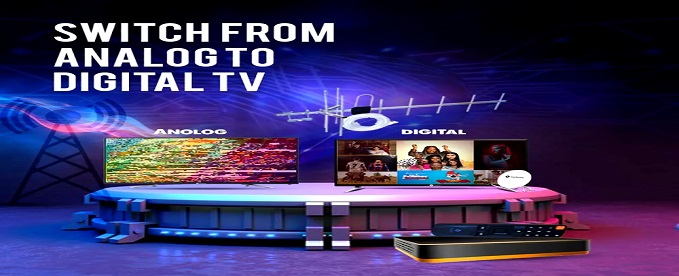
National Broadcasting Commission (NBC) has said that Nigerians will no longer pay annual Digital Access Fees under the renewed Digital Switch Over (DSO) project.

Charles Ebuebu, director-general, NBC, disclosed this in an exclusive interview with the News Agency of Nigeria (NAN) on Wednesday in Abuja,
Ebuebu said viewers only need to purchase an approved decoder and satellite dish which cost below N20,000 to enjoy free television permanently.
“Previously, users paid an annual digital access fee of about N1,500, described as an administrative charge.
“The new system removes that annual fee. It provides free access to free-to-air television channels without any payment.
“Premium channels will be introduced later. Viewers who want those additional channels will be able to access them through paid services.
“Nigerian content on free-to-air channels remains free to watch. Unlike Pay TV, this platform does not require monthly subscriptions for its basic service,” he said
Ebuebu said approved decoders for the FreeTV will cost less than N20,000 and authorised sales outlets will soon be announced.
He urged Nigerians to wait for official information on approved dealers for the DSO decoders, warning that unauthorised sellers are exploiting growing public demand.
He reiterated that people only need a free-to-air decoder, along with a satellite dish instead of the old antenna system to receive the DSO signal.
“Once the equipment is installed, viewers can access all available channels across the country without paying any subscription fees,” he stressed
The DG dismissed claims by some retailers that there are different categories of decoders sold at varying prices, stressing that such sellers are not authorised by the commission.
According to him, the NBC will soon publish the list of approved dealers, official prices, and locations where genuine decoder boxes and accessories can be purchased.
The NBC boss said the DSO project is designed not only to improve television broadcasting but also to stimulate economic growth by creating jobs, attracting investment, and opening up opportunities for businesses that support the broadcasting industry.
Ebuebu noted that content producers and broadcasters stand to benefit significantly from the nationwide reach of the DSO platform.
Unlike the previous system, where many stations had limited regional audiences, he said the new platform will make their channels available to viewers across Nigeria.
He added that the introduction of audience measurement technology will provide scientific and reliable data on television viewership.
Ebuebu added that audience measurement technology will give advertisers greater confidence in placing adverts and enable broadcasters to demonstrate the true size and reach of their audiences nationwide.

NPC Opens Nationwide Digital Birth, Death Registration Platform

FG Launches C.L.I.C.K.D., Consumer Credit Scheme for Tech Devices

Airtel Nigeria Expands Retail Footprint to Strengthen Customer Access Nationwide

Ovaloop Technologies Unveils Digital Tools to Formalize SMEs Operations Across Africa

Kaspersky Survey Highlights the Need for Smartphone Security

NRC, Ponzi Scheme Collapses Resulting Loss of Billions of Naira

NASENI Moves to Digitize CCB’s 5m Assets Declaration and Operations

Lebara Nigeria Launches Lebara Play, Africa’s First Telecom-Owned Micro-Drama Platform

CANAL+ Partners Samsung to Pre-Load DStv Stream on New Samsung TVs In Nigeria, Other African Countries

Tokenization, Blockchain Technology will Transform Financial Institutions – IMF




 E-Financial3 days ago
NDIC Urges Youths to Shun Ponzi Schemes, Embrace Savings

 E-Financial3 days ago
Access Holdings Sells 7.44% Stake in Ghana Unit

 News3 days ago
Adebutu, PDP Chieftain Accuses Nigerian Governors of Embezzling LG Allocations

 E-Business3 days ago
SERAP to Sue NASS over Bill Empowering NDPC to Regulate Social Media

 News3 days ago
NIMASA Unveils Accelerator Scheme to Drive Innovation, Sustainable Growth

 E-Financial3 days ago
NRS Issues July 31 Deadline for e-Invoicing Compliance

 News3 days ago
ICPC Secures Final Forfeiture of N941m Linked to IPPIS Fraud

 News3 days ago
eBusinessLife Advocates Greater Support for Girls in ICT as Students Showcase AI Innovations