

General News
Nigeria Acquires Space Technology for Disaster Management

Nigeria has acquired and deployed Space Technology as part of efforts towards facilitating Disaster Management in the country.
According to Mohammed Audu-Bida (Rtd), the director general of National Emergency Management Agency (NEMA), current statistics showed that over 220, 000 people were killed through disaster-related incidents while properties worth billions of Dollars were destroyed as result of disasters in different parts of the world.
He added that the agency has attained a Full Operational Capacity (FOC) of its Mission Control Centre (MCC) from the COSPAS-SARSAT Secretariat.
The COSPAS-SARSAT is satellite-based equipment which provides distress alert and location information for Search and Rescue services, for Maritime, Aviation and Land Users in distress. The equipment employs spacecraft and regional facilities to detect and locate the signals of distress beacon.
Audu-Bida further explained that following the achievement of full operational capacity, Nigeria is able to operate independently without any supervision from other Mission Control Centres world wide.
“The country now has the capacity to cover the entire West African sub-region in aviation and maritime Search and Rescue operation by receiving and sending all distress alerts within the sub region. “Presently, the equipment is serving only Nigeria, which means the equipment is grossly under-utilized. However, Nema is currently working out modalities with the Ecowas secretariat to bring on board other states within the sub region to hook on to the Nema MCC for search and rescue operation,” he said.
He said as part of effort at addressing the problems of disaster management in Nigeria, series of national workshops on UN-SPIDER and the role of the international charter in disaster management organized by NEMA, NASRDA and the UN-SPIDER office in Vienna.
The workshop examined the facilities and strategies required to set up functional Regional Support Office (RSO) in NASRDA, Abuja with the National Emergency Management Agency as the National Focal Point, with a view to serving as a gateway to space-based information for disaster management support, through the creation of space-based information for database system and a Knowledge Portal Content Management System (KPCMS) for the West African sub-region.
It also examined how the UN-SPIDER would perform its roles as a bridge to connect disaster management communities and space information providers as well as space communities of practice and a platform for fostering alliances.
Finally, the workshop examined how to facilitate capacity building and institutional strengthening to include offering of support to national focal points or national activities in the sub-region. Participants were drawn from Africa, Europe and many international organizations involved in space-based technology for disaster management.
Meanwhile, AVM Audu-Bida described the year 2008 was one of the most devastating on record and thus underlining the need for a continued global action against disasters.
According to him, ‘the impact of these disaster events is usually more pronounced on developing countries due largely to their low level of technological know-how, poor infrastructure, huge population and high poverty level among other problems. What is therefore needed is global collaborative efforts and support to mitigate and manage the disasters’.
In his address titled ‘Space system-based Disaster Management Support’ the DG Nema observed that Nigeria is also vulnerable to disasters of various types including flooding, coastal and gully erosion, oil spills and pollution, aviation related disasters, fire as well as the specific danger of gas emission and flooding from Lake Nyos, a volcanic lake in neighbouring Cameroon, capable of threatening millions of lives and properties downstream.
He said in efforts to achieve greater disaster management, Nema has been organizing workshops, seminars, initiated programmes and collaborating with relevant international organizations and local stakeholders.


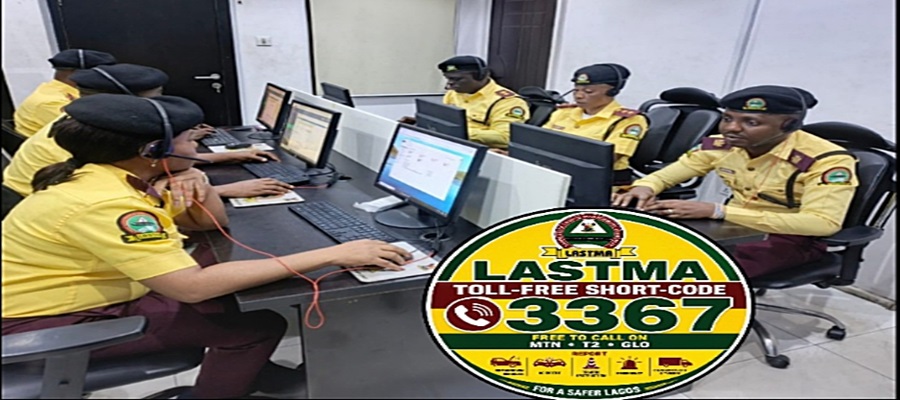
(LASTMA) has launched a new toll-free short-code hotline, 3367, to improve emergency response, enhance traffic managemestrengthen accountability across Lagos State.

The new platform replaces the agency’s previous long-service code and provides a simpler and more accessible channel for residents to report traffic-related incidents. The service is available at no cost to subscribers on MTN, Glo and Etisalat (T2) networks.
Motorists and other road users can use the hotline to report vehicle breakdowns, road crashes, disabled trucks, stranded tankers, traffic obstructions and other emergencies requiring immediate intervention.
The platform also allows members of the public to report the conduct and professionalism of LASTMA personnel, a move aimed at promoting transparency and accountability within the agency.
To ensure wider accessibility, callers can communicate with hotline operators in English, Yoruba or Pidgin English, helping to eliminate language barriers and encourage greater public participation.
Speaking on the initiative, Mr. Olalekan Bakare-Oki, general manager, LASTMA, described the launch as a major milestone in the agency’s efforts to build a safer, more efficient and technology-driven traffic management system.
He said the hotline reflects LASTMA’s commitment to leveraging digital solutions to tackle transportation challenges while strengthening collaboration with residents.
According to Bakare-Oki, the 3367 hotline provides Lagos residents with a direct, convenient and free channel to report incidents requiring urgent attention, noting that the growing complexity of Lagos as a major African megacity demands a proactive and technology-enabled approach to traffic management.
He assured residents that all reports received through the platform would be handled professionally and confidentially before being forwarded to the appropriate operational units for prompt action
Bakare-Oki urged the public to make effective use of the hotline to support road safety, improve accountability and contribute to a more efficient and sustainable transportation system across the state.
General News
PalmPay Strengthens Data Protection Culture with Employee Privacy Workshop and Privacy Champions Programme

PalmPay has reinforced its commitment to responsible data governance and customer information protection through a specialised two-day data protection workshop for employees and the launch of its internal Privacy Champions Programme, an initiative designed to strengthen awareness, accountability, and responsible data handling across the organisation.

The initiative comes at a time when data protection is increasingly critical following recent reports of recorded 281,500 compromised user accounts in the first quarter of 2026, ranking 34th among the world’s most breached countries, according to a new quarterly data breach analysis by cybersecurity firm, Surfshark.
Facilitated by the Nigeria Data Protection Commission (NDPC) and leading Data Protection Compliance Organisation (DPCO) TechHive Advisory, the two-day workshop equipped employees with practical knowledge on privacy governance and data protection obligations, incident awareness, and the role each employee plays in protecting personal data.
The initiative forms part of PalmPay’s ongoing efforts to advance compliance with the Nigeria Data Protection Act (NDPA) 2023. It also reflects the company’s continued investment in safeguarding customer information and fostering a culture where privacy remains everyone’s responsibility.
The Privacy Champions Programme establishes a network of employee representatives across business functions who will support awareness, promote best practices and help strengthen the organisation’s privacy culture. By integrating privacy considerations into day-to–day activities the initiative aims to further enhance accountability and reinforces customer trust.
Speaking on the initiative, Managing Director of PalmPay, Chika Nwosu, stated: “At PalmPay, protecting customer information is fundamental to maintaining the trust our customers place in us everyday, and remains central to our operations. Statistically, 10 out of 100 Nigerians have been affected by data breaches.
Hence, we have a greater responsibility to ensure that personal information is collected, processed, stored, and protected responsibly. This specialised training reflects our continued investment in strengthening internal awareness and ensuring our teams remain equipped to uphold the highest standards of data privacy and protection.”
As a digital financial services platform serving millions of users, PalmPay reaffirmed that privacy and data protection remain embedded in its operational culture, with continuous investments in data governance practices.
PalmPay also encourages customers to remain vigilant and adopt safe digital practices, including protecting account credentials, exercising caution when sharing personal information online, and reporting suspicious activities promptly. The company maintains that building a secure digital ecosystem requires a shared commitment from organisations, regulators, and users alike.


President Bola Tinubu has appointed Dr Obi Adigwe as the National Coordinator of the newly established National Health Technology and Data Analytics Office (NHTDAO).

President Bola Tinubu
The appointment was announced in a statement issued on Friday.
The office, which will be domiciled in the Office of the Coordinating Minister of Health and Social Welfare, is expected to serve as the national coordination platform for Nigeria’s digital health system.
According to the statement, the NHTDAO will complement the work of existing health institutions by promoting coordination and interoperability across public and private healthcare systems, rather than replacing existing agencies.
It said the office would also drive the implementation of the National Digital Health Architecture approved by the National Council on Health in November 2025.
The statement said the initiative formed part of the Federal Government’s efforts to strengthen a secure, technology-driven and data-enabled healthcare system capable of improving service delivery nationwide.
Adigwe, who currently serves as the Director-General of the National Institute for Pharmaceutical Research and Development (NIPRD), has led several initiatives in science, pharmaceutical research, technology transfer and artificial intelligence.
He also coordinated major research funding initiatives, including a ¥300 million nanotechnology grant and an €18 million European Union research grant, while supporting the establishment of Africa’s first Active Pharmaceutical Ingredient (API) training facility through support from Afreximbank.
The statement said the new office would be guided by a steering committee co-chaired by the Coordinating Minister of Health and Social Welfare, Prof. Muhammad Ali Pate, and the Chairman of the Nigerian Economic Summit Group, Mr Olaniyi Yusuf.
Other members of the committee include the Minister of State for Health, Dr Iziaq Adekunle Salako; senior officials of the Federal Ministry of Health and Social Welfare; representatives of the National Information Technology Development Agency (NITDA); and heads of key health agencies, including the National Primary Health Care Development Agency (NPHCDA) and the National Health Insurance Authority (NHIA).
The committee will also include representatives of state commissioners for health from the six geopolitical zones, as well as industry and community stakeholders.
The Federal Government expressed optimism that the office would strengthen coordination across the health sector, accelerate digital transformation and improve healthcare delivery in line with the Renewed Hope Agenda.

FCCPC Dismisses Report Claiming Approval of 48 New Loan Apps

ALTON Backs NCC’s Local Smartphone Manufacturing Drive to Widen Digital Access

LASTMA Launches 3367 Toll-Free Hotline for Emergency Response, Traffic Management

PalmPay Calls for Trust, Infrastructure and Responsible AI to Drive Payment Ecosystem Innovation

OADC Reaffirms Abundant Capacity in Data Centres in Nigeria to Host Financial Data

London Strengthens Global Investment Ties with Africa @ First Ever London-Africa Business Summit

Mobile Internet Gender Gap Widest in Africa – GSMA

FG Targets Alleged N3tn Capital Flight, Opens Airtime Credit Market to Nigerian Fintechs

Japan, UNESCO Boost Digital Learning in 15 CoEs with Donation of ICT Equipment

African Electric Vehicle Platform Raises $215m to Scale Electric Mobility in Nigeria, Others




 General News3 days ago
Tinubu appoints Adigwe to head National Health Technology, Data Analytics Office

 E-Financial3 days ago
Paystack Unveils AI-powered Payments Tools

 E-Financial3 days ago
Fidelity Bank Wins DBN Award for Expanding First-Time Credit Access to MSMEs

 E-Financial3 days ago
NRS, CITN Deepen Partnership to Strengthen Tax Awareness

 General News3 days ago
PalmPay Strengthens Data Protection Culture with Employee Privacy Workshop and Privacy Champions Programme

 E-Financial3 days ago
FCMB Turns Normal Banking into Rewards with New Mobile App Upgrade

 Telecom3 days ago
Meta, FG Unveil New Safety Measures to Protect Nigerian Teens Online

 E-Financial3 days ago
Despite Warnings, FG Draws Down $1.5Bn as First Tranche of FAB $5Bn Loan Deal