

E-Business
Encomiums CWG Launches Tier-3 Center in Lagos, Charts Future with CWG2.0

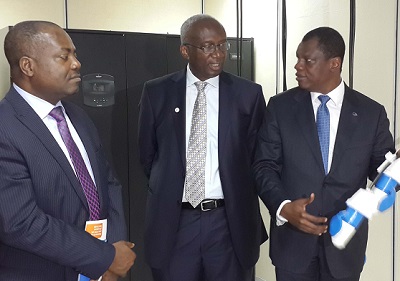
Computer Warehouse Group (CWG Plc), leading pan African information and communication technology conglomerate, has launched a Tier 3 Ultra-Modern Data Center, in line with improving Africa’s economy with Information Technology.
The state-of -the art Data Center, situated at Lekki phase 1, Lagos is specifically built to provide a platform for CWG’s cloud computing business as well as offer excess capacity to enterprise, especially banks for use as a Disaster Recovery Data centre on a co-location basis.
It is also expected that budding online companies such as Jumia and Konga with immense technology requirements shall also avail themselves of the facility.
CWG’s Data Center is equipped with state of the art N+1 power and environmental management infrastructure, which provides a combined generating capacity of 0.7MVA.
To ensure incoming mains power is conditioned and available at all times, there are redundant and Modular 250KVA Uninterruptible Power Supply (UPS) systems.

The UPS also function as bull-mark against power surges and blowout.
Addressing the guests, Mr. Austin Okere, chief executive officer, CWG Plc unveiled the future direction of the company, tagged CWG 2.0.
According to Okere “having majorly completed the pillars for our IT as a Service (ITaaS) strategy, namely creating a platform for rapid Pan African growth and repositioning our service model to cater to the new cloud computing mind-set, we are on target to achieve our objective of being the the number 1 IT Utility enabler in Africa by launching three cloud services in Nigeria; the MTN SaaS for Microfinance banks in conjunction with MTN Nigeria, the Diamond Yello Account bringing Financial inclusion to the 55 million MTN Mobile subscribers in partnership with MTN and Diamond Bank, and the CWG SMERP (a vertically modular Enterprise Resource Planning application for Micro, Small and Medium scale enterprises (MSME), which can be used on a subscription basis by hotels, hospitals, spare-parts dealers Farmers etc.”
“We consider the refocusing of our business into a subscription based model as a dual advantage play. In addition to being a more sustaining strategy, it maximizes our social impact investing on the economy of Africa, and helps to create jobs by empowering entrepreneurs. This in essence defines the new CWG PLC, which we have christened CWG 2.0” he continued.
“MSMEs are regarded as the engine of economic growth. Statistics show that there are 17m+ MSMEs in Nigeria. This compares overwhelmingly with the 260 listed companies on the stock exchange. Without accurate business records, they are unable to generate the accounting reports that banks and financial organizations can depend on to provide financing. Without credit, they are unable to grow their business aggressively.
CWG SMERP can provide these organizations with a strong foundation for growth and sustainability and also provide these firms the opportunity to exploit the internet to access a bigger market. The substantial cost of utilizing ICT is a big barrier for these firms to take advantage of ICT to grow their business” Okere remarked.
Describing the explosive impact that MSME’s can have on the economy if properly supported, Okere remarked rhetorically ‘do you know that by just employing only one additional staff each, the 17m MSME would have created 17million jobs?’
On payments, he explained “We require payment only on a subscription basis which completely removes the CAPEX requirements of ICT usage.
For effective nationwide coverage, we will use a franchise model to enable smaller IT firms and consultancies to assist the MSMEs as business support organizations, and by so doing spur a secondary growth in IT MSMEs which will create thousands of additional jobs”, he concluded.
Speaking at the Data Center Launching, Dr. Ernest Ndukwe, former executive vice chairman, Nigeria Communications Commission (NCC) stated that CWG’s Ultra-modern Data Centre in Lagos is timely, and a leap frog that will aid customers, especially the small and medium enterprises (SMEs).
He also stated that CWG is known for integrity and consistency, and over the years has maintained a strong leadership position in the IT industry which has culminated in several awards by industry watchers.
The recent listing on the Nigerian stock exchange is a testimony of the maturity of the company and shall be a beacon for other companies to follow.
He reminisced coming to launch the CWG VSAT hub in early 2000, before the celebrated boom in the telecoms industry. He remarked that CWG has remained relevant as a result of her innovativeness and subscription to global best practices.
“They have demonstrated the capabilities of leadership through their various achievements in the recent times, especially with their listing on the NSE and now the commissioning of this ultra-modern Data Center facility.” He said.
He further stated that; Data Centre is relevant in the today’s IT world and CWG’s state of art Data Center will benefit, not just the current customers, but the SMEs for whom CWG has developed a special package to support their businesses with ICT.
“These are heartwarming developments. CWG should look beyond Nigeria and Africa; they can go places, especially now that connectivity binds us together,” Ndukwe said.
Engineer Lanre Ajayi, president of Association of Telecommunication Companies of Nigeria (ATCON), said that, CWG has proven its competence as an indigenous company in Nigeria, adding that it has become a pace-setter in the industry.
“Due to their pragmatic efforts, CWG has motivated many other local firms. The launching of this data center is a big step in the right direction. Connectivity is the life wire of any such Data Center. Therefore, CWG should incorporate other stakeholders like NiRA that hosts the .ng to ensure that the expected customers make use of this important infrastructure,” he said.
Ajayi added that with such Data Centers coming up in the country, the rate of capital flight, connectivity, routing and other issues that have bedeviled the industry are been minimized.


E-Business
Cyber Resilience a Critical Priority for Manufacturing Amid Rapid Digitalization – Report Shows


As 60% of manufacturers race toward full digitalisation, cyber risk is increasingly manifesting as a business risk, according to a new global report by Kaspersky and VDC Strategy.

This means cybersecurity is not merely a compliance function, it is a cornerstone of production assurance, safeguarding uptime, quality, and operational continuity.
Manufacturers are modernising to deliver safer, more consistent and more cost-effective production and digitalization is moving fast: just 9% of organisations describe themselves as fully digital today, but 60% expect to get there within two years, according to the joint report by Kaspersky and VDC, titled ‘Cyber Resilience, Built for Manufacturing’.
That shift links shop-floor equipment, production lines and site operations to platforms such as Manufacturing execution systems (MES), Supervisory control and data acquisition (SCADA) and historians, turning many plants into cyber-physical systems (CPS), where a digital disruption doesn’t stay digital. It can slow production lines, quarantine work in progress, invalidate traceability records, or halt production outright.
What’s driving manufacturing digitalization?
Manufacturers are digitising for measurable operational gains, not novelty. Survey respondents identified the primary drivers of their digital transformation strategy as:
- Improving production output or efficiency (24%)
- Reducing operational or production expenses (15%)
- Enabling new strategic opportunities (14%)
- Improving cyber resilience (13%)
The same connected systems that unlock these gains, including MES, IIoT sensors, automated material handling, remote engineering access, also become the systems that determine whether production can be trusted to keep running.
Cyber risk is now a business risk
Cyber risk has evolved from a mere IT concern to a direct threat to revenue generation, as environments transform into cyber-physical systems. In these integrated settings, digital disruptions like malware no longer just affect data, they can cause unsafe operations, scrapped batches, and halted production on the plant floor. This shift highlights the urgent need to treat cybersecurity as a key part of operational resilience.
According to the report, nearly 60% of manufacturing organisations estimate that cyber incidents cause damages exceeding $1 million per event, with an average disruption of 15.3 hours. The most significant losses often result from production halts, missed delivery commitments, and penalties, rather than just forensic costs.
In this context, downtime links cybersecurity risks to overall business performance. Cyber incidents can reduce Overall Equipment Effectiveness (OEE), strain staffing, and disrupt supply chains. Recovery involves more than system restore, it requires re-establishing confidence in process parameters, quality records, and traceability before resuming operations.
Mature cybersecurity programs now incorporate OT security into governance, focusing on metrics valued by production leaders such as time to restore, backup confidence, legacy asset coverage, and safe degraded operation. This alignment ensures cybersecurity supports continuous production and resilience, not just IT compliance.
However, challenges remain due to split ownership. While 59% of organisations’ IT departments manage security policies, these often overlook plant realities. Managing many security tools (44%) and OT patching issues (38%) show that cybersecurity must be embedded into daily routines of production, engineering, and quality teams. Only through such integration can cybersecurity effectively enhance operational reliability and defend against evolving threats.
“As manufacturing environments become increasingly interconnected, cybersecurity shifts focus from merely adding protective layers to ensuring the availability, resilience, and integrity of production processes. The goal is to minimise operational impact and speed up recovery, rather than solely preventing intrusions.
“Kaspersky offers a unified ecosystem that integrates IT, OT, and IIoT security, empowering manufacturers to pursue digital transformation securely. This strategy helps maintain operational continuity and reduces long-term cybersecurity costs,” comments Andrey Strelkov, Head of Industrial Cybersecurity Product Line at Kaspersky.
To implement this strategy, manufacturing companies can leverage solutions from the Kaspersky OT Cybersecurity Ecosystem, centered around Kaspersky Industrial CyberSecurity (KICS), a native Extended Detection and Response platform designed for critical infrastructure protection. KICS enables centralised detection and response to complex attacks across the entire industrial network, ensuring comprehensive visibility and security.


Nigeria Data Protection Commission (NDPC) has commenced a forensic investigation into the University of Lagos (UNILAG), Lotus Bank and Hackerbella Ltd over alleged violations of data protection laws involving students’ personal information.

The investigation follows public complaints alleging that students’ personal data were used to open bank accounts without a lawful basis.
Dr Vincent Olatunji, national commissioner and chief executive officer of the NDPC, directed the investigation team to conduct a comprehensive assessment of the circumstances surrounding the collection, processing, use and disclosure of the affected students’ personal data.
The investigation will also determine the respective roles and responsibilities of UNILAG, Lotus Bank and Hackerbella in the alleged processing of the data.
According to the Commission, the investigation will assess the data protection compliance obligations of the parties under the Nigeria Data Protection Act, 2023 (NDP Act), as well as potential risks posed to the rights and freedoms of the affected data subjects.
The NDPC said the probe would cover several areas, including Data Protection Impact Assessments (DPIAs), the lawfulness and transparency of credit scoring or profiling activities, and the use of automated decision-making systems.
It will also examine the adequacy of privacy notices, data-sharing arrangements, lawful bases for processing, data minimisation and purpose limitation.
Other areas include data retention policies and the adequacy of technical and organisational measures put in place to safeguard the rights and personal data of affected students.
The Commission reiterated that institutions entrusted with the personal data of students, staff and other members of their communities have a heightened responsibility to ensure that such information is processed lawfully, fairly, transparently and securely.
The NDPC therefore warned educational institutions that are yet to comply with its existing data protection compliance directives to take immediate steps to achieve compliance.
The Commission said it would continue to exercise its regulatory mandate to protect the privacy rights of Nigerians and ensure that organisations processing personal data comply with the provisions of the Nigeria Data Protection Act, 2023.

Microsoft is planning to unveil its new Maia 300 AI chip this fall, potentially as soon as next month, The Information reported on Monday, citing people with direct knowledge of the plans.

The company introduced its Maia AI chip in November 2023 but has lagged rivals such as Alphabet and Amazon in scaling up its in-house chip efforts as it seeks to reduce its reliance on Nvidia’s costly processors.
Google began recognizing revenue from direct sales of its custom AI chips, called Tensor Processing Units, in the quarter ended June, while Amazon has also seen growing adoption of its processors, including its Trainium chips.
Microsoft has been in talks with chipmaker TSMC to secure manufacturing capacity for more than 300,000 units of the chip for delivery in 2027, according to the report. It is also looking to significantly ramp up production and persuade major cloud customers such as Anthropic to adopt the chip.
Microsoft ultimately aims to secure capacity for more than 1 million Maia 300 chips, though component supplies and ongoing capacity negotiations with TSMC could constrain its plans, according to the report.
It unveiled its second-generation Maia 200 in January, built by TSMC using 3-nanometer technology.
Microsoft packed the chip with a significant amount of SRAM, a type of memory that can provide speed advantages for AI systems handling large numbers of user requests.

Nigeria Not Making Progress in Fiscal Transparency –US

NCAA to Introduce RFID Technology to Tackle Missing Luggages

SEC Directs Operators to Subscribe to NigSac Alerts, Freeze Terrorists-Linked Funds

Davido Bets $1m in Hit-for-Hit Battle with Colleagues

GSMA Industry Services Unveils Circularity Services to Help Operators Reduce E-Waste and Unlock Value

EFCC Busts NIS Visa Overstay Racket, Uncovers N700m in an Account

Fact-Check: Elon Musk’s “Tesla Pi Phone” is Internet Rumor

NBC Tasks Broadcasting Stations over 2028 DSO Global Deadline

NBC Scraps Annual Digital Access Fee on DSO

Glo Sponsored African Voices to Feature Netflix’s “The Polygamist” Stars




 News2 days ago
Moove Achieves Unicorn Status With $250m Funding

 Telecom2 days ago
MTN Nigeria Clocks 25, Connects over 90m People

 E-Financial2 days ago
FG Suspends NAICOM’s N680m Insurance Recapitalisation Fees

 Broadcasting2 days ago
Affordable, Flexible Streaming Platforms May Kill PAYtv – Report

 E-Business2 days ago
Microsoft to Unveil Next-generation AI Chip in September

 Telecom2 days ago
Subscribers to Seek Legal Redress if Poor Quality of Service Continue in September

 E-Financial2 days ago
SEC Moves to Recover Unclaimed Dividends, Inherited Investments Nationwide

 Telecom2 days ago
ipNX Collaborates with ICT Stakeholders on the Future of Fibre-to-the-Home in Nigeria @ ATCON Forum