

E-Business
Encomiums CWG Launches Tier-3 Center in Lagos, Charts Future with CWG2.0

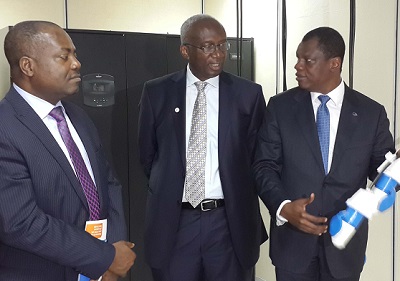
Computer Warehouse Group (CWG Plc), leading pan African information and communication technology conglomerate, has launched a Tier 3 Ultra-Modern Data Center, in line with improving Africa’s economy with Information Technology.
The state-of -the art Data Center, situated at Lekki phase 1, Lagos is specifically built to provide a platform for CWG’s cloud computing business as well as offer excess capacity to enterprise, especially banks for use as a Disaster Recovery Data centre on a co-location basis.
It is also expected that budding online companies such as Jumia and Konga with immense technology requirements shall also avail themselves of the facility.
CWG’s Data Center is equipped with state of the art N+1 power and environmental management infrastructure, which provides a combined generating capacity of 0.7MVA.
To ensure incoming mains power is conditioned and available at all times, there are redundant and Modular 250KVA Uninterruptible Power Supply (UPS) systems.

The UPS also function as bull-mark against power surges and blowout.
Addressing the guests, Mr. Austin Okere, chief executive officer, CWG Plc unveiled the future direction of the company, tagged CWG 2.0.
According to Okere “having majorly completed the pillars for our IT as a Service (ITaaS) strategy, namely creating a platform for rapid Pan African growth and repositioning our service model to cater to the new cloud computing mind-set, we are on target to achieve our objective of being the the number 1 IT Utility enabler in Africa by launching three cloud services in Nigeria; the MTN SaaS for Microfinance banks in conjunction with MTN Nigeria, the Diamond Yello Account bringing Financial inclusion to the 55 million MTN Mobile subscribers in partnership with MTN and Diamond Bank, and the CWG SMERP (a vertically modular Enterprise Resource Planning application for Micro, Small and Medium scale enterprises (MSME), which can be used on a subscription basis by hotels, hospitals, spare-parts dealers Farmers etc.”
“We consider the refocusing of our business into a subscription based model as a dual advantage play. In addition to being a more sustaining strategy, it maximizes our social impact investing on the economy of Africa, and helps to create jobs by empowering entrepreneurs. This in essence defines the new CWG PLC, which we have christened CWG 2.0” he continued.
“MSMEs are regarded as the engine of economic growth. Statistics show that there are 17m+ MSMEs in Nigeria. This compares overwhelmingly with the 260 listed companies on the stock exchange. Without accurate business records, they are unable to generate the accounting reports that banks and financial organizations can depend on to provide financing. Without credit, they are unable to grow their business aggressively.
CWG SMERP can provide these organizations with a strong foundation for growth and sustainability and also provide these firms the opportunity to exploit the internet to access a bigger market. The substantial cost of utilizing ICT is a big barrier for these firms to take advantage of ICT to grow their business” Okere remarked.
Describing the explosive impact that MSME’s can have on the economy if properly supported, Okere remarked rhetorically ‘do you know that by just employing only one additional staff each, the 17m MSME would have created 17million jobs?’
On payments, he explained “We require payment only on a subscription basis which completely removes the CAPEX requirements of ICT usage.
For effective nationwide coverage, we will use a franchise model to enable smaller IT firms and consultancies to assist the MSMEs as business support organizations, and by so doing spur a secondary growth in IT MSMEs which will create thousands of additional jobs”, he concluded.
Speaking at the Data Center Launching, Dr. Ernest Ndukwe, former executive vice chairman, Nigeria Communications Commission (NCC) stated that CWG’s Ultra-modern Data Centre in Lagos is timely, and a leap frog that will aid customers, especially the small and medium enterprises (SMEs).
He also stated that CWG is known for integrity and consistency, and over the years has maintained a strong leadership position in the IT industry which has culminated in several awards by industry watchers.
The recent listing on the Nigerian stock exchange is a testimony of the maturity of the company and shall be a beacon for other companies to follow.
He reminisced coming to launch the CWG VSAT hub in early 2000, before the celebrated boom in the telecoms industry. He remarked that CWG has remained relevant as a result of her innovativeness and subscription to global best practices.
“They have demonstrated the capabilities of leadership through their various achievements in the recent times, especially with their listing on the NSE and now the commissioning of this ultra-modern Data Center facility.” He said.
He further stated that; Data Centre is relevant in the today’s IT world and CWG’s state of art Data Center will benefit, not just the current customers, but the SMEs for whom CWG has developed a special package to support their businesses with ICT.
“These are heartwarming developments. CWG should look beyond Nigeria and Africa; they can go places, especially now that connectivity binds us together,” Ndukwe said.
Engineer Lanre Ajayi, president of Association of Telecommunication Companies of Nigeria (ATCON), said that, CWG has proven its competence as an indigenous company in Nigeria, adding that it has become a pace-setter in the industry.
“Due to their pragmatic efforts, CWG has motivated many other local firms. The launching of this data center is a big step in the right direction. Connectivity is the life wire of any such Data Center. Therefore, CWG should incorporate other stakeholders like NiRA that hosts the .ng to ensure that the expected customers make use of this important infrastructure,” he said.
Ajayi added that with such Data Centers coming up in the country, the rate of capital flight, connectivity, routing and other issues that have bedeviled the industry are been minimized.



Nigeria Data Protection Commission (NDPC) has commenced a forensic investigation into the University of Lagos (UNILAG), Lotus Bank and Hackerbella Ltd over alleged violations of data protection laws involving students’ personal information.

The investigation follows public complaints alleging that students’ personal data were used to open bank accounts without a lawful basis.
Dr Vincent Olatunji, national commissioner and chief executive officer of the NDPC, directed the investigation team to conduct a comprehensive assessment of the circumstances surrounding the collection, processing, use and disclosure of the affected students’ personal data.
The investigation will also determine the respective roles and responsibilities of UNILAG, Lotus Bank and Hackerbella in the alleged processing of the data.
According to the Commission, the investigation will assess the data protection compliance obligations of the parties under the Nigeria Data Protection Act, 2023 (NDP Act), as well as potential risks posed to the rights and freedoms of the affected data subjects.
The NDPC said the probe would cover several areas, including Data Protection Impact Assessments (DPIAs), the lawfulness and transparency of credit scoring or profiling activities, and the use of automated decision-making systems.
It will also examine the adequacy of privacy notices, data-sharing arrangements, lawful bases for processing, data minimisation and purpose limitation.
Other areas include data retention policies and the adequacy of technical and organisational measures put in place to safeguard the rights and personal data of affected students.
The Commission reiterated that institutions entrusted with the personal data of students, staff and other members of their communities have a heightened responsibility to ensure that such information is processed lawfully, fairly, transparently and securely.
The NDPC therefore warned educational institutions that are yet to comply with its existing data protection compliance directives to take immediate steps to achieve compliance.
The Commission said it would continue to exercise its regulatory mandate to protect the privacy rights of Nigerians and ensure that organisations processing personal data comply with the provisions of the Nigeria Data Protection Act, 2023.


Microsoft is planning to unveil its new Maia 300 AI chip this fall, potentially as soon as next month, The Information reported on Monday, citing people with direct knowledge of the plans.

The company introduced its Maia AI chip in November 2023 but has lagged rivals such as Alphabet and Amazon in scaling up its in-house chip efforts as it seeks to reduce its reliance on Nvidia’s costly processors.
Google began recognizing revenue from direct sales of its custom AI chips, called Tensor Processing Units, in the quarter ended June, while Amazon has also seen growing adoption of its processors, including its Trainium chips.
Microsoft has been in talks with chipmaker TSMC to secure manufacturing capacity for more than 300,000 units of the chip for delivery in 2027, according to the report. It is also looking to significantly ramp up production and persuade major cloud customers such as Anthropic to adopt the chip.
Microsoft ultimately aims to secure capacity for more than 1 million Maia 300 chips, though component supplies and ongoing capacity negotiations with TSMC could constrain its plans, according to the report.
It unveiled its second-generation Maia 200 in January, built by TSMC using 3-nanometer technology.
Microsoft packed the chip with a significant amount of SRAM, a type of memory that can provide speed advantages for AI systems handling large numbers of user requests.


X has announced plans to discontinue its Revenue Sharing programme and introduce a new Original Content Rewards programme to reward creators for producing original content on the platform.

The social media company announced the changes at the weekend in a post on its X Creators handle, saying the new programme would reward creators who contribute original content.
“Today, we’re introducing the Original Content Rewards Program, a new way to reward creators who bring original ideas, expertise, reporting, creativity, and commentary to X,” the company said.
X said it would stop accepting new enrolments into the Revenue Sharing programme from Friday, while existing participants would continue earning until September 7, 2026.
“Starting today, we’re no longer accepting new enrollments into Revenue Sharing,” it said.
According to the company, existing Revenue Sharing participants will receive three final payouts, with two scheduled for August 14 and August 28, while the final payment for earnings accrued through September 7 is expected around September 11.
X said existing Revenue Sharing participants would begin getting access to apply for the new programme from September 8, subject to meeting its eligibility requirements.
The first payout under the Original Content Rewards programme will be made on August 28, 2026, while existing Revenue Sharing creators who enrol in the new programme from September 8 will receive their first payment on September 25.
Under the new programme, eligible creators will earn from qualified impressions generated by their original content, with payments made every two weeks.
X defined qualified impressions as unique impressions from Premium users on the Home Timeline feed, where at least 50 per cent of a post is visible.
On the other hand, “The following are excluded from qualified impressions: impressions from the same account counted more than once per post; paid, promoted, or artificially generated impressions; and fraudulent impressions,” it said.
To qualify, creators must be at least 18 years old, live in a country where the programme is available, maintain an account in good standing and have either a personal or vusiness account.
They must also subscribe to X Premium, Premium+ or Premium Business, have at least 500 verified followers and record at least 500,000 Home Timeline impressions from verified users within the previous 90 days.
X said creators must also regularly post original content to remain eligible.
“We want to recognize creators who break news, share expertise, tell stories, create entertainment, and contribute meaningful perspectives to the conversation,” the company said.
The platform said original content could include threads, videos, memes, graphics, illustrations, reporting, analysis, commentary and reactions that add meaningful value to existing conversations.
It said creators who use content produced by others would need to add meaningful commentary, context, analysis, humour or creative transformation for such posts to qualify.
“Building on existing conversations is a core part of X, but simply reposting someone else’s content is not enough,” it said.
X said minor edits such as cropping, filters, borders, watermarks, speed adjustments or simple text overlays would generally not qualify as meaningful transformation on their own.
It also warned that content copied or substantially reproduced from another creator, content downloaded and re-uploaded from X or another platform without being the original author’s, automated content, disinformation and misleading content would be ineligible.
The company said accounts that violate the programme’s requirements could be temporarily or permanently removed from it, depending on the severity of the violation.
It added that creators would be responsible for ensuring they had the necessary rights, permissions or licences to use content created by others.
“Original content is content you personally create that reflects your own voice, perspective, expertise, or creativity,” X said.
The company said the new programme was intended to reward creators who make the platform more valuable by bringing original ideas and perspectives to its conversations.
“The Original Content Rewards Program is designed to reward the creators who start them, shape them, and move them forward,” it said.

NUPRC Warns of Counterfeit, AI-Generated Appointment Letters

KudiWave Asks for Clarification over N750m Transfer from PalmPay Account

NCC Reports over 5,000 Fibre Cuts in 6 Months

PalmPay Reinforces Commitment to Youth Empowerment on International Youth Day

ipNX Joins Calls for Innovation-Friendly Ecosystem and Stronger Local Opportunities at Regenesys AI Summit

EFCC Busts NIS Visa Overstay Racket, Uncovers N700m in an Account

Fact-Check: Elon Musk’s “Tesla Pi Phone” is Internet Rumor

NBC Tasks Broadcasting Stations over 2028 DSO Global Deadline

NBC Scraps Annual Digital Access Fee on DSO

Glo Sponsored African Voices to Feature Netflix’s “The Polygamist” Stars




 E-Business2 days ago
X Replaces Revenue Sharing wit New Creator Rewards Programme

 Telecom2 days ago
MTN Alerts Subscribers over Fake 25GB Anniversary MTN Data Giveaway

 E-Financial2 days ago
Interswitch, Temenos Commit to Advancing Nigeria’s Digital Banking Technology

 E-Financial2 days ago
FG Spent N3.1 Trillion on Domestic Debt Servicing in Q1- DMO

 General News2 days ago
Fake Agency: ICPC Indicts NITDA, Others over Inadequate Due Diligence

 General News2 days ago
UNESCO Taps Oguamanam,Nigerian Scholar to Advisory Body on Science, Tech Ethics

 General News2 days ago
Tax Reform Built on Taxing Prosperity, Not Poverty– Adedeji

 E-Business1 day ago
Microsoft to Unveil Next-generation AI Chip in September