

Broadcasting
With 16 PhDs, Accra Institute of Technology shows the way to produce doctorate degrees in Africa

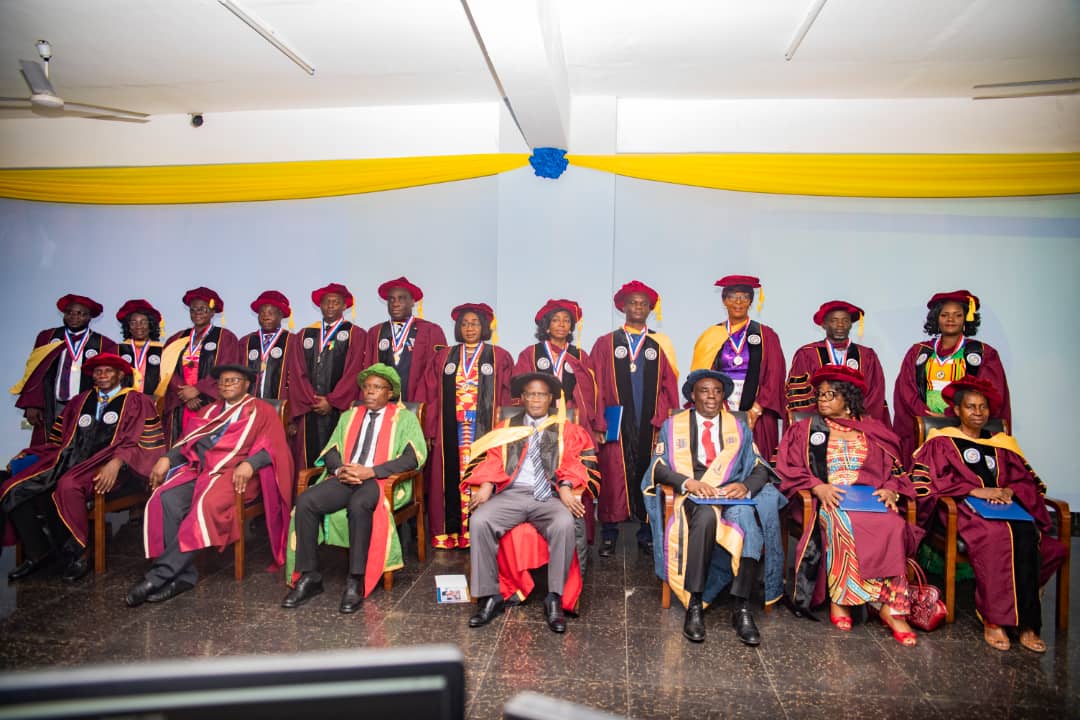
By Dominic Osei-Boakye
Birthed in 2009, started walking fully in the latter part of 2010 at a one block building surrounded by beautifully designed containers at the premises of the Civil Service Training Center and Government Secretarial School at Cantonments, the Accra Institute of Technology (AIT) has defied all odds and become a leader in producing PhDs in Ghana, one of Africa’s major centres of learning.

Once described by a Nigerian journalist as a “potter cabin university” with the registrar’s office labeled as a “two by four cubicle”, the AIT success story provides a model on Africa’s pathway to knowledge and skill development in a more globalised economy. And it is worthy of emulation.
Captained by Professor Clement Dzidonu, a world renowned Computer Scientist, backboned by eminent academics in the Board of Trustees (BoT) including Prof Edward Ayensu (Formerly of World Bank Inspection Panel) as Chairman, Prof. Ivan Addae Mensah (Former Vice Chancellor, University of Ghana) as Vice Chairman, Prof. Jophus Anamuah Mensah (Former Vice Chancellor of University of Education, Winneba), and Prof. Samuel Adjepong (Former Vice Chancellor, University of Cape Coast), the AIT has been built on a solid rock of knowledge champions.
In this league are also Prof. William Otoo Ellis (Former Vice Chancellor, Kwame Nkrumah University of Science and Technology), Very Rev. Ama Afo Blay (Former Director General of Ghana Education Service), Dr. Grace Bediako (Former Government Statistician) and Mr. K.S. Yamoah (Former Managing Director of the Ghana Stock Exchange). All of these academic have helped AIT to lead the way in terms of production of quality PhDs in the country, and the rest of the continent to set the pace in knowledge engineering.

Through its partnership with Open University of Malaysia, the Accra Institute of Technology has produced Eighty-One (81) PhDs since 2016. This translates into an average of Fourteen (14) PhDs per year. This is unprecedented and a great achievement for a young private university like AIT. Considering the fact that the PhD per capita of Ghana is alarmingly low, the contributions of AIT in bridging this gap cannot be underrated. More importantly, the partnership has fostered the new direction of knowledge-sharing across continents to close the gap deep learning and development.
Did this Come Easy? Not at all! To offer, run and graduate students on an internationally benchmarked Doctor of Philosophy (PhD) degree programs in Ghana is by all standards a herculean task. As a non-religiously denominated or related private university which is school fees driven with no support from government nor any other organisations, running PhDs can be very expensive. After paying supervisors, external examiners and reviewers, PhD Research Committee members, internal and external moderators, etc, the university retains virtually nothing and makes no profit. This explains why most of the private universities shy away from this daring venture since it is not financially worthwhile.
Additionally, getting supervisors and external examiners to mentor these PhD students is another huge task. Running PhDs in special areas like Business Administration, Information Technology, Engineering and Education come with so many difficulties in attracting supervisors and external examiners who dully qualify to mentor the students.
However, AIT has surmounted this hurdle with collaborations with several internationally recognized universities with competent Professors who have been working hard to produce these PhDs.
Speaking at the 18th graduation of AIT, held on 17th December, 2022 at the ultramodern Knowledge City Campus in Kokomlemle, where AIT graduated Sixteen (16) PhDs at a goal, the President of AIT could not hide his joy especially having led his team to make this huge contribution to academia in the country.
He stated: “Mr. Chairman, I will need to pause here to comment on the historic nature of the 18th Congregation of this young and dynamic University. Today we are making yet another history in this country’s annals of private university education. Mr. Chairman, it is my great honor and privilege to announce that we are today graduating for the 10th time, PhDs who studied at this university.
“This major achievement of a university barely ten years old makes AIT the first private university in Ghana to successfully offer and graduate students on an internationally benchmarked PhD program. This is no small achievement if put within the context of the fact that the PhD per capita of Ghana is extremely low. Mr. Chairman, we can claim that we have become one of the leading postgraduate research institutions on the continent. I want to take this opportunity to assure you that we are confident that we will again be graduating more PhDs next year.”
He added: “The Quality? The quality of the PhDs produced by AIT is not in contention. As highlighted by the President in his speech ‘Mr. Chairman, I am delighted to inform you that, at AIT, we are mindful of the need to provide high-standard tertiary education and training not only aimed at producing qualified and highly skilled people to drive the nation’s development in the information age but also to produce job creators, with the requisite entrepreneurial skills and expertise to set up and run their corporations in various fields.
“Also, as a research university, our focus on cutting-edge research work through our postgraduate programs and research initiatives is geared towards supporting the nation’s science, technology, and innovation (STI) drive towards developing a modern knowledge-based and wealth-generating economy in the information and technological age.”
AIT’s milestones underscored why it was ranked the best private university in Ghana in 2018 and 2019 and was also awarded the Best Technology University in Ghana for the fourth year running by Ghana Tertiary Awards.
Quality of the PhDs produced by AIT is shown in the progress of their graduates. Currently, AIT has Pro Vice Chancellors in public universities who became Professors in less than three years after completion. 60% of the graduates have become Senior Lecturers, Associate Professors and Full Professors few years after graduation. The strict requirements by AIT for students to publish minimum of five papers in a reputable and ranked journal sets the foundation for this growth. The PhD Candidature system where students are mentored by the PhD Research Committee for one year instead of just one supervisor through series of presentations and the strict requirement to write minimum three chapters of your thesis within that period also contributes heavily to the success of these students.
In the last 10 years of the program, AIT has graduated PhDs who are on the academic and administrative staff of almost all the private and public universities in Ghana and a number of Nigerian universities. Given the high international academic standard of the program, more than half of our PhD graduates in academia obtained their Associate or Full Professor within three years after graduation. These are outstanding landmarks pointing to how Africa can close the gaps for deep knowledge and research as it gears into the fourth industrial revolution (4IR).
If anyone thought AIT is resting on its laurels, then such people must rewrite their notes. At the 18th graduation ceremony, thirty-five (35) students graduated to become PhD Candidates after completing the first three chapters of their thesis in the first year. They should be completing their PhDs in two years. This is coupled with a number of students who are going through their Post Viva corrections and the twenty (20) students who are preparing to submit their thesis for examination. Two years from now, it is estimated that AIT will graduate not less than forty (40) additional PhDs.
The Chairman of the AIT Board of Trustees, Prof Edward Ayensu summed it all up in his speech at the 18th graduation: “So far, we are proud to report that our efforts in all directions are proceeding according to plan. We can assure this Congregation, and all stakeholders, that we shall not relent in our efforts to ensure the full fulfillment of that vision”
Conspicuously, the Accra Institute of Technology is showing the way and will fill the PhD gap in the country and across Africa in no time.
My final message to students all of Africa, start your journey with AIT from Bachelor’s, Master’s and PhD in Business Administration, Engineering, Information Technology, Computer Science, Education and Health and Safety.
Indeed! Your journey to the top starts at Accra Institute of Technology as it lives to its payoff as the University of the Future beginning today. Yes! In AIT, Africa has a chance to leapfrog; the milestones achieved by AIT in so short a while proved that point.
Dominic Osei-Boakye is Registrar at AIT



National Broadcasting Commission (NBC) has said that Nigerians will no longer pay annual Digital Access Fees under the renewed Digital Switch Over (DSO) project.

Charles Ebuebu, director-general, NBC, disclosed this in an exclusive interview with the News Agency of Nigeria (NAN) on Wednesday in Abuja,
Ebuebu said viewers only need to purchase an approved decoder and satellite dish which cost below N20,000 to enjoy free television permanently.
“Previously, users paid an annual digital access fee of about N1,500, described as an administrative charge.
“The new system removes that annual fee. It provides free access to free-to-air television channels without any payment.
“Premium channels will be introduced later. Viewers who want those additional channels will be able to access them through paid services.
“Nigerian content on free-to-air channels remains free to watch. Unlike Pay TV, this platform does not require monthly subscriptions for its basic service,” he said
Ebuebu said approved decoders for the FreeTV will cost less than N20,000 and authorised sales outlets will soon be announced.
He urged Nigerians to wait for official information on approved dealers for the DSO decoders, warning that unauthorised sellers are exploiting growing public demand.
He reiterated that people only need a free-to-air decoder, along with a satellite dish instead of the old antenna system to receive the DSO signal.
“Once the equipment is installed, viewers can access all available channels across the country without paying any subscription fees,” he stressed
The DG dismissed claims by some retailers that there are different categories of decoders sold at varying prices, stressing that such sellers are not authorised by the commission.
According to him, the NBC will soon publish the list of approved dealers, official prices, and locations where genuine decoder boxes and accessories can be purchased.
The NBC boss said the DSO project is designed not only to improve television broadcasting but also to stimulate economic growth by creating jobs, attracting investment, and opening up opportunities for businesses that support the broadcasting industry.
Ebuebu noted that content producers and broadcasters stand to benefit significantly from the nationwide reach of the DSO platform.
Unlike the previous system, where many stations had limited regional audiences, he said the new platform will make their channels available to viewers across Nigeria.
He added that the introduction of audience measurement technology will provide scientific and reliable data on television viewership.
Ebuebu added that audience measurement technology will give advertisers greater confidence in placing adverts and enable broadcasters to demonstrate the true size and reach of their audiences nationwide.

Uchenna Mbunabo, Nigerian filmmaker, has raised concerns over the alleged unauthorised broadcast of Nollywood films by some Ghanaian television stations, calling on Ghana’s National Film Authority (NFA) to strengthen the enforcement of copyright laws.

Uchenna Mbunabo, Nigerian filmmaker
Mbunabo made the remarks during a conversation with James Gardiner, deputy CEO of the National Film Authority (NFA) of Ghana.
He questioned whether it was permissible for television stations in Ghana to download Nigerian movies from YouTube and air them without obtaining permission from the producers.
“I noticed that Ghanaian TV stations, the way they are stealing our films and showing them for free with impunity. Is it legalised in your country for TV stations to go on YouTube, download people’s sweat and show it for free?”
According to Mbunabo, some Ghanaian television stations have been downloading newly released Nollywood films from YouTube and broadcasting them without authorisation, depriving producers of revenue generated through the platform.
He also stated that he had not witnessed Nigerian television stations engaging in similar practices and questioned what measures Ghana was taking to protect filmmakers’ intellectual property.
Responding to the concerns, Gardiner acknowledged that the issue exists and said the National Film Authority had begun engaging relevant stakeholders to address it.
He disclosed that the NFA has held discussions with the Ministry of Communications, the National Communications Authority (NCA) and the National Media Commission (NMC) on improving copyright enforcement.
Gardiner explained that while Ghana has copyright laws, enforcement remains challenging because many television stations now operate digitally and may not have physical offices within the country.
“There are copyright laws, but they are not effective because a lot of the TV stations don’t have offices. Most of them are now digital, so they operate from anywhere. They can even have a Ghanaian TV station but be operating from Austria simply because it is digital.”
He added that authorities are considering a new licensing framework that would require broadcasters to undergo a fresh licensing process to improve monitoring and enforcement.
According to Gardiner, television stations found guilty of illegally broadcasting copyrighted content would be required to compensate affected producers through fines.
He added that repeat offenders could face suspension of their broadcasting licences, while a third violation could result in the revocation of their licences.
Although he did not provide a specific timeline, Gardiner said the reforms were already underway and expressed hope that significant progress would be seen next year.
Mbunabo welcomed the proposed measures but urged the National Film Authority to expedite the process, stating that unauthorised broadcasts continue to affect filmmakers’ ability to recover production costs through legitimate distribution channels such as YouTube.
He also stressed that his comments were not directed at Ghana’s film industry, noting that he has worked with several Ghanaian actors over the years and supports collaborations between Nollywood and Ghallywood.


FAAN to Replace Physical ID Check with V-Pass Biometric Verification

World Bank Says 79 Percent of Nigerians Still Trapped in Poverty despite Reforms

SEC Begins Drive to Recover Unclaimed Dividends

ntel Plays Down Calls and Data Services, Moves to BET Agenda

Nigeria Facing Rising Cybercrime Losses – Report

NRC, Ponzi Scheme Collapses Resulting Loss of Billions of Naira

Nigeria Launches FreeTV Nationwide

NASENI Moves to Digitize CCB’s 5m Assets Declaration and Operations

Lebara Nigeria Launches Lebara Play, Africa’s First Telecom-Owned Micro-Drama Platform

CANAL+ Partners Samsung to Pre-Load DStv Stream on New Samsung TVs In Nigeria, Other African Countries




 E-Business3 days ago
TD Africa Sponsors Check Point Secure 360 Summit to Boost Cybersecurity in Nigeria

 Telecom3 days ago
MTN Foundation, MUSON Celebrate Emerging Music Talents at 2026 Graduation Ceremony

 Telecom3 days ago
NITDA Calls for Digital Infrastructure Expansion to Drive Nigeria’s Industrialisation

 News3 days ago
Guinness Rolls Out Nationwide Consumer Rewards Promotion

 E-Financial3 days ago
Next Currency Crisis May Turn $300Bn in Stablecoins into National Currencies

 General News3 days ago
First Trustees Advocates Estate Planning as an Essential Tool in Every Wealth Creation Strategy

 E-Financial3 days ago
Gigbanc Nigerian Fintech Startup Closes Shop after 3 Years

 Broadcasting3 days ago
Mbunabo, Nigerian Filmmaker Accuses Ghana TV Stations of Pirating Nollywood Films