

General News
Emirates Completes 21 Aircraft “Make-Overs” in 2013

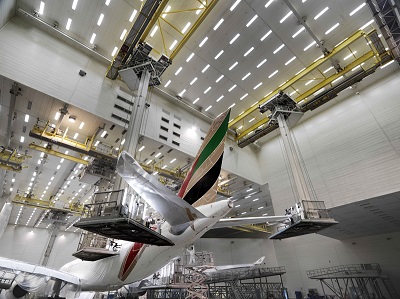
A unique look into Emirates’ aircraft paint hangar showed that apart from being the a global connector of people and places, operates the world’s largest fleets of A380s and Boeing 777s, and to serve these aircraft, it runs the world’s largest state-of-the-art aircraft paint hangar owned by an airline.
In 2013, Emirates’ advanced paint hangar completely stripped 21 aircraft (or nearly 10% of its fleet) of exterior paint and gave them a brand new coat. It took 6,550 hours in total, or 273 days and nights of non-stop stripping and repainting, to complete these “make-overs”.
In addition to these major projects, the paint shop was kept fully engaged with over 60,000 other paint touch-up jobs on the exteriors and interiors of the aircraft, as well as cabin items.
“Our aircraft livery is one of the most recognisable and visible aspects of our brand. It is what people see in the sky, and the first thing our passengers see at their boarding gates. We take pride in maintaining our aircraft to the highest possible standards, and it is important our planes look pristine on the outside as well as on the inside,” said Adel Al Redha, executive vice president and chief operations officer, Emirates.
“It’s not just about looking good. The paint coat has to withstand fierce weather conditions, including severe wind, bitter cold and searing heat, and an exterior coat that is clean of debris and imperfections improves aerodynamics and reduces fuel consumption. Emirates already flies a young and efficient fleet, but with fuel prices at consistently high levels, every little bit of efficiency counts,” he added.

Emirates previously had a minor paint booth in its Dubai hub to manage minor jobs while outsourcing the big projects to an external supplier.
Building its own paint hanger has helped the airline to better control total quality, and co-ordinate flight operations scheduling.
Since the paint hangar started operations in August 2010, it has completed 59 full aircraft “strip-and-repaint” projects and several hundred thousand aircraft component paintings.
After every seven to eight years in service, Emirates fully strips its aircraft of their exterior colour and gives them a brand-new coat.
A Boeing 777 requires a team of 26 to 30 people for a full strip-and-repaint project, which is turned around in just 12 to 13 days.
Emirates’ paint hanger operates 24 hours a day, seven days a week. It employs highly skilled and specialised staff for this purpose, and uses the latest technologies and systems including fully-controlled environments that regulate temperature, humidity and airflow – all of which are critical factors for the perfect glossy coat.
Since the airline’s launch in 1985, all Emirates aircraft wear their white coat with the iconic golden Emirates letters and tail fin in the colours of the flag of the United Arab Emirates.
The branding underwent a subtle change only once in 2000. The flag was redesigned to appear as though it was flowing in the wind and the letters assumed the new Emirates typeface making them softer and more in-keeping with the Arabic calligraphy.
The new look had a buoyant tone making it more contemporary, yet retained the classic look which had become well-known since 1985.
Emirates’ first A380, which entered service in August 2008, will be due for a full repaint in 2015. Emirates operates the largest fleet of A380 with 44 in total and an additional 96 on order.
It also operates the world’s largest fleet of Boeing 777s with 132 in service and 210 more on order.
Emirates was founded as an airline in 1985. It now flies to 141 destinations in 80 countries across six continents, providing air services that enable trade and travel to its home base in Dubai and beyond. Emirates also connects millions of people on the ground each year through its other operations including Emirates Holidays, its destination marketing arm, and tour operator Arabian Adventures. Seamless trade connections are supported through Emirates SkyCargo, its cargo division.
A multinational and multicultural employer with over 160 nationalities working together, Emirates is committed to connecting people around the globe, and helping them to discover, enjoy and share new experiences together. This commitment is reflected in its wide portfolio of international sports and cultural sponsorships.


Independent Corrupt Practices and Other Related Offences Commission (ICPC) indicted the National Information Technology Development Agency (NITDA) and other ministries over administrative lapses that allowed the fictitious Presidential Foreign Investment Promotion Council (PFIPC) to operate.

Musa Aliyu, chairman, ICPC, stated that NITDA, alongside the Office of the Secretary to the Government of the Federation (OSGF), the Budget Office, and other bodies, failed to carry out adequate due diligence and standard operating procedures.
ICPC said however, clarified that the findings pointed to severe internal control weaknesses and administrative negligence rather than active official complicity by NITDA and the other affected agencies.
The briefing followed a 30-day investigation ordered by the president on July 7 into allegations surrounding the purported presidential council.
The commission also cleared the presidency and the Central Bank of Nigeria (CBN) of any wrongdoing but blamed institutional lapses in several ministries, departments and agencies (MDAs).
Aliyu said investigators established that Adeniyi Adeyemi, the director-general, was never appointed by the federal government and that the PFIPC had no legal existence.
“As you may recall, on the 7th of July, Mr. President directed the ICPC to conduct an investigation into the fake Presidential Foreign Investment Promotion Council and submit a report within 30 days,” he said.
“Today, exactly within the stipulated period, we have submitted an interim report based on our interactions with all stakeholders involved.”
According to Aliyu, Tinubu directed the commission to make its findings public in the interest of transparency and accountability.
He said the investigation found that Adeyemi’s purported appointment letter was forged.
“It has been established that Adeniyi Adeyemi Matthew was never appointed by the Federal Government or any authority whatsoever,” he said.
“The Presidential Foreign Investment Promotion Council, which sometimes they called the Presidential Foreign Intervention Promotion Council, was never established by any law, executive order or any valid instrument of government.
“The appointment letter presented by Adeniyi Adeyemi Matthew was completely forged alongside similar documents used to perpetuate the illegal activities of the fake agency.”
Aliyu stated that a purported government gazette used to legitimise the organisation was also fabricated.
“If you recall, there was a gazette which he used to support the fake agency. That gazette is an illegal document that never passed through the processes prescribed by law,” he stated.
“Our investigation found that the office used by the fake agency was the office of the Presidential Economic Advisory Council. The office was broken into and access was gained illegally. That was how he was able to operate from there.”
Aliyu also revealed that investigators uncovered two additional fictitious government agencies allegedly created by the suspect — the FCT Investment Promotion Agency (FIPA) and the Foreign Investment Promotion Agency/Public-Private Partnership (FIPA-PPP).
According to him, fake legislative instruments were used to create the agencies and open bank accounts.
Despite the elaborate scheme, the ICPC chairman said the investigation found no evidence that federal government funds were disbursed to the fake council.
“Our investigation found that no funds of the federal government were approved or disbursed to the fake PFIPC,” he said.
“We also discovered no weaknesses in the systems of the State House or the Central Bank of Nigeria during our investigation. The fake appointment letter did not originate from the presidency.
“Our investigation found that some public officers failed to carry out due diligence and failed to comply with standard operating procedures in their ministries and departments. That gave him the opportunity to carry out these illegal acts.”

Nigeria tax system is build on taxing prosperity not poverty, according to Dr. Zacch Adedeji, executive chairman, Nigeria Revenue Service (NRS).

Dr. Zacch Adedeji, executive chairman, Nigeria Revenue Service
Adedeji, also dismissed the insinuation that the government’s tax reform is aimed at extracting money from Nigerians .
He said the essence of reform is creating an economic environment where individuals and businesses can prosper.
Dr. Adedeji made the clarifications on Sunday night while appearing on Channels Television’s Politics Today, where he defended the administration’s tax reforms and addressed concerns over rising government revenue amid the economic hardship facing Nigerians.
According to him, the government’s objective is to tax the fruits of investment rather than the investment itself.
“For us at Nigeria Tax, we are not there to extract. Our focus is not revenue. I don’t want to tax poverty. I’m to tax the fruit, not the seed, and I’m to tax the return, not investment.”
Adedeji explained that the government would generate more revenue as businesses became more profitable, without necessarily increasing the tax burden on individuals and companies.
He said a company that made N100 in profit could generate N30 in tax revenue for the government, but if its profit increased to N200 or N300, government revenue would rise accordingly.
“So, if I want to make more, I must work for you to make more. And that is why it is in the best interest of us in Nigeria Revenue Service that businesses are doing well, individuals are doing well,” he said.
He said the approach was consistent with President Bola Tinubu’s economic agenda, which seeks to remove barriers to investment and create a more conducive environment for businesses to operate and expand.
Adedeji cited reforms in the electricity sector as part of the government’s efforts to stimulate economic activity.
He noted that the Electricity Act had devolved powers to state governments to generate, transmit and distribute electricity, arguing that improved power supply would boost production and productivity across the economy.

Prof Chidi Oguamanam, Nigerian scholar, has been invited to serve as a member of the United Nations Educational, Scientific and Cultural Organization (UNESCO’s) World Commission on the Ethics of Scientific Knowledge and Technology.

Prof Chidi Oguamanam,
The appointment, which covers four years from 2026 to 2029, recognises Oguamanam’s contributions to the ethics of science and technology and related disciplines.
The invitation was conveyed in a letter from UNESCO on Saturday, which described the commission as an independent advisory body and forum for reflection on major ethical challenges arising from advances in science and technology.
The letter stated, “Recognising your significant contributions to the ethics of science and technology and related disciplines, it is my honour to invite you to become a member of UNESCO’s World Commission on the Ethics of Scientific Knowledge and Technology for a period of four years, from 2026 to 2029.”
Established in 1998, the commission brings together experts from different regions and disciplines to examine ethical issues associated with scientific and technological developments, climate change and the environment.
UNESCO said regional balance was important to the commission’s membership to promote multidisciplinary and transdisciplinary debate on emerging ethical challenges.
According to the organisation, the commission provides guidance and recommendations through its reports to UNESCO, its member states, the scientific community, policymakers, civil society and other stakeholders.
Its previous work has contributed to global normative instruments, including the Declaration of Ethical Principles in Relation to Climate Change adopted in 2017 and the Recommendation on the Ethics of Artificial Intelligence adopted in 2021.
UNESCO noted that the commission had recently published reports examining the ethics of quantum computing and space exploration and utilisation.
The organisation said the commission would now focus on new areas identified for its future work programme, including emerging ethical challenges arising from scientific and technological developments.
In inviting Oguamanam to join the commission, UNESCO expressed confidence in his expertise and active contribution to the development of its forthcoming reports.
The organisation also said it expected members to contribute to “horizon scanning” of emerging ethical challenges and help identify issues that should be addressed in the commission’s next cycle.
Oguamanam’s appointment adds to Nigeria’s representation in international discussions on the ethical implications of science, technology and innovation.
He is expected to serve on the commission alongside experts from different regions and academic disciplines during the 2026–2029 term.

Fake Agency: ICPC Indicts NITDA, Others over Inadequate Due Diligence

Tax Reform Built on Taxing Prosperity, Not Poverty– Adedeji

UNESCO Taps Oguamanam,Nigerian Scholar to Advisory Body on Science, Tech Ethics

MTN Alerts Subscribers over Fake 25GB Anniversary MTN Data Giveaway

X Replaces Revenue Sharing wit New Creator Rewards Programme

EFCC Busts NIS Visa Overstay Racket, Uncovers N700m in an Account

Fact-Check: Elon Musk’s “Tesla Pi Phone” is Internet Rumor

NBC Tasks Broadcasting Stations over 2028 DSO Global Deadline

NBC Scraps Annual Digital Access Fee on DSO

Glo Sponsored African Voices to Feature Netflix’s “The Polygamist” Stars




 General News2 days ago
Guinness Rewards Consumers with ₦17 Million in First Week of ‘Open for More’ Promo Draw

 News3 days ago
Glovo Pioneers AI Quick-Commerce

 News2 days ago
World Bank Debars United Aviation Services, Owner over Fraudulent Activities

 E-Business2 days ago
NITDA Introduces Cloud Certification Boost Data Localisation Compliance

 Telecom2 days ago
NCC, Enugu Sign Deal to Operate Digital Industrial Park, Learning Centre

 News2 days ago
Enugu State Approves Land for ITF’s Digital Fabrication Centre

 E-Financial2 days ago
BOI Opens N250Bn Bond Offer to Fund Businesses

 General News2 days ago
Meta Hit With $567m US Court Order Over Alleged Harm to Children