

General News
Emirates Signs Historic $9.2Bn Order with Rolls-Royce for A380 Engines

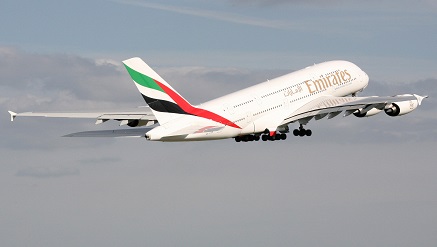
Emirates, a global enabler of business and trade, on Friday announced an historic $9.2 billion (€8.7 billion) deal with Rolls-Royce for Trent 900 engines and a long-term TotalCare package.
The engines will be used to power 50 Airbus A380s ordered at the Dubai Air Show in 2013, which will begin entering service in 2016.
The deal, which is the largest ever for Rolls-Royce, and one of the largest ever export orders for a UK based company, is part of Emirates’ ongoing investment into the UK and Europe.
The partnership marks a significant milestone for aviation manufacturing in the region, securing jobs across Rolls-Royce’s supply chain, from Bristol to Scotland. It will further support trade ties between the UK and the United Arab Emirates, building on the estimated $13.4 billion (€12.7 billion) of bilateral trade recorded in 2013.
Sir Tim Clark, president, Emirates Airline, said: “Rolls-Royce is a key partner for Emirates and we have been impressed with its commitment to continual improvements in the economic and operational performance of the Trent 900. These improvements have been decisive factors in our selection of the product for 50 of our A380s. Today’s announcement is significant not only because it cements the partnership between Emirates and Rolls-Royce, but also because of the large and sustained economic impact that this will have on aviation manufacturing in the UK and Europe.”

On his part, John Rishton, chief executive officer, Rolls-Royce, said: “The success of Emirates over the last thirty years has been extraordinary. Rolls-Royce has been proud to have been part of this success, powering Emirates aircraft since 1996. We are delighted that Emirates has again placed its trust in our technology, with the biggest order in our history.”
“This year we are celebrating the 10th anniversary year of the A380’s first flight and we would like to congratulate Emirates for continuing to place the A380 at the centre of their future growth plans. This is exactly what this remarkable aircraft was designed for; helping leading worldwide airlines such as Emirates to develop and grow profitably,” said Fabrice Brégier, Airbus President and CEO. “As we continue to develop innovative solutions to further improve its already unbeatable economics, we see a long and bright future for the A380, which remains the best solution for enabling air traffic to grow.”
Emirates’ investment in the Airbus A380 programme has had a significant impact on the UK and wider European economies.
A recent Frontier Economics report identified that in 2013/14 Emirates’ investment in the A380 created 7,000 UK jobs, equating to a $630 million (€595 million) GDP contribution.
Across the EU, Emirates’ 140 A380 orders are estimated to have supported 41,000 jobs, equivalent to a massive $3.6 billion (€3.4 billion) GDP.
The A380 programme sits at the heart of Emirates’ growth strategy. 60 A380s are currently in operation, with a further 80 on order, making Emirates by far the largest purchaser of the aircraft. Since its introduction in 2008, over 36 million of the airline’s passengers have flown on the aircraft.
The aircraft has it made Emirates’ operations significantly more efficient, carrying more passengers to and from the world’s busiest and most slot constrained airports.
It has also helped Emirates deliver the level of excellence its customers have come to expect from the brand, through iconic differentiators like the On Board Lounge, purpose built in the UK
In addition to the important contribution that Emirates makes to the UK via its A380 programme, the airline continues to play a key role in providing valuable international connectivity for secondary cities.
Emirates provides unique direct services to Dubai, from Newcastle, Birmingham, Manchester and Glasgow and a further 83 unique one-stop connections between these cities and Africa, Asia and Australia.
These services facilitate trade and investment between the UK regions and key growing markets overseas, positively impacting Foreign Direct Investment (FDI) and supporting the development of regional centres.
Emirates currently operates 16 daily flights from the UK with nine of these operating as an A380; five daily from London Heathrow, two daily from London Gatwick and two daily A380s from Manchester.
Emirates airline operates 112 non-stop flights per week from the UK to Dubai – five services a day from Heathrow, three daily from London Gatwick and Manchester, two per day from Birmingham and Glasgow and a daily service from Newcastle.
In Dubai, passengers can connect to flights to Emirates’ global network which spans over 145 destinations across six continents in 84 countries.
The order announced on Friday will result in an increase in Rolls-Royce’s order book of $6.1bn, in accordance with Group accounting policy.
Rolls-Royce’s vision is to create better power for a changing world via two main business divisions, Aerospace and Land & Sea. These business divisions address markets with two strong technology platforms, gas turbines and reciprocating engines.
Aerospace comprises Civil Aerospace and Defence Aerospace. Land & Sea comprises Marine, Nuclear and Power Systems.
The Group has a strong commitment to apprentice and graduate recruitment and to further developing employee skills.
Globally, the Group has over 1,000 Rolls-Royce STEM ambassadors who are actively involved in education programmes and activities; we have set ourselves a target to reach 6 million people through our STEM outreach activities by 2020.
—



Independent Corrupt Practices and Other Related Offences Commission (ICPC) indicted the National Information Technology Development Agency (NITDA) and other ministries over administrative lapses that allowed the fictitious Presidential Foreign Investment Promotion Council (PFIPC) to operate.

Musa Aliyu, chairman, ICPC, stated that NITDA, alongside the Office of the Secretary to the Government of the Federation (OSGF), the Budget Office, and other bodies, failed to carry out adequate due diligence and standard operating procedures.
ICPC said however, clarified that the findings pointed to severe internal control weaknesses and administrative negligence rather than active official complicity by NITDA and the other affected agencies.
The briefing followed a 30-day investigation ordered by the president on July 7 into allegations surrounding the purported presidential council.
The commission also cleared the presidency and the Central Bank of Nigeria (CBN) of any wrongdoing but blamed institutional lapses in several ministries, departments and agencies (MDAs).
Aliyu said investigators established that Adeniyi Adeyemi, the director-general, was never appointed by the federal government and that the PFIPC had no legal existence.
“As you may recall, on the 7th of July, Mr. President directed the ICPC to conduct an investigation into the fake Presidential Foreign Investment Promotion Council and submit a report within 30 days,” he said.
“Today, exactly within the stipulated period, we have submitted an interim report based on our interactions with all stakeholders involved.”
According to Aliyu, Tinubu directed the commission to make its findings public in the interest of transparency and accountability.
He said the investigation found that Adeyemi’s purported appointment letter was forged.
“It has been established that Adeniyi Adeyemi Matthew was never appointed by the Federal Government or any authority whatsoever,” he said.
“The Presidential Foreign Investment Promotion Council, which sometimes they called the Presidential Foreign Intervention Promotion Council, was never established by any law, executive order or any valid instrument of government.
“The appointment letter presented by Adeniyi Adeyemi Matthew was completely forged alongside similar documents used to perpetuate the illegal activities of the fake agency.”
Aliyu stated that a purported government gazette used to legitimise the organisation was also fabricated.
“If you recall, there was a gazette which he used to support the fake agency. That gazette is an illegal document that never passed through the processes prescribed by law,” he stated.
“Our investigation found that the office used by the fake agency was the office of the Presidential Economic Advisory Council. The office was broken into and access was gained illegally. That was how he was able to operate from there.”
Aliyu also revealed that investigators uncovered two additional fictitious government agencies allegedly created by the suspect — the FCT Investment Promotion Agency (FIPA) and the Foreign Investment Promotion Agency/Public-Private Partnership (FIPA-PPP).
According to him, fake legislative instruments were used to create the agencies and open bank accounts.
Despite the elaborate scheme, the ICPC chairman said the investigation found no evidence that federal government funds were disbursed to the fake council.
“Our investigation found that no funds of the federal government were approved or disbursed to the fake PFIPC,” he said.
“We also discovered no weaknesses in the systems of the State House or the Central Bank of Nigeria during our investigation. The fake appointment letter did not originate from the presidency.
“Our investigation found that some public officers failed to carry out due diligence and failed to comply with standard operating procedures in their ministries and departments. That gave him the opportunity to carry out these illegal acts.”

Nigeria tax system is build on taxing prosperity not poverty, according to Dr. Zacch Adedeji, executive chairman, Nigeria Revenue Service (NRS).

Dr. Zacch Adedeji, executive chairman, Nigeria Revenue Service
Adedeji, also dismissed the insinuation that the government’s tax reform is aimed at extracting money from Nigerians .
He said the essence of reform is creating an economic environment where individuals and businesses can prosper.
Dr. Adedeji made the clarifications on Sunday night while appearing on Channels Television’s Politics Today, where he defended the administration’s tax reforms and addressed concerns over rising government revenue amid the economic hardship facing Nigerians.
According to him, the government’s objective is to tax the fruits of investment rather than the investment itself.
“For us at Nigeria Tax, we are not there to extract. Our focus is not revenue. I don’t want to tax poverty. I’m to tax the fruit, not the seed, and I’m to tax the return, not investment.”
Adedeji explained that the government would generate more revenue as businesses became more profitable, without necessarily increasing the tax burden on individuals and companies.
He said a company that made N100 in profit could generate N30 in tax revenue for the government, but if its profit increased to N200 or N300, government revenue would rise accordingly.
“So, if I want to make more, I must work for you to make more. And that is why it is in the best interest of us in Nigeria Revenue Service that businesses are doing well, individuals are doing well,” he said.
He said the approach was consistent with President Bola Tinubu’s economic agenda, which seeks to remove barriers to investment and create a more conducive environment for businesses to operate and expand.
Adedeji cited reforms in the electricity sector as part of the government’s efforts to stimulate economic activity.
He noted that the Electricity Act had devolved powers to state governments to generate, transmit and distribute electricity, arguing that improved power supply would boost production and productivity across the economy.

Prof Chidi Oguamanam, Nigerian scholar, has been invited to serve as a member of the United Nations Educational, Scientific and Cultural Organization (UNESCO’s) World Commission on the Ethics of Scientific Knowledge and Technology.

Prof Chidi Oguamanam,
The appointment, which covers four years from 2026 to 2029, recognises Oguamanam’s contributions to the ethics of science and technology and related disciplines.
The invitation was conveyed in a letter from UNESCO on Saturday, which described the commission as an independent advisory body and forum for reflection on major ethical challenges arising from advances in science and technology.
The letter stated, “Recognising your significant contributions to the ethics of science and technology and related disciplines, it is my honour to invite you to become a member of UNESCO’s World Commission on the Ethics of Scientific Knowledge and Technology for a period of four years, from 2026 to 2029.”
Established in 1998, the commission brings together experts from different regions and disciplines to examine ethical issues associated with scientific and technological developments, climate change and the environment.
UNESCO said regional balance was important to the commission’s membership to promote multidisciplinary and transdisciplinary debate on emerging ethical challenges.
According to the organisation, the commission provides guidance and recommendations through its reports to UNESCO, its member states, the scientific community, policymakers, civil society and other stakeholders.
Its previous work has contributed to global normative instruments, including the Declaration of Ethical Principles in Relation to Climate Change adopted in 2017 and the Recommendation on the Ethics of Artificial Intelligence adopted in 2021.
UNESCO noted that the commission had recently published reports examining the ethics of quantum computing and space exploration and utilisation.
The organisation said the commission would now focus on new areas identified for its future work programme, including emerging ethical challenges arising from scientific and technological developments.
In inviting Oguamanam to join the commission, UNESCO expressed confidence in his expertise and active contribution to the development of its forthcoming reports.
The organisation also said it expected members to contribute to “horizon scanning” of emerging ethical challenges and help identify issues that should be addressed in the commission’s next cycle.
Oguamanam’s appointment adds to Nigeria’s representation in international discussions on the ethical implications of science, technology and innovation.
He is expected to serve on the commission alongside experts from different regions and academic disciplines during the 2026–2029 term.

Fake Agency: ICPC Indicts NITDA, Others over Inadequate Due Diligence

Tax Reform Built on Taxing Prosperity, Not Poverty– Adedeji

UNESCO Taps Oguamanam,Nigerian Scholar to Advisory Body on Science, Tech Ethics

MTN Alerts Subscribers over Fake 25GB Anniversary MTN Data Giveaway

X Replaces Revenue Sharing wit New Creator Rewards Programme

EFCC Busts NIS Visa Overstay Racket, Uncovers N700m in an Account

Fact-Check: Elon Musk’s “Tesla Pi Phone” is Internet Rumor

NBC Tasks Broadcasting Stations over 2028 DSO Global Deadline

NBC Scraps Annual Digital Access Fee on DSO

Glo Sponsored African Voices to Feature Netflix’s “The Polygamist” Stars




 General News3 days ago
Guinness Rewards Consumers with ₦17 Million in First Week of ‘Open for More’ Promo Draw

 News3 days ago
World Bank Debars United Aviation Services, Owner over Fraudulent Activities

 E-Business3 days ago
NITDA Introduces Cloud Certification Boost Data Localisation Compliance

 Telecom3 days ago
NCC, Enugu Sign Deal to Operate Digital Industrial Park, Learning Centre

 E-Financial3 days ago
BOI Opens N250Bn Bond Offer to Fund Businesses

 Telecom3 days ago
GITEX Nigeria to spotlight Africa’s $1trn AI economic potential

 News3 days ago
Enugu State Approves Land for ITF’s Digital Fabrication Centre

 General News3 days ago
Meta Hit With $567m US Court Order Over Alleged Harm to Children