

Telecom
Moniepoint Study Reveals How Strong Cultural Bonds, High Levels of Trust Drives Nigerian Family Businesses

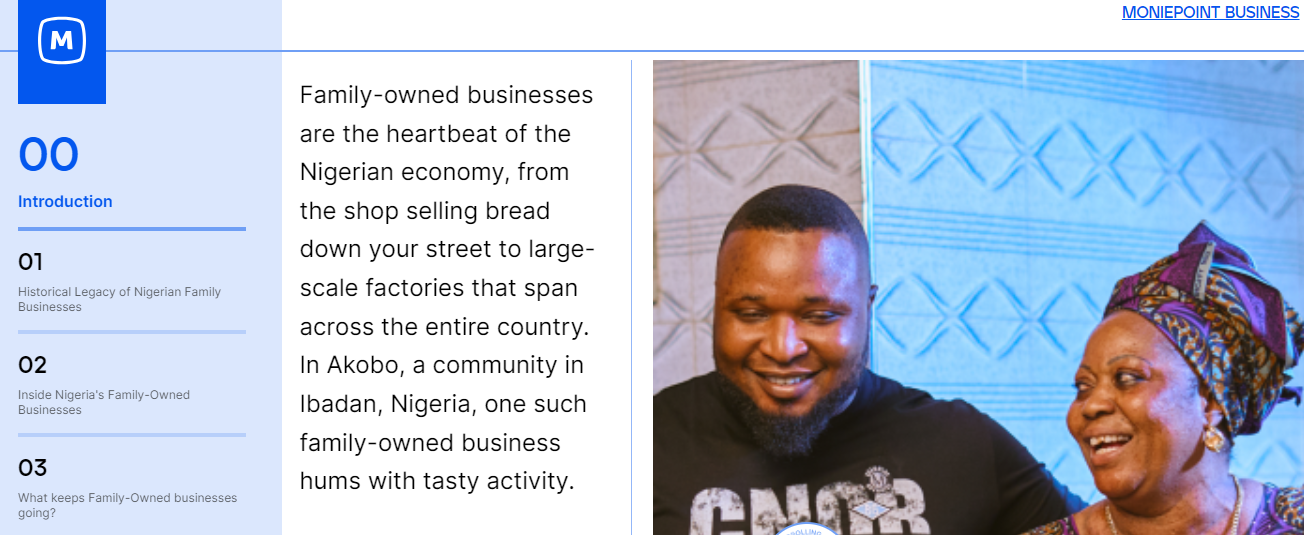
Against the urgent need to deepen the Federal Government’s economic agenda – financial inclusion, job and wealth creation and fiscal growth, the critical role played by family businesses as the heartbeat of Nigeria’s economy has once again been spotlighted and thrust into sharp focus.

Africa’s leading digital financial services provider, Moniepoint Inc has released its latest case study – How families power Nigeria’s economy, a reflective chronicle of how the legacy of family businesses, from centennial conglomerates to bustling local eateries, are a living narrative and solid testament to Nigeria’s entrepreneurial spirit.
It will be recalled that the Special Adviser to the President on Presidential Enabling Business Environment Council (PEBEC) and Investment, Dr Jumoke Oduwole recently revealed that there are approximately 23.8 million family businesses, responsible for millions of jobs, dispersed throughout the country and collectively they contribute around $200 billion annually into the nation’s economy. Closely aligned to this disclosure is the oft-stated data that with over 40 million micro, small and medium enterprises (MSMEs) contributing nearly 50% of the national GDP; accounting for over 84% of total employment as well as 96% of businesses in Nigeria. These figures reflect the glaring significance and the impact that family businesses have on Nigeria’s economy.
According to the Moniepoint study, which provides deep insights into what has kept these businesses going across generations, how they navigate challenges, and opportunities for growth and innovation, more than half of Nigerian family businesses don’t have strong digital capabilities with very few seeing it as a priority area.
The lack of clear governance and business management structures, as well as poor succession planning are some of the challenges that undermine the scalability of family businesses in Nigeria.
Key drivers that undergird a lot of these enterprises include, strong cash flow with a view to ensuring that they remain profitable, high levels of trust driven by shared vision and business objectives and cohesive cultural bonds where one out of every two Nigerian businesses bear the distinction of being a family business.
Furthermore, the study avers that the story of Nigerian family businesses is one of resilience, adaptation, and enduring legacy. It posits furthermore that the future of Nigerian family businesses is bright with potential even as more enterprises embrace the tools and strategies for success in a digital age, supported by innovative driven solution partners.
It contends that as they evolve, family businesses will remain at the heart of Nigeria’s economic and cultural identity, powering the nation’s economy and shaping its future for future generations while ushering in a new era of growth, sustainability, and global competitiveness.
Speaking to the rationale behind this latest study, Vice President, Communications and Public Relations, Moniepoint Inc, Edidiong Didi Uwemakpan noted that the decision to focus on family businesses was driven by their significant contributions to Nigeria’s economy despite their varying sizes and sectors.
“At Moniepoint, we pride ourselves on being more than just a financial services provider; we are an astute partner to business owners, helping them to be financially happy while ensuring that our innovative solutions power the dreams of these enterprises.
“We believe that the growth of family businesses directly supports the entire economy, which in turn essentially extends our ability to positively impact everyone else which aligns with our brand’s mission,” she said.
Stating Moniepoint’s commitment to helping these businesses embrace digitization, “Our services have helped several family-owned businesses improve their operations through simplified payment collection, cash flow management, and access to capital.
“Our recent partnership with the CAC will further catalyze technology adoption for these businesses while providing a foundation for them to adopt better record keeping, financial reporting and governance practices which are pivotal for their efficiency, productivity and long-term viability, and also drive market access and trade facilitation into regional and global value chains for them.”
In 2023, Moniepoint MFB, was honored with the prestigious Rising Star Family Business Award in recognition of the giant strides made by the firm over the years and their contribution to the Nigerian economy at the Businessday, My Family My Business, and PwC Nigeria Family Business Summit.



Galaxy Backbone Limited (GBB) has said that sustained collaboration among African countries remains central to the continent’s drive toward digital transformation.

The organisation stressed that building secure, interoperable and inclusive digital systems across Africa cannot be achieved in isolation, calling for stronger regional partnerships to accelerate innovation and shared infrastructure development.
The position was contained in a statement issued on Sunday by the Head of Corporate Communications at Galaxy Backbone, Chidi Okpala.
As it prepares to host a major delegation of policymakers, technology leaders and development partners in Abuja, GBB said the engagement would further highlight the importance of cross-border cooperation in shaping Africa’s digital future.
Okpala explained that the initiative is designed to provide both dialogue and practical exposure to Nigeria’s digital infrastructure ecosystem.
According to him, the visit will allow delegates to better understand how shared ICT systems are supporting governance and service delivery in the country.
“This engagement will provide an opportunity for African stakeholders to not only discuss policy frameworks but also see firsthand how digital public infrastructure is being deployed to improve efficiency, connectivity and innovation in the public sector,” Okpala said.
He added that GBB’s hosting role reflects its growing importance in advancing digital governance and infrastructure development across the continent.
“Galaxy Backbone is increasingly positioned as a key enabler of trusted digital infrastructure, and this engagement reinforces that role within Nigeria and beyond,” he noted.
Speaking ahead of the programme, the Managing Director and Chief Executive Officer of Galaxy Backbone, Professor Ibrahim Adeyanju, said the future of Africa’s digital economy depends on the ability of countries to work together in building resilient systems.
“No single country can achieve the level of transformation required on its own. We must share knowledge, align strategies, and invest in systems that can serve the entire continent,” Adeyanju said.
According to the statement, the engagement will feature a continental dialogue themed “Building Africa’s Digital Foundations Together,” bringing together stakeholders from 11 African countries in Abuja.
The programme is being organised in partnership with Co-Develop, Smart Africa, and MicroSave Consulting, with discussions expected to focus on Digital Public Infrastructure (DPI), digital identity systems, secure connectivity, interoperability frameworks, and inclusive digital ecosystems.
GBB said delegates will also undertake a guided tour of its infrastructure and facilities in Abuja, where they will be exposed to Nigeria’s digital transformation journey and the systems supporting cloud services, cybersecurity, government connectivity, and digital platforms.
The company noted that the tour is intended to demonstrate how shared ICT infrastructure is strengthening governance and enabling more efficient public service delivery.
Participants are expected to explore practical pathways for accelerating the deployment of digital public infrastructure to support economic growth and institutional reforms across Africa.
GBB maintained that the initiative also confirms Nigeria’s position as a regional hub for digital innovation and infrastructure development, while deepening cooperation among African nations.

MTN Nigeria reinforced its commitment to supporting African storytelling and emerging creative talent at the 12th Africa Magic Viewers’ Choice Awards (AMVCA), held on Saturday, May 9, 2026, at Eko Hotels & Suites.

MTN Nigeria
Hosted by Bovi Ugboma and Nomzamo Mbatha, the star-studded event brought together some of the biggest names in African film, television, and entertainment for a night celebrating creativity, culture, and cinematic excellence.
As part of its participation at the Awards Night, MTN Nigeria sponsored the Best Short Film category, one of the standout moments of the evening aimed at recognising and rewarding emerging filmmakers shaping the future of African storytelling.
The award was presented by the General Manager, Enterprise Sales, MTN Nigeria, Febisola Oyeleye, alongside actor Jide Oyegbile.
The winning film, Hussaini, by filmmakers Orire Nwani and Josh Olaoluwa, earned both the prestigious AMVCA recognition and a ₦5 million cash prize sponsored by MTN Nigeria.
Speaking during the presentation of the cash prize to the winners, Chief Marketing Officer, MTN Nigeria, Onyinye Ikenna-Emeka, reiterated MTN’s commitment to youth empowerment and supporting the creative industry through platforms that spotlight emerging talent.
According to her, the brand remains intentional about supporting young Nigerians who continue to push boundaries through creativity and storytelling. “At MTN, one of the things that we are so committed to is youth empowerment.
We believe that the youth of Nigeria are actually the future of the country. When we see young people being productive and coming out tops in what they do, it speaks to their commitment and ability to move beyond boundaries.
One of the ways we support the creative industry is through the short film category, and we are delighted to see deserving winners who are obviously on their way to great things,” she said.
The filmmakers behind Hussaini also celebrated the win, with one of the creators describing it as a defining moment after multiple nominations in the category.
“This is our last nomination in this category, and I’m excited we finally have it,” he said. “Next year, we are coming for Best Feature Film.”
Beyond the Awards Night, MTN’s presence throughout the AMVCA week extended to initiatives such as Young Filmmakers Day and the #MTNFilmChallenge, both designed to spotlight emerging talent and create opportunities for young creatives to tell authentic Nigerian and African stories through film and digital content.
With its continued investment in platforms that celebrate creativity and empower young storytellers, MTN Nigeria once again highlighted the important role partnerships can play in shaping the future of Africa’s entertainment industry.

MTN Nigeria strengthened its support for Nigeria’s creative economy by rewarding five emerging filmmakers through the #MTNFilmChallenge at the Young Filmmakers Day as part of the 12th Africa Magic Viewers’ Choice Awards (AMVCA) week.

The event, which held at MultiChoice Studios Lagos, brought together young and aspiring filmmakers for a day of learning, collaboration, and celebration of African storytelling.
The #MTNFilmChallenge, a short-form film initiative inviting creators to share one to three-minute stories reflecting perspectives on Nigerian culture, hustle, and everyday life, drew entries from across the country. At the close of submissions, five standout filmmakers including Precious Aisa, Fitz-Williams Ochie, Ugwueze Jennifer, Anuyimika Ayomide, and Alexander Oshiame were rewarded with cash prizes worth ₦4,650,000 in total, while two other finalists received consolation prizes.
MTN reiterated its commitment to supporting Africa’s growing creative ecosystem by creating platforms that not only encourage creative expression but also expand visibility for young talents navigating the digital content space.
Chief Marketing Officer, MTN Nigeria, Onyinye Ikenna-Emeka, said the company remains intentional about empowering young Nigerians and creating opportunities for emerging creatives to thrive within the entertainment industry. “At MTN, we strongly believe young people are central to Nigeria’s future, and it is always inspiring to see them pushing boundaries through creativity and storytelling.
“For us, supporting initiatives like the short film category and the #MTNFilmChallenge is about creating platforms where young creatives can be seen, encouraged, and celebrated. We are excited to see these filmmakers taking bold steps and telling authentic stories that reflect the richness of our culture and experiences,” she said.
The event also gave a platform for the next generation of storytellers to engage directly with established industry figures including Uche Jombo, Orire Nwani, Tamara Adeyemi, and Stan Eze through curated masterclasses and panel sessions.
As the opening event of AMVCA Week, Young Filmmakers Day set the tone for the celebrations ahead, reinforcing the Awards’ role not just as a platform for recognition, but as a catalyst for growth, collaboration, and innovation within Africa’s film and television industry.
With the 12th AMVCA underway, the focus remains on celebrating excellence while nurturing the next generation of storytellers shaping the future of African cinema.

Xenophobic Attacks: Anonymous Nigeria Threatens to Leak South African Stolen Data

WHO Says Ebola Outbreak Worse than Reported

Chapel Hill Denham Says Banks Lose N2.5 Trillion Annually to High CRR in New Report

Lagos Sanctions 15 Money Lending Firms for Operational Violations

FirstBank, Visa Launch Multicurrency Signature, Naira Debit Cards

MTN, VDT, Zoracom, Digital Realty Back 2026 Girls in ICT Campaign

Vitel Wireless Partners Fintechs to Expand Access to Services

Kaspersky Discovers Vulnerability in Qualcomm Snapdragon Chips that can Lead to Data Loss & Device Compromise

Bank Customers to Pay N1,500 for ATM Card Issuance, Replacement – CBN

FCCPC Licenses 5 Firms for Airtime, Data Lending as Telcos Step Aside




 General News2 days ago
World Bank Blocks Social Media Comments from Nigerians over Loan Backlash

 Telecom2 days ago
Nigerians Lose N12.5bBn to Telecom-Related Financial Crimes – PwC

 Telecom2 days ago
NITDA, FMCIDE Deepen Collaboration on Nigeria’s Digital Transformation

 E-Business2 days ago
Jumia Nigeria Records Strong Q1 2026 Growth as Technology-Led Strategy Drives Market Expansion

 General News2 days ago
LG Electronics Strengthens Household Energy Efficiency in Nigeria with Advanced Inverter Refrigerator Solutions

 Telecom2 days ago
NITDA Showcases Nigeria’s Startup Framework as Model for Angola

 News2 days ago
Only 1 in 3 Families Fully Secure their Devices, Kaspersky Study Reveals

 Telecom2 days ago
Upperlink, ICANN, Others Rally Global Participation for UA Day 2026