

Telecom
eBusiness Life Int’l Girls in ICT: Stakeholders Advocate Investment In Young Girls


Stakeholders that gathered for the 12th edition of the celebration of the International Girls in ICT Campaign organised by eBusiness Life Communication Limited in Lagos last Thursday, have called on parents and corporates to make concerted efforts at investing in the young girls to enable them prepare for tech careers of the future.

Convener, Girls-In-ICT/CEO, e-Business Life Communication Limited, Mrs. Ufuoma Emuophedaro (2nd from left); Manager, South-West Zonal office, National Information Technology Development Agency (NITDA), Mrs. Jumoke Alaka, who represented the Director General of the Agency, Dr. Inuwa Abdulahi (far right); and Deputy Director, Head Corporate Communication, NCC, Nnenna Ukoha, who represented the Executive Vice Chairman/CEO of the Nigerian Communications Commission (NCC), Dr. Aminu Maida (2nd from right; with winners of the STEM Quiz competition at the just-concluded eBusiness Life Int’l Girls in ICT Day Celebration held in Lagos.
In his keynote address at the event, the Executive Vice Chairman/CEO of the Nigerian Communications Commission (NCC), Dr. Aminu Maida charged the girls to follow evolving trends in the world of technology and pursue excellence in order to make a difference in the workforce of the future.
Dr. Maida, who was represented by the Deputy Director, Head Corporate Communication, NCC, Nnenna Ukoha noted that there will always be gaps to be filled in the ICT field.
According to the NCC Boss, the significance of encouraging young girls and women to consider careers in ICT, stems from the fact that the gender represents half of the global population, and it will only be fair and equitable to seek their views and input in standards that are essential to the shaping of technology.
Furthermore, he noted that encouraging these girls is an investment in the future of the nation.
“The ICT sector offers exciting and well-paid career opportunities; from software development to data analysis, cybersecurity to artificial intelligence, the opportunities are endless. By encouraging more girls and women to enter the ICT field, we can help bridge the digital divide and ensure that everyone has equal access to the opportunities of the digital age,” Maida opined.

He further encouraged young women to latch onto the provisions of Federal Government’s 3MTT initiative, which seeks to provide and empower young Nigerians with technology career opportunities in AI/Machine Learning; Data Analysis & Visualisation; User Interface (UI), User Design (UX) among others.
In a virtual message from the International Telecommunications Union (ITU), the Secretary General, Doreen Bogdan-Martin explained that the 2024 theme, “Leadership”, speaks to more than holding a job title or position of power, but about harnessing the power of ideas and innovation, and the ability to navigate change with confidence even as a student.
“Right now, just 21% of all ICT Ministers are women, and only 32 out of 165 ICT regulators are led by a woman. In the highest positions of government, gender equality will not be reached for another 130 years. In the private sector women in technologists occupy less than a third of positions and face a pay gap of up to 21%. Just 22% of AI workers globally are women. And the hiring rate of women in tech leadership roles has stalled. When we look at C-Suite roles in STEM, just 1 in 8 is held by a woman.”
She called for investment in girl education, mentorship and skill-building opportunities so they can not only succeed but thrive as digital trailblazers.
Manager, South-West Zonal office, National Information Technology Development Agency (NITDA), Mrs. Jumoke Alaka, who represented the Director General of the Agency, Dr. Inuwa Abdulahi, highlighted the numerous opportunities inherent in the ICT sector, and implored the young girls to stay away from negative sides of technology as a means of impacting the society positively. She encouraged them to also read hard copy materials as a means of retaining knowledge and referencing. She encouraged them to read more of hard copy materials to avoid distractions and easy switch to unnecessary Apps that come with reading from gadgets.
Mrs. Alaka also charged parents to guide their children on the beneficial use of ICT gadgets.
While taking the young girls on an insightful tech-talk session, Digital Strategist and Founder, ‘MissTechy’ – Nigeria’s top Female Tech Blog and video channel, Oluwatobi Ayeni, charged them to be inquisitive and explore ICT. This, she noted, will help them develop interest that will culminate into driving initiatives and filling gaps in technology.
CEO, MyHealthHub, Dr. (Mrs.) Ochuko Ibe while taking the girls on a health talk, challenged them to look at situations around them and seek ways of plugging gaps with technology. She referenced her journey through different fields and how she developed a passion for technology and now uses it to bridge medical gap in rural and underserved areas.
In her welcome address, Convener, Girls-In-ICT/CEO, e-Business Life Communication Limited, Mrs. Ufuoma Emuophedaro, citing ITU’s estimate of skills shortfall of over two million jobs in the ICT sector within the next five years, said girls and young women who learn coding, apps development and computer science will not only be well-placed for a successful career in the ICT sector, but ICT skills that are rapidly becoming a strong advantage for students in just about any other field they might choose to pursue. “Girls with ICT skills can expect to earn good salaries and enjoy plenty of career opportunities.
Girls in ICT Day reminds us that ICTs help to improve the lives of people everywhere – through better health care, better environmental management, better communications, and better educational systems that transform the way children and adults learn.”
Referencing the 2024 theme, Mrs. Daro noted: “While there is a leadership gender gap in every industry, the largest gaps are found in the STEM fields. Women in ICT often find themselves in junior or support roles rather than in managerial roles, with little opportunity for advancement. They are also less likely to hold an executive position, become ICT entrepreneurs, or be represented among science and technology policymakers.
To thrive in STEM, girls and young women must be exposed to women in leadership positions, fostering inspiration and breaking down barriers that hinder their progress. The Girls in ICT Day 2024 theme aims to address these challenges, encouraging empowerment and leadership development for a more equitable future in STEM.”
The event was attended by 170 students from 17 schools across Lagos and Ogun States, and several other guests from the corporate world.
Activities at the event included STEM Quiz and Vlogging competitions; Students roundtable, which was anchored by foremost journalist, Louisa Olaniyi, random quiz and entertainments.
In the Vlogging competition, moderated by tech enthusiast, Digital Strategist and Founder, ‘MissTechy’ – Nigeria’s top Female Tech Blog, Oluwatobi Ayeni, Reagan Memorial Baptist Girls Secondary School, Yaba to the First Prize, while the Second and Third Prizes went to Chrisland College, Ikeja and The Lagoon School, Lekki.
In the STEM Quiz Competition, the top prize went to The Lagoon School, Lekki, while Baptist Girls Academy, Obanikoro and Government Senior College, Agege settled for the 2nd and 3rd positions.
The Event got partnership and support from the NCC, NITDA, Globacom, Digital Encode, VDT Communications, Digital Realty, Huawei Technologies, Inq Digital, and CocaCola.
This year’s theme for the International Girls in ICT campaign is ‘Leadership’ as stated by the ITU.


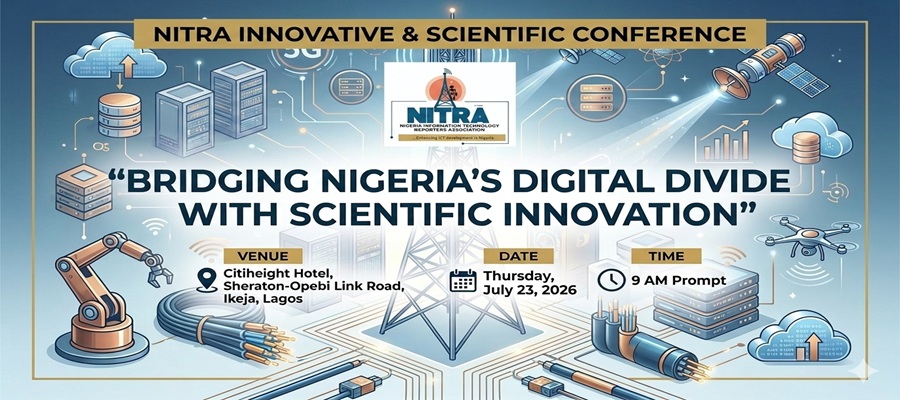
The need for Nigeria to think outside the box in its need to drive towards global relevance with innovations and scientific developments will be on the front burner at the NITRA Innovative & Scientific Conference scheduled to hold on Thursday July 23, 2026 in Ikeja, Lagos.

NITRA
The Nigerian Communications Commission (NCC) will lead other delegates to discuss and take far-reaching decisions at the event, which has its theme as “Bridging Nigeria’s Digital Divide With Scientific Innovation”.
Other companies that have indicated interest in partnering with NITRA include mobile communications company, Tecno; Africa’s premier end-to-end AI solutions company, Hyperspace; and telecommunications data infrastructure company, Digital Realty.
Speaking on the proposed event, the Chairman, Nigeria Information Technology Reporters Association (NITRA), Chike Onwuegbuchi noted that the event will seek to create a platform for government and private organisations to deliberate on policies around scientific innovations in Nigeria, challenges, place of indigenous and foreign collaboration, roles of each stakeholder, and grassroots development in that regard, among others.
According to him: “The Federal government, with series of programmes and partnerships, has established the urgent need to create an ecosystem that thrives on scientific innovation, breeding institutions and individuals with a target of placing the country at the fore-front of Next-Gen development.
It is a known fact that digital and scientific innovations are crucial, not only to the survivability of a nation, but also to the sustainability of its growth and development, with significant effect on economic strength, global image, defense and security, government capabilities to function, and public health and safety, communication and digital footprint, among others.
The federal government is actively driving scientific innovation to foster economic diversification and build a $1 trillion economy by 2030. Efforts are heavily focused on commercializing research, establishing massive research funds, and funding strategic infrastructure, particularly in technology, biotechnology, and healthcare. Core government initiatives and policies include the newly instituted National Research and Innovation Development Fund (NRIDF), which aims to mobilize about $500 million annually to support research and the commercialization of scientific outputs; and the Nigeria Genomic City, a multi-ministerial initiative aimed at transforming Nigeria into a leading hub for genomics, precision medicine, and biotechnology. It is designed to protect indigenous data, stimulate artificial intelligence in health, and develop a highly skilled scientific workforce.
According to the General Secretary of NITRA, Mr. Chidiebere Nwankwo, the forum will also be a vehicle to propagating the views of decision makers to the public, thereby furthering the cause of public awareness and information dissemination on the topic.
The focus, he said will be on how Nigeria can sustain digital innovative growth and scientific development in Nigeria

The board of global payments company, PayPal, says a 53 billion dollars takeover offer from financial technology firm, Stripe, and private equity company, Advent International, does not adequately reflect the company’s long-term value.

PayPal
According to reports, the proposed acquisition, valued at 60.50 dollars per share, remains under consideration, with the board yet to formally respond to the offer.
The directors are said to be evaluating not only the financial value of the proposal but also the structure of the financing, the timeline for completing the transaction and the likelihood of obtaining regulatory approvals.
They are also considering the possibility of competing bids emerging.
Although the offer represents a premium of about 28 per cent above PayPal’s recent share price, the board believes the company could deliver greater value to shareholders if its ongoing turnaround strategy succeeds.
Following reports of the bid, PayPal shares gained about two per cent to close at 56.73 dollars.
Sources familiar with the discussions said Stripe and Advent have secured approximately 50 billion dollars in debt financing from JPMorgan and Morgan Stanley, while both firms would jointly contribute 17 billion dollars in equity.
Under the proposal, the two companies would jointly own PayPal instead of dividing its operations.
PayPal, Stripe, Advent International, JPMorgan and Morgan Stanley have all declined to comment on the proposed transaction.
The discussions come as PayPal seeks to strengthen its business after years of increasing competition from rivals including Apple Pay, Google Pay and emerging financial technology firms.
The company, which was valued at about 360 billion dollars in 2021, now has a market capitalisation of approximately 36 billion dollars.
Since assuming office as Chief Executive Officer in March 2026, Enrique Lores has embarked on a restructuring programme aimed at improving operational efficiency and restoring growth.
The restructuring includes the creation of three business divisions comprising Checkout, Venmo and Consumer Financial Services, and Payments and Crypto.
The company is also targeting 1.5 billion dollars in cost savings through the deployment of artificial intelligence technologies.
PayPal’s latest financial results indicated signs of recovery, with first-quarter revenue rising seven per cent year-on-year to 8.35 billion dollars, while total payment volume increased by eight per cent to 464 billion dollars.
If approved, the transaction would combine two of the world’s largest digital payments companies.
The combined business would process an estimated 3.7 trillion dollars in annual payment volume, significantly strengthening its position in the global online payments market.
However, analysts expect the proposed acquisition to face intense regulatory scrutiny because of the companies’ combined market share in merchant payment services.
To address possible antitrust concerns, the bidders have reportedly considered options, including separating PayPal’s Braintree business or other assets if required by regulators.
Sources said Stripe and Advent remain interested in pursuing the acquisition despite the board’s reservations, although negotiations are expected to continue.
Market observers are also awaiting PayPal’s earnings report scheduled for July 28 for further indications of the company’s financial recovery and future growth prospects.

Concerns over network reliability and its impact on Nigeria’s growing creator economy took centre stage at MTN Nigeria’s Data on Trial event, where content creator and streamer, Jarvis, challenged telecommunications operators to improve connectivity for digital creators.

Speaking during the event, Jarvis asked whether there were locations in Nigeria where uninterrupted internet connectivity could support real-life (IRL) streaming without network disruptions.
“Are there places where there is no breakage when streaming IRL?” she asked.
Her question highlighted the challenges faced by content creators who depend on stable internet services for live streaming, content uploads and real-time engagement with audiences.
Responding, MTN Nigeria’s Chief Technical Officer, Mr Yahaya Ibrahim, said network performance depends on several factors, including location, network coverage, device capability and the number of users connected to a particular base station.
He noted that operators continue to invest in expanding network capacity to meet the growing demand for data services.
Earlier, MTN’s General Manager, Network Performance and Quality Assurance, Mr Michael Ndukwe, explained the evolution of mobile network technology in Nigeria, from first-generation (1G) services to the current fifth-generation (5G) technology.
According to him, each phase of technological advancement has significantly increased network capacity and enabled new digital services.
Ndukwe cited Nigerian Communications Commission (NCC) data showing that Nigerians consumed about 13.2 million terabytes of data in 2025.
He added that data usage reached approximately 4.06 million terabytes in the first quarter of 2026, reflecting the country’s increasing reliance on digital platforms and online services.
According to him, the growth is being driven by wider adoption of 4G and 5G networks, increased smartphone penetration, the proliferation of smart devices and expanding use of social media platforms.
Participants at the event noted that as more Nigerians build businesses and careers around digital content, access to reliable and high-speed internet has become critical to sustaining the country’s digital economy and creator ecosystem.

Dangote Refinery’s Private Placement Reportedly Hits $2.5Bn

FG, UNODC Plan National Strategy against Organized Crime

EFCC Busts NIS Visa Overstay Racket, Uncovers N700m in an Account

CBN to Monitor Every Dollar with FXBT, Forex Tracker

NCC, NDLEA Partner to Fight Piracy and Drug Trafficking

NRC, Ponzi Scheme Collapses Resulting Loss of Billions of Naira

NASENI Moves to Digitize CCB’s 5m Assets Declaration and Operations

Lebara Nigeria Launches Lebara Play, Africa’s First Telecom-Owned Micro-Drama Platform

CANAL+ Partners Samsung to Pre-Load DStv Stream on New Samsung TVs In Nigeria, Other African Countries

Tokenization, Blockchain Technology will Transform Financial Institutions – IMF



 News2 days ago
EFCC Busts NIS Visa Overstay Racket, Uncovers N700m in an Account

 News3 days ago
FAAN to Replace Physical ID Check with V-Pass Biometric Verification

 News3 days ago
CBN Introduces Digital Tracker to Monitor BDC Forex Transactions

 General News3 days ago
Nigeria Facing Rising Cybercrime Losses – Report

 Telecom3 days ago
ntel Plays Down Calls and Data Services, Moves to BET Agenda

 Telecom3 days ago
Airtel Delivers Free Employability Training to Young Nigerians @ World Youth Skills Day

 News3 days ago
CAC Begins Removing 100,000 Companies from Register Over Regulatory Non-Compliance

 General News3 days ago
TotalEnergies Inaugurates Africa’s Largest Hybrid Renewable Project