

/home/kenneth/web/nigeriacommunicationsweek.com.ng/public_html/wp-content/themes/zox-news/parts/post-single.php on line 153
">
Warning: Undefined array key 0 in /home/kenneth/web/nigeriacommunicationsweek.com.ng/public_html/wp-content/themes/zox-news/parts/post-single.php on line 153
Warning: Attempt to read property "cat_name" on null in /home/kenneth/web/nigeriacommunicationsweek.com.ng/public_html/wp-content/themes/zox-news/parts/post-single.php on line 153
SAP Africa Partners Nosmay to Deliver Cloud as a Service

SAP, the global market leader in enterprise application software, is proud to announce its first Managed Cloud as a Service (MCaaS) partnership in Ghana, Nosmay Company Limited. MCaaS is SAP’s latest partnering business model that gives solution providers complete control of customer relationships for cloud delivery of SAP software. This model sees SAP’s partners directly licensing the software and then offering applications directly to clients as a service.
Nosmay delivers application, infrastructure and enterprise solutions to its customers, with the goal of assisting organisations to use technology to stay competitive, increases their profitability and driving their growth.
“Through this partnership Nosmay will be able to better address the lower and upper end of the Ghanaian and West African markets with a subscription based cloud offering that will drastically reduce the cost of operations for our customers and will also enable us to scale our operations, be more competitive and drastically increase the reach of SAP within West Africa.,” explains Adelaide Ntow, Communications Consultant at Nosmay.
According to a recent forecast1 from market research company International Data Corporation (IDC) titled “Worldwide Spending on Hosted Private Cloud Services to Surpass $24 Billion in 2016”, the hosted private cloud services market will experience a compound annual growth rate (CAGR) of more than 50 percent between 2012 and 2016.
“Our MCaaS model is yet another example of the choice that we are providing to our partners. It opens the door for some partners to engage with SAP in a way that makes sense for their business. Partners have told us that it’s a great approach to help them tap into operating expense budgets, to create differentiated solutions based on SAP software, and to maximise revenue from their own intellectual property by targeting a much broader market than might otherwise be possible,” says Richard Edet, MD of SAP West Africa.
During the rest of this year, SAP Africa is planning to make greater investments with the aim of providing its MCaaS partners with additional support that includes business development resources. The latter will help match partners with the right opportunities, allowing them to grow their business.


Warning: Undefined array key 0 in /home/kenneth/web/nigeriacommunicationsweek.com.ng/public_html/wp-content/themes/zox-news/parts/post-single.php on line 493
Warning: Attempt to read property "cat_ID" on null in /home/kenneth/web/nigeriacommunicationsweek.com.ng/public_html/wp-content/themes/zox-news/parts/post-single.php on line 493


Federal Competition and Consumer Protection Commission (FCCPC) has dismissed as false a report claiming it approved 48 additional digital loan applications, raising the number of licensed digital lenders in Nigeria to 505.

In a statement posted on its official X handle on Sunday, the commission described the publication, titled “FCCPC Approves 48 More Loan Apps, Raises Licensed Digital Lenders in Nigeria to 505,” as “false, misleading and” not reflective of its actions.
The commission said it had not granted any new approvals or licences for digital lenders, stressing that it was complying with an ex parte order of the Federal High Court restraining the implementation of the Digital, Electronic, Online and Non-Traditional Consumer Lending Regulations, 2025, pending further proceedings.
The statement read, “The attention of the Federal Competition and Consumer Protection Commission has been drawn to a publication titled ‘FCCPC Approves 48 More Loan Apps, Raises Licensed Digital Lenders in Nigeria to 505.’ The publication is false, misleading and does not represent the position or actions of the Commission.
“The FCCPC is a law-abiding institution and is fully complying with the ex parte Order of the Federal High Court restraining the implementation of the Digital, Electronic, Online and Non-Traditional Consumer Lending Regulations, 2025 pending further proceedings.
“Consequently, the Commission has not granted any new approvals or licences pursuant to those Regulations. Any publication suggesting that the Commission recently approved additional digital lenders under the Regulations is entirely false.”
The commission urged members of the public, industry stakeholders and media organisations to disregard the publication and rely only on information released through its official communication channels.
It reiterated its commitment to complying with court orders and providing accurate information on its regulatory activities.

Association of Licensed Telecommunications Operators of Nigeria (ALTON) has declared support for the Nigerian Communications Commission (NCC’s) push to promote local smartphone manufacturing in the country.

Gbenga Adebayo, chairman, ALTON,
The News Agency of Nigeria reported that ALTON described the move as a practical measure capable of accelerating broadband adoption and expanding digital inclusion across the country.
Gbenga Adebayo, chairman, ALTON, made the remarks to newsmen on Saturday while reacting to comments by Idris Olorunnimbe, chairman, NCC Board, who had earlier called for local smartphone production and innovative financing models to address Nigeria’s digital inclusion gap.
Adebayo said Nigeria must intentionally transition from being predominantly a technology consumer to becoming an innovator, designer and manufacturer of digital technologies, pointing to the country’s large telecommunications market and youthful population as the scale and human capital needed to support world-class manufacturing.
He said Nigeria’s ambition in local manufacturing should extend well beyond simply assembling imported components into finished devices.
“Our ambition should extend beyond assembling devices. We must pursue genuine knowledge transfer, research and development, product engineering, software development, semiconductor capabilities and large-scale manufacturing,” he said, adding that the goal should be producing devices and digital technologies for Nigeria, Africa and the global market.
Adebayo explained that the emergence of artificial intelligence has further strengthened Nigeria’s opportunity to become a competitive technology manufacturing hub, noting that AI is transforming product design, manufacturing, quality assurance, supply chain management, customer experience and software innovation.
He said investing in AI-enabled manufacturing would improve productivity, create high-value jobs and strengthen Nigeria’s competitiveness across Africa.
On tackling counterfeit and non-type-approved devices, Adebayo described the grey market as a major challenge affecting consumers, original equipment manufacturers and the wider telecommunications ecosystem.
He said robust local manufacturing backed by strong quality standards would provide credible alternatives to grey-market imports.
“This will strengthen consumer protection, improve network performance, retain greater value within our economy, and stimulate industrial growth,” he said, while also endorsing innovative smartphone financing, stronger device management systems and identity-enabled credit frameworks to help more Nigerians afford quality smartphones.
Adebayo said telecom operators remain ready to partner with government, manufacturers, financiers, academia, investors and development partners to build sustainable local manufacturing capacity in Nigeria.
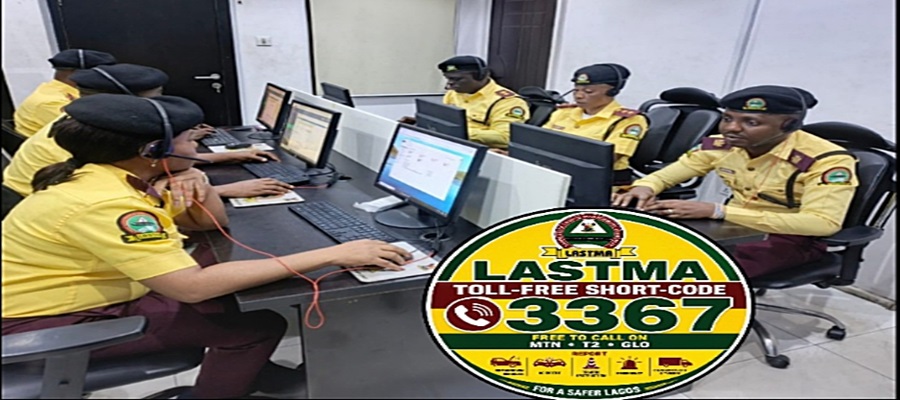
(LASTMA) has launched a new toll-free short-code hotline, 3367, to improve emergency response, enhance traffic managemestrengthen accountability across Lagos State.

The new platform replaces the agency’s previous long-service code and provides a simpler and more accessible channel for residents to report traffic-related incidents. The service is available at no cost to subscribers on MTN, Glo and Etisalat (T2) networks.
Motorists and other road users can use the hotline to report vehicle breakdowns, road crashes, disabled trucks, stranded tankers, traffic obstructions and other emergencies requiring immediate intervention.
The platform also allows members of the public to report the conduct and professionalism of LASTMA personnel, a move aimed at promoting transparency and accountability within the agency.
To ensure wider accessibility, callers can communicate with hotline operators in English, Yoruba or Pidgin English, helping to eliminate language barriers and encourage greater public participation.
Speaking on the initiative, Mr. Olalekan Bakare-Oki, general manager, LASTMA, described the launch as a major milestone in the agency’s efforts to build a safer, more efficient and technology-driven traffic management system.
He said the hotline reflects LASTMA’s commitment to leveraging digital solutions to tackle transportation challenges while strengthening collaboration with residents.
According to Bakare-Oki, the 3367 hotline provides Lagos residents with a direct, convenient and free channel to report incidents requiring urgent attention, noting that the growing complexity of Lagos as a major African megacity demands a proactive and technology-enabled approach to traffic management.
He assured residents that all reports received through the platform would be handled professionally and confidentially before being forwarded to the appropriate operational units for prompt action
Bakare-Oki urged the public to make effective use of the hotline to support road safety, improve accountability and contribute to a more efficient and sustainable transportation system across the state.

FCCPC Dismisses Report Claiming Approval of 48 New Loan Apps

ALTON Backs NCC’s Local Smartphone Manufacturing Drive to Widen Digital Access

LASTMA Launches 3367 Toll-Free Hotline for Emergency Response, Traffic Management

PalmPay Calls for Trust, Infrastructure and Responsible AI to Drive Payment Ecosystem Innovation

OADC Reaffirms Abundant Capacity in Data Centres in Nigeria to Host Financial Data

London Strengthens Global Investment Ties with Africa @ First Ever London-Africa Business Summit

Mobile Internet Gender Gap Widest in Africa – GSMA

FG Targets Alleged N3tn Capital Flight, Opens Airtime Credit Market to Nigerian Fintechs

Japan, UNESCO Boost Digital Learning in 15 CoEs with Donation of ICT Equipment

African Electric Vehicle Platform Raises $215m to Scale Electric Mobility in Nigeria, Others




 General News3 days ago
Tinubu appoints Adigwe to head National Health Technology, Data Analytics Office

 E-Financial3 days ago
Paystack Unveils AI-powered Payments Tools

 E-Financial3 days ago
NRS, CITN Deepen Partnership to Strengthen Tax Awareness

 E-Financial3 days ago
Fidelity Bank Wins DBN Award for Expanding First-Time Credit Access to MSMEs

 General News3 days ago
PalmPay Strengthens Data Protection Culture with Employee Privacy Workshop and Privacy Champions Programme

 E-Financial3 days ago
FCMB Turns Normal Banking into Rewards with New Mobile App Upgrade

 Telecom3 days ago
Meta, FG Unveil New Safety Measures to Protect Nigerian Teens Online

 E-Financial3 days ago
Despite Warnings, FG Draws Down $1.5Bn as First Tranche of FAB $5Bn Loan Deal