

News
WiDEF Launches Round of Technical Assistance to help Close the Gender Digital Divide

The Women in the Digital Economy Fund (WiDEF) announced today the launch of its second competitive round, this time inviting applications from large private sector enterprises seeking technical support to scale proven solutions to significantly close the gender digital divide.

Announced by the White House in March 2023, WiDEF is a joint effort between USAID and the Bill & Melinda Gates Foundation to accelerate progress on closing the gender digital divide, managed by CARE, Global Digital Inclusion Partnership and the GSMA Foundation.
This round of support takes the form of tailored technical assistance to scale products, services or approaches that can significantly increase women’s access to and usage of the internet. It follows WiDEF’s first round of funding and support that closed on May 6th 2024 for local organisations.
The technical assistance on offer aims to help to unlock opportunities to significantly close the gender digital divide, rather than supporting an enterprise’s ongoing “business as usual” activities. Examples of the kind of technical support private sector enterprises might apply for might include:
– Research into the principal barriers and needs of underserved segments of women to inform actions to better support them to access and use digital technology and the internet
– Evaluation of existing products and services for women to inform their evolution and wider usage
– Testing specific approaches and services to ensure they best meet the needs of underserved women
– Product adaptation and iteration, including the analysis of service usage data, user feedback and further design research
Business modelling and support for scaling products and services
“From our experience, we have seen how the right technical assistance can truly help companies unlock impact at scale.
“Through this new round, we believe we can deepen the private sector’s contribution to the closing of the gender divide across low- and middle-income countries, in line with the GSMA Foundation’s unwavering commitment to addressing this challenge,” said Max Cuvellier Giacomelli, Head of Mobile for Development, GSMA.
WiDEF will provide successful applicants in countries where USAID operates with tailored technical assistance for up to two years valued in the range of $50,000 to $150,000 USD. This support will be provided by the WiDEF Consortium and third-party suppliers engaged by WiDEF.
WiDEF aims to support commercially sustainable, scalable and evidence-based solutions to help close the gender digital divide. Successful applicants will need to articulate how their solution – and the technical assistance they draw on – will address at least two of the following core priority areas for WiDEF:
Improved access to affordable devices and online experiences
Increased availability of relevant products and tools
Elevation of digital literacy and skills
Enhancement of safety and security
Additionally, all applications will need to generate insights and data that expand the collection and use of gender-disaggregated research and analysis.
Full eligibility criteria and the application process can be found here. Applications are due by September 12, 2024.



Pan-African talent accelerator ALX is expanding its footprint and shifting to a fully self-paced learning model to train and integrate young Africans into the workforce, as the global economy reorganises around artificial intelligence (AI).

Partnering with the MasterCard Foundation, the technology training provider and career accelerator designed to equip African talent, says it enables learners to access tech training for $5 a month.
It emphasises a shift in demographics saying that by 2035, more young Africans will enter the workforce annually.
ALX notes that its model has graduated 347,100 learners, with 63% finding employment within six months. Women represent over half of all graduates. To increase flexibility, the organisation emphasises that learning is now entirely self-paced.
“Learners progress through modular blocks, earning credentials as they go, ensuring that the training fits around their existing responsibilities,” says Shana-Michelle Rabonda, Chief Operating Officer of ALX.
Rabonda adds that global employers are taking notice: “We are building a direct pipeline to the global digital economy. When companies look for elite tech talent, they are looking at Africa.”
Due to this demand, firms such as Absa, Stanbic Bank, MTN, and KPMG now employ between 50 and 180 ALX graduates each. Meanwhile, community entrepreneurs have created over 60,100 jobs through AI startups like Signvrse and Edulga.
With Africa’s AI market projected to grow to $16.5 billion by 2030, ALX operates alongside competitors like Moringa School and GoMyCode to secure mindshare.
“With the right skills and networks, young Africans can seize these opportunities,” Rabonda emphasises. “Africa’s youth should not just be consumers of AI; they should be creators shaping innovations that will define the global economy.”
A Federal High Court sitting in Lagos has ordered the advertisement of a winding-up petition filed against telecommunications service provider, Swift Network Plc, over its alleged inability to settle a debt exceeding N115 million.

The order followed an application filed by Optics and Wireless Limited through its counsel, Bimbo Adebayo-Ogunlaja, urging the court to permit the publication of the winding-up petition instituted against the company.
In the petition, Optics and Wireless Limited alleged that Swift Network Plc is indebted to it in the sum of N115,482,302.88, being the outstanding payment for network devices supplied to the telecommunications firm since April 2024.
The petitioner is also seeking the payment of N70,530,062 as accrued interest arising from a loan facility allegedly obtained to finance the transaction between both parties, as well as general damages for breach of contract.
According to court documents, the dispute arose from a series of transactions carried out between April 2024 and February 2025, during which Swift Network Plc, through its procurement officer, allegedly requested the petitioner to manufacture and supply various network devices based on purchase orders issued by the company.
The petitioner stated that payment for the supplied items was expected either immediately after delivery or within 30 days of supply, but alleged that Swift Network repeatedly failed to honour the agreement despite receiving the products.
Optics and Wireless Limited further claimed that it became apparent after the final order for servers in April 2025 that the respondent was either unwilling or unable to settle the accumulated debt.
The petitioner also informed the court that its solicitors, Messrs Zionla Legal Practitioners & Solicitors, subsequently issued a statutory notice of demand dated December 11, 2025, demanding payment of the outstanding sum and accrued interest.
According to the petitioner, all efforts to recover the debt proved unsuccessful, adding that the situation has exposed the company to serious financial challenges and possible legal action from the bank that allegedly granted it the loan facility used to execute the supply contracts.
Optics and Wireless Limited argued that Swift Network Plc is insolvent and unable to meet its financial obligations, urging the court to wind up the company in line with the provisions of the Companies and Allied Matters Act and the Winding-Up Rules.
Among the reliefs sought, the petitioner asked the court to order that Swift Network Plc be wound up by the court and that any voluntary winding-up process involving the company should continue under the supervision of the court.
Justice Lewis Allagoa subsequently adjourned the matter till July 10 for further hearing.
News
Simba Infrastructure, Galaxy Backbone Partner to Deliver Hosted Unified Communications and Call Centre Solutions Across Nigeria
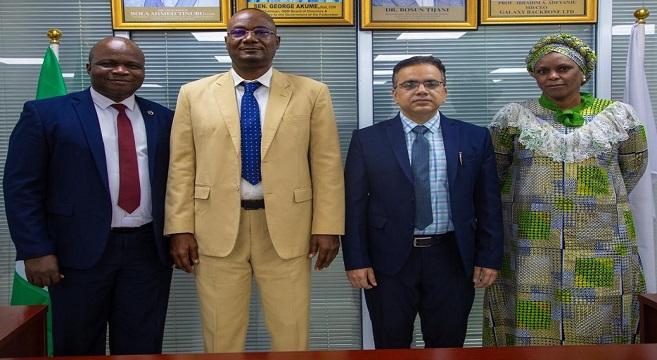
Simba Infrastructure Limited, a leading provider of customer experience and communications technology, has entered into a strategic partnership with Galaxy Backbone Limited (GBB), the Federal Government of Nigeria’s ICT infrastructure and shared services provider, to deliver Hosted Unified Communications (UC) and Hosted Call Centre Solutions to organisations across both the public and private sectors.

This collaboration brings together Simba Infrastructure’s deep expertise in converged communication technologies, systems integration, and private-sector engagement with Galaxy Backbone’s trusted government relationships, world-class Tier III and Tier IV data centre infrastructure, and an extensive fibre-optic network spanning 30 states and the Federal Capital Territory.
Together, both organisations will deliver secure, scalable, and cost-effective communication solutions designed to transform how businesses and government institutions engage with customers and citizens.
Under this this partnership, Simba Infrastructure will lead business development efforts within the private sector, delivering tailored Unified Communications and Call Centre solutions aligned with the unique needs of enterprises. Galaxy Backbone, on the other hand, will drive adoption within the public sector, providing secure, locally hosted data centre services that ensure compliance, reliability, and operational efficiency.
Commenting on the partnership, Sanjay Vaswani, Director at Simba Infrastructure said: ”Simba is pleased to mark this first phase of collaboration, with a long-term vision of deploying fully localized, AI-driven technologies that enable developers to build and scale using Naira-based solutions.
“While Aminu Usman, Profit Centre Head at Simba Infrastructure tressed on the fact that partnering with Galaxy Backbone will marks a significant milestone in our mission to deliver innovative, cloud-based communication solutions to Nigerian organizations.
“By combining Galaxy Backbone’s robust infrastructure and strong public sector presence with Simba’s customer-centric approach and technological expertise, we are creating a powerful platform to drive digital transformation and business growth.”
Also speaking, the GM Strategic Partnerships & Regional Business, Galaxy Backbone Limited, Abdul-Malik Suleiman noted; “Galaxy Backbone remains committed to advancing digital inclusion, secure communication, and reliable ICT services across Nigeria. Our partnership with Simba Infrastructure strengthens our ability to deliver innovative, locally hosted Unified Communications and Call Centre solutions that will benefit both public and private sector organisations.”
This partnership underscores a shared commitment to advancing Nigeria’s digital transformation agenda by equipping organisations with the tools to enhance collaboration, streamline communication, and improve customer experience—while ensuring that critical data remains securely hosted within Nigeria.

CBN Extends PoS Geo-Fencing Enforcement Deadline to August 2026

Nigerian Capital Market to Transition to T+1 Settlement Cycle on Monday

Report Shows Start-ups Fuel Innovations in Africa

NCC Expands IPv6 Board with the Appointment of Olusola Teniola, Funke Opeke Others

FidBank UK Broadens Investment Pathways for Nigerians into the UK Market

MTN, VDT, Zoracom, Digital Realty Back 2026 Girls in ICT Campaign

Vitel Wireless Partners Fintechs to Expand Access to Services

Opay Plans IPO in US, Targets $4Bn in Valuation

CPN Begins Crackdown on Quack IT Professionals, Vows Tougher Action against Cybercrime

Nigeria Hit by 24.1m Data Breaches – Surfshark




 E-Business2 days ago
Anthropic Raises $65 Bn to Expand AI Research, Innovation

 Telecom2 days ago
Telcos Mull Calculator to Address Data Depletion Complaints

 General News2 days ago
NCDC Says Lagos, FCT, Others on High Ebola Alert

 Telecom3 days ago
Bharti Airtel Named Fourth Largest Mobile Network Operator in the World
- General News3 days ago
NCDC Warns against Using Bitter Kola, Salt Water as Ebola Remedies

 General News2 days ago
How Enugu State is using GovTech to Fix its Housing and Land Administration

 E-Business2 days ago
EU Slams Temu With Massive $232m Fine over Dangerous Products

 Telecom3 days ago
MTN Reportedly Spends N60Bn on Diesel Annually