

Telecom
Airtel, UNICEF Commend Lagos School on Impressive Use of Nigeria Learning Passport

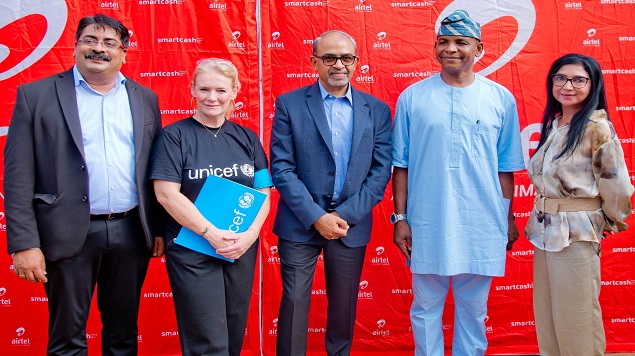
Sunil Taldar, the Group Chief Executive Officer of Airtel Africa, has described as remarkable the progress recorded by St Agnes Primary School, Maryland Lagos with the use of the Nigeria Learning Passport as part of the Reimagine Education Programme introduced by Airtel and the United Nations Children’s Fund (UNICEF) in 2022.

Mr Taldar made this declaration while on a joint visit with the leadership of UNICEF and Airtel Nigeria. The delegation, which included the Chief Executive Officer, Airtel Nigeria, Dinesh Balsingh; UNICEF Chief of Field Office, Celine Lafoucriere; and other senior executives from Airtel and UNICEF, engaged with school administrators, teachers, and pupils to assess the progress recorded under the Reimagine Education Programme.
This visit marks another significant step in Airtel’s long-standing collaboration with UNICEF to drive inclusive and technology-driven education, ensuring that more Nigerian children have access to quality learning resources.
Through the collaboration, Airtel has reported that over 1,200 schools have been equipped with tablets and data to connect teachers and learners to digital learning platforms.
Speaking with the media after a demonstration of NLP and digital learning devices, Mr Taldar said, “What I saw today at St Agnes Primary School was impressive and we are encouraged by the impact made for students and teachers through our partnership with UNICEF,” adding that “our partnership with UNICEF is one of the ways we are ensuring that more children in Nigeria and beyond have access to digital learning tools that will equip them for their future. This visit reaffirms our dedication to making education more inclusive, accessible, and impactful.”
Also commenting on the company`s commitment to digital education and bridging the digital divide for Nigerian children, the Chief Executive Officer and Managing Director of Airtel Nigeria, Dinesh Balsingh, highlighted the importance of technology-driven learning, the impact of Airtel’s partnership with UNICEF, and the role of the Nigeria Learning Passport in providing students and teachers with essential digital learning tools.
“At Airtel Nigeria, we are deeply committed to empowering young minds through technology-driven education. Our visit to St. Agnes Primary School underscores our dedication to bridging the digital divide and ensuring that more Nigerian children have access to quality learning resources.
Through our partnership with UNICEF, we continue to invest in initiatives like the Nigeria Learning Passport, which provides students and teachers with the tools they need to succeed in a rapidly evolving digital world.”
On her part, UNICEF Chief of Lagos Field Office, Celine Lafoucriere, emphasised the importance of collaborative efforts to reimagine education.
“Education is a fundamental right, and digital learning has become a key enabler in bridging educational gaps. Our partnership with Airtel Africa and Airtel Nigeria continues to provide innovative learning solutions, ensuring that every child, regardless of location or socio-economic status, has the opportunity to learn and thrive.
We are excited about the ongoing implementation of the Nigeria Learning Passport and the transformation it brings to education in Nigeria,” she said.
Recall that in 2023, Airtel and UNICEF paid a similar visit to Oremeji Primary School Ajegunle Lagos, one of Airtel Nigeria’s seven adopted schools.
This visit to St. Agnes Primary School reflects a broader engagement with schools benefiting from the Nigeria Learning Passport (NLP) – a digital education platform developed by UNICEF in partnership with the Nigerian government and Microsoft.
The NLP is designed to provide accessible, high-quality educational content to students, teachers, and parents, supporting learning both in and outside the classroom.
Airtel’s collaboration with UNICEF aligns with its broader corporate social responsibility (CSR) agenda to support education, digital inclusion, and sustainable development.
The Nigeria Learning Passport continues to gain traction as a powerful tool in ensuring that children, including those in remote and underserved areas, have access to interactive, high-quality educational content.
At Airtel Africa, we believe that education is the cornerstone of progress, and we remain committed to leveraging technology to drive sustainable learning solutions across the continent.



Localised, industrial-grade artificial intelligence (AI) data centre infrastructure will be delivered across Africa and the Global South, following a strategic alliance between sovereign AI infrastructure company Amini, electronics manufacturing giant Hon Hai Technology Group (Foxconn) and French digital firm Bull.

The three-way partnership aims to close the sovereign compute gap by allowing governments, telecommunications operators, financial institutions and energy companies to acquire and operate computing systems domestically.
Africa’s digital economy is projected to reach $1.5 trillion by 2030, which is driving regional demand for AI-enabled services across public administration, energy and finance, the parties say.
However, advanced cloud and AI processing capabilities have historically remained concentrated within a small number of external providers. The partnership seeks to establish locally anchored infrastructure, enabling domestic organisations to retain control over data and digital sovereignty.
Under the agreement, Amini will drive local market engagement and deployment, leveraging its existing platforms for locally anchored data capacity.
Foxconn will provide specialised hardware, server architecture and modular data centre technologies in its first dedicated infrastructure initiative focused on African markets.
Bull integrates its expertise in high-performance computing, quantum computing and emerging-market digital capacity. By operating independent systems, critical national sectors can bypass reliance on external platform architectures.
Financial entities can deploy independent credit, risk assessment and financial inclusion algorithms, while energy providers can implement localised machine learning for predictive maintenance and national grid optimisation.
“AI is becoming foundational infrastructure for every economy, yet most of the world still lacks the compute capacity required to participate on its own terms,” said Kate Kallot, founder and CEO of Amini. “This partnership ensures that Africa and the Global South can acquire, own and operate AI infrastructure locally, with sovereignty and long-term economic value at its core.”
Alexandre Jouys, chief commercial officer and head of Southern Europe, Middle East and Africa at Bull, added that Africa and more generally the Global South have the potential to emerge as a global-scale AI hub, by continuing to build regional computing capacity and supply chain independence.

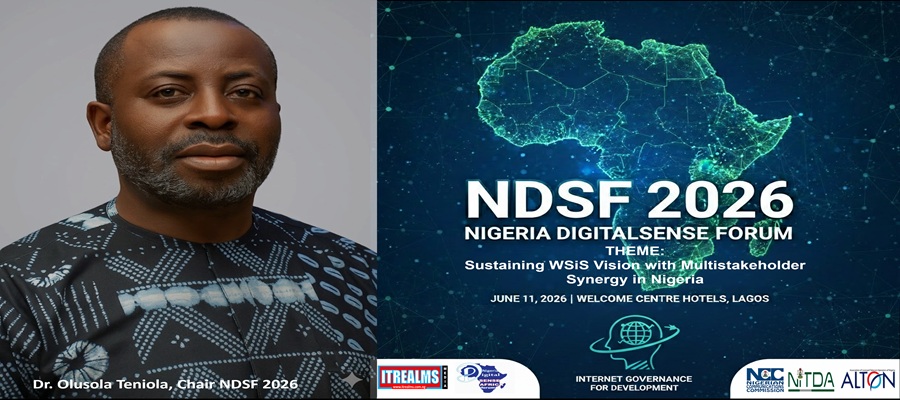
The organizing committee of the 2026 Nigeria DigitalSENSE Forum (NDSF) on Internet Governance for Development (IG4D) is proud to announce Dr. Olusola Teniola as the Chairman for this year’s landmark event.

A seasoned leader with over 32 years of global experience in the telecommunications and technology sectors, Dr. Teniola brings a wealth of strategic expertise to the forum.
The Convener of NDSF and Group Executive Editor, ITREALMS Media group, Ogbuefi Remmy Nweke, welcomed the appointment, noting that Dr. Teniola’s leadership comes at a pivotal time for Nigeria’s digital economy.
Dr. Teniola currently serves as the Director of Strategic Business Initiatives at ipNX Nigeria, where he leads market expansion across West and Central Africa.
His recent contributions as a Digital Development Consultant to the World Bank Group for the May 2025 Country Private Sector Diagnostic report further underscore the high-level expertise he brings to the 2026 forum.
Dr. Teniola’s career is defined by high-impact leadership and infrastructure development:
- He previously served as COO for Oodua Infraco Resource Limited, overseeing the deployment of 870km of digital infrastructure in Southwest Nigeria.
- He is the past President of the Association of Telecommunications Companies of Nigeria (ATCON) and succeeded Dr. Ernest Ndukwe as the National Coordinator for the Alliance for Affordable Internet (A4ai).
- His background includes executive roles at global giants such as British Telecom, Vodafone, Cisco Inc, and Alcatel-Lucent Technologies.
- He has been a vital contributor to the Nigerian Broadband Plan (2012-2013 and 2020-2025) and currently serves on the IPv6 Council.
Dr. Teniola holds a B.Eng (Hons) in Computer & Information Engineering from South Bank University, an MBA from the University of Bath School of Management, and an Honorary Doctorate (DBA) from Prowess University.
He is a Fellow of the MSME Institute of Management & Professional Studies and a member of the Chartered Institute of Directors (IoD) Nigeria.
Nigerian Communications Commission (NCC) says ongoing investments and regulatory interventions in the telecommunications sector are expected to address persistent quality of service challenges across the country.

NCC
In a statement signed by the Head of Public Affairs, Nnenna Ukoha, on Wednesday, the commission acknowledged public concerns over dropped calls, slow internet speeds, unstable data services and service disruptions affecting consumers.
The commission said telecommunications services had become central to work, education, business, access to essential services and social connectivity, adding that consumers deserved reliable services and value for money.
According to the NCC, improving quality of service has remained a major regulatory priority over the past two years.
It said the commission had intensified monitoring of Mobile Network Operators, Internet Service Providers and Tower Companies, while strengthening data-driven oversight and stakeholder engagement to address structural challenges affecting service delivery.
The commission disclosed that the sector was undergoing one of its largest network expansion and modernisation phases in recent years following a prolonged period of under-investment.
It said Mobile Network Operators invested more than N2.13 trillion in network infrastructure and upgrades in 2025, while Tower Companies invested an additional N373.8 billion.
According to the NCC, the investments supported the addition and upgrade of more than 2,800 telecommunications sites nationwide to improve network coverage and capacity.
The commission said interventions included deployment of additional 4G and 5G infrastructure, fibre backhaul expansion, targeted deployments in high-demand urban areas, expansion into underserved communities and equipment upgrades.
It added that operators had committed to adding or upgrading more than 12,000 sites in 2026, with nearly 3,000 already completed.
The NCC also said over 730 additional 5G sites had been deployed across 27 states in 2026.
The commission noted that 4G penetration rose from 45 per cent in January 2024 to 54 per cent currently, while national median download speeds improved from 16.5Mbps to 20Mbps within the same period.
It further said power availability at telecom towers improved from a national average of 99.3 per cent in January 2025 to 99.7 per cent.
According to the commission, spectrum reallocation among major operators and spectrum block rearrangements were also being implemented to improve network efficiency and service performance.
The NCC, however, acknowledged persistent external challenges affecting service quality, including vandalism, theft of telecom equipment, fibre cuts, power disruptions and access denial for maintenance.
It disclosed that more than 27,000 avoidable fibre-cut incidents linked mainly to road construction and vandalism were recorded in 2025.
The commission said it was collaborating with the Office of the National Security Adviser and other stakeholders to implement the Presidential Order on Critical National Information Infrastructure.
It added that operators had been mandated to notify consumers of major service outages promptly and restore services within specified timeframes.
The NCC said enforcement of the updated Quality of Service Regulations 2024 commenced in November 2025, including consumer compensation measures for poor service quality and additional investment obligations on Tower Companies.
It warned that regulatory action would continue against operators that fail to deliver measurable improvements.
The commission reaffirmed its commitment to ensuring affordable, reliable and high-quality telecommunications services for all Nigerians.

Lagos Captures over 6.4m Residents in LASRRA Database

FG to Launch Nationwide Free Digital TV Platform June 17

FG, World Bank Launch $65m SPESSE Funding for 24,000 Nigerians

FG to Balance Innovation with National Security with Stronger Drone Regulations

Kaspersky Challenges IT Leaders with Next-generation Cyber Protection Simulations

Vitel Wireless Partners Fintechs to Expand Access to Services

MTN, VDT, Zoracom, Digital Realty Back 2026 Girls in ICT Campaign

Kaspersky Discovers Vulnerability in Qualcomm Snapdragon Chips that can Lead to Data Loss & Device Compromise

MTN Suspends Data, Airtime Borrowing Service over New FCCPC Lending Rules

Bank Customers to Pay N1,500 for ATM Card Issuance, Replacement – CBN




 Telecom3 days ago
MTN, Airtel, Glo Under Pressure as FG Demands Better Service Delivery

 E-Business3 days ago
Firm Warns of Phishing Attacks via Compromised Amazon Simple Email Service Accounts

 E-Financial3 days ago
Mastercard, BMONI Launch Multi-Currency Payment Cards in Nigeria

 General News2 days ago
PalmPay, LASUBEB Deepen Efforts to Keep More Children in School

 News3 days ago
Dr. Olusola Teniola, Honoured with Yoruba Study Group Golden Leadership Excellence Award

 News2 days ago
National Assembly to Review National Data Protection Act

 General News3 days ago
Moniepoint Partners GDG Lagos, Women Techmakers to Empower the Next Generation of Women Architects in Tech

 Broadcasting3 days ago
Metro Digital, Nigerian Firm Accuses Multichoice Of Refusal to Obey Court Judgements