

General News
Moniepoint Partners GDG Lagos, Women Techmakers to Empower the Next Generation of Women Architects in Tech

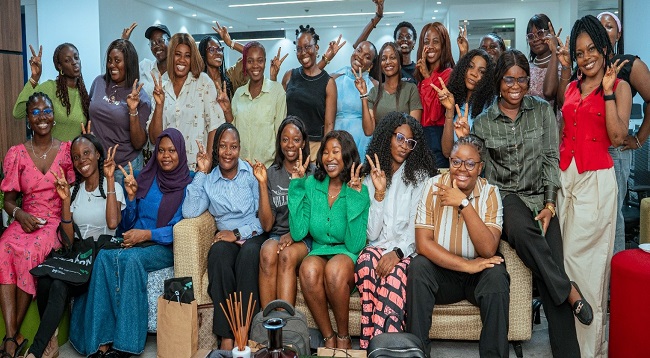
In a critical move to bolster talent density and accelerate Nigeria’s digital economy, Africa’s all in one financial ecosystem, Moniepoint hosted an International Women’s Day event bringing together women in technology for a day of leadership development and hands-on product building.

Held at Moniepoint’ Headquarters in Lagos, themed “Break the Pattern,” the event was organised in partnership with Women Techmakers Lagos and Google Developer Group (GDG) Lagos with participants spanning both technical and non-technical backgrounds, reflecting the breadth of women currently active across Nigeria’s digital economy.
In a keynote address delivered by Kemi Nwogu, Head of Product at Moniepoint Inc, titled “Breaking the Pattern: How Women Can Redefine the Future of Tech,” she made the case that progress for women in technology requires not just access to existing structures, but the tools and confidence to reshape them. Furthermore, Nwogu issued a bold call to action, urging attendees to move beyond traditional career playbooks and take ownership of shaping the industry’s future.
“From a young age, many girls have been subtly discouraged from pursuing science and tech. They are told sometimes directly, sometimes indirectly, that tech is too hard, too technical, or simply not for them. These patterns are not facts, they are constructs. And what has been constructed can be deconstructed! The future of tech needs leaders who build people, not just products, cultures, not just systems,”said Nwogu.
On building skills with purpose, she urged women to “show up everyday, make small, steady progress with online courses, coding bootcamps, open-source projects while leveraging the full ecosystem; take on challenging tasks as your greatest classroom using real problems to build real skills; while knowing why you’re building a skill as every learning goal can be tied to a career journey.”

This thematic fare of the event was further explored in a panel discussion, “Unscripted: Leading Beyond the Patterns We Inherited”, moderated by Atinuke Oluwabamikemi Kayode and featuring leaders from fintech, creative design, and software engineering space, including Chukwu Adaeze (Creative Director, CAV Digital), Chinenye Ogbu (Customer Experience Lead, Hydrogen), and Motunrayo Koyejo (Senior Software Engineer, Cowrywise).
The robust and extensive conversation examined the professional archetypes that have historically defined leadership in the Nigerian tech ecosystem: the engineering culture that equates output with exhaustion, the creative industry’s tendency toward top-down authority, the script-driven rigidity of customer-facing roles. The panelists also provided deep insights into how they had navigated and, in places, dismantled those patterns within their teams and organizations.
The event went beyond conversations to a hands-on workshop, Prompt to Production, facilitated by Taiwo Famakinde which guided attendees through modern product development from prompt design through rapid prototyping to the deployment of a functional application using AI tools.
A lot of the participants entered with little to no prior experience building software products. The workshop then fed directly into a Buildathon, where participants developed and deployed their own solutions in real time, with the strongest builds recognised and rewarded at the closing ceremony.
“IWD celebrations are often heavy on inspiration, but we wanted to offer something more, a proof of capability. Oftentimes, there is a gap between having ideas and actually building them, and we set out to bridge that by creating a space where women could easily deploy their ideas into live products with AI in just a few hours. By the end of the day, something that once felt complex due to the fast pace of AI started to feel possible.
“Our participants left with both the technical confidence to build and the leadership frameworks to navigate their careers on their own terms, ensuring they are no longer just participants in the tech ecosystem, but the architects of its future. They are now ready to test their ideas and lead without waiting for perfect conditions or a full team.” said Funke Olasupo, Co-organizer, Women Techmakers Lagos.
Interestingly, the “Break the Pattern” event sits within a broader investment in Nigeria’s technology talent pipeline that Moniepoint has deployed over the years. As one of Nigeria’s most significant fintech employers, the company runs a critical engine that sustains Nigeria’s formal and informal economy.
Moniepoint has invested in developer community partnerships including its ongoing collaboration with GDG Lagos as well as internal programmes designed to build engineering depth across product domains that include its highly successful Women in Tech initiative, DreamDevs, HatchDev and the government’s acclaimed 3MTT programme.



United States Government has said that Nigeria is not making significant progress in fiscal transparency, referencing gaps in the country’s budget disclosure, expenditure reporting, public procurement transparency and audit processes.

The assessment is contained in a report by the United States Department of State, which reviewed Nigeria’s fiscal transparency practices in its 2026 fiscal transparency report for countries published on Tuesday.
The report noted that the US government stated that Nigeria made some key fiscal documents available to the public, significant shortcomings remained in the disclosure of budgetary information and the management of public finances.
The report noted that “the government made its enacted budget and end-of-year report widely and easily accessible to the public, including online, but did not publish its executive budget proposal within a reasonable period.”
It also stated that while the Nigerian government had made information concerning the country’s debt obligations publicly available, its budget documents failed to provide a comprehensive picture of government revenues and expenditures.
“The government made information on debt obligations, including major state-owned enterprise debt, publicly available, but budget documents did not provide a substantially complete picture of the government’s revenues and expenditures, or break down expenditures to support executive offices in the budget,” the report stated.
The US government further raised concerns about discrepancies between Nigeria’s approved budget and the actual revenues and expenditures recorded during implementation.
It said, “Actual revenues and expenditures did not reasonably correspond to those in the enacted budget.”
The report also criticised the country’s supreme audit institution, stating that it did not meet international standards of independence and did not publish substantive reports, although it had access to the entire executed budget.
“The supreme audit institution did not meet international standards of independence or publish substantive reports but did have access to the entire executed budget,” it stated.
The assessment, however, acknowledged that Nigeria’s sovereign wealth fund had an adequate legal framework and disclosed information about its funding and the general approach to withdrawals.History
“The sovereign wealth fund had a sound legal framework and disclosed its source of funding and general approach to withdrawals,” the US government said.
The World Bank Group is supporting the expansion of Africa’s digital commerce infrastructure to help small businesses reach new markets, create jobs, and strengthen economic opportunities across the continent.

Through Jumia, Africa’s leading e-commerce platform, the investment is expected to enable approximately 60,000 local annual active sellers to participate more fully in the digital economy, support around 1,800 direct jobs, and create income-generating opportunities for more than 100,000 independent sales agents.
As digital commerce continues to grow across Africa, reliable access to online marketplaces, logistics networks, and digital payments are becoming increasingly important for entrepreneurs and small businesses seeking to expand beyond local markets. Strengthening this infrastructure can help firms increase sales, improve productivity, and connect consumers with a wider range of affordable goods and services.
To support this effort, the International Finance Corporation (IFC), the private sector arm of the World Bank Group, is investing US$25 million in equity in Jumia Technologies AG (Jumia), Africa’s largest public e-commerce platform. The investment will support Jumia’s next phase of growth across its core African markets, strengthening its integrated marketplace and logistics network.
By expanding access to digital commerce tools and services, the investment will help businesses grow, improve price transparency, and contribute to more inclusive and resilient private sector development across Africa.
“The support of the World Bank Group is a milestone for Jumia and for African e-commerce more broadly. It validates both the discipline we have brought to our business in recent years and the tangible impact our platform has on small businesses, jobs, and consumers across our eight markets. With partners like the IFC, we can accelerate the digital commerce infrastructure Africa needs” said Francis Dufay, CEO of Jumia.
“Jumia demonstrates how pan-African e-commerce platforms can expand economic opportunity at scale. Our investment supports the company’s next phase of growth while contributing to create jobs, digitizing supply chains and distributions channels and mobilizing private investment” said Farid Fezoua, Director for Equity, Funds, and Venture Capital at the International Finance Corporation, World Bank Group.

Nigerian Upstream Petroleum Regulatory Commission (NUPRC) has cautioned the public against fake recruitment offers and fraudulent employment letters circulating in the agency’s name.

Eniola Akinkuotu, head of Media and Corporate Communications of the Commission, stated that NUPRC has received reports of counterfeit and AI-generated appointment letters bearing names not known to the regulator.
The Commission also said fraudsters have been extorting money from jobseekers by promising placement within the agency.
NUPRC has reported the incidents to law enforcement and said investigations are underway.
The regulator reiterated that there is no ongoing recruitment exercise and warned members of the public not to make any payments for supposed job offers.
“Whenever the Commission decides to recruit, the process will be conducted strictly in accordance with extant laws and government regulations,” the statement said.
The Commission urged jobseekers to verify any purported offer and to rely only on official NUPRC communications for recruitment information.
The warning follows growing concerns about the misuse of digital tools, including artificial intelligence, to fabricate apparently authentic documents that can deceive the public.

Nigeria Not Making Progress in Fiscal Transparency –US

NCAA to Introduce RFID Technology to Tackle Missing Luggages

SEC Directs Operators to Subscribe to NigSac Alerts, Freeze Terrorists-Linked Funds

Davido Bets $1m in Hit-for-Hit Battle with Colleagues

GSMA Industry Services Unveils Circularity Services to Help Operators Reduce E-Waste and Unlock Value

EFCC Busts NIS Visa Overstay Racket, Uncovers N700m in an Account

Fact-Check: Elon Musk’s “Tesla Pi Phone” is Internet Rumor

NBC Tasks Broadcasting Stations over 2028 DSO Global Deadline

NBC Scraps Annual Digital Access Fee on DSO

Glo Sponsored African Voices to Feature Netflix’s “The Polygamist” Stars




 Telecom2 days ago
ipNX Joins Calls for Innovation-Friendly Ecosystem and Stronger Local Opportunities at Regenesys AI Summit

 E-Business2 days ago
NDPC Probes UNILAG, Lotus Bank, Hackerbella over Alleged Students’ Data Misuse

 News2 days ago
PalmPay Reinforces Commitment to Youth Empowerment on International Youth Day

 Telecom2 days ago
NCC Reports over 5,000 Fibre Cuts in 6 Months

 E-Financial2 days ago
KudiWave Asks for Clarification over N750m Transfer from PalmPay Account

 Telecom2 days ago
Google Selects Six Nigerian News Creators for Emerging Voices Growth Lab

 E-Financial2 days ago
Nigerians Borrow More to Buy Homes as Mortgage Demand Climbs – CBN

 General News2 days ago
NUPRC Warns of Counterfeit, AI-Generated Appointment Letters