

General News
Again, Gambaryan, Binance Executive Accuses 3 Lawmakers, NSA of Demanding $150m Bribe

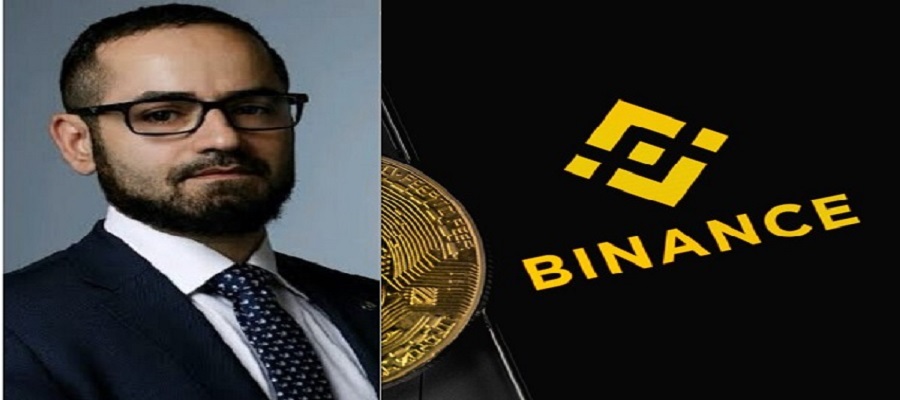
Tigran Gambaryan, head, Financial Crime Compliance Unit at Binance, cryptocurrency firm, who was detained in Nigeria for several months last year, has again alleged that three Nigerian lawmakers demanded a $150 million bribe from him.

Tigran Gambaryan, head, Financial Crime Compliance Unit at Binance
Gambaryan, also alleged that, Nuhu Ribadu, National Security Adviser (NSA) demanded billions worth of crypto accounts to fund his future political ambitions. He, however, did not say in which currency the alleged demand was made.
Tweeting on his X handle, formerly known as Twitter, with the name @TigranGambaryan on Friday, Gambaryan named two lawmakers involved in a meeting of January 5, 2024, at the National Assembly as Peter Akpanke and Philip Agbese, whom he said were working under the committee of Ginger Obinna Onwusibe, while he could not recall the name of the third lawmaker.
Narrating his alleged ordeal in Nigeria on X, Gambaryan said that the lawmakers set up fake cameras and media to make the meeting with his team official but that the cameras were not even plugged in.
Onwusibe is the chairman of the House of Representatives Committee on Financial Crimes, Akpanke is a member of the committee, and Agbese is the deputy spokesperson of the House.
The NSA’s office and the lawmakers have all denied the allegations. This is just as the federal government called on Nigerians to disregard the accusations, saying there are false and outrageous.
Gambaryan, who was detained in February 2024 on a five-count allegation of money laundering, was released on October 23, 2024, on diplomatic grounds due to ill health.
Continuing, Gambaryan said ‘@NuhuRibadu invited us to the official meeting and worked through Sa’ad Abubakar. Another key figure in this situation was Hamma Adama Belloji. Ogunjobi was just a pawn; they used him too. This was sold as a friendly meeting with the NSA, the head of the SEC (Securities and Exchange Commission), and the CBN (Central of Bank of Nigeria) governor and includes a discussion of the briber that was solicited by the House of Representatives.
‘The $26 billion figure they kept pushing publicly as some mystery money escaping Nigeria is complete BS. This information was provided in response to their request and was simply cumulative trade data for Nigerians on the platform. This money didn’t leave Nigeria-it was just people buying and selling crypto. For example, if you trade $100 a hundred times, that’s $10,000 in trade volume, but in reality, you only used $100. Again, just another example of them lying to cover up their BS investigation.
‘They lied about Nadeem escaping during mosque prayers. In reality, he returned and escaped afterwards. I don’t know exactly how he managed to flee. He emailed me in November, but we haven’t discussed the details of his escape. It’s possible he paid someone off, but I have no proof. If Belloji had simply checked his passport for a visa, he would have realized that Nadeem did not use that passport to travel to Nigeria.
‘They sent a letter to the U.S. Embassy and the British High Commission, falsely claiming that we were voluntarily participating in strategic talks. This was a blatant lie’, he said.
While noting that some Economic and Financial Crimes Commission (EFCC) officials, who were not present when Nadeem escaped, were detained, he added that: ‘Nadeem did not escape lawful detention-we were being held illegally. Belloji even admitted that he would fabricate evidence to obtain a court order to detain us for 14 days. Once the court order expired, they were unable to get an extension from the judge. At that point, they continued holding us illegally and had no justification for doing so.
‘There was a lot of noise about using Interpol to capture Nadeem. As someone who has been involved in multiple extradition cases, I can confidently say this was a joke. Extradition is a lengthy legal process, and no rational judge in Kenya or wherever would ever approve extradition for someone who escaped illegal detention at the hands of rogue law enforcement-especially when that detention involved holding employees hostage to pressure their employer. All noise’, he said.
Our company was a scapegoat’
Gambaryan stated further that Binance was made a scapegoat for the naira’s devaluation, when it was the direct result of President Bola Ahmed Tinubu’s ‘monetary policy’. According to him, the Nigerian operatives violated international privacy laws on user data on all Nigerians to target opposition members for allegedly ‘manipulating the price of the naira.’
Accusations against Ribadu
Gambaryan said Ribadu emphasised that he wanted billions in payouts to fund his future political ambition but was ‘trapped’ because any settlement would be perceived as a bribe. He added: ‘I guess he really wanted his boss’ job.’
He added: ‘Ribadu even hired a U.S. law firm to negotiate my release, but this failed due to their incompetence and greed.
‘Ribadu overstepped his authority and embarrassed Nigeria in front of U.S. National Security Advisor Jake Sullivan. Ribadu acting like… angered the White House and led to diplomatic repercussions-the U.S. limited visas to the Nigerian delegation for UNGA (United Nations General Assembly), and (President Joe) Biden refused to meet with Tinubu until my situation was resolved.
‘In the end, Ribadu overestimated his influence. They thought they could secure a quick win, but instead, they created an international incident, exposing his incompetence on a global scale,’ the Binance executive said.
The federal government has however called on Nigerians to disregard what it called falsehoods being peddled by the Binance executive.
In a statement issued last night, Mohammed Idris, the Minister of Information and National Orientation.
It noted with concern the ‘outrageous allegations, misinformation, and defamatory statements being disseminated by Tigran Gambaryan’.
He said while the federal government is hesitant to engage Mr Gambaryan, ”given the high-level diplomatic intervention that resolved his case, we are obliged to set the records straight to stop his falsehoods from gaining grounds.
‘The first visit by Mr Gambaryan and his colleagues to Nigeria was discretional on their part and government was not officially involved. However, when the attention of the government was called to an alleged bribery demand during that trip, an investigation was immediately opened into it, though there was no formal complaint by anyone.
‘Mr Gambaryan’s second visit to Nigeria was part of a wider probe into the criminal manipulation of the Nigerian currency through peer-to-peer platforms like Binance, but investigators were frustrated by the tactics deployed by Gambaryan and his team.
‘Mr Gambaryan was released by the Nigerian government in October 2024, on humanitarian grounds and following a high-level diplomatic intervention that ended with tangible benefits for Nigeria.
The government rejected Binance’s offer of a $5 million down payment in exchange for Mr Gambaryan’s freedom, in favour of a more beneficial settlement with the American government.’
The minister added, ‘we categorically deny the retaliatory claims made by Mr. Gambaryan against Nigerian officials involved in his case, and we urge the public to disregard these false accusations in their entirety.
‘It is essential to note that Mr. Gambaryan’s allegations are not only unsubstantiated but also lack credibility, given his apparent motive to discredit and intimidate those who ensured he faced justice.
‘However, we are confident that both the Nigerian and American judicial systems will provide Mr. Gambaryan with a fair opportunity to substantiate his claims in court. Until then, we advise the public to exercise caution and not be swayed by Mr. Gambaryan’s unfounded and malicious claims.’
Also speaking on the allegations, the lawmakers mentioned denied demanding bribe from Binance, asking Mr Gambaryan to provide evidence to back his allegations or be ready to face consequences.
One of the affected lawmakers and deputy spokesman of the House, Agbese, said he was ‘outraged’ by the ‘false’ allegation as he was not part of any meeting with the Binance team, but had a chance encounter with them when he visited his friend, Akpanke.
He said: ‘Let it be on record that I am not a member of the Committee on Economic and Financial Crimes. I visited my colleague, Peter Akpanke, in his office, where he was meeting with some visitors about the activity of his committee, with Peter Anekwe, a member of the committee present. We exchanged pleasantries and, in character with my person as an avid pursuer of knowledge, discussed Binance’s activities that did not include any demand from anyone.
‘It was during this visit to the office of Peter Akpanke, with Peter Anekwe present, that he told me they were interfacing with the Binance team from abroad over a referral to their committee. What transpired between the two of them and the Binance executive after I left the office is left to them. I never saw those visitors again after that chance meeting and did not afterwards attend any meeting with Binance executives, the EFCC, or the DSS (Directorate of State Services).
‘I am aware that when this issue was first raised, the chairman of the committee went to court and Binance apologised. So, all inquiries should be directed to the committee, not to Philip Agbese.
‘I have never used any cryptocurrency as I do not have a crypto wallet anywhere in the world, so I could not have asked for funds to be credited to a non-existent wallet.
‘Gambaryan and his associate, who escaped from prison, should return to the EFCC and defend themselves. Instead of trying to implicate me, they should focus on addressing the allegations against them’, he said.
Agbese demanded a retraction and an apology from Gambaryan within seven days if he failed to provide evidence or face legal action from his lawyers.
When contacted, Akpanke also denied demanding bribe from Binance executives as alleged and challenged Gambaryan to provide evidence that he (Akpanke) and other members of the committee demanded gratification from him as alleged.
Akpanke said: ‘Whatever we did with Binance was transparent; it was an open thing. Is it just to allege; how did we demand? This is the question you people should ask them as journalists. Where did we demand it? What for? Did the Nigerian government not charge them to court? If there were such a thing, why did they charge them to court? It is not true. I have not met Binance executives since we had a meeting with him in my office, in which I represented the chairman and everything was open and transparent. There was nothing hidden’.
While maintaining that he had no contact with the firm after submitting his investigation report to the chairman of the committee, Akpanke said the allegation had been made before and there is a pending court case about it and the firm had failed to show up.
Meanwhile, efforts to get the reaction of the chairman of the Financial Crimes Committee, Ginger Onwusibe, were not successful as he did not respond to calls and WhatsApp messages sent to him.
But a top government source said Gambaryan was being economical with the truth.
Efforts to speak with the NSA, Ribadu, were not successful. Also, Zakari Mijinyawa, who speaks on behalf of the office, could not be reached.
‘He (Gambaryan) contradicted himself because in one place he said Ribadu asked him for bribe to fund his future political ambition, and in another place, he said any money collected by Ribadu will be seen as bribe’, said the source.


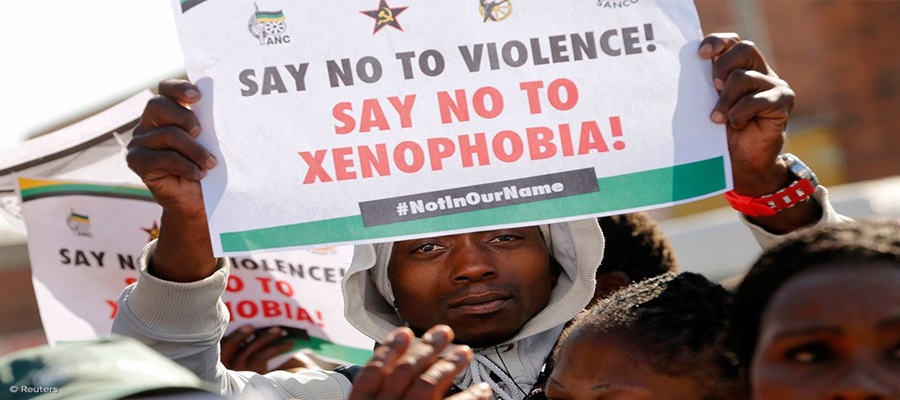
Anonymous Nigeria, hacktivism, known for launching coordinated cyberattacks and protests in support of socio-political movements, has threatened to leak stolen South African government data unless its demands were met.

The group, called for the department to stop xenophobic attacks on Nigerians in South Africa, or it will expose the data.
“They call themselves correctional services, but they can’t correct the citizens. What a shame,” the group said in its Telegram channel, MyBroadband reported.
“They killed a lot of Nigerians while the so-called correctional services watched and the ministry of justice.”
It is immediately know if Anonymous Nigeria is affiliated to Nullsec Nigeria.
But in a post on a hacker forum, Nullsec Nigeria included a link showcasing an example of data stolen from the department.
It included two bid invitation notices, bid results, a copy of the bids received, and a notice of a bid awarded in various formats.
“We’ll expose all your evil deeds for the world to see, unless this attack stops. But if not, we’ll leak everything they got,” Nullsec Nigeria said.
“Unless the government of South Africa ends these xenophobic attacks on Nigeria, we’ll expose everything about you, your evil deeds will be exposed, and the world shall know.”
MyBroadband asked the Department of Correctional Services about the claimed breach and Nullsec Nigeria’s demands, but it did not immediately respond to our questions.
Nullsec Nigeria also claimed responsibility for breaching several other entities in South Africa, while responding to an X post about its OpSouthAfrica campaign in its Telegram channel.
“I wanna express something here. I saw a report on the #OpSouthAfrica hack by Nullsec Nigeria, but it was stolen by another person,” it said. “Tag the real breachers next time.”
In a separate thread on the hacker forum, Nullsec Nigeria also claimed responsibility for breaching the Ephraim Mogale Local Municipality’s systems.
It claimed to have hacked the local government’s website and threatened to expose “everything you got for others to see how heartless you are. You killed mothers, brothers, students.”
Nullsec Nigeria said the breach and the threats were in response to the xenophobic attacks on and killing of Nigerians and the South African government’s supposed silence on the issue.
“These attacks are still going on in the dark, and we’ll expose them all. If the South African government doesn’t act first, the whole of South Africa will suffer,” it said.
“This is just a wave. These documents are about 11GB, but we decided to pull just this one.”
Its post included two images: one for a public hearing and another, a handwritten tender document for the appointment of an insurance service provider.
It also included a link to several other documents, including an old annual report, council resolutions, financial statements, and various other notices.
The Nigerian Government recently announced plans to bring citizens back to the country from South Africa after violent protests over foreign nationals in the country erupted earlier in May.
President Cyril Ramaphosa condemned the protests and criminal acts directed at foreign nationals in his From the Desk of The President weekly newsletter on 11 May 2026.
He emphasised the recent demonstrations and attacks did not represent the views of the South African people, nor the government’s policy.
“These are the acts of opportunists who are exploiting the legitimate grievances, particularly those of the poor, under the false guise of ‘community activism’,” The President said.
“Some of these people are assuming functions that only state officials are permitted to perform, including stopping people to check identification and conducting searches of private property.”
He added that such lawlessness would not be tolerated, regardless of who the perpetrators or victims were.
World Bank has restricted comments on its Instagram page after thousands of Nigerians flooded the platform begging them to stop lending money to Nigeria.

The protest erupted after reports that President Bola Ahmed Tinubu is seeking a fresh $1.25 billion dollar loan for approval on June 26.
Some Nigerians asked the World Bank to provide more details about the purpose of the loan and how the funds would be managed.
Others said the country should reduce dependence on foreign loans and focus on improving local revenue.
The federal government has continued to defend its borrowing plans.
Officials say the funds will support economic reforms, development projects and efforts to strengthen the economy.
Nigeria remains one of the major borrowers from the World Bank in Africa, with different administrations securing loans over the years for infrastructure, social programmes and economic support.


The Lagos State Government plans to establish a Cybersecurity Operations Centre to strengthen protection of government systems, digital services and citizen data amid rising cyber threats linked to the city’s expanding digital economy.

Tunbosun Alake, Lagos commissioner for innovation, science and technology, said the centre would help secure the infrastructure supporting online payments, e-government services, cloud platforms and technology-driven business operations across the state.
According to Alake, the facility will monitor, detect and respond to cyber threats targeting government networks, digital transactions and sensitive public data.
The move comes as Lagos accelerates its smart city agenda through investments in broadband infrastructure, digital identity systems and automated public services.
Alake said Lagos had already deployed 109 Data Protection Officers across Ministries, Departments and Agencies, which he described as the highest number among Nigerian states, to strengthen compliance with data protection regulations.
Alongside the proposed cybersecurity centre, the state also launched the Lagos Campus Network Upgrade project aimed at improving digital infrastructure within the public sector.
The upgrade is expected to improve network performance, automate internal government processes and enhance digital engagement with residents. The cybersecurity initiative follows the release of Lagos State’s cybersecurity guidelines in April.
The framework recommends measures including multi-factor authentication, vulnerability testing, encrypted backups and tighter endpoint security controls.
The guidelines align with Nigeria’s Cybercrime Act 2024, the Nigeria Data Protection Act 2023 and the National Cybersecurity Policy and Strategy 2021.

Xenophobic Attacks: Anonymous Nigeria Threatens to Leak South African Stolen Data

WHO Says Ebola Outbreak Worse than Reported

Chapel Hill Denham Says Banks Lose N2.5 Trillion Annually to High CRR in New Report

Lagos Sanctions 15 Money Lending Firms for Operational Violations

FirstBank, Visa Launch Multicurrency Signature, Naira Debit Cards

MTN, VDT, Zoracom, Digital Realty Back 2026 Girls in ICT Campaign

Vitel Wireless Partners Fintechs to Expand Access to Services

Kaspersky Discovers Vulnerability in Qualcomm Snapdragon Chips that can Lead to Data Loss & Device Compromise

Bank Customers to Pay N1,500 for ATM Card Issuance, Replacement – CBN

FCCPC Licenses 5 Firms for Airtime, Data Lending as Telcos Step Aside




 General News2 days ago
World Bank Blocks Social Media Comments from Nigerians over Loan Backlash

 Telecom2 days ago
Nigerians Lose N12.5bBn to Telecom-Related Financial Crimes – PwC

 Telecom2 days ago
NITDA, FMCIDE Deepen Collaboration on Nigeria’s Digital Transformation

 E-Business2 days ago
Jumia Nigeria Records Strong Q1 2026 Growth as Technology-Led Strategy Drives Market Expansion

 General News2 days ago
LG Electronics Strengthens Household Energy Efficiency in Nigeria with Advanced Inverter Refrigerator Solutions

 Telecom2 days ago
NITDA Showcases Nigeria’s Startup Framework as Model for Angola

 News2 days ago
Only 1 in 3 Families Fully Secure their Devices, Kaspersky Study Reveals

 Telecom2 days ago
Upperlink, ICANN, Others Rally Global Participation for UA Day 2026