

E-Financial
PalmPay Partners AfriGO to Issue Over 5m Cards

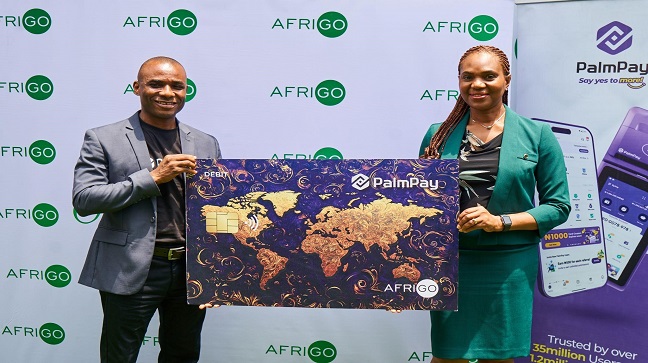
PalmPay and AfriGO have announced a strategic partnership. This collaboration aims to redefine the payment landscape by issuing over 5 million AfriGO cards to Nigerians. Through this initiative, PalmPay and AfriGO are set to empower underserved communities, drive financial inclusion, and strengthen Nigeria’s digital economy.

AfriGO Card, powered by Afrigopay Financial Services Limited, a subsidiary of the Nigeria Inter-Bank Settlement System (NIBSS), is a homegrown payment solution designed to bolster financial sovereignty. By leveraging AfriGO’s infrastructure, PalmPay is creating more payment options by providing solutions tailored specifically to local market needs.
PalmPay’s commitment to issuing 5 million AfriGO cards underscores its dedication to bridging the financial gap for the unbanked and underserved populations in Nigeria. The AfriGO card, built on EMVCo standards, ensures secure transactions with tokenization and contactless payment capabilities. PalmPay seamlessly integrates these features into its robust digital ecosystem, offering users a frictionless and secure payment experience.
A Commitment to Innovation and Financial Accessibility
Managing Director of PalmPay Nigeria, Chika Nwosu, expressed enthusiasm about the partnership:
“At PalmPay, we are committed to creating financial solutions that are not only innovative but also inclusive. Partnering with AfriGO allows us to deliver secure, cost-effective, and localized payment options that empower Nigerians and strengthen the digital economy. This is a milestone in our mission to redefine financial accessibility in Nigeria.”
Similarly, Ebehijie Momoh, Managing Director/CEO of Afrigopay Financial Services Limited (AFSL), highlighted the broader impact of the partnership:
“We are excited to partner with PalmPay to revolutionize financial services and expand access to digital payments across Nigeria. Through this collaboration, AfriGO and PalmPay will provide enhanced access to digital payments—particularly in underserved areas—drive financial inclusion, and support the rapidly growing digital economy in Nigeria
AfriGO cards will enable users to perform seamless transactions, including physical and online purchases, ATM withdrawals, money transfers, and cashless payments via Agent POS terminals. The AfriGO Instant Settlement service ensures that merchants and agents benefit from immediate transaction finalization, leading to greater efficiency, improved cash flow, and reduced risk.”
For merchants, the AfriGO cards promise reduced transaction fees and instant settlement times, Consumers will enjoy a secure, affordable, and locally supported payment solution that enhances their daily financial interactions.
As PalmPay and AfriGO move forward with this ambitious initiative, they pave the way for fintech innovation and collaboration, fostering a more inclusive and dynamic financial ecosystem in Nigeria. This partnership underscores PalmPay’s dedication to expanding digital financial services and positioning Nigeria at the forefront of payment innovation.


Standard Bank Group has identified Nigeria and four other markets as strategic growth hubs as it seeks to tap into $15.4 billion revenue opportunity driven by expanding small and medium-sized enterprises (SMEs) and rising intra-African trade.

The bank disclosed the plan through Bill Blackie, the Chief Executive Officer of its Business and Commercial Banking (Standard Bank Group) division, who outlined the lender’s growth strategy in an interview with Bloomberg.
Under the strategy, Standard Bank will deepen its presence in Nigeria, Ghana, Kenya, Uganda and Tanzania while consolidating its dominance in South Africa. The five markets account for about 85 per cent of the estimated revenue opportunity available to the group’s BCB operations.
The expansion forms part of the lender’s broader ambition to accelerate earnings growth through 2028, leveraging increasing demand for banking services among businesses across the continent.
According to Blackie, the BCB division has recorded robust growth over the past five years, supported by rising business activity and greater demand for financial services across Africa.
He said the division doubled both headline earnings and return on capital between 2020 and 2025, with return on capital increasing from 19 per cent to 38 per cent during the period.
Earnings from operations across the continent also expanded at an average annual rate of 30 per cent.
Building on this performance, the bank is targeting compound annual growth of between eight and nine per cent through 2028, although Blackie expressed confidence that growth could reach double-digit levels as the strategy gains traction.
A key pillar of Standard Bank’s growth strategy is expanding support for SMEs and mid-sized businesses, which account for most enterprises across Africa.
The bank is particularly positioning itself to benefit from opportunities created by the African Continental Free Trade Area (AfCFTA), which is expected to accelerate economic integration and cross-border commerce across the continent.
According to the International Trade Centre, nearly half of Africa’s small businesses export to other African countries, compared with only 14 per cent of larger firms, underscoring the critical role of SMEs in driving regional commerce.
The lender is also leveraging its extensive African footprint and strategic partnership with the Industrial and Commercial Bank of China (ICBC) to attract businesses seeking access to international markets, particularly China.

The National Insurance Commission (NAICOM) has handed over the management of African Alliance Insurance Plc to a newly constituted board nominated by shareholders.

The move ends a regulatory intervention that rescued the troubled insurer from the brink of collapse.
The development marks a major milestone in the insurance industry’s efforts to strengthen policyholders’ protection and restore confidence in the sector, following months of intensive regulatory oversight aimed at stabilising the company.
NAICOM had stepped into the affairs of African Alliance Insurance in October 2024 after the insurer was hit by severe liquidity constraints, mounting annuity payment arrears, unresolved claims obligations, regulatory infractions and reputational challenges that threatened its survival and eroded public trust.
Speaking at the handover ceremony, Commissioner for Insurance, Olusegun Omosehin, said the intervention had achieved its primary objectives of restoring operational stability, settling outstanding liabilities and protecting the interests of shareholders and annuitants.
Omosehin said a successful turnaround demonstrates the regulator’s commitment to safeguarding the insurance industry while ensuring that policyholders do not bear the consequences of corporate distress.
He also highlighted the significance of the newly enacted Nigerian Insurance Industry Reform Act (NIIRA) 2025, describing it as a game-changer for the sector.
The Commissioner observed that had the fund been in existence before the African Alliance’s crisis, it would have helped to cushion the impact on policyholders by facilitating the timely settlement of legitimate claims and annuity obligations.
He charged the new board to uphold high standards of corporate governance, transparency and regulatory compliance, while prioritising prompt claims settlement, sound solvency management and prudent business practices.
Industry stakeholders view the successful rehabilitation of African Alliance as a test case for regulatory intervention in Nigeria’s insurance sector, particularly at a time when operators are under pressure to strengthen their capital base, improve governance standards and rebuild public confidence.
During its tenure, the NAICOM appointed an interim board to restore liquidity through the recovery of trapped dividend funds and other inflows, settled a significant portion of annuity arrears and legacy claims, facilitated the transfer of the company’s annuity portfolio, completed forensic and actuarial reviews and addressed several regulatory and operational challenges.


Banks and their customers lost a combined N134.48 billion after criminals using illegal stole from financial institutions and its depositors between 2020 and 2025.

Attempted fraud across the banking and payments ecosystem amounted to N187.79 billion during the six-year period, while actual losses stood at N134.48 billion, according to data contained in Nigeria Payments System Vision 2028 document, issued by the Central Bank of Nigeria (CBN).
The losses were recorded across multiple payment channels, including over-the-counter transactions, Automated Teller Machines, cheques, e-commerce platforms, Internet banking, mobile banking, Point of Sale terminals, web channels and other electronic payment platforms, highlighting the growing challenge of safeguarding Nigeria’s increasingly digital financial system.
An analysis of the data showed that fraud losses increased steadily from N11.61billionin 2020 to N12.77 billion in 2021 and N14.32 billion in 2022.
The figure rose further to N17.67 billion in 2023 before surging dramatically to N52.26 billion in 2024, the highest annual loss recorded within the six-year period.
The 2024 figure alone accounted for nearly 39 per cent of the total N134.48 billion lost between 2020 and 2025, showing the scale of the fraud challenge faced by banks, payment service providers and customers.
Similarly, attempted fraud climbed from N13.26bn in 2020 to N14.48 billion in 2021, N16.41 billion in 2022 and N19.72 billion in 2023 before jumping to N86.36 billion in 2024.
However, both attempted fraud and actual losses declined in 2025, falling to N37.57 billion and N25.85 billion, respectively.
The report attributed the sharp rise in fraud losses in 2024 largely to a major internal fraud case involving N30 billion.
According to the document, “Fraud amounts in Internet Banking, Mobile, and POS channels declined, yet overall losses rose by 196 per cent, primarily due to a major internal case involving N30bn. Web fraud incidents also increased by 169 per cent.”
The apex bank noted that the trend demonstrated how a single large-scale fraud incident could significantly distort industry-wide loss figures despite improvements in several digital payment channels.
Before the 2024 spike, the report showed that fraud patterns had evolved across different payment platforms.
In 2021, web-based fraud declined by 43 per cent, but losses still increased because of a 276 per cent rise in Point of Sale fraud incidents.
In 2022, fraud losses rose by 12 per cent, driven largely by major fraud incidents affecting corporate accounts, while ATM fraud surged by more than 2,000 per cent despite declines in mobile, POS and web channels.
The report further revealed that fraud losses in 2023 increased by 23 per cent, largely due to an explosion in e-commerce-related fraud cases. “Fraud losses rose by 23 per cent, largely due to a spike in e-Commerce incidents, which escalated by 1,961 per cent. Mobile, POS, and Web channels recorded moderate increases,” the CBN stated.
Despite the persistent fraud threat, the regulator said the industry recorded a notable improvement in 2025 following stricter controls and enhanced collaboration among stakeholders.
The document stated, “In 2025, electronic payment fraud declined by 51 per cent, demonstrating the success of stricter regulations, increased industry cooperation, enhanced prevention strategies, and improved monitoring.”
It added that the Central Bank of Nigeria, working alongside industry stakeholders, had strengthened oversight and introduced collaborative safeguards aimed at reducing vulnerabilities across payment platforms.
The findings come as Nigeria experiences an unprecedented shift towards electronic payments, with instant transfers, mobile banking, fintech applications and digital wallets becoming central to daily commercial activities.
In the foreword to the Payments System Vision 2028 document, Olayemi Cardoso, governor, CBN, said Nigeria’s payments ecosystem had evolved into one of the most dynamic and innovative in the world over the past decade, driven by real-time payments, digital adoption and fintech-led transformation.
Cardoso said the country had recorded significant growth in electronic payments and digital financial services under the previous Payments System Vision 2025 framework but stressed that the next phase would require stronger resilience and coordination as the system continued to expand.
The CBN acknowledged that while digitalisation has improved financial inclusion and lowered transaction costs, it has also created new risks that require stronger cybersecurity measures, consumer protection mechanisms and fraud-monitoring systems.
Under the new Payments System Vision 2028, the regulator plans to prioritise security, trust, innovation, interoperability, inclusion and collaboration as guiding principles for the next stage of payments system development.
The framework also seeks to strengthen regulatory oversight, improve cyber resilience and deploy emerging technologies to combat increasingly sophisticated fraud threats.

FG Bans Use of Gmail, Other Personal Emails for Civil Service Operations

Indwelt Studios Seeks Increased Awareness @ World Sickle Cell Day

Standard Bank Targets $15.4b SME Growth in Nigeria, Others with Trade Expansion Drive

Payaza Launches AI-powered Storefront Platform to Drive Cross-border Commerce

NAICOM’s 18 Months Management Spill @ African Alliance Ends

CBN Extends PoS Geo-Fencing Enforcement Deadline to August 2026

FG Targets Alleged N3tn Capital Flight, Opens Airtime Credit Market to Nigerian Fintechs

London Strengthens Global Investment Ties with Africa @ First Ever London-Africa Business Summit

NCC Drafts New Rules for Virtual Mobile Operators

Japan, UNESCO Boost Digital Learning in 15 CoEs with Donation of ICT Equipment




 E-Financial3 days ago
FG Issues Transition Guidelines for Tax Acts 2025

 E-Financial2 days ago
How Fraudsters Stole N134Bn from Banks, Customers in 6 Years – CBN

 Telecom3 days ago
Telecom Regulator, NCC, Digital Encode, AfriGoPay Support eBusinesslife Girls In ICT Campaign

 Telecom3 days ago
Mobile Technologies Boost Africa’s Economy by $240B in 2025, Commences a New Phase of Digital Transformation

 General News2 days ago
Police Uncovers N7.7Bn Telecom Data Fraud Syndicate, Recovers Assets Worth Millions

 Telecom2 days ago
TikTok, ICC Gather Nigeria’s Entrepreneurs to Drive Small Business Growth and Digital Transformation
 E-Business2 days ago
Payaza Launches AI-powered Storefront Platform to Drive Cross-border Commerce

 E-Financial3 days ago
Fidelity Bank Empowers 1,950 Residents in Anambra, Distributes Machines, Cash Grants, School Support Items