

E-Financial
Fidelity Bank Empowers 1,950 Residents in Anambra, Distributes Machines, Cash Grants, School Support Items

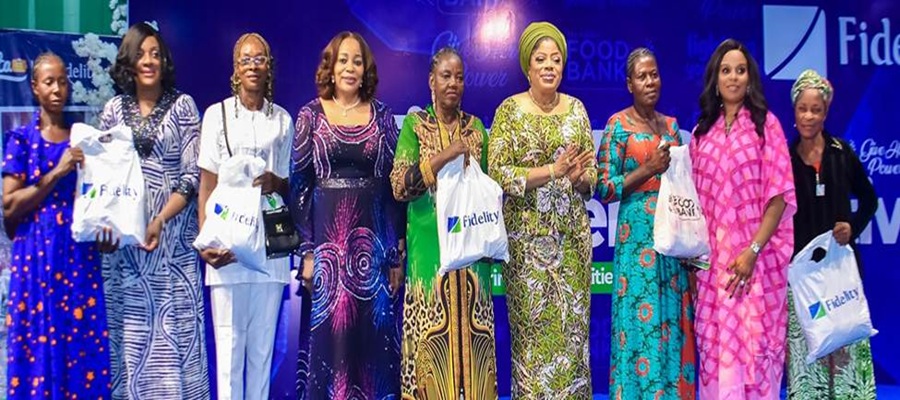
Fidelity Bank Plc, leading financial institution, has reaffirmed its commitment to sustainable social impact and economic inclusion through the empowerment of women and schoolchildren in Anambra State.

Fidelity Bank
The landmark intervention, held recently in Awka during the 2026 Fidelity Empowerment Programme, featured the distribution of 200 sewing and grinding machines to women entrepreneurs, N25 million in seed capital support, 1,500 food packs to vulnerable households, and 250 solar-powered school bags to schoolchildren.
The initiative was implemented in partnership with Healthy Living with Nonye Soludo, a Non-Governmental Organisation led by the Wife of the Governor of Anambra State, Dr. Mrs. Nonye Soludo.
Speaking at the event, the Managing Director and Chief Executive Officer of Fidelity Bank Plc, Dr. Nneka Onyeali-Ikpe, described the programme as a reflection of the Bank’s enduring commitment to empowering individuals, strengthening communities, and creating opportunities for sustainable growth.
According to the bank’s CEO, the initiative marked the first time that three of Fidelity Bank’s flagship social impact initiatives—the Fidelity Food Bank Initiative, Lighting Young Minds Programme, and Give Her Power Initiative—were brought together under a single intervention platform; and Anambra State is the first beneficiary.
“Today is more than an empowerment event; it is a demonstration of our belief that meaningful progress begins when people are given the tools and opportunities to succeed.

“At Fidelity Bank, our purpose goes beyond banking. We are committed to helping individuals realize their aspirations, overcome challenges, and build better lives.
“When communities thrive, businesses thrive; when families prosper, societies become stronger; and when people are empowered, possibilities become endless,” she stated.
Dr. Onyeali-Ikpe further noted that the Fidelity Food Bank Initiative continues to provide critical support to vulnerable households across Nigeria, particularly during a period of economic challenges affecting many families.
“Access to food remains a basic human need. By supporting vulnerable families, we are restoring dignity, strengthening resilience, and fostering greater social inclusion within our communities,” she added.
Speaking on the Lighting Young Minds Programme, Dr. Onyeali-Ikpe explained that the solar-powered school bags distributed to pupils are designed to enhance learning outcomes by providing a reliable source of light for studying after dark, especially in communities with limited access to electricity.
The programme also featured the Give Her Power Initiative, through which women received vocational tools and financial support aimed at promoting entrepreneurship, enhancing household income, and advancing women’s economic participation.
In her remarks, the Wife of the Governor of Anambra State, Dr (Mrs.) Nonye Soludo, commended Fidelity Bank for its unwavering commitment to uplifting vulnerable groups and investing in community development.
“We gather today, not merely to distribute items or celebrate another social impact initiative, but to reaffirm a simple truth: when we invest in people, we invest in the future. Every woman supported, every child empowered, and every family assisted represents a step towards building a stronger, healthier, and more prosperous Anambra State,” she said.
Mrs. Soludo expressed appreciation to Fidelity Bank for aligning with the vision of empowering communities and improving lives through impactful interventions.
“Beyond the empowerment items being distributed today, Fidelity Bank is investing in human potential, family stability, and community development. This partnership demonstrates the important role socially responsible organisations can play in advancing sustainable development and improving the quality of life of the people they serve,” she added.
The Fidelity Empowerment Programme forms part of Fidelity Bank’s broader commitment to driving positive social impact across Nigeria through targeted interventions in education, economic empowerment, food security, health, and community development.
Ranked among the best banks in Nigeria, Fidelity Bank Plc is a full-fledged Commercial Deposit Money Bank serving more than 10 million customers through digital banking channels, its 255 business offices in Nigeria and United Kingdom subsidiary, FidBank UK Limited.
The Bank is a recipient of multiple local and international awards, including the 2025 Development Bank of Nigeria (DBN) Innovation Award for MSME support; Best Retail and SME Bank Award from Independent Newspapers; Best Bank for Export & Trade Finance and Most Innovative Bank of the Year at the 2025 BusinessDay Banks and Financial Institutions (BAFI) Awards; and Nigeria’s Best Private Bank at the 2025 Euromoney Awards. The Bank also received the inaugural Most Improved Commercial Bank of the Year award by Nairametrics, the SME Bank of the Year award by NewsDirect, and the Straight-Through Processing (STP) Excellence Award by Citi Group, in addition to recognition by Global Brands Magazine for Excellence in Community Empowerment.


Debt Management Office (DMO) said the federal government spent N3.14 trillion on servicing its domestic debt in the first quarter of 2026.

The office disclosed the data in its latest domestic debt service report for Q1 2026.
The figure comprises N2.97 trillion in interest payments and N169.68 billion in principal repayments.
The agency said in January, the government spent N741.82 billion on domestic debt service, while the figure rose to N967.67 billion in February.
Debt service increased further to N1.43 trillion in March, bringing the total for the quarter to N3.14 trillion.
The March figure was 47.7 percent higher than the N967.67 billion recorded in February and 92.7 percent above the N741.82 billion spent in January.
Also, the debt office said interest payments accounted for about 94.6 percent of total domestic debt service during the quarter.
The DMO said treasury bills accounted for the largest share of interest payments at N1 trillion, while interest on federal government bonds stood at N1.96 trillion.
The agency said the government also paid N4.24 billion in interest on FGN savings bonds during the period.
The DMO said the principal component of the debt service comprised N169.68 billion in repayments on local-denominated promissory notes.
Overall, the government’s domestic debt service rose sharply through the quarter, with March accounting for almost half of the N3.14 trillion spent between January and March.
Nigeria’s public debt increased by 0.01 percent to N159.35 trillion in the Q1 of 2026.


Interswitch Group, an integrated digital payments and commerce company, together with global banking software provider, Temenos have reassured the Central Bank of Nigeria (CBN) of their commitment to advancing the modernisation of Nigeria’s financial services sector.

Interswitch and Temenos had earlier in June announced a strategic partnership across Africa which would see Interswitch leverage Temenos solutions – across core banking, digital banking, payments, wealth management and financial crime mitigation – to provide cloud-hosted and on-premises managed services to banks and financial institutions across Africa.
This will enable institutions to progressively transform their banking platform and evolve to more customer-centric business models. The service will initially support key African markets including Nigeria, Ghana, Côte d’Ivoire, Kenya and others.
The recent regulatory visit to CBN headquarters in Abuja, was led by the Founder and Group Chief Executive Officer of Interswitch, Mitchell Elegbe, and Managing Director for the Middle East and Africa (MEA) at Temenos, Santhosh Rao, as part of the ongoing efforts by both organisations to deepen collaboration with Central Banks across the African region on the future of digital banking infrastructure across Nigeria and key African markets.
Discussions centred on the strategic partnership between Interswitch and Temenos, and how it will enable Nigerian financial institutions to progressively modernise their core banking platforms and transition to more customer-centric business models.
The two organisations also explored opportunities to work with the CBN in charting new frontiers in Central Bank Digital Currency (CBDC) innovation, leveraging resilient financial networks and decentralised application platforms to support the issuance and management of CBDCs.
Commenting on the visit, Elegbesaid: “Our partnership as Interswitch with Temenos and our continued engagement with the Central Bank of Nigeria reflect a shared commitment to building banking infrastructure that is resilient, inclusive, and ready for the next phase of Africa’s financial evolution.
We are proud to be at the table as these conversations shape the future of digital banking technology and innovation across key Africa markets…”
The Bank of Industry, through BOI Financing SPV Plc, has opened subscriptions for its inaugural Series 1 Fixed Rate Bond worth up to N250bn under its $1bn multi-currency instruments programme, seeking to raise long-term capital to finance businesses across Nigeria’s priority sectors.

The offer, which opened on 5 August and closes on 11 August, is being arranged by Chapel Hill Denham as the lead issuing house. The five-year bond is priced within a yield range of 17.35 per cent to 17.50 per cent and will be listed on the FMDQ Securities Exchange.
According to the offer document, proceeds from the issuance will be deployed to finance eligible businesses and projects across sectors, including agriculture and food processing, healthcare, engineering and technology, renewable energy, petrochemicals, oil and gas, creative industries and solid minerals, in line with BOI’s development finance mandate.
The lender said the financing is expected to improve access to medium and long-term funding for Nigerian enterprises, expand productive capacity, create and preserve jobs, deepen local value addition, support import substitution, boost exports and strengthen domestic value chains.
BOI, Nigeria’s foremost development finance institution, said it has provided funding to more than one million businesses across the country and disbursed over N1.27tn between 2023 and 2025. The institution operates across 34 states and the Federal Capital Territory and is jointly owned by the Ministry of Finance Incorporated and the Central Bank of Nigeria.
The bank also highlighted its financial performance, reporting a 36 per cent compound annual growth rate in gross earnings between 2021 and 2025.
Interest income rose 64 per cent to N884bn in 2025 from N538bn in the previous year, while its capital adequacy ratio stood at 39 per cent, nearly four times the regulatory minimum of 10 per cent. Its non-performing loan ratio was 1.7 per cent, below the CBN’s prudential limit of five per cent.
The bond has been assigned AAA ratings by Agusto & Co. and Intelligence Africa, reflecting the issuer’s strong capitalization, profitability, liquidity and ownership structure.
The issuance is open to institutional and qualified investors with a minimum subscription of N5m and additional investments in multiples of N1m. Interest will be paid semi-annually at a fixed rate, while principal repayment will begin in the third year through equal semi-annual amortised instalments until maturity in 2031.
The bond is also exempt from tax, making it an attractive investment option for investors seeking stable returns amid expectations of declining interest rates.

Fake Agency: ICPC Indicts NITDA, Others over Inadequate Due Diligence

Tax Reform Built on Taxing Prosperity, Not Poverty– Adedeji

UNESCO Taps Oguamanam,Nigerian Scholar to Advisory Body on Science, Tech Ethics

MTN Alerts Subscribers over Fake 25GB Anniversary MTN Data Giveaway

X Replaces Revenue Sharing wit New Creator Rewards Programme

EFCC Busts NIS Visa Overstay Racket, Uncovers N700m in an Account

Fact-Check: Elon Musk’s “Tesla Pi Phone” is Internet Rumor

NBC Tasks Broadcasting Stations over 2028 DSO Global Deadline

NBC Scraps Annual Digital Access Fee on DSO

Glo Sponsored African Voices to Feature Netflix’s “The Polygamist” Stars




 General News2 days ago
Guinness Rewards Consumers with ₦17 Million in First Week of ‘Open for More’ Promo Draw

 News3 days ago
Glovo Pioneers AI Quick-Commerce

 News2 days ago
World Bank Debars United Aviation Services, Owner over Fraudulent Activities

 E-Business2 days ago
NITDA Introduces Cloud Certification Boost Data Localisation Compliance

 Telecom2 days ago
NCC, Enugu Sign Deal to Operate Digital Industrial Park, Learning Centre

 News2 days ago
Enugu State Approves Land for ITF’s Digital Fabrication Centre

 E-Financial2 days ago
BOI Opens N250Bn Bond Offer to Fund Businesses

 General News2 days ago
Meta Hit With $567m US Court Order Over Alleged Harm to Children