

News
Inec, NCS Lay Blueprint for e-Voting in 2011

The Independent National Electoral Commission (Inec) and the Nigeria Computer Society (NCS) have joined forces to computerize voting in Nigeria, which would give boost to democracy.
Both organizations had in November last year, held a retreat to brainstorm and fashion out an effective e-voting system that would allow for improved casting of vote and effective collation of election results, to put an end to unsavoury incidents witnessed in recent elections.
Prof. Charles Uwadia, president of NCS, who read the communiqué from the joint retreat between Inec and NCS, commended the electoral body for its commitment to improving the nation’s electoral process through ICT, which would by extension improve the well being of the citizens.
The retreat, he said, was held to examine the entire gamut of the electoral process and determine the role ICT can play, and then bring that to fruition.
Uwadia disclosed that at the end of the retreat, it was resolved that such problems as mass thumb printing of ballot papers, ballot stuffing, ballot box hijack, impersonation of voters, errors due to manual collation of results, multiple registration, among others associated with the current voting system; can be overcome with e-voting system.

According to him, “the retreat recognized that Inec has an existing communication backbone based on satellite communication technology, which network consists of a satellite gateway (control center), located at the Inec headquarters and terminals installed at remote locations (Inec state offices and all the local government areas of the federation).”
But he said some of the terminals at the remote locations had been vandalized, and so the retreat recommends the replacement of the redundant/inactive terminals with portable/mobile terminals and the deployment of additional terminals during periods of elections.
He said that it was recognized that the cost of the space segment on the network has huge financial implications, hence the retreat recommends that the electoral body should subscribe to the size of the space segment needed for its operational purposes during non-election years while the requirement should be scaled up during election year to meet the demands for the election results collation and dissemination.
Prof. Maurice Iwu, Inec chairman, represented by Engr. Emmanuel Akem, Inec’s director of ICT, reiterated that Inec and NCS’ partnership is geared towards harnessing the goods of ICT in the electoral process, adding that the Commission had done a lot in deploying ICT but needs to improve on what has been achieved.
The retreat recommends that Inec should explore the use of the GSM¬-Unstructured Supplementary Service Data (USSD) and General Pack Radio Service (GPRS) technologies to complement the existing light weight encrypted secure file socket transmission for election result transmission and collation.
It also recommends that when the systems for e-collation and e-dissemination of election results are fully implemented, the election results in Nigeria should under normal circumstances be published within the period of six hours after closing election polls in every part of the country.
The retreat identified machine failure, vote flipping, possibility of inaccurate transmission of election results, usability problems, as challenges associated with electronic voting system; while noting that these can be overcome with contemporary technologies.
It noted that electronic voting system offers the best available option to prevent election manipulation and to assure the integrity and sanctity of each vote that is cast, thereby recommending a system based on consensus protocol which will allow for three confirmatory evidences/witnesses/channels for each vote cast.
While recommending the distributed encryption technique for purposes of secured data transmission, the retreat re-emphasizes the importance of a comprehensive and accurate registered voters’ database – a critical national asset which must be well secured to provide the necessary platform for a reliable electoral system. This, the Inec needs to do in partnership with other relevant government agencies such as the National Identity Management Commission (NIMC), Federal Road Safety Commission (FRSC), Nigerian Immigration Service, among others.
The retreat observed that the level of skilled IT professionals in Inec needs to be enhanced through continuous training, and that Management and personnel of the Commission need requisite technology training to ensure smooth electoral process.
It recognized the need for Inec to strategically embark on programmes aimed at ensuring that the electorate and the entire public believe in its systems, processes and procedures.
The retreat, according to Prof. Uwadia, recommends that any e-voting machine that Inec might consider for deployment for the electoral process in Nigeria must possess the ability to capture at least 3-forms of confirmatory evidence for each vote cast, interface for real-time/wireless transmission of data, facility for accurate authentication of voters’ information, facility that allows the blind and visually impaired to cast votes unassisted.
Others include that the equipment battery life must last for a minimum of ten hours, must be fool-proof, tamper-proof and weather-proof to perform under any condition, have provision for verifiable audit trail; have provision that allows voters to confirm that their votes have been recorded as cast, voice prompt that could be customized in any Nigerian dialect, provision for automatic and periodic uploading of election results while voting is in progress.
Asked if the country is going to witness proper e-voting in the 2011 presidential elections, Engr. Akem said that would depend on how soon the resolutions at the retreat would be implemented, while stressing on the need for the amendment of the Evidence Act by the National Assembly to accommodate e-voting


Africa Prudential Plc has reaffirmed its commitment to sustainable growth and digital transformation after posting another strong half-year financial performance, driven by robust growth in its core registrar business, technology-driven solutions and increased activity in Nigeria’s capital market.

Speaking during the company’s H1 2026 Investor Call on Tuesday, the management outlined plans to deepen revenue diversification and accelerate innovation as part of efforts to reduce reliance on interest income and strengthen long-term profitability.
The company reported gross earnings of ₦4.28 billion for the first half of 2026, representing a 27 per cent increase from ₦3.34 billion recorded in the corresponding period of 2025.
Profit before tax rose by 22 per cent to ₦2.41 billion, while profit after tax climbed 18 per cent to ₦1.59 billion.
Net operating income also increased by 27 per cent to ₦4.21 billion, while total assets grew by 13 per cent to ₦46.53 billion. Shareholders’ funds similarly rose by 13 per cent to ₦12.52 billion.
According to the company, the impressive performance was driven by sustained growth in its registrar business, increased corporate actions across the Nigerian capital market, stronger treasury earnings supported by the prevailing interest rate environment and rising adoption of its technology-enabled products and services.African Mineral Wealth
Managing Director and Chief Executive Officer, Dr. Catherine Nwosu, said Africa Prudential is steadily evolving from a traditional share registrar into a diversified technology and business solutions provider serving the broader capital market ecosystem.
Addressing concerns from investors about the sustainability of earnings if interest rates decline, Nwosu said the company was deliberately expanding its non-interest income sources.
“Interest rates influence our treasury income positively, but that is why we are deliberately diversifying our revenue streams. Our strategy is to grow recurring fee-based business lines such as our digital solutions, Know Your Customer (KYC) services, AGM technology, probate services and the SabiVest mobile app. Over time, this will reduce our reliance on interest income and create a more balanced and resilient earnings mix,” she said.
She noted that increasing activity in the Nigerian capital market presents fresh opportunities for technology-driven solutions.
“With capital market activity nearly doubling over the past year, demand for seamless digital investor experiences, improved market efficiency and stronger compliance standards continues to grow. We are investing in technology-enabled solutions that position us to capitalise on these opportunities while delivering sustainable value to our shareholders,” she added.
Looking ahead, the company identified five strategic priorities for the second half of 2026, including driving sustainable growth through its core registrar business and new revenue streams, accelerating technology-led product innovation, strengthening brand leadership, investing in talent development and reinforcing corporate governance.
The investor call attracted institutional investors, shareholders, analysts, regulators and other capital market stakeholders, reflecting strong interest in Africa Prudential’s earnings outlook, revenue diversification strategy and long-term growth plans.
News
IHS Nigeria Donates Business-Support Equipment to Empower People with Disabilities in Abuja Community

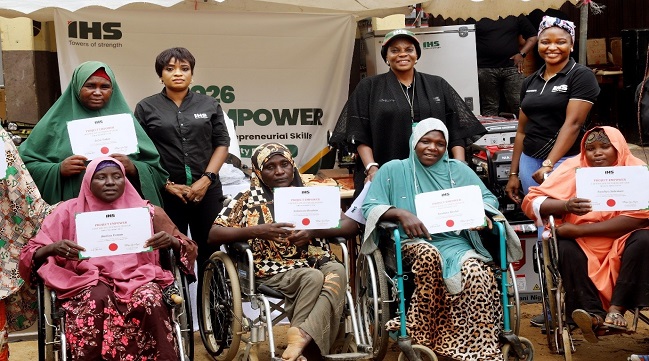
Communications infrastructure company, IHS Nigeria, has donated business support equipment to empower people with disabilities within the Karonmajiji community in the Federal Capital Territory, Abuja. This is part of the company’s commitment to drive inclusive community development and sustainable livelihood support under its Project Empower initiative.

The equipment was distributed to beneficiaries during a ceremony held in the community on Monday, July 27. The initiative was conceived following a community needs assessment and is designed to empower active traders by providing them with business tools rather than cash grants, thereby strengthening their businesses and ensuring long-term economic impact and accountability.
Speaking at the event, Director, Sustainability, IHS Nigeria, Titilope Oguntuga, described the initiative as a reflection of the company’s commitment to advancing inclusive development by equipping persons with disabilities with the tools and opportunities needed to build resilient livelihoods.
She explained that rather than providing short-term financial assistance, IHS Nigeria adopted an asset-based approach by donating 50 pieces of business support equipment, including sewing machines, freezers, generators and hairdressing kits, to the selected beneficiaries.
According to her, the intervention is designed to create lasting value by supporting entrepreneurship, promoting self-reliance and strengthening household incomes, while contributing to the achievement of the United Nations Sustainable Development Goals, particularly SDG 1 (No Poverty), SDG 8 (Decent Work and Economic Growth) and SDG 10 (Reduced Inequalities).
In his opening remarks, the Chief of the Karonmajiji Disabled Community, Alhaji Sulaiman Muhammed Katsina, represented by the Secretary of the Community, Alhaji Mohammed Dantani commended IHS Nigeria for its commitment to empowering persons with disabilities through practical and sustainable interventions.
He described the initiative as a demonstration of genuine partnership with the community and expressed appreciation for the company’s continued engagement with the Association, noting that the donation of the equipment was a significant investment in improving the livelihoods of persons with disabilities and would create meaningful economic opportunities for the beneficiaries and their families.
The event brought together traditional rulers, government representatives, leaders and members of the Karonmajiji Disabled Community Association, implementing partners, including Field of Skills and Dreams Vocational Technical and Entrepreneurship (FSD VTE) Training Institute and other community stakeholders, reaffirming a shared commitment to promoting inclusion and sustainable community development.
Project Empower reinforces IHS Nigeria’s commitment to advancing sustainable development through strategic partnerships that promote economic inclusion, strengthen community resilience and create opportunities for underserved communities.

The Chartered Institute of Bankers (CIBN) and the Association of Corporate Communication and Marketing Professionals in Banks (ACAMB) have enjoined banks to further deepen and prioritize financial inclusion, women’s empowerment and sustained growth through strategic mandates and frameworks, aimed at closing the financial gap and empowering more small, and medium enterprise (MSME) owners.

Both organisations made this call during a courtesy visit to the newly invested 24th President and Chairman of Council of the Chartered Institute of Bankers of Nigeria (CIBN), Dr. Dele Alabi, Ph.D, FCIB, as part of plans to congratulate him on his investiture as well as seek a stronger alliance between both bodies.
The visit followed Alabi’s investiture where he unveiled his “IMPACT” Vision, themed “Consolidating Our Local Impact, Enhancing Our Global Relevance.”
The vision rests on six pillars: Inclusion across geographic, gender, and generational lines; Membership growth and quality; Professionalism and ethics; Accountability; Competencies and skills development; Technology, automation, and innovation. Other areas of shared interest, include women empowerment, financial inclusion and literacy, as well as MSME clinics, all of which are top on his agenda.
Alabi explained that under him, the institute will be prioritising financial inclusion and women empowerment, because of its realisation that women are often the primary financial managers and caregivers in families. Access to savings, micro-credit, and insurance acts as a safety net during crisis and allows them to significantly improve living conditions.
He added that CIBN would be happy to drive joint knowledge sharing and exchange sessions with CBN and ACAMB across various platforms. “Educating the public through public awareness programmes, with ACAMB as the rallying point, is central to what we do,” he noted.
ACAMB President, Jide Sipe, who led the delegation, spoke in unison with the CIBN president, as he noted that, closing the inbalances in financial access help economies grow faster, reduces inequality, and encourages greater civic participation by all.

EFCC Arraigns 4 over Alleged $5.3m Fraud Scheme

CBN Orders N19Bn Refunds to Customers as Complaints Rise

Access Bank Debunks Shutdown Report, Vows Action against Perpetrators

Oye, AERE Raises Alarm as 8m MSMEs Collapse in 18 Months

Kaspersky Uncovers Cyber Threats Defining the First Half of 2026 in Nigeria, Others

NRC, Ponzi Scheme Collapses Resulting Loss of Billions of Naira

EFCC Busts NIS Visa Overstay Racket, Uncovers N700m in an Account

From Scarcity to Scale: What Africa Can Learn from India’s Agricultural Transformation

Tokenization, Blockchain Technology will Transform Financial Institutions – IMF

BON Establishes Six Ad Hoc Committees to Modernize Broadcasting




 Telecom2 days ago
Fact-Check: Elon Musk’s “Tesla Pi Phone” is Internet Rumor

 E-Financial2 days ago
Malpass, Ex World Bank Chief Raises Alarm over Nigeria’s Secretive Debt Structures

 Telecom2 days ago
How and Why Apps Deplete Data – ALTON

 E-Financial2 days ago
S&P Global Acquires Agusto & Co. to Strengthen Credit Ratings Across Africa

 News2 days ago
CIBN, ACAMB Push for Financial Inclusion, Women Empowerment

 Telecom2 days ago
Galaxy Backbone Soft Launches Government Service Portal to Simplify Access to Public Services

 E-Business2 days ago
NDPC Directs DCPMIs to Register with Agency or Face Legal Consequences

 Broadcasting2 days ago
Africa Prudential Posts N1.59bn Profit in H1 2026, Reaffirms Digital Growth Strategy