

Broadcasting
Dayo Samuel: An African Product Leader, Driving AI and Embedded Finance


Dayo Samuel
In this conversation, we’ll explore his journey, his approach to product leadership, and the lessons he’s learned along the way.
Dayo, Africa’s technology ecosystem is growing rapidly, but infrastructure challenges still exist. How do you approach building products that balance global best practices with the unique realities of African markets?
Dayo Samuel (DS): Yeah, so for me, it always starts with context. I’ve seen that when you just copy-paste global playbooks into African markets, it doesn’t always land because the realities on the ground are different. Things like payment infrastructure, internet reliability, and even how trust is built with users those are not the same as in Europe or the U.S.
So the way I approach it is to learn from global best practices things like user-centered design, iterative testing, strong product frameworks, research methodology but then adapt them with the realities here. For example, in embedded finance, you can’t assume every user has a credit card on file. You need to consider mobile money, offline access, or even social trust networks as part of the product design.
I prefer to run reasonably controlled, research-led experiments. What I mean by that is I spend time understanding the local constraints and user behaviors first through interviews, observation, or data and then I design quick pilots to test solutions against those insights. That way, the experiments are not just “try and see,” they’re actually grounded in the realities of the people we’re building for.
At the end of the day, I see my role as bridging both worlds: bringing in the structure and discipline of global product leadership, but staying close enough to the ground here in Africa to design for what’s real. That balance is what creates products that actually scale sustainably.
In markets where reliable data can be scarce or fragmented, how do you go about gathering and validating customer insights to guide your product decisions?
DS: Yeah, that’s a really common challenge here. Sometimes the data just isn’t complete or reliable, so you can’t just rely on dashboards or reports like you would in other markets. For me, it’s about triangulating insights from multiple sources. I combine whatever quantitative data is available even if it’s fragmented with qualitative research: talking directly to users, observing behavior in context, and understanding their real pain points.
Many African startups struggle with scaling beyond their first wave of users. From your experience, what does achieving true product–market fit in Africa look like, and how can companies measure it effectively?
DS: Yeah, achieving a product–market fit here is a bit different from other markets. In Africa, it’s not just about hitting growth numbers or downloads, it’s about building something that actually works for the people you’re serving, given local realities. For me, true product–market fit happens when users not only adopt the product but rely on it, tell others about it, and engage with it consistently, even in environments where infrastructure or trust can be challenging.
From my experience, getting there starts with really understanding the user: running research-led experiments, observing behavior in context, testing assumptions, and iterating quickly. For example, in embedded finance, we had to validate whether people would trust a new payment flow or rely on it for recurring transactions and that meant combining qualitative insights with small pilots before scaling.
As for measuring it, I focus on a few key signals: retention over time, engagement metrics that show real usage, and how much users become advocates for the product. In Africa, sometimes the numbers alone don’t tell the story so combining quantitative metrics with qualitative feedback is what really shows whether you’ve found a product that fits the market.
Monetization is often tricky in Africa, where consumers are highly price-sensitive. How do you design business models that are both inclusive and sustainable in the long term?
DS: Yeah, monetization here definitely has its challenges. For me, it’s about designing business models that meet people where they are affordable, accessible, and relevant while still making the product sustainable. I combine user research with small experiments to test pricing, payment methods, and value perception. For example, with embedded finance, we explored mobile-money-first flows and tiered pricing, validating what people would actually pay for before scaling. It’s all about balancing inclusivity with long-term viability.
There’s a growing demand for skilled product managers across Africa, but the talent pipeline is still maturing. How have you built or mentored product teams to deliver global-standard products while staying rooted in local context?DS: Yeah, building product teams here is definitely about balancing global standards with local realities. For me, it starts with hiring people who are curious and adaptable, not just technically strong, but willing to learn from the market and the users. Then, I mentor them through research-led, hands-on experiences: small experiments, pilots, and iterative testing that are rooted in local context.
I also emphasize frameworks and processes from global best practices things like structured roadmaps, clear metrics, and user-centered design but always adapt them to what actually works here. Over time, this approach helps teams deliver products that meet international quality, but are also deeply relevant and usable for African users.
With global tech giants entering African markets, how can local product managers differentiate their solutions and compete on both value and scale?
DS: Local product managers win by deeply understanding the market and designing for realities global players might overlook things like offline access, mobile money, and social trust. I focus on research-led experiments to test solutions quickly, combining local insights with global best practices. That’s how you deliver products that are both relevant and scalable.
Fintech, mobility, and e-commerce have all seen significant regulatory attention in Africa. How do you navigate shifting government policies while ensuring product innovation isn’t stifled?
DS: Regulation is definitely a big factor here, so I treat it as part of the product strategy, not a blocker. I stay close to policy updates, engage with stakeholders early, and design flexible solutions that can adapt as rules change. At the same time, I ensure experimentation culture to keep innovation moving, so we’re iterating and learning without risking compliance. It’s about being proactive, adaptable, and user-focused.
Partnerships with telcos, banks, and even governments often determine the success of African products. What’s your framework for evaluating and structuring partnerships that drive adoption?DS: Partnerships start with alignment, understanding what the partner can bring and how it adds value to the user. I evaluate potential partners based on reach, trust, operational capability, and shared incentives. Structuring the partnership is about clear roles, measurable goals, and flexibility to iterate. I also run small pilots early to test assumptions before scaling, so the partnership drives real adoption, not just theoretical impact.
Africa is made up of 54 very different markets. What strategies have worked best for you when trying to scale a product across multiple countries on the continent?
DS: Scaling across Africa is all about balancing standardization with local adaptation. I start with a core product framework that works universally, but I don’t assume it fits every market out of the box. I spend time understanding local behaviors, regulations, and infrastructure, then run small, research-led pilots in each market to validate assumptions before full rollout.
I also focus on building modular solutions things like flexible payment flows or language support that can be adjusted per market without redesigning everything. And finally, I prioritize partnerships and local teams who understand the context; they’re key to scaling efficiently while keeping the product relevant and trusted.
Finally, looking ahead, with technologies like AI, blockchain, and digital identity gaining traction, what do you see as the biggest product opportunities in Africa over the next decade?
DS: Looking ahead, I see huge opportunities at the intersection of technology and local needs. AI can help personalize financial services, credit scoring, and even healthcare in ways that were impossible before. Blockchain opens doors for transparent transactions, secure identity, and cross-border payments. Digital identity, in particular, is foundational once people can prove who they are, a lot of services become accessible, from banking to government programs.
For me, the biggest product wins will be solutions that combine these technologies with a deep understanding of local context solving real problems for users while building trust and accessibility. Products that do that will scale fast and have lasting impact.



National Broadcasting Commission (NBC) and the Independent National Electoral Commission (INEC) are set to introduce a joint broadcast monitoring framework ahead of the 2027 general elections as part of efforts to curb unethical broadcasting and promote responsible election coverage.

Charles Ebuebu, director-general, NBC, who disclosed the plan recently, said the collaboration would strengthen election monitoring through the deployment of advanced technology and closer coordination between regulatory agencies.
According to him, the increasing influence of digital and online platforms has made it imperative for regulators to work together rather than operate independently.
“We have written to INEC, and we are going to have a joint monitoring outlook over the elections. Gone are the days when agencies work in silos. When we coordinate, we’re able to monitor more effectively,” Ebuebu said.
He explained that the partnership would enable both agencies to jointly identify and address violations of broadcasting regulations during the election period instead of handling such issues separately.
Beyond INEC, Ebuebu said the NBC is also partnering with other key regulators to strengthen oversight of election-related content across digital platforms.
According to him, the commission is finalising agreements with the Nigerian Communications Commission (NCC) and the National Information Technology Development Agency (NITDA) ahead of the polls to reinforce its monitoring capabilities.
“We are calling in other stakeholders to reinforce the election monitoring. We are signing agreements with the Nigerian Communications Commission and the National Information Technology Development Agency before the elections,” he said.
Ebuebu also revealed that the NBC is upgrading its monitoring infrastructure with artificial intelligence (AI)-powered tools to keep pace with the rapidly expanding media landscape.
He noted that the proliferation of online platforms has made traditional monitoring methods inadequate.
“With online platforms, there are thousands of them. You need more than staff; you need AI monitoring facilities,” he said.
The NBC chief added that the commission has significantly improved its monitoring capacity and can currently track nearly 50 broadcast channels from its monitoring centre in Abuja.
He said additional monitoring facilities would be established across the country in line with evolving broadcasting technologies.As part of preparations for the 2027 elections, Ebuebu announced plans for a sensitisation workshop in Ibadan that will bring together broadcasters, INEC officials, security agencies and other stakeholders.
He said the engagement had become necessary as political discussions surrounding elections continue to grow more heated, including on television, stressing the need for broadcasters to adhere to professional standards.
Ebuebu noted that the commission has had to issue several warnings to broadcast stations for violating the broadcasting code during election periods.
“We have had to write several of them because they simply forget what the code says,” he said

Mrs. Clementine Wamba, head, Digital Switch Over (DSO) at the National Broadcasting Commission (NBC), has stressed the need for broadcasting stations and practitioners nationwide to work towards meeting the 2028 global deadline for the switch over.

She made the call in her presentation titled, “DSO Big Picture: Free TV Audience Measurement and the Evolving Media Landscape”, at the 2026 NBC South West Summit held in Ibadan.
Wamba harped on the need for practitioners to adopt DSO in the transmission of news and other programmes in order to meet future challenges, stating that any country that fail to align with the DSO by 2028 will be shut out of practice.
This development, according to her, may result in job losses and other consequences that could hinder the growth of the industry in Nigeria, noting that Free TV is tailored towards the DSO, with provision for many channels in contrast to the age-long analogue system.
According to her, “The Digital Switch Over is a technological improvement on the age-long analogue style of broadcasting in the country. With the adoption of the DSO, practitioners will be in tune with global practice of broadcast journalism.
“Also, its benefits include efficient use of spectrum, changing of industry landscape, more access to national development programmes and better viewing experience.”
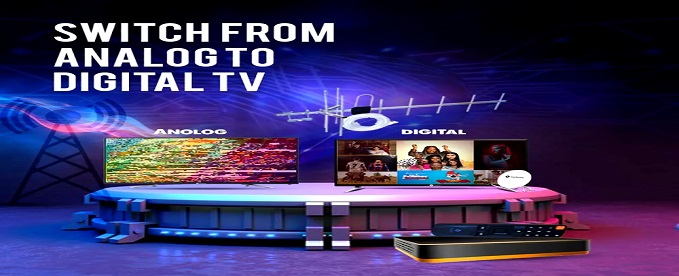
National Broadcasting Commission (NBC) has said that Nigerians will no longer pay annual Digital Access Fees under the renewed Digital Switch Over (DSO) project.

Charles Ebuebu, director-general, NBC, disclosed this in an exclusive interview with the News Agency of Nigeria (NAN) on Wednesday in Abuja,
Ebuebu said viewers only need to purchase an approved decoder and satellite dish which cost below N20,000 to enjoy free television permanently.
“Previously, users paid an annual digital access fee of about N1,500, described as an administrative charge.
“The new system removes that annual fee. It provides free access to free-to-air television channels without any payment.
“Premium channels will be introduced later. Viewers who want those additional channels will be able to access them through paid services.
“Nigerian content on free-to-air channels remains free to watch. Unlike Pay TV, this platform does not require monthly subscriptions for its basic service,” he said
Ebuebu said approved decoders for the FreeTV will cost less than N20,000 and authorised sales outlets will soon be announced.
He urged Nigerians to wait for official information on approved dealers for the DSO decoders, warning that unauthorised sellers are exploiting growing public demand.
He reiterated that people only need a free-to-air decoder, along with a satellite dish instead of the old antenna system to receive the DSO signal.
“Once the equipment is installed, viewers can access all available channels across the country without paying any subscription fees,” he stressed
The DG dismissed claims by some retailers that there are different categories of decoders sold at varying prices, stressing that such sellers are not authorised by the commission.
According to him, the NBC will soon publish the list of approved dealers, official prices, and locations where genuine decoder boxes and accessories can be purchased.
The NBC boss said the DSO project is designed not only to improve television broadcasting but also to stimulate economic growth by creating jobs, attracting investment, and opening up opportunities for businesses that support the broadcasting industry.
Ebuebu noted that content producers and broadcasters stand to benefit significantly from the nationwide reach of the DSO platform.
Unlike the previous system, where many stations had limited regional audiences, he said the new platform will make their channels available to viewers across Nigeria.
He added that the introduction of audience measurement technology will provide scientific and reliable data on television viewership.
Ebuebu added that audience measurement technology will give advertisers greater confidence in placing adverts and enable broadcasters to demonstrate the true size and reach of their audiences nationwide.

YEDC Warns Customers, Says 20 Percent Electricity Bonus is Scam

FG to Support 12 Tech Startups with N482m under iDICE

NBC, INEC, Plan Joint Broadcast Monitoring Framework ahead of 2027 Elections

No Going Back on July 31 Deadline for Insurance Firms’ Recapitalisation – NAICOM

Court Affirms FCCPC’s Power to Regulate Digital Lending

NRC, Ponzi Scheme Collapses Resulting Loss of Billions of Naira

NASENI Moves to Digitize CCB’s 5m Assets Declaration and Operations

Lebara Nigeria Launches Lebara Play, Africa’s First Telecom-Owned Micro-Drama Platform

CANAL+ Partners Samsung to Pre-Load DStv Stream on New Samsung TVs In Nigeria, Other African Countries

Tokenization, Blockchain Technology will Transform Financial Institutions – IMF




 News1 day ago
NIMASA Unveils Accelerator Scheme to Drive Innovation, Sustainable Growth

 E-Financial1 day ago
Access Holdings Sells 7.44% Stake in Ghana Unit

 E-Financial1 day ago
NRS Issues July 31 Deadline for e-Invoicing Compliance

 E-Business1 day ago
SERAP to Sue NASS over Bill Empowering NDPC to Regulate Social Media

 News1 day ago
ICPC Secures Final Forfeiture of N941m Linked to IPPIS Fraud

 E-Financial1 day ago
NDIC Urges Youths to Shun Ponzi Schemes, Embrace Savings

 News1 day ago
Adebutu, PDP Chieftain Accuses Nigerian Governors of Embezzling LG Allocations

 News1 day ago
eBusinessLife Advocates Greater Support for Girls in ICT as Students Showcase AI Innovations