

General News
Paradigm Initiative Condemns the Internet Shutdown and Media Restrictions in Uganda Ahead of the 2026 General Election


Paradigm Initiative (PIN) strongly condemns the internet shutdown implemented in Uganda ahead of Thursday’s general election, as well as the restrictions placed on media coverage of protests and demonstrations. These actions constitute serious violations of digital rights, media freedom, and democratic principles at a critical moment in the country’s electoral process.

Internet Shutdown
Evidence indicates that internet access across Uganda has been disrupted, affecting social media platforms, messaging services, and online news outlets.
This development comes despite earlier public assurances by the Uganda Communications Commission that the government did not intend to shut down the internet during the elections.
The shutdown represents a troubling reversal of that commitment and raises serious concerns about transparency, accountability, and respect for fundamental rights.
Uganda has a well-documented history of internet shutdowns during elections, including during the 2016 and 2021 general elections. In 2021, a near-total internet blackout lasted several days, severely undermining freedom of expression, access to information, election observation, media reporting, and economic activity.
Repeating these measures despite widespread national, regional, and international condemnation demonstrates a continued pattern of using digital restrictions as a tool of election management.
Paradigm Initiative further condemns directives preventing media houses from covering protests or demonstrations during this period. Such restrictions violate media freedom and the public’s right to receive information, and undermine the role of the press as a democratic watchdog. Suppressing coverage of protests fuels misinformation, heightens tension, and erodes public trust in the electoral process.
Article 29 of the Constitution of the Republic of Uganda guarantees the rights to freedom of expression, freedom of the press and other media, and access to information. Uganda is also a State Party to the International Covenant on Civil and Political Rights (ICCPR) and the African Charter on Human and Peoples’ Rights, which protect these rights under Articles 19 and 9, respectively.
Any restriction on these rights must meet the strict tests of legality, necessity, proportionality, and legitimate aim. Blanket internet shutdowns and platform restrictions fail these tests and are incompatible with Uganda’s constitutional and international obligations.
At the international level, the United Nations Special Rapporteur on the promotion and protection of the right to freedom of opinion and expression, together with other UN Special Procedures mandate holders, has consistently affirmed that internet shutdowns are inherently disproportionate and can never be justified under international human rights law, including during elections, protests, or periods of political tension.
The African Commission on Human and Peoples’ Rights has recently issued a specific call urging the Government of Uganda to keep the internet on and to respect freedom of expression and media freedom during the current electoral period.
This call builds on established African human rights standards, including Resolution 580 on Internet Shutdowns and Elections in Africa and Principle 38 of the Declaration of Principles on Freedom of Expression and Access to Information in Africa, which prohibits States from interfering with access to digital technologies.
Internet Service Providers and technology companies operating in Uganda also bear responsibility under the UN Guiding Principles on Business and Human Rights to respect human rights, ensure transparency, and avoid complicity in unlawful or disproportionate restrictions on connectivity.
Paradigm Initiative calls for:
The immediate restoration of full internet access across Uganda and an end to all forms of digital disruption during and after the electoral period.
The withdrawal of all directives restricting media coverage of protests, demonstrations, or political developments during elections.
Accountability from Internet Service Providers, including the publication of transparency reports to users detailing government orders affecting internet access.



As part of Connecting Africa, CNN’s Victoria Rubadiri meets companies making deals to expand intra-regional trade. She also sits down with Sanya Alleyne the Adviser to the Organization of Eastern Caribbean States (OECS) Business Council to get a sense of the current landscape of South-South trade.

At the Afri-Caribbean Investment Summit in Abuja, Nigeria, Rubadiri meets Aisha Maina, the brains behind the summit who believes providing the opportunity to meet face to face is the pathway to creating a tangible trade link. She explains why this is her belief, “When you go to the Caribbean and you go anywhere in the world, they talk about African drums, they have the African dances, but because they’re so far away from Africa, it’s what has been handed down. And I wanted them to see the real thing, what we have […] it has become a flourishing relationship, and that’s why I keep saying that the bridge is built. Because they have connected.”
From agriculture to financial services, businesses leaders have said that no sector should be overlooked if new partnerships are to be formed. Alleyne delves into how this looks for trade with the Caribbean, “The Caribbean has a longstanding history in being able to attract foreign direct investment. And the same goes for the continent of Africa. It is just about being able now to drill down into the weeds of it and being able to flesh out a framework that we can be able to facilitate, create a trade.”
For Alleyne, the next ten years are hoping to hold, “Regular commercial flights between the continent and the region. I think success would be being able to trade in our indigenous currencies to settle payments. And I also believe success would be the ability of our peoples to understand each other, become closer, and see ourselves as one.”
General News
NATEP Advances Policy Reform and Expanded International Partnerships A Year After Relaunch

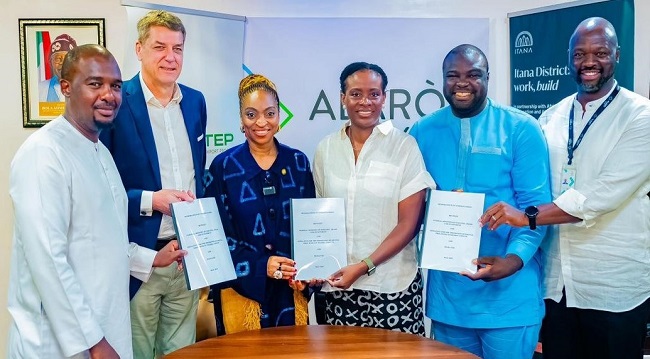
The National Talent Export Programme (NATEP) marks one year since its strategic relaunch with significant institutional progress, policy milestones, and international partnerships that have repositioned Nigeria as a major talent hub in the global services export economy.

The most decisive of those milestones came in November 2025, when the Federal Executive Council (FEC) approved the establishment of the National Coordination Mechanism for Services Exports (NCMSE), creating a formal governance framework to strengthen inter-agency coordination, align national policy with global digital trade, and accelerate the growth of Nigeria’s services export sector.
Since its approval, the NCMSE has provided the institutional architecture for bringing together previously disconnected programmes, agencies, and stakeholders under a common services export agenda. By fostering greater alignment among key institutions—including National Information Technology Development Agency (NITDA), Outsource To Nigeria Initiative (OTNI), and flagship talent initiatives such as 3MTT—the mechanism is helping to improve policy coherence, streamline implementation, and position talent development as a strategic driver of Nigeria’s services export competitiveness.
Building on this foundation, the Nigeria Talent Accelerator Network (NTAN) was officially launched in Lagos, in partnership with the World Economic Forum (WEF). It is co-chaired by the Federal Ministry of Industry, Trade and Investment and the Ministry of Education, along with private-sector leaders from Africa Finance Corporation (AFC) and Flour Mills of Nigeria. This formally enters Nigeria into the WEF Global Accelerators Network, uniting public, private, and development sectors behind a unified workforce roadmap.
“We are witnessing a shift in the global economy, where greater value and the competitive advantage will be determined by a nation’s ability to cultivate talent, harness deep knowledge-based industries, and participate in high-value services markets built seamlessly across borders. As Africa becomes a more integrated marketplace, the continent has a unique opportunity to emerge as the leading contributor to the world’s talent economy.
“NATEP is laying the foundation for Nigeria to lead this transition by unlocking the full potential of our human capital, strengthening international partnerships, and positioning Nigerian talent at the centre of the next era of global services trade.” — Honourable Minister of Industry, Trade, and Investment; Dr. Jumoke Oduwole, MFR
NATEP also intensified efforts to deepen international partnerships that support Nigeria’s services export ambitions. Under the World Economic Forum’s Future of Jobs Survey, a country-partner mandate was activated to mobilise senior business leaders and ensure Nigeria’s labour market realities are reflected in global workforce assessments and benchmarking exercises.
Concurrently, NATEP has commenced the development of an innovative financing framework to support talent development and export-led growth. The proposed four-layer capital stack combines catalytic public investment with outcomes-linked private capital, adapting global financing models to Nigeria’s economic realities and workforce priorities.
NATEP working with the Nigeria Outsourcing Association also partnered with the Global Business Services sector to streamline the Association in line with global best practice, further strengthening Nigeria’s credentials as a premier hub for international services outsourcing.
These partnerships have been matched by equally significant progress on the domestic policy front. In March 2026, a zero draft of Nigeria’s National Outsourcing Policy was forwarded to the Federal Ministry of Industry, Trade and Investment for interministerial review, establishing the foundational architecture for a sector with transformative economic potential.
Across the programme’s Technical Working Groups (Demand, Supply, and Enabling Environment), implementation plans have been formalised, workstream leadership structures established, and talent development pathways validated, helping to consolidate a coherent national framework for talent supply, workforce readiness, and export competitiveness.
The Enabling Environment Technical Working Group has adopted WTO/GATS taxonomy standards and mapped five priority digital export sectors- Software/SaaS, Data and AI, Cybersecurity, Fintech, and BPO/ITES- equipping Nigeria to compete aggressively in the highest-growth segments of global digital trade.
“Our mandate at NATEP is to position Nigeria as a premier global talent hub by building an enabling ecosystem through policy, platforms, promotion, and partnerships,” said Teju Abisoye, National Coordinator of NATEP. “The progress achieved over the past year brings us closer to our strategic objectives of enabling one million direct export-linked jobs, supporting millions more indirect jobs, attracting significant investment into the sector, and equipping Nigerians with globally recognised skills and certifications. Nigeria is not only preparing for the future of work; it is helping build the policy and institutional foundations required to compete and lead in it.”
As NATEP enters its next phase, the programme’s focus shifts decisively toward implementation at scale: operationalising the Private Sector-backed financing framework, advancing the National Outsourcing Policy through the policy approval process, and mobilising the full capabilities of NTAN to deliver workforce outcomes that strengthen Nigeria’s position in the global services export economy.

Central Bank of Nigeria (CBN) has reportedly granted Union Bank of Nigeria, Polaris Bank and Keystone Bank additional time to complete their recapitalisation process following the expiration of the March 31 deadline set for all banks.

CBN
Sources familiar with the development said the apex bank approved a three-week regulatory window to enable the three institutions, currently under intervention management, to conclude outstanding aspects of their recapitalisation plans.
The sources indicated that the decision was informed by the unique legal and regulatory challenges facing the banks, particularly issues relating to ownership disputes and ongoing judicial proceedings.
Under the CBN’s recapitalisation programme, commercial banks with national licences are required to maintain a minimum share capital and share premium of N200 billion, while those with international authorisation are expected to have N500 billion. Banks operating with regional licences are required to maintain a minimum capital base of N50 billion.
The three banks are estimated to require at least N350 billion collectively to retain their national banking licences under the new capital framework.
Industry sources said the institutions were exploring several options, including fresh capital injections from investors, licence restructuring and possible mergers or acquisitions, although they were reportedly inclined towards standalone recapitalisation strategies.
The banks also have the option of downgrading their operations to regional banking licences, which require a lower capital threshold.
The CBN had, in January 2024, dissolved the boards and management of Union Bank, Polaris Bank and Keystone Bank, citing infractions related to regulatory non-compliance, corporate governance failures and violations of conditions attached to their operating licences.
According to the apex bank, the affected institutions were found to have engaged in activities that posed risks to financial stability, contrary to provisions of the Banks and Other Financial Institutions Act (BOFIA) 2020.
Legal disputes have since complicated the ownership structure of some of the banks. In the case of Union Bank, former shareholders recently secured a judgment at the Federal High Court voiding the bank’s takeover by the CBN. The apex bank has appealed the ruling.
At the conclusion of the banking recapitalisation exercise on March 31, the CBN announced that 33 banks successfully met the revised minimum capital requirements.
The apex bank disclosed that Nigerian banks raised about N4.65 trillion in fresh capital during the 24-month exercise, with 72.55 per cent sourced from domestic investors and 27.45 per cent from international markets.
The CBN described the outcome as a significant boost to the resilience of the banking sector and its capacity to support economic growth.
In a statement issued after the exercise, the apex bank noted that a limited number of institutions remained subject to ongoing regulatory and judicial processes, which were being addressed through established supervisory and legal frameworks.
CBN Governor, Olayemi Cardoso, had previously assured depositors and stakeholders that the three banks remained fully operational and that measures were being taken to resolve all outstanding issues.
He said the apex bank would continue to support efforts by the affected institutions to address their legal and regulatory challenges while safeguarding financial system stability.

Legend Internet Reports Losses despite N505m Revenue

INEC Probes Claims of Leaked Voter Data from CVR System

Ecobank Raises Record $450m in Nature Bond for Africa’s Biodiversity

NPS, New Payment Infrastructure Hits 153,000 Transactions in Pilot Phase

African Electric Vehicle Platform Raises $215m to Scale Electric Mobility in Nigeria, Others

MTN, VDT, Zoracom, Digital Realty Back 2026 Girls in ICT Campaign

Vitel Wireless Partners Fintechs to Expand Access to Services

CPN Begins Crackdown on Quack IT Professionals, Vows Tougher Action against Cybercrime

Nigeria Hit by 24.1m Data Breaches – Surfshark

Kaspersky Identifies Ongoing Supply Chain Attack on Official Daemon Tools Website Distributing Backdoor Malware




 Telecom2 days ago
NCC Retains Rudman as Chair of Newly Inaugurated IPv6 Council Board, Urges Advancement of Nigeria’s Digital Migration

 E-Financial2 days ago
POS Operators Threaten to Suspend Services over Exclusivity Practice

 E-Financial2 days ago
Nigerian Banks Under Pressure as Bad Loans Hit 8.03% After CBN Policy Shift

 E-Financial2 days ago
Banks Lending to FG Hit N15.66 Trillion in One Year– CBN

 Telecom2 days ago
MTN, ALTON, Upperlink, NiRA back 2026 Nigeria DigitalSENSE forum, awards

 E-Business1 day ago
AI and IoT Hold the Key to Nigeria’s Economic Future – NCC

 Broadcasting1 day ago
Good News for DStv Users: Watch over 160 Channels Without Paying Extra

 General News2 days ago
AfDB Says 70 Percent of Nigerian Firms Depend on Generators