

E-Financial
Iran-Israel-US Conflict and CBN’s FX Gains: A Stress Test for Nigeria’s Monetary Stability

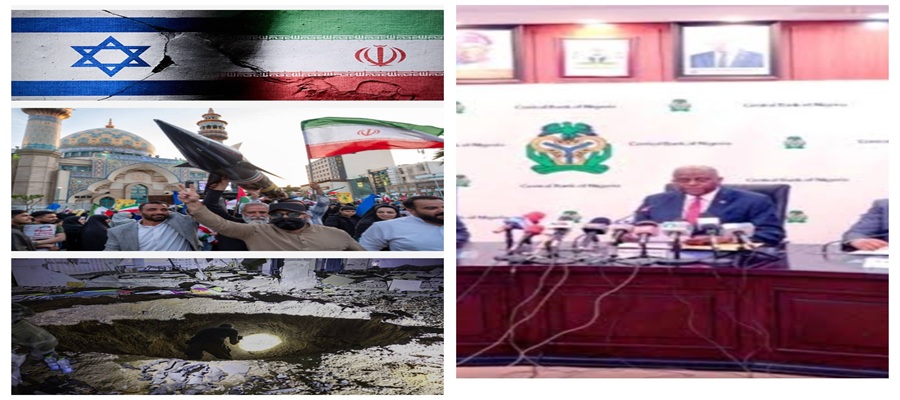
Blaise Udunze
At the 304th policy meeting held on Wednesday, the 25th February, the Central Bank of Nigeria’s (CBN) Monetary Policy Committee cut the rate by 50 basis points to 26.5 percent from 27 percent, which has been widely described as a cautious transition from prolonged tightening to calibrated easing.

CBN
The CBN stated that the decision followed 11 consecutive months of disinflation. The economy witnessed headline inflation easing to 15.10 percent in January 2026, and food inflation falling sharply to 8.89 percent. Foreign reserves are climbing to $50.45 billion, their highest level in 13 years. The Purchasing Managers’ Index is holding at an expansionary 55.7 points.
As reported in the paper, no doubt that the macroeconomic narrative appears encouraging. On a closer scrutiny, the sustainability of these gains is now being tested by forces far beyond the apex bank’s policy corridors. This is as a result of the clear, direct ripple effect of the escalating conflict between Iran and Israel, with direct military involvement from the United States, has triggered one of the most significant geopolitical energy shocks in decades. For Nigeria, the timing is delicate. Just as the CBN signals confidence in disinflation and stability, global volatility threatens to complicate and possibly distort its monetary path.
The rate cut, though welcomed by many analysts, must be understood in context. Nigeria remains in an exceptionally high-rate environment. An MPR of 26.5 per cent is still restrictive by any standard. The Cash Reserve Ratio (CRR) remains elevated at 45 per cent for commercial banks, and this effectively sterilises nearly half of deposits, while liquidity ratios are tight, and lending rates to businesses often exceed 30 per cent once risk premiums are included. The adjustment is therefore incremental, not transformational.
The Director/CEO of the Centre for the Promotion of Private Enterprise (CPPE), Dr. Muda Yusuf, has repeatedly noted that Nigeria’s deeper challenge lies in weak monetary transmission. According to him, even when the benchmark rate falls, structural rigidities, high CRR, elevated deposit costs, macroeconomic uncertainty, and crowding-out from government borrowing prevent meaningful relief from reaching manufacturers, SMEs, agriculture, and other productive sectors. Monetary easing, without structural reform, risks becoming cosmetic. The point is that even before structural reforms take effect, the fact is that an external shock will first reshape the landscape.

The Iran-Israel conflict and US involvement have reignited fears in global energy markets. Joint U.S. and Israeli strikes on Iranian targets and retaliatory missile exchanges across the Gulf have unsettled oil traders. Brent crude, already rising in anticipation of escalation, surged toward $70-$75 per barrel and could climb higher if shipping through the Strait of Hormuz, through which nearly 20 per cent of global oil supplies pass, faces disruption. It is still an irony that a major crude exporter is also an importer of refined petroleum products.
Higher crude prices offer a theoretical windfall. For Nigeria’s economy, it is well known that oil remains its largest source of foreign exchange and accounts for roughly 50 per cent of government revenue. The good thing is that rising prices could boost reserves, improve forex liquidity, strengthen the naira, and ease fiscal pressures. In theory, this external cushion could support macroeconomic stability and reinforce the CBN’s easing posture.
However, the upside is constrained by structural weaknesses. Nigeria’s oil production remains below optimal capacity. A significant portion of crude exports is tied to long-term contracts, limiting immediate gains from spot price surges. As SB Morgen observed in its analysis, Nigeria’s “windfall” is volatile and limited by soft production performance.
More critically, Nigeria’s dependence on imported refined products exposes it to imported inflation. Rising global crude prices increase the cost of petrol, diesel, jet fuel and gas. With fuel subsidies removed, these increases are passed directly to consumers and businesses. Depot pump prices have already adjusted upward amid Middle East tensions.
Energy costs are a primary driver of Nigeria’s inflation and this has remained sacrosanct. When fuel prices rise, transportation, logistics, food distribution, power generation, and manufacturing costs will definitely skyrocket, as well as the inflationary impulse spreads quickly through the economy. This will push households to face higher food and transportation costs. Businesses see shrinking margins. Real incomes erode.
Thus, the same oil shock that boosts government revenue may simultaneously reignite inflationary pressure, precisely at a moment when the CBN has begun cautiously easing policy.
This dynamic introduces a difficult policy dilemma, even as this could be for the fragile gains of the MPC. This is to say that if energy-driven inflation resurges, the CBN may be forced to pause or reverse its easing cycle. It is clearly spelled that high inflation typically compels tighter monetary conditions. As Yusuf warned, geopolitical headwinds that elevate inflation often push central banks toward higher interest rates. A renewed tightening would strain credit conditions further, undermining growth prospects.
There is also the risk of money supply expansion. Increased oil revenues, once monetised, can expand liquidity in the domestic system. Historically, surges in oil receipts have been associated with monetary growth, inflationary pressure, and exchange rate volatility. Without sterilisation discipline, a revenue boost could ironically destabilise macro fundamentals.
The exchange rate dimension compounds the complexity. Heightened geopolitical risk, just as it is currently playing out with the Iran-Israel conflict, often triggers global flight to safety. This will eventually lure investors to retreat to U.S. Treasuries and gold. Emerging markets face capital outflows. If it happens that foreign portfolio investors withdraw from Nigeria’s fixed-income market in response to global uncertainty, pressure on the naira could intensify.
Already, the CBN has demonstrated sensitivity to exchange rate dynamics by intervening to prevent excessive naira appreciation. A sharp rate cut in the midst of global volatility could destabilise carry trades and spur dollar demand. What should be known is that the 50-bps reduction reflects not just domestic disinflation, but global risk management such as geopolitical tensions, oil prices, and foreign investor sentiment.
Beyond macroeconomics, geopolitical implications carry security concerns. Analysts warn that a widening Middle East conflict could embolden extremist narratives across the Sahel and it directly has security consequences for Nigeria and the broader region. Groups such as Boko Haram and ISWAP may exploit anti-Western framing to recruit and mobilise more followers in the Sahel region, thereby giving the extremist groups new propaganda opportunities. The pebble fear is that a diversion of Western security resources away from West Africa could create regional vacuums. What the Nigerian economy will begin to experience is that security instability will disrupt agricultural output, logistics corridors, and investor confidence, feeding back into inflation and slow economic growth and as ripple effects, the economy becomes weaker.
Nigeria’s diplomatic balancing act adds another layer of fragility because it is walking on a tactful tightrope. The country is trying not to upset anyone, but maintains cautious neutrality, urging restraint while preserving ties with Western allies and Middle Eastern partners. Yet rising tensions globally between major powers, including Russia and China, complicate the geopolitical chessboard. Invariably, this will have a direct impact as trade flows, remittances, and investment patterns may change unexpectedly, affecting Nigeria’s economy.
With the current conflict in the Middle East, the prospects for economic growth also face renewed strain or are under increased pressure. The stock markets in developed countries have been fluctuating a lot because people are worried that there will be problems with the energy supply. If the whole world does not grow fast, then people will use less oil over time. This means that the good things that happen to Nigeria because of oil prices will probably not last, and any extra money Nigeria gets from oil prices now will be lost. Nigeria will not get to keep the money from high oil prices for a long time. The oil prices will affect Nigeria. Then the effect will go away. One clear thing is that since Nigeria relies heavily on oil exports, this commodity dependence exposes the country to significant risk.
Meanwhile, Nigeria’s domestic fundamentals remain structurally challenged. The recapitalisation of banks, with 20 of 33 institutions meeting new capital thresholds, strengthens resilience, but does not guarantee credit expansion into productive sectors. Banks continue to prefer risk-free government securities over private lending in uncertain environments.
Fiscal discipline remains essential. Elevated debt service obligations absorb substantial revenue. Election-related spending poses upside inflation risks. This understanding must be adhered to, that without credible deficit reduction and revenue diversification, monetary easing may be undermined by fiscal expansion.
At the moment, given the current global and domestic uncertainties, the 50 percent interest cut rate appears less like a pivot toward growth and more like a signal of cautious optimism under conditional stability. The policy decision is based on several key expectations with the assumptions that disinflation will persist, exchange rate stability will hold, and global conditions will not deteriorate dramatically.
But the Iran-Israel-U.S. conflict introduces uncertainty into all three assumptions, which is wrongly perceived as behind the rate cut that inflation will keep coming down, that the exchange rate will stay stable, and global conditions won’t worsen, are all undermined by the unfolding conflict.
If the global oil prices rise sharply and fuel becomes more expensive locally, overall prices in the economy could increase again, which means inflation could accelerate. Another dangerous trend is that if foreign investors pull capital out of Nigeria, exchange rate stability could weaken, seeing the naira coming under pressure. If global growth slows, export earnings could decline. Each of these scenarios would constrain the CBN’s flexibility.
This is not to dismiss potential upsides. Higher oil prices, if production improves, could bolster reserves and moderate fiscal deficits. Forex liquidity could strengthen the naira. Investment in upstream oil and gas could gain momentum. Historically, crude price increases have correlated with improved GDP performance and stock market optimism in Nigeria.
Yet history also warns of volatility. A good example is during the 2022 Ukraine conflict, oil prices spiked above $100 per barrel, which created a potential revenue windfall oil exporting countries, but Nigeria struggled to translate that temporary advantage into sustained economic improvement. Inflation persisted. In the case of Nigeria, the deep-rooted systemic or structural weaknesses and inefficiency diluted the benefits that should have been gained.
The lesson is clear because temporary external windfalls or short-term luck cannot substitute for structural and deep internal economic reforms.
The point is that sustainable development demands diversification beyond oil, to strengthening multiple parts of its economy at the same time, such as improved refining capacity, infrastructure investment, agricultural security, logistics efficiency, and fiscal consolidation. Monetary policy, as the action taken by the CBN at the MPC meeting by adjusting interest rates or attempting to control money supply, can anchor expectations and moderate volatility, but it cannot build productive capacity; it will only help to reduce short-term economic swings.
The CBN’s decision to cut the interest rate appears cautious. It is not a bold shift but rather a small adjustment. This shows that the bank is being careful and optimistic about the economy. It also knows that there are still problems. The trouble in the Middle East, like the fighting that affects the oil supply, reminds the people in charge that Nigeria’s economy is closely tied to what happens with energy around the world. This includes things like inflation, the value of money, and how fast the economy grows.
Until structural reforms reduce dependence on volatile oil cycles and imported fuel, Nigeria’s monetary policy will remain reactive to external crises. To really make the economy strong and stable, Nigeria needs to make some changes. It requires resilience against geopolitical storms.
The MPC has taken a step. Whether it marks a turning point depends less on 50 basis points and more on how Nigeria navigates a world increasingly defined by conflict-driven volatility.
Blaise, a journalist and PR professional, writes from Lagos and can be reached via: [email protected]



Securities and Exchange Commission (SEC) has commenced the implementation of a fully electronic registration system for capital market operators, marking a major milestone in its digital transformation drive aimed at improving regulatory efficiency, reducing processing time and strengthening oversight of Nigeria’s capital market.

The new electronic registration (e-Registration) platform, deployed through the Commission’s ePortal, allows designated regulatory services to be completed entirely online, eliminating manual processes for services covered in the current phase.
The initiative comes as the SEC intensifies reforms to modernise the Nigerian capital market, enhance the ease of doing business and leverage technology to improve service delivery to market participants.
In a statement issued on Wednesday, the Commission said Capital Market Operators (CMOs) can now complete designated post-registration processes electronically, from application submission and regulatory review to approvals and the communication of regulatory decisions.
According to the regulator, the platform is designed to simplify interactions between operators and the Commission, reduce administrative bottlenecks, shorten processing timelines and give applicants real-time visibility into the status of their applications.
The SEC said the transition to a fully digital registration process would also improve operational efficiency by introducing standardised workflows, electronic documentation, secure digital record management and stronger audit trails, while enhancing regulatory oversight.
“The new platform represents a major step towards creating a seamless digital regulatory ecosystem that enhances operational efficiency while strengthening regulatory effectiveness,” the Commission stated.
Beyond improving efficiency, the regulator said the platform would reinforce the integrity of regulatory processes by minimising delays associated with paper-based documentation and improving the quality of regulatory data used for supervision and decision-making.
It added that the digital system would provide a stronger foundation for regulatory analytics and future technology-driven innovations aimed at enhancing market oversight.
The Commission explained that the implementation is being rolled out in phases to ensure a smooth transition for market participants while safeguarding the stability and integrity of regulatory processes.
For now, the e-Registration platform is limited to post-registration services for existing Capital Market Operators.
entrants seeking registration in the Nigerian capital market are not yet covered under the current phase, adding that electronic processing for new registrations will be introduced at a later date.
The Commission urged all licensed operators to familiarise themselves with the new platform and comply with implementation timelines to ensure a seamless migration to the digital system.
The latest move forms part of the SEC’s broader reform agenda to modernise market infrastructure, improve transparency and strengthen investor confidence as Nigeria seeks to deepen its capital market and enhance its competitiveness in the global financial system.
Market observers believe the digital registration initiative is expected to reduce compliance costs, improve regulatory turnaround time and support a more efficient operating environment for licensed operators, while reinforcing the Commission’s push towards a technology-driven capital market ecosystem.

Elon Musk’s social media company X, formerly known as Twitter, launched its own bank account-like product where users can send money to one another.

The service, known as X Money, is not a new bank.
X Money is using technology and banking services provided by Cross River Bank, and branding that backbone as X Money.
It is common for new financial companies to use a traditional bank’s backbone to launch its services, as chartering a new bank is a timely and costly process.
Currently X Money is invite only, and users will receive a “X”-branded Visa debit card that is useable at any ATM.
Users of X will be able to send money to other X users in real-time, the company said. Invitations are only available to X’s paying members presently
In order to attract customers, X Money is offering a 6% yield on deposits and 3% cashback on eligible purchases.
In order to earn the 6% yield, a customer would need to deposit at least $1,000 into an account.
Customers would also have to be signed up for X’s premium services, which is at least $8 a month. It would require at least a deposit of $1,600 in order to cover X’s premium services cost.
Musk has long talked about turning X into an “everything app” that would include financial services.
Musk has his origins in financial services, creating one of the first online banks under the brand X.com. That company was later bought and merged into what is now known as PayPal.
It’s still early for X Money, but the company is entering into a competitive market, dominated by PayPal’s Venmo money transfer service and other peer-to-peer money transfer services like Zelle and Cash App.

Central Bank of Nigeria (CBN) imposed N430 million in penalties on financial institutions in 2025 over delays in resolving customer complaints and failure to comply with its directives, underscoring a tougher regulatory stance on consumer protection in the banking sector.

The sanctions were disclosed in the apex bank’s 2025 Annual Report, which showed that 21 penalties worth N430 million were imposed on financial institutions during the review period for infractions linked to complaints management.
According to Nairametrics, the report stated that the affected institutions were sanctioned for “delays in resolving customer complaints to failure to comply with the Bank’s directives.”
The report read, “the Bank imposed 21 penalties on financial institutions to the tune of N430.00 million, for infractions ranging from delays in resolving customer complaints to failure to comply with the Bank’s directives.”
The latest enforcement action comes as the CBN recorded a rise in the number of complaints lodged by users of financial services, suggesting greater reliance on the regulator’s consumer protection framework.
According to the report, the CBN received 23,129 complaints from consumers of financial services in 2025, representing a 10.53% increase from the 20,925 complaints recorded in 2024.
The apex bank attributed the increase to growing public awareness and stronger confidence in its complaint resolution process rather than a deterioration in banking services.
The report stated, “The Bank received a total of 23,129 complaints from consumers of financial services in 2025, a rise of 10.53%, above the 20,925 in 2024. The trend reflected increased awareness and improved confidence in the Bank’s consumer complaint resolution process.”
It added that 18,824 complaints were successfully resolved during the year, representing a 9.36% increase from the 17,213 complaints resolved in 2024.
The report also showed a sharp increase in the value of claims handled by the regulator.
Claims denominated in local currency rose to N40.61 billion in 2025 from N17.13 billion a year earlier, while foreign currency claims climbed to $344.2 million from $1.06 million.
consumers recovered N19.12 billion and $329.3 million in refunds during the year, compared with N9.66 billion and $0.67 million refunded in 2024.
Beyond the N430 million sanctions relating to customer complaints, the CBN disclosed that it imposed another 11 penalties worth N1.26 billion on financial institutions for regulatory breaches and failure to respond to regulatory queries.
The report indicates that complaints management formed part of a wider overhaul of the CBN’s supervisory and market conduct framework in 2025.
In 2022, the CBN issued a guide on how aggrieved customers can complain about financial institutions such as commercial banks.
The regulator established a dedicated Compliance Department to strengthen oversight of financial crime, market conduct, complaints management, advertising standards, cybersecurity, data protection and corporate governance across CBN-regulated institutions.
Olayemi Cardoso, governor, CBN, recently said that the CBN and deposit money banks are reviewing excessive transaction alerts and customer charges amid complaints from bank users over confusing debit notifications and deductions.
Cardoso said the apex bank had set up a quarterly engagement structure involving its consumer protection team, deposit money banks and the top 10 microfinance banks to address unresolved customer complaints.

Nwokolo, Nollywood Actor Claims Internet Fraud is “Keeping Economy Afloat’

SEC Begins Full e-Registration for Capital Market Operators

Elon Musk Launches Invite-only X Money with Visa Debit Card

CBN Fines Banks N430m for Ignoring Customers’ Complaints

Kaspersky Uncovers New Mirage Kitten Malware Used in Cyber-espionage Campaign Across Africa, Others

NRC, Ponzi Scheme Collapses Resulting Loss of Billions of Naira

EFCC Busts NIS Visa Overstay Racket, Uncovers N700m in an Account

From Scarcity to Scale: What Africa Can Learn from India’s Agricultural Transformation

Tokenization, Blockchain Technology will Transform Financial Institutions – IMF

BON Establishes Six Ad Hoc Committees to Modernize Broadcasting




 News2 days ago
History as Lagos Becomes First Nigerian State to Launch Greenhouse Gas Registry

 Telecom1 day ago
Fact-Check: Elon Musk’s “Tesla Pi Phone” is Internet Rumor

 E-Business2 days ago
UNN to Partner Firm on AI, Smart Mobility Innovation Centre

 Telecom2 days ago
AI Investment Gap Threatens Africa’s Future Growth

 Telecom2 days ago
AMCON Puts ntel Up for Sale, Seeks Investors

 E-Financial2 days ago
Remita Raises Alarm Over Nigeria’s Digital Divide, Calls for More Investment

 E-Financial1 day ago
Malpass, Ex World Bank Chief Raises Alarm over Nigeria’s Secretive Debt Structures

 Telecom2 days ago
Court Affirms NDPC’s Powers to Register Major Data Controllers, Processors