

E-Financial
Iran-Israel-US Conflict and CBN’s FX Gains: A Stress Test for Nigeria’s Monetary Stability

Blaise Udunze
At the 304th policy meeting held on Wednesday, the 25th February, the Central Bank of Nigeria’s (CBN) Monetary Policy Committee cut the rate by 50 basis points to 26.5 percent from 27 percent, which has been widely described as a cautious transition from prolonged tightening to calibrated easing.

CBN
The CBN stated that the decision followed 11 consecutive months of disinflation. The economy witnessed headline inflation easing to 15.10 percent in January 2026, and food inflation falling sharply to 8.89 percent. Foreign reserves are climbing to $50.45 billion, their highest level in 13 years. The Purchasing Managers’ Index is holding at an expansionary 55.7 points.
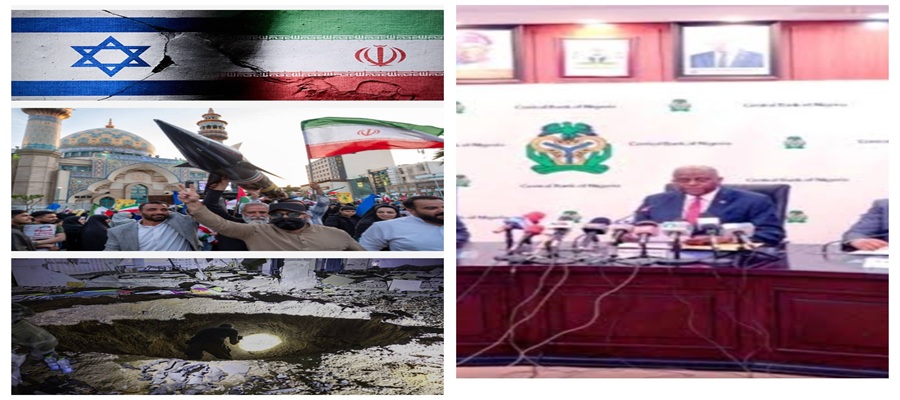
As reported in the paper, no doubt that the macroeconomic narrative appears encouraging. On a closer scrutiny, the sustainability of these gains is now being tested by forces far beyond the apex bank’s policy corridors. This is as a result of the clear, direct ripple effect of the escalating conflict between Iran and Israel, with direct military involvement from the United States, has triggered one of the most significant geopolitical energy shocks in decades. For Nigeria, the timing is delicate. Just as the CBN signals confidence in disinflation and stability, global volatility threatens to complicate and possibly distort its monetary path.
The rate cut, though welcomed by many analysts, must be understood in context. Nigeria remains in an exceptionally high-rate environment. An MPR of 26.5 per cent is still restrictive by any standard. The Cash Reserve Ratio (CRR) remains elevated at 45 per cent for commercial banks, and this effectively sterilises nearly half of deposits, while liquidity ratios are tight, and lending rates to businesses often exceed 30 per cent once risk premiums are included. The adjustment is therefore incremental, not transformational.
The Director/CEO of the Centre for the Promotion of Private Enterprise (CPPE), Dr. Muda Yusuf, has repeatedly noted that Nigeria’s deeper challenge lies in weak monetary transmission. According to him, even when the benchmark rate falls, structural rigidities, high CRR, elevated deposit costs, macroeconomic uncertainty, and crowding-out from government borrowing prevent meaningful relief from reaching manufacturers, SMEs, agriculture, and other productive sectors. Monetary easing, without structural reform, risks becoming cosmetic. The point is that even before structural reforms take effect, the fact is that an external shock will first reshape the landscape.

The Iran-Israel conflict and US involvement have reignited fears in global energy markets. Joint U.S. and Israeli strikes on Iranian targets and retaliatory missile exchanges across the Gulf have unsettled oil traders. Brent crude, already rising in anticipation of escalation, surged toward $70-$75 per barrel and could climb higher if shipping through the Strait of Hormuz, through which nearly 20 per cent of global oil supplies pass, faces disruption. It is still an irony that a major crude exporter is also an importer of refined petroleum products.
Higher crude prices offer a theoretical windfall. For Nigeria’s economy, it is well known that oil remains its largest source of foreign exchange and accounts for roughly 50 per cent of government revenue. The good thing is that rising prices could boost reserves, improve forex liquidity, strengthen the naira, and ease fiscal pressures. In theory, this external cushion could support macroeconomic stability and reinforce the CBN’s easing posture.
However, the upside is constrained by structural weaknesses. Nigeria’s oil production remains below optimal capacity. A significant portion of crude exports is tied to long-term contracts, limiting immediate gains from spot price surges. As SB Morgen observed in its analysis, Nigeria’s “windfall” is volatile and limited by soft production performance.
More critically, Nigeria’s dependence on imported refined products exposes it to imported inflation. Rising global crude prices increase the cost of petrol, diesel, jet fuel and gas. With fuel subsidies removed, these increases are passed directly to consumers and businesses. Depot pump prices have already adjusted upward amid Middle East tensions.
Energy costs are a primary driver of Nigeria’s inflation and this has remained sacrosanct. When fuel prices rise, transportation, logistics, food distribution, power generation, and manufacturing costs will definitely skyrocket, as well as the inflationary impulse spreads quickly through the economy. This will push households to face higher food and transportation costs. Businesses see shrinking margins. Real incomes erode.
Thus, the same oil shock that boosts government revenue may simultaneously reignite inflationary pressure, precisely at a moment when the CBN has begun cautiously easing policy.
This dynamic introduces a difficult policy dilemma, even as this could be for the fragile gains of the MPC. This is to say that if energy-driven inflation resurges, the CBN may be forced to pause or reverse its easing cycle. It is clearly spelled that high inflation typically compels tighter monetary conditions. As Yusuf warned, geopolitical headwinds that elevate inflation often push central banks toward higher interest rates. A renewed tightening would strain credit conditions further, undermining growth prospects.
There is also the risk of money supply expansion. Increased oil revenues, once monetised, can expand liquidity in the domestic system. Historically, surges in oil receipts have been associated with monetary growth, inflationary pressure, and exchange rate volatility. Without sterilisation discipline, a revenue boost could ironically destabilise macro fundamentals.
The exchange rate dimension compounds the complexity. Heightened geopolitical risk, just as it is currently playing out with the Iran-Israel conflict, often triggers global flight to safety. This will eventually lure investors to retreat to U.S. Treasuries and gold. Emerging markets face capital outflows. If it happens that foreign portfolio investors withdraw from Nigeria’s fixed-income market in response to global uncertainty, pressure on the naira could intensify.
Already, the CBN has demonstrated sensitivity to exchange rate dynamics by intervening to prevent excessive naira appreciation. A sharp rate cut in the midst of global volatility could destabilise carry trades and spur dollar demand. What should be known is that the 50-bps reduction reflects not just domestic disinflation, but global risk management such as geopolitical tensions, oil prices, and foreign investor sentiment.
Beyond macroeconomics, geopolitical implications carry security concerns. Analysts warn that a widening Middle East conflict could embolden extremist narratives across the Sahel and it directly has security consequences for Nigeria and the broader region. Groups such as Boko Haram and ISWAP may exploit anti-Western framing to recruit and mobilise more followers in the Sahel region, thereby giving the extremist groups new propaganda opportunities. The pebble fear is that a diversion of Western security resources away from West Africa could create regional vacuums. What the Nigerian economy will begin to experience is that security instability will disrupt agricultural output, logistics corridors, and investor confidence, feeding back into inflation and slow economic growth and as ripple effects, the economy becomes weaker.
Nigeria’s diplomatic balancing act adds another layer of fragility because it is walking on a tactful tightrope. The country is trying not to upset anyone, but maintains cautious neutrality, urging restraint while preserving ties with Western allies and Middle Eastern partners. Yet rising tensions globally between major powers, including Russia and China, complicate the geopolitical chessboard. Invariably, this will have a direct impact as trade flows, remittances, and investment patterns may change unexpectedly, affecting Nigeria’s economy.
With the current conflict in the Middle East, the prospects for economic growth also face renewed strain or are under increased pressure. The stock markets in developed countries have been fluctuating a lot because people are worried that there will be problems with the energy supply. If the whole world does not grow fast, then people will use less oil over time. This means that the good things that happen to Nigeria because of oil prices will probably not last, and any extra money Nigeria gets from oil prices now will be lost. Nigeria will not get to keep the money from high oil prices for a long time. The oil prices will affect Nigeria. Then the effect will go away. One clear thing is that since Nigeria relies heavily on oil exports, this commodity dependence exposes the country to significant risk.
Meanwhile, Nigeria’s domestic fundamentals remain structurally challenged. The recapitalisation of banks, with 20 of 33 institutions meeting new capital thresholds, strengthens resilience, but does not guarantee credit expansion into productive sectors. Banks continue to prefer risk-free government securities over private lending in uncertain environments.
Fiscal discipline remains essential. Elevated debt service obligations absorb substantial revenue. Election-related spending poses upside inflation risks. This understanding must be adhered to, that without credible deficit reduction and revenue diversification, monetary easing may be undermined by fiscal expansion.
At the moment, given the current global and domestic uncertainties, the 50 percent interest cut rate appears less like a pivot toward growth and more like a signal of cautious optimism under conditional stability. The policy decision is based on several key expectations with the assumptions that disinflation will persist, exchange rate stability will hold, and global conditions will not deteriorate dramatically.
But the Iran-Israel-U.S. conflict introduces uncertainty into all three assumptions, which is wrongly perceived as behind the rate cut that inflation will keep coming down, that the exchange rate will stay stable, and global conditions won’t worsen, are all undermined by the unfolding conflict.
If the global oil prices rise sharply and fuel becomes more expensive locally, overall prices in the economy could increase again, which means inflation could accelerate. Another dangerous trend is that if foreign investors pull capital out of Nigeria, exchange rate stability could weaken, seeing the naira coming under pressure. If global growth slows, export earnings could decline. Each of these scenarios would constrain the CBN’s flexibility.
This is not to dismiss potential upsides. Higher oil prices, if production improves, could bolster reserves and moderate fiscal deficits. Forex liquidity could strengthen the naira. Investment in upstream oil and gas could gain momentum. Historically, crude price increases have correlated with improved GDP performance and stock market optimism in Nigeria.
Yet history also warns of volatility. A good example is during the 2022 Ukraine conflict, oil prices spiked above $100 per barrel, which created a potential revenue windfall oil exporting countries, but Nigeria struggled to translate that temporary advantage into sustained economic improvement. Inflation persisted. In the case of Nigeria, the deep-rooted systemic or structural weaknesses and inefficiency diluted the benefits that should have been gained.
The lesson is clear because temporary external windfalls or short-term luck cannot substitute for structural and deep internal economic reforms.
The point is that sustainable development demands diversification beyond oil, to strengthening multiple parts of its economy at the same time, such as improved refining capacity, infrastructure investment, agricultural security, logistics efficiency, and fiscal consolidation. Monetary policy, as the action taken by the CBN at the MPC meeting by adjusting interest rates or attempting to control money supply, can anchor expectations and moderate volatility, but it cannot build productive capacity; it will only help to reduce short-term economic swings.
The CBN’s decision to cut the interest rate appears cautious. It is not a bold shift but rather a small adjustment. This shows that the bank is being careful and optimistic about the economy. It also knows that there are still problems. The trouble in the Middle East, like the fighting that affects the oil supply, reminds the people in charge that Nigeria’s economy is closely tied to what happens with energy around the world. This includes things like inflation, the value of money, and how fast the economy grows.
Until structural reforms reduce dependence on volatile oil cycles and imported fuel, Nigeria’s monetary policy will remain reactive to external crises. To really make the economy strong and stable, Nigeria needs to make some changes. It requires resilience against geopolitical storms.
The MPC has taken a step. Whether it marks a turning point depends less on 50 basis points and more on how Nigeria navigates a world increasingly defined by conflict-driven volatility.
Blaise, a journalist and PR professional, writes from Lagos and can be reached via: [email protected]


When people and businesses gain genuine access to financial services, they gain the ability to transact securely, build savings, and access credit. That access creates the conditions for progress: more stable revenues, better business decisions, and the capacity to grow. Progress, sustained over time, is what produces financial happiness. This framework is how Moniepoint measures its impact.

According to Moniepoint 2025 Impact Report, titled creating financial happiness; “Financial happiness is the feeling of confidence and ease that comes with financial freedom and well-being. It is a condition that develops over time and requires a specific set of enablers to take hold.
For millions of people and businesses across Nigeria, those enablers, like tools and solutions to manage their finances, have historically been out of reach. Moniepoint was built to change that, and this change, for us, begins with inclusion”.
Across the world, access to digital tools is a key driver of financial inclusion. The World Bank’s Global Findex 2025 report finds that more than 60% of adults in low- and middle income economies now make or receive digital payments. In Nigeria, this figure is around 54%. Moniepoint has been a key driver in expanding this access with its POS terminals. “Our terminals also drive financial inclusion for individuals.
The report stated that, in 2025, Moniepoint enabled 100 million people to make payments via their POS terminals across the country. For customers in communities where bank branches are scarce or non-existent, a Moniepoint terminal at their local shop, market stall, or fuel station provides reliable access to digital financial services.
They can make purchases, withdraw cash, and manage their money without travelling long distances or depending solely on physical currency. Critically, customers without cards can complete transactions through direct bank transfers to the terminal’s account.
Beyond practical benefits, Moniepoint terminals have also introduced a new layer of trust to everyday commerce. “When network issues make it unclear if a payment went through, the Moniepoint terminal’s loud beep provides instant confirmation for everyone, building trust in digital payments with every transaction”.
Moniepoint POS terminals operate across all 774 local governments in Nigeria, ensuring that small sellers and large stores can accept payments reliably, regardless of location.
In 2025, millions of Nigerians, businesses and individuals alike, accessed Moniepoint services through its mobile app. Top among them are groups like women and low-income earners, who have historically been excluded from formal banking. Inclusion of women is particularly important, as they typically manage household spending and informal savings but are frequently left out of structured financial systems. “Through our app, they are gaining financial independence and greater control over their economic decisions,” the report added.
For millions of Nigerians, debit cards represent a move away from the limits of cash transactions. They enable safer, more reliable everyday payments, particularly as more local businesses begin to accept digital payments.
Moniepoint debit cards are designed to meet this need. In 2025, Moniepoint customers completed over 300 million card transactions at physical locations, largely driven by essential, food-related purchases. Most of this spending took place at neighbourhood provision shops where households buy everyday items such as rice, cooking oil, and soap.
“We’ve made access to our cards intentionally simple. Customers can get a Moniepoint debit card by requesting it within their mobile app or from neighbourhood agents, without lengthy paperwork or waiting periods. By lowering these barriers, more people are able to access financial tools and participate in the formal financial system.
“Our cards also safeguard our customers’ financial information. They don’t carry special markings or any identifiers that could expose our customers or put their financial security at risk. In the event of loss, this reduces the likelihood of targeted fraud or misuse.
“When people can pay with their debit cards at their neighbourhood stores, they can manage their spending, reduce cash handling, and transact more securely. Merchants also benefit, recording higher transaction volumes and more consistent customer activity.
“Moniepoint helps millions of businesses and individuals across Nigeria access seamless payments and banking, every day. The widespread adoption of our tools and services, as highlighted, demonstrates our critical role in expanding financial access, supporting everyday commerce, and enabling more Nigerians to participate safely and consistently in the digital economy,” the report noted.


ChatPay has launched Africa’s conversational banking platform, enabling individuals and businesses to access financial services through WhatsApp.

The Lagos-based fintech startup, is in controlled rollout, connecting WhatsApp to linked-bank management, airtime and supported electricity payments through simple conversations.
The company said the platform is designed to enable users to send money, pay bills, buy airtime and manage business transactions within WhatsApp conversations, subject to the completion of regulatory approvals and integration with licensed banking partners.
According to ChatPay, the platform is operated by CP Technology Limited and is currently undergoing a phased rollout ahead of its planned public launch.
The company said the initiative is intended to simplify access to financial services by leveraging WhatsApp, which it estimates is used by more than 50 million Nigerians monthly.
Speaking on the idea behind the platform, Adeoluwasubomi Odebunmi, product lead and co-founder, said the concept emerged while she was studying Software Engineering at Babcock University.
“I saw the gap while I was still in school—how much friction there was just to move money. I didn’t want to just study the problem. I wanted to help fix it,” she said.
Odebunmi said she had previously worked on software solutions spanning e-commerce, real estate management, school administration and artificial intelligence applications before co-founding ChatPay.
Aseoluwa Siyanbola, growth lead and co-founder, said his experience managing Nigerian bank accounts while studying abroad highlighted some of the challenges users face with digital banking services.
According to him, difficulties such as one-time password (OTP) failures and inconsistent banking applications inspired the team to explore conversational banking solutions.
“We each encountered similar challenges and came together to build a solution that simplifies everyday financial transactions,” he said.
cAbraham William, tech lead and co-founder, said the company is focused on improving access to financial services through a platform that many Nigerians already use daily.
“We want to make financial services easier to access by allowing people to carry out transactions through a familiar messaging platform,” he said.
William said he oversees the company’s engineering, technology strategy and system architecture.
ChatPay said its services will be introduced in phases as regulatory requirements are met and integrations with banking partners are completed.
The company added that its newly launched “Founding 2,500” programme will enable selected early users to test features, provide feedback and participate in product development before the platform’s wider rollout.
According to the company, interested users can register for the waitlist and the Founding 2,500 programme through its website.
Founded by Odebunmi, Siyanbola and William, ChatPay said its long-term goal is to expand conversational banking services beyond Nigeria into other African markets after its domestic rollout.

United Bank for Africa (UBA) Plc has been named Nigeria’s Best Bank for Retail Banking and Best Bank for Sustainability Leadership (ESG) at the 2026 Euromoney Awards for Excellence, reinforcing its position as one of Africa’s leading financial institutions.

The awards were presented on July 17 at The Peninsula London in the United Kingdom, recognising financial institutions that have demonstrated outstanding performance, innovation, customer impact and sustainable banking practices.
The double recognition highlights UBA’s growing influence in retail banking and its commitment to advancing environmental, social and governance (ESG) principles across its operations.
According to Euromoney, UBA distinguished itself through a series of sustainability initiatives, including the introduction of a Green Financing Facility designed to support households and businesses transitioning to renewable energy.
The publication also cited the bank’s ₦5 billion financing programme, implemented in partnership with the Bank of Industry (BOI), to provide funding for women-owned businesses.
Euromoney further recognised UBA’s commitment to achieving net-zero carbon emissions by 2050, describing it as a demonstration of the bank’s long-term sustainability strategy.
The publication also highlighted the bank’s efforts to integrate sustainability into its operations through the deployment of solar-powered energy solutions across 50 branches and comprehensive ESG capacity-building programmes that have trained more than 16,000 employees across the UBA Group.
In the retail banking category, Euromoney noted that UBA continued to consolidate its position as one of Africa’s largest retail banking institutions.
According to the publication, the bank expanded its customer base to more than 37 million by the end of 2025, while retail banking revenue increased more than fourfold to ₦429.5 billion.
The awards also recognised UBA’s continued investment in digital banking innovation, particularly enhancements to its artificial intelligence-powered chatbot, LEO.
Euromoney noted that LEO became Africa’s first AI-powered banking platform to facilitate cross-border money transfers in local currencies through the Pan-African Payment and Settlement System (PAPSS).
Commenting on the awards, UBA’s Group Managing Director and Chief Executive Officer, Mr Oliver Alawuba, described the recognition as a validation of the bank’s commitment to delivering value to customers while promoting sustainable development across Africa.
“To be recognised as Nigeria’s Best Bank for both ESG and Retail Banking in the same year sends a powerful message that sustainable banking and commercial success are mutually reinforcing.
“At UBA, we are committed to financing Africa’s future, supporting businesses and communities, promoting financial inclusion, and delivering innovative banking solutions that improve lives.
“These awards belong to our customers for their confidence in us and to every member of the UBA family whose dedication continues to make our vision a reality,” he said.
Also speaking, UBA’s Group Head, Marketing, Brand and Corporate Communications, Mrs Alero Ladipo, said the awards reflected the bank’s unwavering commitment to putting customers at the centre of its operations.
According to her, every innovation, investment and banking solution introduced by UBA is aimed at creating exceptional value for customers while expanding access to financial services.
“These awards are a powerful affirmation of our Customer First philosophy.
“Whether it is supporting entrepreneurs with access to finance, enabling seamless digital payments, advancing clean energy financing or expanding financial inclusion across Africa, UBA remains focused on delivering meaningful impact.
“We are honoured that one of the world’s most respected financial publications has recognised these efforts,” she said.
UBA currently operates in 20 African countries, as well as the United Kingdom, United States, France and the United Arab Emirates, serving more than 45 million customers through a combination of digital banking platforms and physical branch networks.
The bank said it remains committed to strengthening financial inclusion, driving innovation and supporting sustainable economic development across Africa and beyond.

HURIWA, CLO Protests Bill Asking Social Media Firms’ to Open Shops Nigeria

Anambra Govt Bans Graduation Ceremonies in Anambra Schools

Airtel Secures Another 10-year Spectrum Renewal in Nigeria

Moniepoint as a Key Driver in Expanding Financial Access for Businesses in Nigeria

Nigeria, Israel Strengthen Research, Technology Collaboration

NRC, Ponzi Scheme Collapses Resulting Loss of Billions of Naira

NASENI Moves to Digitize CCB’s 5m Assets Declaration and Operations

EFCC Busts NIS Visa Overstay Racket, Uncovers N700m in an Account

Tokenization, Blockchain Technology will Transform Financial Institutions – IMF

From Scarcity to Scale: What Africa Can Learn from India’s Agricultural Transformation




 E-Financial3 days ago
FG Says Rumours, Fear, Can Crash Banks

 Telecom3 days ago
Court Dismisses Pan African Towers’ Bid to Halt Ex-CEO’s Suit, Awards ₦500,000 Costs

 E-Business3 days ago
Kaspersky Warns of a Phishing Campaign Abusing Microsoft Authentication Mechanism

 Telecom3 days ago
Telcos Seek Clear Regulatory Framework on Airtime Credit Services

 News3 days ago
IMF Sees 4% AI Growth Boost for Africa

 Telecom3 days ago
MTN Nigeria Announces 2026 mPulse Spelling Bee, Opens Entries for Students Nationwide

 Telecom3 days ago
MTN Warns Customers against Fake Promo

 E-Financial3 days ago
EU Debunks Fake Compensation Scheme Targeting West African Bank Customers