

Telecom
CTO 2014 Forum Calls for ICT Role in Social Development


Participants at this year’s three-day Commonwealth Telecommunications Organisation (CTO) Forum 2014 renewed calls for a greater role for ICTs in social empowerment.
Stakeholders at the Forum which ended on Thursday in Dhaka praised the Organisation for the success of this year’s event, which is held in Bangladesh for the first time.
The event focused primarily on the need for greater efforts in the use of ICTs as tools for social empowerment.
“If we want to achieve double-digit economic growth, the unlimited opportunities of a technology-based, creative economy are calling us, and we can’t afford to miss the train”, said Zunaid Ahmed Palak MP, Bangladesh’s State Minister of Posts, Telecommunications and Information Technology as he called for stronger and wider collaboration between key sectors.
“I do not believe that ICTs have a sufficient place in the global development goals beyond 2015, and Commonwealth countries will consult to explore how more commitment can be made to ICTs”, said Professor Tim Unwin, secretary-general of the CTO in his closing remarks.
The event was attended by over 200 participants from Commonwealth countries and beyond, including Bhutan, the Netherlands, Switzerland, Thailand, Tunisia, USA and Nigeria.
“An excellent opportunity to be appraised of key developments in several ICT areas” – Cris Seecheran, Telecommunications Authority of Trinidad & Tobago.
“A great place for sharing and gathering ideas and knowledge among Commonwealth countries” – Morshed Noman, The Daily Prothom Alo, Bangladesh.
“The CTO facilitates excellent networking opportunities among actors in the field” – Shahid Akbar, Bangladesh Institute of ICT in Development.
“Great event for networking with regulators and ministries of ICTs” – Bilel Jamoussi, ICT Ministry, Tunisia.
“The event was well managed”, according to Josephine Anuwa, Nigerian Communications Commission.
“Educating and mind opening sessions”, added Chungu Vestus, Zambian Information and Communication Technology Authority.
Held every year in a Commonwealth country, the Commonwealth Telecommunications Organisation Forum is the annual gathering of the 53-group of member countries where they discuss common ICT issues.
Announcement of the 2015 location is expected at the end of the Organisation’s Council meeting also taking place this week in Dhaka, on 11 – 12 September 2014.


If there is one thing that brings everyone together across the country, it is the beautiful game of football. The energy is always on a different level. From the passionate debates in local viewing centers to the excitement shared across social media, football is more than just a sport for us—it’s a major part of how we connect and share moments with friends and family.

Google and Gemini
As the FIFA World Cup 2026™ kicks off across North America, the excitement is already building up everywhere. But let’s be honest: life moves fast, and keeping up with every single goal and update can feel like a full-time job. You don’t want to be the one asking for the score long after the game is over.
The good news is that technology has made it easier than ever to stay in the loop. Google and Gemini have introduced some very useful tools to bring you right into the heart of the action, whether you’re a serious analyst or just here for the fun. From pinning live scores to your phone screen to using AI to see yourself as a pro player, here are 6 ways to experience the World Cup like a boss.
1. Get Match Updates “Sharp-Sharp” on Your Screen
We’ve all been in that situation where we are busy with other things but dying to know the latest score. You don’t need to keep searching and refreshing heavy pages that drain your data. Now, when you search for soccer, it’s much faster to see real-time information about the game, including visuals for live scores, lineups, and current standings.
The best part is the pinning feature. You can actually pin a match’s live score directly to your Android or iOS device’s lock screen just by following that match or team. This means you can see the score at a glance without even needing to unlock your phone. You’ll even get updates before the match starts and after it ends.
How to set it up: Search for your favorite team or a specific match on Google and tap the option to “follow” them. This pins the score to your lock screen so you get updates automatically before and after each game.
2. Settle the Arguments with AI
Arguments about football rules or player stats are a huge part of the fun. Instead of going back and forth with friends, let AI Mode in Search give you the facts. You can use AI Mode for all sorts of things, from asking complex questions about specific rules to finding deep details about players and teams.
If you’re trying to understand a coach’s strategy, you can ask AI Mode to create an interactive visual for you—for instance, a breakdown of soccer formations and when a coach might use them. While these interactive features are for Pro and Ultra subscribers now, they will be free for everyone in Search by the summer.
How to use it: Open Google Search and type your deep football questions directly into the prompt bar. You can then specifically ask it to “create an interactive visual” to help explain things like team formations.
3. Find the Perfect Place to Watch with “Ask Maps”
Sometimes the best way to watch a match is at a viewing party with other fans. If you’re looking for a great spot to join the fun, the Ask Maps feature is here to help. You can just type something like, “Find me a reservation for 4 at 7:30 p.m., somewhere I can watch the World Cup match and meet other fans.”
To help you get there on time, Google Maps and Waze provide the latest information on road closures and transit routes so you can navigate the games with confidence. Also, for the first time on Waze, you can see live score updates at a glance whenever your car is at a stop.
How to use it: In the Google Maps app, use the “Ask Maps” feature to request a reservation at a place specifically for watching the match. If you are driving with Waze, simply bring your car to a stop to see live scores on your dashboard.
4. Catch Up on the Latest Gist Every Morning
For those who can’t stay up late to watch every game, there’s a perfect way to wake up to the news. If you have a Gemini Plus, Pro, or Ultra subscription, you can use Scheduled Actions to receive a daily summary of international soccer news.
This summary is completely tailored to you. You can customize the briefing to focus only on your favorite teams and players, and choose exactly when you want it delivered.
How to set it up: Open Gemini Settings, tap “Scheduled actions,” and select the soccer news digest template. Customize it with your team names and your preferred time to receive your summary every day.
5. Become the Star of Your Own Match Photos
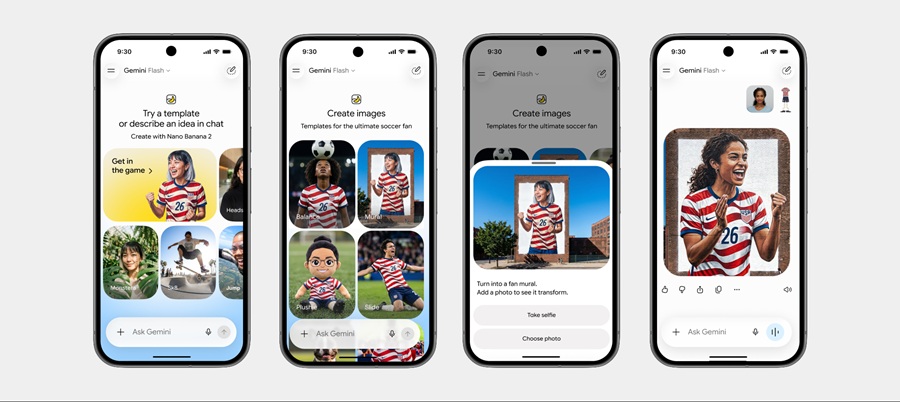
Ever wondered what you would look like as a professional football star? The new Nano Banana templates in the Gemini app let you put yourself right into the action. You just upload a photo of yourself to these custom scenes, and you can see yourself celebrating in a massive stadium or making a hero’s diving goal-line save.
The generated image will even show you wearing your country’s colors or the official jersey. These fun templates are rolling out in the “Images” tab in Gemini.
How to use it: In the Gemini app, go to the “Images” tab, tap the “+” icon, and click “Create image.” Upload your photo to one of the custom soccer scenes to see yourself repped in the official jersey.
6. Get the Full Match Experience in One Place
Finally, Gemini can now act as your personal dashboard for the entire tournament. The app references live match information and news to give you the latest scores, highlights, and standings as they happen.
For many topics, Gemini goes beyond just text by creating visual elements like stats, images, and videos. This transforms a simple response into a dynamic “Matchday Hub” where you can see all the action at once.
How to use it: Ask Gemini for a match update or current standings to automatically open your “Matchday Hub.” The app will immediately show you a mix of live scores, highlights, and stats for the game you asked about.
The World Cup is all about sharing the excitement, and with these Google and Gemini tools, you won’t miss a beat. Whether you’re pinning live scores to your screen or seeing yourself in the official jersey, there’s a tool for every fan. Set up your updates, grab your friends, and get ready for a month of pure football magic. No stress, just vibes!
Telecom
Airtel Africa Foundation Launches Airtel Green Schools to Promote Sustainability Education in Nigeria

Airtel Africa Foundation, through Airtel Nigeria, has launched the Airtel Green Schools initiative, a sustainability-focused programme designed to create environmental learning spaces in primary and secondary schools.

The spaces, which are branded Airtel Garden, have been introduced as part of Airtel Nigeria’s activities to commemorate the 2026 World Environment Day, themed “Climate Action”.
According to Airtel Nigeria’s schedule, the company’s 10 adopted schools, located in nine states across country’s six geopolitical zones, have been onboarded as Green Schools.
Each of the schools now features an Airtel Garden, with dedicated sections for edible crops, fruit trees and shade trees, enabling pupils to learn firsthand about food cultivation, biodiversity and the importance of increasing green cover to help mitigate the effects of climate change.
The gardens also incorporate composting stations where organic waste generated within the school environment can be converted into nutrient-rich compost. To boost circular economy practices, plastic recycling segments have also been built in to repurpose common wastes such as plastic bottles and tyres.
The beneficiary schools of the programme include St. George’s Nursery and Primary School, Ipaja, Lagos; Yahaya Primary School, Zaria; Iyeru-Okin Primary School, Iyeru-Okin, Kwara; St. John Primary School, Ijebu Igbo, Ogun State, and Community Primary School, Amumara, Imo State.
Others are Presbyterian Primary School, Ediba, Cross-River; Migrant Farmers Community Primary School, Umuahia, Abia State; Gwange III Primary School, Maiduguri, Borno State; Mayflower Secondary School, Ikenne, Ogun State; and Government Day Primary School, Gombe State.
Segun Ogusanya, Chairman of the Airtel Africa Foundation, highlighted the developmental focus of Airtel Garden. “We are excited to inaugurate Airtel Green Schools, which are designed to go beyond awareness and create real behavioural change within Nigeria’s school communities.
“Through the Restore, Reduce and Educate pillars, we are equipping young people with practical tools such as gardens, recycling awareness, and environmental learning resources.
2Our goal is to create a replicable Green School model that can be scaled and sustained over time, ensuring that environmental education becomes part of everyday learning for the children in our adopted schools,” he said.
A key feature of the launch programme is the signature “Read, Engage, Plant” experience, an immersive environmental learning model that combines storytelling, practical engagement and environmental action.
At the launch, Airtel staff from the Employee Volunteer Programme (EVP) led pupils of the adopted schools in the reading “Jojo and Jade, Heroes of Mother Earth” before joining in interactive environmental activities such as crop planting. The programme also featured a recitation of the climate action pledge and the inauguration of Airtel Garden Eco Club.
Speaking on the flag-off of Airtel Green Schools and Airtel Garden, the Chief Executive Officer of Airtel Nigeria, Dinesh Balsingh, said, “Climate action becomes meaningful when awareness is translated into action.
“Through the Airtel Garden, we are creating living classrooms where pupils can learn practical lessons about environmental stewardship, sustainable agriculture, waste management and the importance of protecting our planet. We believe that empowering young people with these experiences today will help shape a more environmentally responsible generation tomorrow.”
The Airtel Green Schools campaign is built on the telecom giant’s sustainability theme of Reuse, Educate, and Restore. Through tree planting and garden development, the programme seeks to establish green spaces within school communities while promoting waste reduction and responsible environmental practices via composting and plastic recycling.
Telecom
GSMA Launches Global Satellite Regulatory Playbook to Help Policymakers Build Future-Ready Connectivity Frameworks
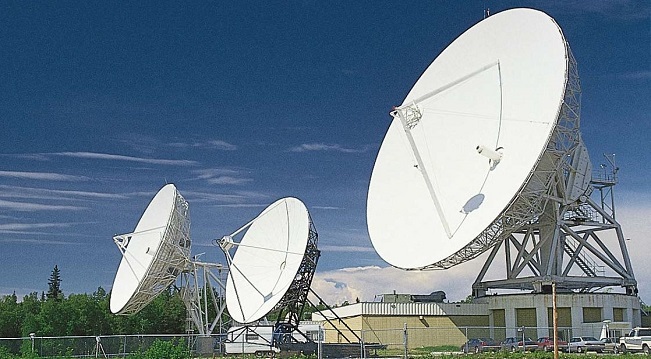
The GSMA has launched its new Satellite Regulatory Playbook, a practical guide designed to help policymakers develop clear, consistent and future-ready policy frameworks for the rapidly evolving satellite connectivity sector.

As Low Earth Orbit (LEO) satellite services expand globally and begin to complement terrestrial mobile and broadband networks, the Playbook provides governments with a structured framework to modernise satellite regulation in ways that support societal needs, protect consumers, and encourage investment in the next generation of communications networks.
Developed in collaboration with Access Partnership, the Playbook focuses on emerging satellite broadband and direct-to-device (D2D) services delivered directly to end users without mobile operator partnerships, where existing regulatory frameworks often leave gaps.
Where mobile operators are involved, existing regulations typically provide sufficient safeguards. The playbook offers practical guidance that policymakers can adapt to their national circumstances. It is designed to support technology-neutral regulation while promoting greater consistency in regulatory outcomes across markets.
The GSMA emphasises that no single connectivity technology can meet all of society’s long-term communications needs. Instead, resilient and inclusive digital societies require multiple forms of connectivity working together, including mobile, fixed and satellite networks. Regulatory frameworks therefore need to evolve to address all connectivity services consistently, ensuring users receive comparable protections and benefits regardless of how services are delivered.
Michaela Angonius, Head of Policy & Regulation at the GSMA, said: “As satellite connectivity becomes an increasingly important part of the global communications landscape, policymakers have an opportunity to create regulatory frameworks that are fit for the future.
“The Satellite Regulatory Playbook gives policymakers practical guidance to create frameworks that protect people, ensure law enforcement can always do their job, attract investment into the whole communications sector and keep pace with innovation.”
“Connectivity is not a choice between terrestrial and satellite networks. Meeting the needs of citizens, businesses and governments requires a diverse and complementary connectivity ecosystem. Regulation should therefore be technology-neutral and focused on delivering consistent outcomes for consumers and society, regardless of how services are provided.”
The Playbook identifies eight key regulatory pillars that policymakers should consider when developing or modernising frameworks for satellite services:
- Local establishment rules
- National security
- Consumer protection and operational measures
- Infrastructure and facility requirements
- End-user terminal deployment
- Fiscal considerations
- Emergency services and public safety
- Enforcement
The guidance is underpinned by the GSMA’s principles of transparency, regulatory parity, harmonisation, collaboration and balanced innovation. Together, these principles aim to support regulatory certainty, encourage investment, strengthen consumer trust and promote fair competition across the broader connectivity ecosystem.
Recognising that regulatory frameworks vary significantly between countries, the Playbook does not prescribe a one-size-fits-all model. Instead, it provides a flexible framework that regulators can tailor to national priorities while helping to reduce fragmentation and promote greater international alignment.
As satellite services continue to evolve and expand, the GSMA believes that forward-looking and harmonised regulatory approaches will be essential to unlocking the full benefits of next-generation connectivity for consumers, businesses and societies worldwide.

FG Proposes Africa-Wide Payment Card without Conversion through US Dollar

Providus, Unity Bank Begin Integration Phase after Supreme Court Nod

EFCC, CAC Raise Concerns over Unregistered PoS Operators

6 Easy Ways to Enjoy the 2026 World Cup with Google and Gemini

The Gathering on 100 Awards N5m to Young Entrepreneurs in Enugu
CBN Extends PoS Geo-Fencing Enforcement Deadline to August 2026

London Strengthens Global Investment Ties with Africa @ First Ever London-Africa Business Summit

FG Targets Alleged N3tn Capital Flight, Opens Airtime Credit Market to Nigerian Fintechs

Mobile Internet Gender Gap Widest in Africa – GSMA

Japan, UNESCO Boost Digital Learning in 15 CoEs with Donation of ICT Equipment




 News2 days ago
PalmPay MD Seeks Stronger Infrastructure, Access to Finance for SMEs @ Digital Pay Expo 2026

 Telecom2 days ago
Africa Projected to Lead Global 5G Growth

 News2 days ago
Kaspersky Identifies over 336 Unique Domains Impersonating the Official World Cup Website

 Broadcasting2 days ago
Lebara Nigeria Launches Lebara Play, Africa’s First Telecom-Owned Micro-Drama Platform

 General News2 days ago
Paystack Launches Programme to Support Nigerian Businesses

 Telecom1 day ago
NITDA Unveils Bold Vision to Make Nigeria an AI Powerhouse

 E-Financial2 days ago
SEC Bars Dangote Refinery IPO Adverts

 Telecom2 days ago
The Future of AI in Nigerian SMEs: Overcoming Barriers to Implementation