

General News
Faces, Backgrounds of Those Who Want to Rule Nigeria

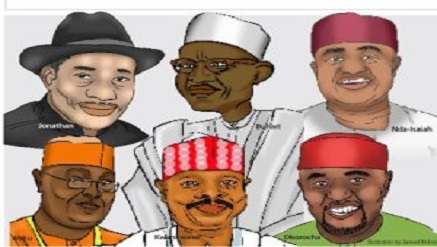
Yes, the 2015 race for Aso Rock, Nigeria’s seat of power has started — and candidates have completely immersed themselves in the battle of the presidential election!
Leadership newspaper took a look at the contenders are reported that the ‘fireworks’ going off across the various political parties occasioned by the build-up to the elections leave much to be desired.
The presidential seat will certainly be keenly contested for, with the Peoples Democratic Party (PDP) working tooth and nail to retain and indeed, consolidate their grip on power, while the All Progressives Congress (APC) continues to make a case to the electorate as the veritable alternative to the ‘15 years of misrule’ by the PDP.
According to the newspaper, constitutionally, the various political parties will have to come up with a flag bearer as a first step towards the inevitable ‘clash’ on Election Day and as expected, the process towards this is anything but easy, as it has thrown up a number of distinguished Nigerians who want to be sworn in as president on May 29, 2015.
The question, therefore, is whom does the cap fit? In no particular order LEADERSHIP Friday has assembled politicians who are vying for the presidency in 2015 and has examined the edge each possesses over the rest.

President Goodluck Jonathan:
The sitting president of Nigeria on the platform of the PDP, no doubt, is at the centre of the 2015 presidential election.
He will remain a favourite in this contest, because he is the man to beat. Like a boxing champion returning to the ring to defend his title, GEJ is preparing for the 2015 election.
It is widely perceived, however, that his reneging on the alleged one-term pact he signed to in 2011 with the governors and the reality that he has performed below expectations are reasons for the resentment towards him by both party members and a large part of the population, including his political godfather, former president Obasanjo.
But he is still the most powerful politician at present, being the president and commander-in-chief of the nation’s armed forces.
Thus, whichever way things go, he will play a very active role in who wins in the 2015 election. Beating a sitting president has so far not been possible in Nigeria, no matter how unpopular he is.
To defeat this one will require the mobilisation of the whole country in neutralising the rigging machinery often associated with his political party.
Sam Nda-Isaiah:
The publisher of Leadership Newspapers is described as “the new kid on the block” by political strategists and therefore the real face of the “change” the APC sports as its slogan among all the aspirants on the platform.
At 52 and from the private sector, he is the youngest presidential aspirant and thus represents the school of thought earnestly seeking a generational shift in the political power equation of the country.
His being a Christian from the North makes him capable of eroding Jonathan’s pivotal and key support in and from the region.
Sam has another critical advantage. Northern Muslims feel very comfortable with him in a way they do not with others, like Prof Jerry Gana.
His candidacy, therefore, in spite of his political CV (according to political experts), has the potential of uniting the whole North.
His fresh face and lack of political baggage might see him coasting to victory. His candidacy would also put a lie to PDP’s claim that APC is a Muslim party.
He is a member of the Asian think-tank, the Global Institute for Tomorrow (GIFT) based in Hong Kong, an association that has taken him to numerous brainstorming sessions in Singapore, China, India and Hong Kong in search of solutions to today’s global problems and the promise for tomorrow.
Sam has always belonged to the progressive tendency that has been in opposition since 1999.
He was the first to start advocating publicly that Nigerian opposition parties must fuse in order to form a common front to wrest power from the PDP in the interest of the nation.
General Muhammadu Buhari:
This is still the only presidential aspirant who gives the opposition sleepless nights, because of his reputation as an honest and disciplined leader.
Gen Buhari seems to be the most influential man from the North and his voice will echo power come 2015.
Buhari is a very well respected former head of state. He is often described as being as straight as an arrow. His greatest strength is that he is very popular with the masses of the North and that will play a key role as he goes into the elections.
Buhari was selected to lead the country by middle and high-ranking military officers after a successful military coup d’état that overthrew civilian president Shehu Shagari on December 31 1983.
During his regime, he ran a public campaign against indiscipline known as War Against Indiscipline (WAI). Buhari served as the chairman of the Petroleum Trust Fund (PTF), a body funded from the revenue generated by increase in price of petroleum products, to pursue developmental projects around the country.
A 1998 report in New African praised the PTF under Buhari for its transparency, calling it a “rare success story”. His influence and credibility will play a vital role in the weight that the opposition pulls.
Former Vice President Atiku Abubakar:
A man with nine lives, he is a veteran of so many wars with presidents, the most evident being the one with his ex-boss, former president Olusegun Obasanjo.
The former vice-president of Nigeria seems to be mustering his energies to take another shot at the presidency on the platform of the APC before retiring.
Age, we know, does not seem to be on his side. He played a decisive and prominent role in the factionalism that hit the PDP, his former party.
One of the consequences of that rebellion was the block shift of five PDP governors in one day and the mass defection at the National Assembly of members to APC.
This, according to political strategists, was a signal of the end of the PDP’s monopoly as the only national party in Nigeria. At present, we are faced with one reality, and it is that PDP may no longer remain the one united force — at least not before 2015.
Atiku’s strongest point is the financial war chest at his disposal, with which he can dislodge perceived opponents within the party.
Governor Rabiu Kwankwaso:
The governor has undoubtedly done well in his state and will be banking on that to speak for him. He also has the political sagacity and finances at his disposal with which to prosecute his ambition.
He is one of the PDP governors who crossed over to the APC when the president reneged on his alleged promise not to seek a second term in office.
The two-time governor, former minister of defence and ambassador would most certainly make a fine president, but he has to successfully battle the other powerful and credible aspirants in the primaries, if he is to fly the APC flag.
He started work in 1975 with WRECA. He joined partisan politics in the aborted Third Republic, where he contested elections to the House of Representatives; he won and became the deputy speaker.
At the time, he belonged to the Peoples Front faction of the Social Democratic Party (SDP) led by General Shehu Yar’adua. Kwankwaso is known for his transformation agenda in Kano State, widely referred to as “Kwankwasiyya”.
He has been able to attend to the plight of the common man and this has given him acceptance and credibility in the state.
Governor Rochas Okorocha:
Governor Rochas’ popularity, occasioned by his free education campaign across the country on a charity basis and his having given the presidency a shot in the past, has put him in a comfortable position in the build-up to the elections.
Rochas cuts it as a true Nigerian, speaking the major languages in the country – Igbo, Yoruba and Hausa, and he also has the financial muscle to flex in prosecuting his ambition.
Governor Rochas has done well in his home state of Imo and that he will be banking on as a reference point.
Okorocha was a commissioner in the Federal Character Commission and a member of the National Constitutional Conference when democracy was restored in 1999. Okorocha had earlier competed in the primaries to be PDP candidate for governor of Imo State, but lost to Achike Udenwa.
He moved to the All Nigeria People’s Party (ANPP) and was an unsuccessful presidential aspirant on the party’s platform in 2003. He returned to the PDP and President Olusegun Obasanjo appointed him special adviser on inter-party affairs.
Okorocha formed the Action Alliance (AA) party in 2005, planning to become its presidential candidate for the 2007 elections. On March 2 2013, Rochas led an All Progressives Grand Alliance (APGA) faction and decamped to All Progressives Congress.
He was later elected by his colleague governors in the opposition as chairman of the Progressive Governors Forum.
Prof Akasuba Abiola:
One of the wives of the late business mogul, Chief M.K.O Abiola, she hopes to make history as the first female president of Nigeria.
She will certainly be relying on the affirmative action and the fact that women have done creditably well in their assigned duties.
Prof Akunyili of blessed memory readily comes to mind. She will also hope to ride on the name and reputation of her husband, who was denied the presidential mandate he is widely believed to have won.
If she clinches the primaries, her party has the financial muscle and structure with which to see her being sworn in as president.
But she will have to defeat the president at the primaries first. Going by the agitation by women groups, which are struggling for gender balance and equity, Akasuba may whip up quite some support.
Muhibeedeen Aliyu:
Prof Mahmood Muhibeedeen Aliyu is a strong academician who is passionate about leading the country to greater heights and he believes the best platform for this is education.
Aliyu is aspiring on the platform of the APC, although he recently described the party’s N27million presidential nomination form fee as against PDP’s N22million as ridiculous.
Aliyu is a professor of Business Education at the Ahmadu Bello University, Zaria. He holds a doctorate degree in the same field.
As a university professor, he has supervised various workshops aimed at fostering national development. He is a researcher with in-depth experience and is well known for his community service. He has headed various departments in different institutions where he taught.
He was the head, Business Education Department, College of Education, Minna. He was the secretary, P.G. Committee, Department of Vocational & Technical Education, ABU, Zaria. He was also the coordinator, L.V.T Programme, Business Education.
Aliyu is an activist who strongly believes it is time for the emergence of a new crop of well-meaning leaders in the country. He has written many books, to foster national development.
Certainly the 2015 general elections will be a defining moment in our national history and evolution, with the hope of a smooth transition for the fourth consecutive time since 1999. With violence, corruption, religious intolerance and underdevelopment plaguing Nigeria’s quest to be among the twenty most developed nations of the world, whoever becomes president will have a lot on his or her plate, as Nigerians earnestly yearn for good leadership.


Chinonso Akujobi, former staff of Access Bank in Lagos, has been remanded in Ikoyi prison after she was arraigned on a five-count charge bordering on stealing to the tune of N294.5m.

Akujobi who is being prosecuted by the Economic and Financial Crimes Commission (EFCC) was arraigned before Justice I.O. Ijelu of the State High Court sitting in Ikeja, Lagos.
EFCC alleged that Akujobi stole the money between January and December 2025 while under the employment of Access Bank Plc.
As stated in one the charges, the defendant stole the money through unauthorized payments from the general ledger of Access Bank to her account number 0036668871 with the name Chinonso A., Uchechi A. and Florence A., thereby committing an offence of stealing, contrary to Section 280 and punishable under Section 287 of the Criminal Law of Lagos State, 2015.
The defendant pleaded “not guilty“ to the charges when they were read to her.
In view of this, S.M.Yabo, prosecution counsel, asked the court for a trial date and also prayed for the remand of the defendant in a Correctional centre.
Justice Ijelu, thereafter, adjourned the case till October 8, 2026, for the hearing of the bail application and the commencement of trial.
The Judge also ordered that the defendant be remanded in the Ikoyi correctional Centre.

The Nigerian Safety Investigation Bureau (NSIB) says the flight captain of the VMO Aero aircraft that landed on a roadway near Asaba Airport in Delta State told investigators that the observer pilot mistakenly identified the paved road as the runway before touchdown.

The bureau disclosed this in a preliminary report released on Thursday on the June 10 incident, which prompted the Nigeria Civil Aviation Authority (NCAA) to ground the private jet.
The aircraft had seven people on board, including the pilot-in-command (PIC), second-in-command (SIC), an observer pilot, a cabin crew member and three passengers.
According to the report, the aircraft was cleared by Air Traffic Control (ATC) to approach Runway 11 at Asaba Airport after the crew requested a right orbit.
The crew initially discontinued the approach, executed a missed approach and repositioned for a second landing attempt.
NSIB said the crew reported that the aircraft’s navigation systems indicated it was correctly established on the published RNAV Runway 11 approach.
“The PIC and SIC reported that the observer pilot identified the paved surface ahead as the runway,” the report stated.
However, the observer pilot gave investigators a different version of events.
According to NSIB, he said the aircraft remained inside cloud until late in the approach and that the Ground Proximity Warning System (GPWS) repeatedly issued “TERRAIN, TERRAIN, PULL UP” alerts.
He also said he observed a telecommunications mast directly ahead and instructed the flight captain to abandon the approach and climb immediately.
The bureau further disclosed that a cabin crew member reported that one of the passengers became concerned after overhearing discussions among the pilots and asked whether one of them was undergoing training. The passenger was reportedly reassured that all three pilots on board were experienced captains.
NSIB said no abnormal events were reported in the cabin before touchdown.
The aircraft eventually landed at about 8:57 a.m. on an under-construction paved roadway near Asaba Airport instead of the designated runway.
The bureau said its investigation into the incident is ongoing, while the preliminary report highlights conflicting accounts among the cockpit crew over the circumstances that led to the erroneous landing.

European Union has warned Meta Platforms Inc. that it could face a significant financial penalty unless it changes what regulators describe as the “addictive design” features of Facebook and Instagram.

The European Commission issued the warning in preliminary findings released on Friday, saying Meta had failed to sufficiently address risks posed by its platforms, particularly to children and vulnerable users.
The Commission said features such as infinite scrolling, personalised content recommendations and automatic video playback were designed in ways that encouraged excessive engagement with the platforms.
EU Executive Vice-President for Tech Sovereignty, Security and Democracy, Henna Virkkunen, said protecting the physical and mental well-being of European citizens should be a priority for social media companies.
The Commission said Meta should consider introducing design changes, including disabling autoplay and infinite scrolling by default, providing effective screen-time reminders and adjusting recommendation systems to reduce the focus on maximising user engagement.
The findings were issued under the European Union’s Digital Services Act (DSA), which sets obligations for major online platforms to address risks associated with their services.
Meta, however, rejected the Commission’s conclusions, saying it disagreed with the findings but would continue engaging with European regulators.
The company said it had already implemented measures aimed at protecting younger users, including Teen Accounts that allow parents to manage screen time limits and restrict access during night hours.
The EU said its investigation, which began in 2024, found that existing time-management tools on Facebook and Instagram could easily be bypassed, while parental controls required technical knowledge that limited their effectiveness.
Regulators also expressed concerns over children’s nighttime use of the platforms and the possibility that features such as Reels and Stories could encourage compulsive behaviour.
If the Commission’s preliminary findings are confirmed, Meta could face a fine of up to six per cent of its annual global revenue under the DSA.
The warning comes as the EU steps up efforts to strengthen online safety measures for children, with an expert panel established by European Commission President Ursula von der Leyen expected to present recommendations on protecting minors online.
Several EU member states, including France, have also supported discussions on restricting social media access for children, following Australia’s decision to ban users under 16 from accessing social media platforms.
Meanwhile, the Commission is continuing a separate investigation into whether Meta’s recommendation algorithms create “rabbit hole” effects by directing users towards increasingly extreme content.

Police Busts Syndicate Who Allegedly Stole N3Bn from Financial Institution

MTN Accelerates Network Expansion to Meet Surging Telecom Demand

Court Remands Akujobi, Ex Access over alleged Theft of N294.5m

TeKnowledge, Equinix Partner to Advance Nigerian Digital Infrastructure

NSIB Faults Runway Identification, Reveals Cockpit Disagreement in Asaba Jet Incident

NASENI Moves to Digitize CCB’s 5m Assets Declaration and Operations

Nigeria Launches FreeTV Nationwide

Mobile Internet Gender Gap Widest in Africa – GSMA

Lebara Nigeria Launches Lebara Play, Africa’s First Telecom-Owned Micro-Drama Platform

CANAL+ Partners Samsung to Pre-Load DStv Stream on New Samsung TVs In Nigeria, Other African Countries




 Telecom3 days ago
NCC Seeks Cost-Based Pricing Framework for Ducts

 E-Financial3 days ago
CBN Warns against Rejection of N100 Banknotes

 Telecom2 days ago
Fixed Wired Internet Market Lags as Mobile Gains Ground

 News3 days ago
Flutterwave Secures Circle Ventures Investment to Deepen USDC Payment

 News3 days ago
How EFCC Turned Recovered Loot Into School Supplies for Thousands of Nigerian Students

 Telecom3 days ago
Meta Introduces Muse Image With Advanced AI Image Editing Across WhatsApp and Instagram

 News2 days ago
Study Reveals How Moniepoint is Powering Nigeria’s $11Bn Food Service Sector

 E-Financial3 days ago
BVN Enrollments Hit 69.55m- NIBSS