

General News
EFCC Swoops on Ex-Govs over Allegations of Fraud

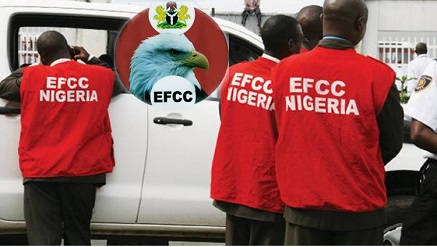
Economic and Financial Crimes Commission (EFCC), may have decided to swoop on some immediate past governors in the country, with their constitutional immunity stripped, according to National Mirror.
Some of the state chief executives could not be touched while in office because they enjoyed constitutional immunity from prosecution despite the myriads of allegations levelled against them.
Already, the commission has commenced investigation against the administration of Ibrahim Shema in Kaduna State, Martin Elechi, Ebonyi State and Sule Lamido of Jigawa State.
In Katsina State, the EFCC has invited four top officials who served under the Shema-led administration for questioning over some financial transactions.
Those invited include the state’s accountant general; permanent secretary, Ministry of Agriculture; his Works counterpart, and the general manager of the State Road Maintenance Agency, KASROMA.
Their invitation by the commission was contained in a two-page letter signed by one Aminudeen Muhammad on behalf of its chairman, and addressed to the Secretary to the Katsina State government.
The letter, which was obtained by National Mirror yesterday, indicated that the four officials would appear before the commission today (Wednesday) and tomorrow (Thursday).
According to the letter, the officials were directed to appear before the anti-graft agency with documents detailing financial transactions in their respective ministries and departments.
The state’s accountant general, who is billed to appear today, was directed to appear with statutory budgets of the state from 2011-2015 and details of all allocations made to the state from the federation account from 2011 to May 2015.
When appearing, he is also to present details of all allocations made to the 34 local government areas of the state from the federation account from 2011 to May 2015 as well as fund releases made to KASROMA, Ministries of Works, Agriculture and Sports from 2011 to May 2015.
The KASROMA boss, permanent secretaries of the Agriculture and Works ministries are scheduled to appear on Thursday and, were directed to appear with records of all contracts awarded, yearly budget, actual fund released and actual expenditure from 2011-2015.
According to the letter, the commission is investigating a case in which there is need to obtain certain clarification from the officials.
It was gathered that the commission’s invite may not be unconnected with investigations carried out by the present administration in the state at the committee level, on financial dealings by the past government.
Our correspondent reports that the last time the EFCC quizzed state government officials was some three years ago, when it reportedly questioned officials under the Shema-led government on financial dealings worth billions belonging to the local government areas.
EFCC also, yesterday, quizzed Elechi over an alleged financial mismanagement.
A reliable source told National Mirror that the ex-governor, who came to honour the invitation, arrived the commission’s head office in Abuja at about 10:a.m.
According to him, no sooner had Elechi arrived than a team of EFCC operatives commenced his investigation.
He said he was being drilled to give account of his stewardship as two-term governor of the state christened the ‘Salt of the Nation.’
It could not be confirmed whether the ex-governor would be granted administrative bail or be remanded by the commission.
However, as at the time of filing this report, Elechi was still being investigated.
When contacted, EFCC spokesman, Wilson Uwujaren, confirmed the arrest of the ex-governor, saying that he was being questioned over pending issue pertaining to an alleged financial recklessness.
He however declined to confirm whether the erstwhile governor would be remanded at the commission’s custody.
Wilson said: “I can confirm to you that the ex-governor is with us. He is being investigated to give account of his stewardship during his reign.
“He arrived our commission’s office at about 10:a.m and as I speak investigation is still ongoing.”
On January 29, the EFCC also invited the former governor’s son, Nnanna Elechi, for interrogation.
The agency has also turned its searchlight on Lamido, who on returning to Nigeria from abroad last week, said he would honour an invitation today over an ongoing investigation which allegedly implicated him.
He stated that because the EFCC is government’s anti-graft agency commissioned by law, there was no reason he would decline the invitation. Lamido is willing to honour the invitation and claims he would have also done so if he was still a governor with immunity.
Another former governor that may get an invite from the commission is Babangida Aliyu of Niger State.
The state’s current Governor, Abubakar Sani Bello, last week accused top functionaries of the Aliyu’s government of pocketing N2.9bn on the eve of their departure.
Governor Bello said his predecessor took a loan on the eve of his departure and did nothing with the money.
And, since his assumption of office, Governor Mohammed Abubakar of Bauchi State has been at loggerhead with his predecessor, Isa Yuguda, over the state’s finances.
Abubakar had accused Yuguda of leaving empty treasury, while the state allegedly received N837bn as allocation from the Federal Government in eight years.
He has threatened to invite the EFCC to investigate the administration over what he called financial recklessness.



Haleon, a global consumer health company with a purpose to deliver better everyday health, is introducing its corporate identity across Nigeria in a phased transition. Trusted brands such as Panadol, Sensodyne, Macleans, Otrivin, Voltaren, Cac 1000 and Andrews Liver Salts remain unchanged in formulation, quality, and effectiveness.

Following the formal demerger from GSK, Haleon was launched on July 18, 2022, as an independent company 100% focused on consumer health. Haleon is the new home for brands like Sensodyne, Panadol, Centrum and others, trusted by millions worldwide for their proven effectiveness in improving everyday health.
From relieving tooth sensitivity or pain to providing essential vitamins and nutrients, our products are designed to fulfil Haleon’s purpose: to deliver better everyday health with humanity.
This revised corporate identity is a branding change only and does not affect the safety, quality, or efficacy of the products. Haleon is sharing this update as part of its commitment to transparency and consumer confidence, helping consumers continue to choose the brands they know and trust.
Haleon’s collaboration with Fidson Healthcare forms part of this approach, reinforcing the value of local production in supporting trusted everyday health brands in Nigeria.
Panadol Extra 100s and Panadol Pain & Fever 100s are currently being produced and supplied to the market under the Haleon identity. Sensodyne Rapid Action will bear the Haleon corporate identity from mid-June, followed by Andrews Liver Salts later this year.
In due course, additional brands—including Otrivin, Voltaren, Cac 1000, Macleans, and the wider Sensodyne portfolio—will also transition to the Haleon identity.
Haleon remains committed to ensuring consumers can continue to access the same high-quality brands at pharmacies, supermarkets and other retail outlets across Nigeria.
“As Haleon introduces its identity in Nigeria, we want consumers to feel informed and reassured. The trusted products they rely on remain the same in quality, formulation and effectiveness.
“At the same time, our local production approach in partnership with Fidson Healthcare supports reliable access to high-quality everyday health products in Nigeria,” said Himanshu Raj, Haleon General Manager for Sub-Saharan Africa.


Tech entrepreneur and SpaceX founder, Elon Musk, has become the world’s first trillionaire after the successful public listing of SpaceX pushed his net worth beyond the $1 trillion mark.

Elon Musk
According to multiple financial reports, Musk’s fortune surged to approximately $1.1 trillion following SpaceX’s historic stock market debut on June 12, making him the first individual in history to achieve the milestone.
The sharp increase in wealth was driven primarily by SpaceX’s initial public offering (IPO), which valued the company at more than $1.7 trillion at listing before rising above $2 trillion during its first day of trading. Musk’s holdings in SpaceX, combined with his stakes in Tesla and other ventures, significantly boosted his net worth.
Musk, 54, is also the founder or co-founder of companies including Tesla, SpaceX, Neuralink and The Boring Company. He acquired social media platform X, formerly Twitter, in a $44 billion deal and has remained one of the most influential figures in technology and business.
Financial analysts noted that Musk’s wealth now far exceeds that of any other billionaire.
Matt Durot, deputy editor at Forbes Wealth, said the gap between Musk and the world’s second-richest individual had widened significantly, with no other person currently close to the trillion-dollar threshold.
Despite the historic achievement, Musk’s vast wealth has reignited debates over global inequality and the responsibilities of ultra-wealthy individuals in addressing humanitarian challenges.
Advocacy groups have frequently pointed to issues such as hunger, disease eradication and access to education as areas where large-scale private philanthropy could make a significant impact.
In 2021, Musk publicly challenged the United Nations to provide a detailed plan showing how billions of dollars could help combat world hunger. Although a proposal was later presented, no donation followed.
Analysts note that much of Musk’s wealth remains tied to company shares rather than liquid cash, meaning his net worth can fluctuate significantly with market movements.
Nevertheless, the SpaceX IPO marks a historic moment in global finance, placing Musk in a wealth category previously considered unimaginable.
Commenting on Musk’s business achievements, Jamie Dimon, chief executive officer of JPMorgan Chase, described him as “the Edison of our time.”
Musk’s rise from co-founding internet startup Zip2 in the 1990s to becoming the world’s first trillionaire is regarded by many analysts as one of the most remarkable wealth creation stories in modern history.
Recent research by Kaspersky has shown that the so-called “grey” websites repeatedly target all world regions, and this may be driving both financial loss and large-scale data harvesting.

Grey websites are deceptive online platforms that fall outside traditional phishing definitions but still manipulate users into voluntarily handing over money and personal data. Kaspersky’s new report provides detailed insights into the threats posed by the grey websites on global and regional levels.
Unlike classic phishing attacks, which aim to steal credentials outright, grey websites rely on persuasion, misleading interfaces, and hidden terms to exploit users. They often impersonate legitimate services such as e-commerce platforms, financial tools, AI services, or subscription-based content, making them significantly harder to detect.
Kaspersky analysis shows that the majority of suspicious resources globally fall into several recurring categories:
- Fake browser extensions and “security tools” that actually harvest browsing data and track user activity.
- Fraudulent financial platforms including crypto exchanges, trading tools, and investment schemes promising unrealistic returns.
- Intermediary services (e.g., legal or real estate), charging for low-value or nonexistent services while harvesting sensitive personal data.
- Subscription traps offering low-cost trials that convert into costly recurring payments hidden in fine print.
- Fake online shops that either deliver counterfeit goods or nothing at all.
Example of a grey website.
A notable trend is the emergence of tools disguised as AI services or image-processing platforms, reflecting attackers’ ability to adapt to current digital trends and target younger audiences.
There are proven security solutions that help users to detect grey websites across different types of devices – those running on Windows, Linux, Android and iOS. The detection model is based on many factors, including domain name and age, IP reputation, stability of the infrastructure used, DNS configurations, HTTP security headers, digital identity and popularity of the web resource and other criteria.
Regional specifics
Regional variations in grey websites demonstrate how threat actors localise scams based on user behaviour and trending technologies.
In Europe, the threat landscape is dominated by links to suspicious browser extensions and fake “privacy-enhancing” tools.
These resources often present themselves as security solutions, promising safer browsing or anonymous search capabilities. In reality, they function as browser hijackers – intercepting traffic, collecting cookies, tracking user behaviour, and injecting advertisements.
The popularity of these threats reflects a high level of user concern around privacy and security, which attackers actively exploit. Additionally, these regions show a steady presence of phishing intermediaries and crypto-related scams, indicating a blend of technical and financially motivated attacks.
Across African markets, financial scams are the most prominent category of suspicious resources. Fraudulent trading platforms, fake brokers, and investment schemes frequently mimic legitimate financial services, often accompanied by fabricated licenses or endorsements.
These platforms typically prevent users from withdrawing funds, instead introducing additional “fees” or taxes to prolong the scam. The concentration of these threats highlights how attackers leverage growing interest in online investing while exploiting gaps in regulatory enforcement and financial literacy.
In the Middle East and North Africa region, suspicious resources frequently mimic communication (Internet telephony) tools, financial platforms, or betting services. Additionally, Ponzi-style investment schemes and crypto scams are widespread, often presented through polished interfaces that mimic legitimate platforms.
Web browser-based threats also play a significant role, with malicious extensions targeting user data and browsing activity. The regional threat profile reflects a convergence of financial fraud and technical compromise, where users risk both data exposure and monetary loss.
“Suspicious websites don’t look harmful at first glance. But they exploit trust, urgency, and familiarity, and a single click on what looks like a harmless AI image tool, a “secure” browser extension, or a heavily discounted online shop could be all it takes to lose money or expose sensitive data.
Instead of direct credential theft, attackers turn to behavioural manipulation – whether that’s subscribing, investing, or installing software,” comments Anna Larkina, Web Content and Privacy Analysis Expert at Kaspersky.

UK, Nigeria Launch £15m Growth Programme to Accelerate Economic Transformation

Haleon Introduces New Corporate Identity in Nigeria

Elon Musk Makes History as the World’s First Trillionaire

NITDA Unveils Ambitious Strategy to Turn Southwest into Nigeria’s Next Innovation Powerhouse

Airtel Africa Foundation Publishes Inaugural Annual Report

CBN Extends PoS Geo-Fencing Enforcement Deadline to August 2026

Jumia Nigeria Records Strong Q1 2026 Growth as Technology-Led Strategy Drives Market Expansion

NCC Drafts New Rules for Virtual Mobile Operators

TD Africa, HPE Drive Conversations on the Future of Intelligent Networking

Anthropic Raises $65 Bn to Expand AI Research, Innovation




 E-Business2 days ago
Firm Discovered a New Corporate Phishing Technique using a Popular AI Web Development Platform

 Telecom2 days ago
No More Deleting and Reposting: Instagram Unveils Long-Awaited Profile Update

 Telecom2 days ago
Airtel Nigeria Launches Web Data Calculator to Give Customers Greater Visibility into Data Usage

 Telecom2 days ago
All Set for 2026 Nigeria DigitalSENSE Forum and Awards: NLNG, IHS, and others rally support

 Telecom2 days ago
NCC Board Reviews Telecom Sector, Notes Progress in Network Expansion, Consumer Compensation

 Telecom2 days ago
FG’s $10m Hello.cv Deal Sparks Outrage as Experts Question Snub of .ng Domain

 E-Financial2 days ago
America Borrows Power, Nigeria Borrows Survival

 General News2 days ago
MSMEs Paucity of Funds Receives Boost as Senate Backs Bill Seeking to Unlock Cash for them