

News
Babock University Deploys TCR Academic Technologies

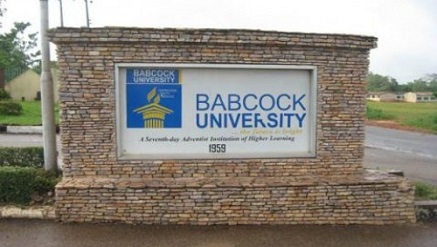
Babcock University, Ilesan Remo, Ogun State has raised the bar in education technology by becoming the first university in Nigeria to embrace a Total Classroom Revolution.
TCR will wirelessly connect all undergraduates, post graduates and Certificate students; lecturers, School Administrators and Parents to classrooms, Chapel, Halls of Residence, Library, and Cafeteria in a campus-wide Platform.
When completed, the project will help to accelerate students learning, research and social collaboration using a combination of some of the latest and best- in- class advanced education technologies that can only be found among the top universities in the world.
The projects sits well with Babcock trademark of continuous pursuit of academic excellence so that both lecturers and graduates of Babcock university are exposed to the same cutting- edge education technologies like their counterparts in Europe , Asia and American universities.
The technologies will connect both lecturers and students in real time live for collaboration, learning and problem solving.
The technology also ensures, through the use of a special tool, the fastest route possible towards content creation, authoring and publishing capacities for lecturers.
Besides, parents are integrated into the world of real- live education development of their wards. All lecturers of the university will undergo Technology appreciation training to enable them optimize the full potential of the package.
Babcock university working with a consortium of six companies from Canada, Israel, Germany, USA , France, and India will ; with effect from next academic session ; provides each student of the university with an educational- purpose- built 10.1” Babcock Learning Tablets ( BLT) that comes with a special browser that allows students to SURF -FOR -FREE for the duration of their academic session both on and off campus.
The BLT comes each with a solar charger that also serves as keyboard designed to double the life span of the battery of the tablet.
The BLTs are products of a Canadian company with eighteen patents for its peerless education Learning Tablets that have revolutionized education in the UK, Canada and India.
The special Tablets built for Babcock students come a new technology that compresses bandwidth to ensure students have free access to basic internet facilities meant for education purposes only not only while they are on campus but even while at home during vacation.
The package also integrates In- Motion- Identification Biometrics (IMID) which is the latest and most advanced biometrics in the world today.
IMID is an Israeli patented innovation that allows for identification and authentication of students while in -motion from a distance without the usual delay and health challenges that are associated with legacy biometrics technologies.
The biometrics can identify up to eight students at once – using their behavioral, voice and facial characteristics.
The technology will be deployed at Babcock university Halls of residence, Cafeteria, and Chapels in the first phase.
Third on the list of TCR component is the implementation of Advanced Learning Management system (ALMS) which allows seamless recording of the video and audio lectures delivered by lecturers and archiving of those lectures to make it easier for students to review time and time again.
Babcock university lecturers will benefit immensely from its content creation and authoring tool that puts them at the driver seat of converting their content to books and hand-outs at the speed of light.
Thus, Babcock has become the first university in Africa to join the league of the Top Global 100 universities that use the Germany solutions to drive both students and lecturers productivity. Furthermore Babcock will have access to over twenty features on ALMS such as student attendance and participation in classroom, Social Jam ,etc
The software components of the Total Classroom Revolution are sourced from four countries – Nigeria, USA, France , India.
The software includes but not limited to a robust schoolApp , anti- theft for all the students Tablets, PUSH Communication and APPLICATION technology using Firmware Over the Air( FOTA), Student Management System etc
Two topmost Nigerian banks are providing the financial power to the Consortium handling the project.
In addition, each lecturer of the university will get one laptop that connects them to their fellow lecturers and students on campus. Each of the five hundred classrooms will be fitted with one wireless projector; U- POINTER and Inverter to support the Total Classroom Revolution.
A combination of U-Pointer and wireless projector will replace the expensive legacy white interactive board, thereby reducing the capital expenditure of the university.
A 360 degree Internet Security will also be provided to protect the hardware and software from virus, malware, ransom ware, worms and other cyber threats.
“The ALMS helps students/lecturers interact seamlessly in a way that students can connect to their lecturers laptop using the software on their Tablets and if for any reason they are not able to be in class they have an option of participating in the “live”class activities, receive lectures via telephone/video feed. Students can form online study group/discussions on different subjects,” according to the Consortium managing the project.
The project will see the deployment of 12,000 customised Babcock Learning Tablets (BLT) for students with 32 Gigabit android powered 10.1 inch tablets.
According to Mr. Akin Akintayo, IVETEC -WiniGroup project manager the company coordinating the six consortium of companies ” An ALMS Control Room and Hardware maintenance and service centre will be established on the campus by the consortium to drive technology skills transfer, servicing and repairing of tablets , laptops and other hardware development. The Center will be manned by qualified, experienced Hardware and Software Engineers drawing from among Babcock university graduates of Computer Science department.
Professor J Kayode Makinde, Vice Chancellor of the university, sees the Total Classroom revolution as ”Another evidence of the Babcock University Management’s unwavering commitment towards the continuous achievement of academic excellence that Babcock is known for since its inception.”
Professor Kayode Makinde believes that “This new project will further consolidate the leadership position of Babcock as a pacesetter and the best in the league of private universities in Nigeria’.



Ola Olukoyede, chairman of the Economic and Financial Crimes Commission (EFCC), has disclosed that the commission recovered more than N7.2 million stolen from the bank account of a serving judge by suspected internet fraudsters in a midnight cyberattack.

Ola Olukoyede, Chairman of the Economic and Financial Crimes Commission (EFCC).
Olukoyede made the disclosure at the public presentation of two books authored by retired High Court judge, Justice Alaba Omolaye-Ajileye.
He said the serving judge, who is from a South-South state, contacted him around 1:00 a.m. after receiving multiple debit alerts indicating that funds had been withdrawn from her account.
According to him, the stolen money represented savings the judge had accumulated over six years to finance her child’s education.
Olukoyede said the EFCC immediately swung into action and successfully recovered the entire sum before 6:00 p.m. on the same day.
He said the incident underscored the increasing sophistication of cybercriminals and the urgent need for stronger collaboration among law enforcement agencies, the judiciary and members of the public in tackling financial crimes.
The EFCC chairman also called for amendments to Nigeria’s legal framework to accommodate the use of artificial intelligence (AI) in criminal investigations and prosecutions.
According to him, existing evidence laws should be reviewed to recognise AI-generated evidence as technology continues to reshape crime detection and investigation.
Also speaking at the event, former Attorney-General of the Federation and Minister of Justice, Chief Kanu Agabi (SAN), urged anti-corruption agencies to intensify efforts to trace and recover public funds allegedly stolen and stashed in foreign countries.
Agabi stressed the need for sustained collaboration among relevant institutions to strengthen Nigeria’s anti-corruption efforts and improve accountability in public service.
In his remarks, a former President of the Nigerian Bar Association (NBA), Chief Wole Olanipekun (SAN), called for stricter enforcement of the country’s cybercrime laws to curb the growing menace of internet fraud.
Olanipekun said effective implementation of existing laws, alongside stronger institutional cooperation, would help address the increasing threat posed by cybercriminals to individuals and the nation’s financial system.

Federal Government has cleared nearly N39 billion in outstanding pension liabilities owed to retirees under the Defined Benefit Scheme (DBS), including former employees of the defunct Nigerian Telecommunications Limited (NITEL), Mobile Telecommunications Limited (MTEL), the Power Holding Company of Nigeria (PHCN) and other federal government agencies.

The Pension Transitional Arrangement Directorate (PTAD) disclosed this in a statement, saying the payments were in line with President Bola Tinubu’s Renewed Hope Agenda, which prioritises the settlement of inherited pension liabilities and improved welfare for retired public servants.
According to the directorate, the largest component of the payment, amounting to N25 billion, covered about 35 months of outstanding pension arrears owed to nearly 10,000 eligible retirees of the defunct NITEL and MTEL.
PTAD also said it disbursed about N9.5 billion as the first tranche of Back End Computation (BEC) arrears to eligible pensioners of the defunct Power Holding Company of Nigeria.
The Executive Secretary of PTAD, Mrs Tolulope Odunaiya, described the payments as a significant milestone in the Federal Government’s efforts to clear inherited pension obligations and strengthen confidence in the Defined Benefit Scheme.
Odunaiya said the settlement was made possible following presidential approval granted in 2025 and funding provided under the 2026 Appropriation Act.
She noted that the intervention had enabled the directorate to resolve long-standing pension liabilities affecting thousands of retirees.
“The successful settlement reflects the Federal Government’s commitment to sustaining pension reforms and ensuring that retirees receive their entitlements promptly in line with the objectives of the Renewed Hope Agenda,” she said.
Odunaiya thanked the affected pensioners for their patience while the liabilities remained outstanding and reaffirmed PTAD’s commitment to transparent, efficient and pensioner-focused service delivery.
She added that the directorate would continue to work towards improving pension administration and ensuring timely payment of retirees’ benefits.


A Federal High Court, Lagos has declared Mrs. Ebele Okpala, a female banker with Keystone Bank, wanted over alleged N35 million fraud.

Apart from declaring the banker who is said to be outside the country wanted, Justice deinde Dipeolu, trial judge in the matter, also directed the Department of State Security (DSS), Nigerian Immigration Service (NIS), and Nigeria Customs Service (NCS), to arrest her upon arriving the country.
Justice Dipeolu made the above order while granting a motion ex-parte marked FHC/L/530C/2024, filed and moved by M. Bello, on behalf of the Nigeria Police.
In the motion, Ebele Okpala and one Perpetual Onyeto, also a banker were listed as first and second defendants/respondents in the suit, while DSS, NIS and NCS were listed as cited parties/respondents.
In urging the court to make the above orders, Bello, informed the court that the application was pursuant to several sections of the Administration of Criminal Justice Act (ACJA) 2015, and under the court’s inherent jurisdiction. Adding that the application was supported by an affidavit deposed to by Inspector Tope Akerele of the Force Criminal Investigation Department (FCID), Special Fraud Unit (SFU), Ikoyi, Lagos.
In granting the application, Justice Dipeolu held, “After considering the application and the supporting affidavit, the request had merit and granted all the reliefs sought by the prosecution.
“That an order is hereby made that the 1st defendant/despondent be declared wanted and placed on the wanted list of the Nigeria Police Special Fraud Unit, 13, Milverton Road, Ikoyi, Lagos until she is arrested.
“That an order is hereby made compelling cited parties/respondents to assist in apprehending 1st defendant/Respondent once he enters into the country.
“That an order is hereby made permitting the Publication of the name of the 1st defendant/despondent in the National Daily Newspapers and Social Media handles by the Nigeria Police Special Fraud Unity Ikoyi, Lagos for the purpose of fulfilling the requirement of the Order 1 above.”
Recall that both the wanted banker and the second defendant/respondent were previously arraigned before the court by the operatives of the police Special Fraud Unit, PSFU.
Specifically, the two bankers were arraigned before the court sometimes in September 2024, on alleged conspiracy, theft, money laundering, fraudulent lift of lien placed on bank’s customer’s account and obtaining the sum of N35 million by false presence.

World Bank Okays New $1.25Bn Loan for Nigeria

Xenophobia: MTN Nigeria Belongs to Nigerians, Not Only South Africans — Toriola

SEC Grants Approval to Luno, Other Crypto Firms under Regulatory Sandbox

MTN Nigeria Celebrates Volunteers at Y’ello Care Impact Showcase

Listicle: 10 Essential Meta Safety Tools Every Parent and Teen Should Know

Mobile Internet Gender Gap Widest in Africa – GSMA

FG Targets Alleged N3tn Capital Flight, Opens Airtime Credit Market to Nigerian Fintechs

Nigeria Launches FreeTV Nationwide

UK, Nigeria Launch £15m Growth Programme to Accelerate Economic Transformation

NASENI Moves to Digitize CCB’s 5m Assets Declaration and Operations




 E-Financial2 days ago
IMF Raises Concerns over N8.83 Trillion Unreported Spending in Nigeria’s Budgets

 News2 days ago
Court Declares Keystone Bank Staff Wanted over Alleged N35m Fraud

 Telecom2 days ago
OpenAI in Talks to Offer U.S. Government 5% Stake Amid AI Scrutiny

 E-Business2 days ago
NOTAP to Commercialise University Research, Expands Patent Drive

 E-Business2 days ago
Kaspersky Warns of a Large-scale Campaign using Fake Free Software to Deploy a RAT via ScreenConnect

 E-Business2 days ago
FG Unveils Digital Postcode System for MDAs

 News2 days ago
UK Deepens Digital Partnership with Nigeria to Drive Inclusive Growth

 E-Financial2 days ago
NDIC Warns Against Transactions with 46 Closed Microfinance Banks