

Telecom
Ericsson Targets Indoor Space for LTE Software Upgrades with New Suite


Over the last few years a major shift in connectivity has been gaining speed; especially the shift from a mainly laptop era and into a fully mobile era.
The new era is driven by connectivity with friends, family, and colleagues through multiple devices – growing to 4.3 devices per user by 2020, according to Ericsson study and where business transactions are often made over the cellular network.
The resulting influx of devices, users, and applications trying to access the network can result in poor indoor coverage and performance.
And with the coming growth in the Internet of Things contributing to 26 billion connected devices in 2020, providing the right coverage to indoor spaces will become a greater challenge.
To support these changes in connectivity, Ericsson, long recognized for high-performance, innovative hardware, is pushing performance further by adding capacity and functionality with software-only upgrades.
On Tuesday, Ericsson announced its next major software release, Ericsson Networks Software 16A, which will feature a new suite of LTE software upgrades targeting the indoor space.
Among the hundreds of new and enhanced software feature options in Network Software 16A, the new suite features advances in uplink and downlink performance – boosting network uplink speeds by up to 200 percent, downlink speeds by up to 30 percent and adding LTE Unlicensed (LTE-U), the first commercial step in Licensed Assisted Access – as well as features to support greater energy efficiency of small cells.

To achieve these gains, Ericsson has been working with leading customers on lab tests and trial activities.
According to Mike Sapien, principal Analyst Enterprise Services, Ovum, “While operators have understood that they need to design mobile networks for increasing amounts of data now, Wi-Fi networks have traditionally been the solution of choice for indoor connectivity for enterprise customers. However, Wi-Fi cannot service the need for reliable and mobile voice services or text messaging, much less handle the business-critical applications that require the app coverage, voice services, and full mobility provided by cellular. Now, as we move toward 5G, both cellular and Wi-Fi will need to work together to offer differentiated and seamless service.”
Increases in video and media uploads by businesses and consumers via apps like Instagram and Facebook call for better uplink speeds.
Ericsson Networks Software 16A includes two uplink enhancements that will enable mobile operators to utilize 64 Quadrature Amplitude Modulation (QAM) on uplink to provide 50-percent better peak speeds of 75 Mbps.
In addition, it enables uplink carrier aggregation, which can double uplink data speeds.
Combined, these improvements provide peak uplink data rates up to 150 Mbps, which is a 200 percent improvement.
Further enhancements focused on the indoor space boost download speeds by 30 percent using 256 QAM encoding.
Earlier this year, in a live demonstration with Ericsson, Telstra achieved the world’s first download peak rates of 600 Mbps using this new feature.
Devices that support these advances become available this year, in line with commercial availability of the Ericsson Networks Software 16A.
Networks Software 16A also includes LTE-U, to drive higher performance. LTE-U enables operators to combine the reliability of licensed spectrum with indoor data speed boosts provided by unlicensed spectrum.
Arun Bansal, senior vice president and head of Business Unit Radio, Ericsson, commented thus: “To keep pace with mobile broadband demand from both consumers and industry, operators need solutions that deliver both high performance and efficiency.
“Ericsson’s indoor software innovations deliver both. And, these new features combined with Ericsson’s end-to-end solutions, flexible go-to-market and business models and proactive relationships with key device ecosystem partners, ensure that our leading operators not only keep pace, but set the pace.”
Ericsson Networks Software 16A builds on energy-efficiency capabilities in previous releases and now includes Cell Sleep mode.
This feature enables individual carriers to automatically switch off during periods of low traffic demand, ensuring greater energy efficiency of small cells.
Indoor is the new hub of mobile activity and operators will need strategic models and services to cover this huge footprint.
To complement operator efforts, Ericsson is expanding its use of channel partners, such as Anixter and working with leading real estate developers and property managers, including Skanska, helping to create new business opportunities.
Through Ericsson’s flexible service and business models, mobile operators can choose their level of involvement.
For operators who wish to deploy and manage indoor networks themselves, Ericsson offers easy-to-deploy hardware and installation tools.
Ericsson Global Services offers a comprehensive range of small cell services, from strategic network analysis through design, integration, optimization and monitoring, right up to a fully managed Small Cells as a Service (SCaaS) offering.
With SCaaS, complete ownership of the hardware and deployment is handled through Ericsson Global Services, allowing for a simple and easy go-to-market model for indoor opportunities.
Ericsson also offers enterprise solutions for operators to bring to their customers, ranging from Mobile Unified Communications and Video Communications to Managed Enterprise Cloud.



Clydestone Ghana Plc has filed a writ of summons and statement of claim against MTN Ghana, MTN Group Limited and Mobile Money Fintech Limited, alleging unauthorized use of its intellectual property.

The company announced the court action at the Ghana Stock Exchange, confirming proceedings in the Commercial Division of the High Court of Ghana.
The case relates to work commissioned in 2007 that Clydestone alleges was later used without authorisation or compensation.
Clydestone said the claim involves proprietary intellectual property, confidential commercial information and operational methodology developed during the engagement. The company is seeking declarations, damages and equitable remedies.
In a statement, Clydestone said MTN Ghana engaged it in 2007 to develop a commercial and operational framework for a mobile money business.
“The work was developed and delivered by the company’s founder and Group CEO, Paul Jacquaye, and included a full mobile money ecosystem covering the commercial model, operational architecture, implementation methodology and business case.”
Clydestone said the work was commissioned on the understanding that a non-disclosure agreement and memorandum of understanding would be signed.
It alleges these agreements were not finalised despite repeated requests.
The company further alleges MTN Ghana later used its proprietary work and methodology without authorisation or compensation, including in MTN Mobile Money Ghana and other markets.
Clydestone said the alleged use has continued since the launch of MTN Mobile Money Ghana in 2009.
“The wrongful use of that work has been ongoing since 2009. What has changed is the availability of independently verifiable information that documents its scale and commercial significance,” the company said.
It cited the GSMA State of the Industry Report on Mobile Money 2026 and MTN Ghana’s 2025 annual report as evidence of the platform’s scale.
According to Clydestone, the reports show approximately 19.3 million active users and annual revenue of about GHS 6.0 billion ($516m).
The company said it reviewed its records following these publications and concluded there were sufficient grounds to initiate legal proceedings.
It added that it has received no payment or acknowledgement for the work since December 2007, and that pre-action correspondence in 2026 received no substantive response.
“The Board of Directors has unanimously authorised the commencement of these proceedings,” the company said.
Jacquaye said: “This case is about accountability for commissioned intellectual property.
“When independent publications in 2025 and 2026 revealed the scale of the mobile money business, we reviewed all documentation relating to the original engagement and concluded these proceedings were necessary.”
MTN Group Limited, named as a defendant, had not commented at the time of publication.

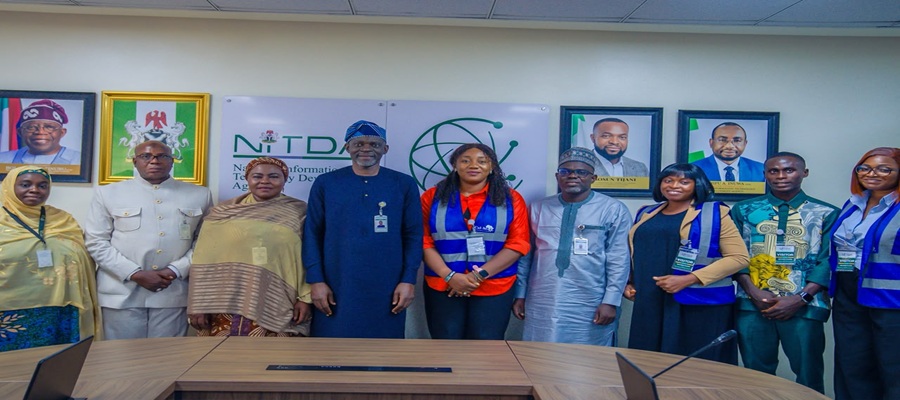
National Information Technology Development Agency (NITDA) has reaffirmed its commitment to expanding digital inclusion through strategic partnerships aimed at equipping underserved communities with digital skills and access to technology.

Mr. Oladejo Olawunmi, Director, Digital Development Services representing the Director General of NITDA, and the Executive Director of Cal-Maji Foundation, alongside members of their respective delegations, pose for a group photograph following a strategic engagement on advancing digital literacy, capacity building, and digital inclusion for women, youth, and underserved communities.
Director-General of NITDA, Kashifu Inuwa, made the commitment during a courtesy visit by the Executive Director of Cal-Maji Foundation, Mrs Faith Ayuba, to the agency’s headquarters in Abuja.
Represented by the Director of Digital Development Services, Mr Oluwunmi Oladejo, Inuwa said collaboration with community-based organisations remained central to NITDA’s vision of ensuring that no Nigerian was left behind in the country’s digital transformation journey.
He noted that feedback from beneficiary communities demonstrated the long-term impact of the agency’s interventions across the country.
“It is always gratifying to receive feedback from communities that have benefited from our interventions.
“Many of these projects were implemented years ago, and it is rewarding to know they are still creating opportunities,” he said.
The NITDA boss explained that the agency continued to monitor the performance of its intervention centres nationwide while leveraging emerging technologies to enhance digital learning and virtual capacity-building.
According to him, the National Digital Literacy Framework remains the foundation of NITDA’s efforts to equip children, students, artisans, farmers, professionals and other groups with digital competencies needed in a technology-driven economy.
Responding to requests for additional support, Inuwa disclosed that the agency would consider training community-based instructors to sustain digital literacy initiatives at the grassroots.
He encouraged the foundation to submit a formal request, accompanied by evidence of activities at its digital centre, to facilitate further intervention.
The director-general, however, acknowledged that maintaining internet connectivity across numerous intervention centres nationwide remained a major funding challenge.
He stressed the need for innovative financing models and stronger collaboration to ensure the sustainability of digital inclusion projects.
Earlier, Ayuba commended NITDA for its openness to partnerships and its commitment to supporting initiatives that deliver measurable impact in underserved communities.
She described the agency as one of the few government institutions that prioritised impactful programmes over personal connections.
According to her, the Cal-Maji Foundation focuses on improving access to education, strengthening food systems, enhancing food security and providing social protection for women and young people, particularly in remote communities.
Ayuba said NITDA’s Knowledge Access Centre, established at the foundation’s community school in a border community in Kogi State, had significantly transformed learning by providing students and residents with access to computers, internet services and digital education.
“The ICT centre became an equaliser.
“Young people who ordinarily would never have had access to computers or the internet suddenly had the opportunity to acquire digital knowledge.
“We came back simply to say thank you because this partnership has changed lives,” she said.
She disclosed that more than 1,000 children had benefited from the foundation’s educational programmes.
Ayuba also presented a former student who progressed from the community school to a Nigerian university after utilising the digital resources available at the centre.
She described the student’s achievement as evidence of the enduring impact of the collaboration.
The foundation’s executive director appealed for deeper collaboration through the training of community instructors, upgrading of computer systems and expanded access to NITDA’s digital capacity-building programmes.
She stressed that rural communities must not be left behind as Nigeria advances in emerging technologies such as artificial intelligence, cybersecurity and digital innovation.
The meeting ended with both organisations reaffirming their commitment to strengthening collaboration to expand digital opportunities, promote inclusive technology adoption and support Nigeria’s digital economy agenda.

National Information Technology Development Agency (NITDA) has unveiled the National Software Quality Assurance (SQA) Framework to improve software quality, strengthen cybersecurity and enhance public confidence in Nigeria’s digital infrastructure and government services.

The framework, approved by the Director-General of NITDA, Kashifu Inuwa Abdullahi, under the provisions of the NITDA Act 2007, establishes national standards for the design, testing and deployment of software across Federal Government institutions, regulated industries and the broader digital ecosystem.
According to the agency, the initiative is aimed at reducing costly information technology failures, improving service delivery and ensuring that software powering critical national infrastructure meets globally accepted quality standards.
The framework comprises three regulatory instruments, namely the National Software Development Guideline, the National Software Testing Guideline and the Software Testing Organisations Licensing (STOL) Guideline.
NITDA explained that the National Software Development Guideline mandates structured software development processes, secure coding practices based on the Open Worldwide Application Security Project (OWASP), standardised system documentation and compliance with Web Content Accessibility Guidelines (WCAG) 2.1 AA for citizen-facing digital services.
The National Software Testing Guideline introduces mandatory testing benchmarks covering software functionality, cybersecurity, system performance under peak demand and interoperability before deployment.
Under the STOL Guideline, independent Licensed Software Testing Organisations (LSTOs) will be accredited and regulated to evaluate and certify software before it is deployed.
The agency stated that all Federal Government software projects would now be required to undergo independent third-party testing and obtain official certification before deployment.
It added that compliance with the framework would become a mandatory requirement for obtaining IT Project Clearance.
To strengthen risk management, the framework introduces a three-tier software classification model based on the criticality of systems.
Under the classification, Class A covers high-risk and critical national infrastructure such as core banking systems, national identity platforms and electricity grid control systems.
Class B applies to medium-risk enterprise platforms, while Class C covers lower-risk internal software applications.
NITDA said Class A systems would undergo more rigorous security assessments, including advanced penetration testing and specialised audits conducted by top-tier accredited software testing organisations.
The agency identified three major benefits of the framework.
It said the initiative would improve the reliability and security of digital public services, protect government investments from software failures and cyber threats, and enhance service delivery to citizens.
It also noted that regulating independent software testing would stimulate the growth of Nigeria’s software assurance industry, create employment opportunities for technology professionals and promote indigenous innovation.
According to NITDA, the framework will further strengthen international confidence in locally developed software, enabling Nigerian technology companies to compete more effectively in global markets and attract foreign investment.
Speaking on the development, Inuwa said quality remained fundamental to building trust in Nigeria’s digital economy.
“Quality is the foundation of digital trust.
“With this Framework, every software solution serving Nigerians, whether built for government or the private sector, will meet clear national standards for security, reliability and interoperability.
“This is how we modernise government technology and position Nigerian software to compete on the global stage,” he said.
The agency disclosed that the framework would take full effect in the second quarter of 2027.
It said the implementation period would include nationwide stakeholder engagement, capacity-building programmes and the accreditation of software testing organisations.
NITDA added that an Expression of Interest (EOI) would soon be issued to qualified organisations seeking licences to operate as independent software testing bodies under the new regulatory regime.

Nwokolo, Nollywood Actor Claims Internet Fraud is “Keeping Economy Afloat’

SEC Begins Full e-Registration for Capital Market Operators

Elon Musk Launches Invite-only X Money with Visa Debit Card

CBN Fines Banks N430m for Ignoring Customers’ Complaints

Kaspersky Uncovers New Mirage Kitten Malware Used in Cyber-espionage Campaign Across Africa, Others

NRC, Ponzi Scheme Collapses Resulting Loss of Billions of Naira

EFCC Busts NIS Visa Overstay Racket, Uncovers N700m in an Account

From Scarcity to Scale: What Africa Can Learn from India’s Agricultural Transformation

Tokenization, Blockchain Technology will Transform Financial Institutions – IMF

BON Establishes Six Ad Hoc Committees to Modernize Broadcasting




 Telecom1 day ago
Fact-Check: Elon Musk’s “Tesla Pi Phone” is Internet Rumor

 News2 days ago
History as Lagos Becomes First Nigerian State to Launch Greenhouse Gas Registry

 E-Business2 days ago
UNN to Partner Firm on AI, Smart Mobility Innovation Centre

 Telecom2 days ago
AI Investment Gap Threatens Africa’s Future Growth

 Telecom2 days ago
AMCON Puts ntel Up for Sale, Seeks Investors

 E-Financial2 days ago
Remita Raises Alarm Over Nigeria’s Digital Divide, Calls for More Investment

 E-Financial1 day ago
Malpass, Ex World Bank Chief Raises Alarm over Nigeria’s Secretive Debt Structures

 Telecom1 day ago
How and Why Apps Deplete Data – ALTON