

E-Business
Konga Discloses Big Discounts Coming on ‘Yakata’ 2015

Konga.com, Nigeria’s largest online mall has promised customers the most unprecedented discounts ever given by any sales outlet in Nigeria, during this years’ Konga.com Yakata sale promo.
The Yakata salesis Konga.com’s version of famous ‘Black Friday’ sales that holds in several countries in the western world.
The 2015 Yakata will be a two day online shopping event starting on Thursday, November 26 and continuing on Friday, November 27.
Gabriel Gab-Umoden, vice president marketing, Konga.com, speaking on the upcoming discount salessaid that to excite the customers this year, kongahas curated an unbeatable line up of top selling items to be sold mind blowing discounts for the period of the Yakata sales.
In his words; “We know that Konga’s customers are looking to us to provide the lowest prices and greatest deals for this edition, and we have put all necessary measures in place to ensure that our customers are not disappointed.We would have discounts on almost every item on the site.In addition to these amazing discounts, shoppers get an additional 5 per cent discount when they pay using KongaPay.Yakata is a way of saying ‘Thank you’ to our customers for their patronage over the year.”
One star product that would be launched on the 1st day of Yakata is the brand new Alcatel Popstar android smartphone. The phone will be available exclusively on Konga, at a special price of N15,900, an unbeatable deal for an android phone of its great specs.
The discount sales promo has recorded huge successes in the last two editions. It will be recalled that the first Yakata sales held in 2013 and recorded N50 million worth of orders every hour at peak periods, with the company selling 500% more items during the two days massive discount sales than it did in all of 2012.
Also in 2014, offering up to 70 per cent savings on select items across categories, Konga’s Yakata sales recorded over N600 million worth of items in two days.
With the rapid growth of e-commerce in Nigeria, the 2015 Yakata editionis certainly going to be mind-blowing with unbelievable discounts across fully stocked categories.
Konga.com was launched in July 2012 with a mission, ‘To Become the Engine of Commerce and Trade in Africa’.
The company has recorded very rapid growth and in just 3 years, konga.com has built an operation that leads the market in customer satisfaction, merchandise shipped and innovation.
Konga began operations as a first party retailer investing in inventory and infrastructure to support the birth of ecommerce in the region. The company has now evolved to become Nigeria’s most vibrant online marketplace with close to 30,000 merchants registered and selling on the platform.
With over 200,000 products listed on the site, spanning various categories including Phones, Computers, Clothing, Shoes, Home Appliances, Books, healthcare, Baby Products, personal care and much more; konga is Nigeria’s largest online marketplace.



Pope Leo XIV called Monday for the “disarming” of artificial intelligence in his long-awaited manifesto on the rapidly developing technology, and warned of “new forms of slavery” behind its rise.

Leo, warned against “a race for ever more powerful algorithms and larger datasets, driven by the desire to secure geopolitical or commercial dominance”.
He presented his first encyclical, “Magnifica Humanitas” (Magnificent Humanity) in person at the Vatican, alongside AI experts including Christopher Olah, co-founder of US giant Anthropic.
Anthropic is embroiled in a legal battle with the US military after opposing the use of its technology for lethal autonomous warfare and mass surveillance.
At the presentation, Olah said AI companies operate “inside a set of incentives and constraints that can sometimes conflict with doing the right thing”.
He welcomed input from outside actors like the Catholic Church, to “push events in a better direction” saying that “the questions raised by AI are bigger than the AI research community”.
In the encyclical, Leo also sounded the alarm over AI-directed weaponry, saying it was “not permissible to entrust lethal” decisions to tech.
Leo has repeatedly clashed with the White House over the Iran war and its use of religion to justify conflict.
The “just war” theory — espoused recently by the Trump administration — was “outdated”, Leo wrote, adding that “no algorithm can make war morally acceptable”.
AI could be worth up to $4.8 trillion by 2033, a 25-fold increase in a decade, while concentrating its profits in the hands of a limited few, according to the United Nations.
“Disarming AI means freeing it from the mentality of ‘armed’ competition,” the pope wrote.
“To disarm does not mean rejecting technology, but preventing it from dominating humanity,” Leo wrote.
AI should be “human-friendly”, accessible to all, and open to discussion and debate, he added.
The head of the world’s 1.4 billion Catholics has made the hot-button issue a cornerstone of his papacy by dedicating to it his first encyclical — a document that lays the basis for Church teaching and longer-term debate.
The manifesto references a range of cultural giants, from Greek philosopher Plato to Beethoven and his Ninth Symphony, even citing a character from JRR Tolkien’s “The Lord of the Rings”.
“Magnifica Humanitas” was signed on May 15, the 135th anniversary of an 1891 encyclical by Leo XIII, which laid the foundations of the Church’s social doctrine during the Industrial Revolution.

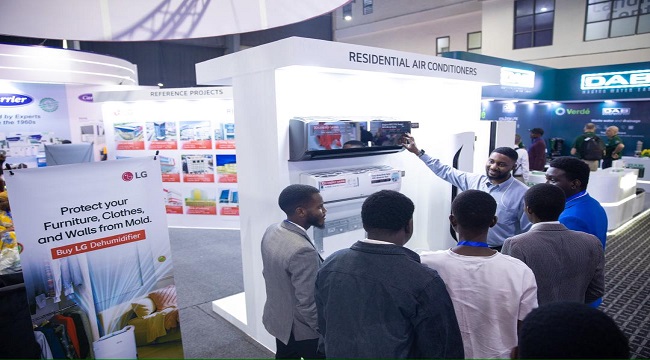
LG Electronics reaffirmed its position as a leading innovator in climate control and energy-efficient air conditioning solutions with its participation at Mega Clima Nigeria 2026, the 9th International Air Conditioning and Refrigeration Exhibition recognized as the largest HVAC+R sector show in West Africa.

Held at the Landmark Centre, Lagos, the three-day exhibition brought together global manufacturers, distributors, contractors, engineers, and industry stakeholders to explore the future of heating, ventilation, air conditioning, and refrigeration technologies across the region.
As one of the featured exhibitors at the event, LG leveraged the platform to showcase a range of advanced HVAC solutions designed to address the growing demand for smarter, more energy-efficient, and scalable cooling systems across residential, commercial, and industrial environments.
With West Africa’s HVAC sector continuing to evolve alongside rapid urbanisation, infrastructure growth, and increasing attention to sustainability, Mega Clima has become a strategic meeting point for conversations around innovation, efficiency, and climate-responsive technologies. The 2026 edition featured over 100 global brands, thousands of professional visitors, technical workshops, and networking opportunities, further positioning the exhibition as a key industry platform within the region.
Showcasing Smart Climate Solutions for Residential and Industrial Needs
At the LG exhibition booth, visitors and stakeholders engaged directly with a range of the company’s advanced HVAC technologies, including the LG Multi V.5 and Multi VS systems, both designed to deliver high-performance cooling while optimising energy consumption.
Speaking during the exhibition, Business Development Manager, LG Electronics Nigeria, Ifeoluwa Babarinsa, highlighted the adaptability and efficiency of the showcased systems, particularly their ability to support multiple indoor units while maintaining low energy consumption.
According to him, the LG Multi V.5 system is designed primarily for industrial and large-scale commercial applications, while the Multi VS system is tailored toward residential use cases, providing flexible solutions for varying environmental and operational demands.
A major highlight of the systems is their scalability, with both solutions capable of connecting to as many as 64 indoor units, offering increased operational flexibility across different building types and installation requirements.
The exhibition also featured several indoor HVAC solutions compatible with the VRF systems, including the Round Cassette, Ceiling Concealed Type Units, and Four-Way Cassette Units.
Particular attention was drawn to the Round Cassette unit, which was presented as an innovative cooling solution suitable for spaces without conventional ceiling structures. The unit also demonstrated enhanced airflow performance through its round-flow air distribution system and faster cooling capabilities.
Through live demonstrations and product engagement sessions, LG provided visitors with practical insight into how modern HVAC technologies can improve comfort, operational efficiency, and energy management across residential and commercial spaces.
Reinforcing LG’s Commitment to Energy Efficiency and Innovation
LG’s participation at Mega Clima Nigeria 2026 reflects the company’s broader commitment to delivering technologies that align with evolving consumer and industry needs, particularly in markets where energy efficiency and sustainable infrastructure are becoming increasingly important.
As conversations around environmental sustainability and smart infrastructure continue to shape the future of the HVAC industry, the exhibition provided an opportunity for LG to reinforce the role of intelligent climate solutions in supporting long-term energy optimisation and building performance.
The company’s showcased systems emphasised not only cooling performance, but also operational efficiency, adaptability, and user-focused design, qualities that continue to define LG’s approach to innovation across both consumer and commercial categories.
“This year, we showcased our inverter product range alongside advanced HVAC solutions that reflect LG’s continued commitment to innovation, energy efficiency, and smarter climate control technologies. One of the key highlights was our AI-powered VRF solution, the Multi V i, which represents the next phase of intelligent cooling systems we are introducing into the Nigerian market. As the headquarters of LG Electronics West Africa, Nigeria remains a strategic hub for us, and we remain committed to expanding access to innovative solutions that meet the evolving needs of customers and businesses across the region.”
LG’s presence at the exhibition also reflected its continued investment in engaging industry professionals, technical experts, and business stakeholders through platforms that encourage collaboration, knowledge exchange, and technological advancement within the HVAC sector.
Positioning Technology as a Driver of Smarter Living and Infrastructure
Beyond product displays, Mega Clima Nigeria 2026 created a broader conversation around the future of climate control technologies within rapidly developing urban environments. From commercial buildings and hospitality spaces to residential infrastructure, the demand for efficient and intelligent cooling systems continues to grow across the region.
By participating in one of West Africa’s most influential HVAC exhibitions, LG demonstrated its readiness to support this growth through solutions that combine advanced engineering, smart functionality, and energy-conscious performance.
The exhibition further reinforced LG’s philosophy of creating technologies that improve everyday experiences while supporting the broader goals of efficiency, sustainability, and modern living.
As the HVAC industry continues to evolve across Africa, LG remains committed to delivering solutions that not only respond to present demands, but also anticipate the future needs of businesses, homes, and infrastructure across the continent.
Kaspersky experts explain which online offers travellers should be cautious of when planning their trip, to avoid spoiling their experience ahead of the upcoming games.

Thousands of fans are expected to attend the World Cup 2026, and many are already handling their travel logistics, purchasing their flights and other transport tickets, booking accommodation, and arranging everything they need to reach the host cities. As interest grows, so does the number of fraudulent schemes that exploit the fact that fans are actively preparing for their upcoming journey.
In late April 2026, Kaspersky experts detected a campaign exploiting the branding of a well-known transport app, targeting users in Mexico. The interface of a fake Spanish-language website, impersonating one of the services, prompts users to enter their phone number and password in order to “claim prizes.” In reality, the attackers are mimicking a trusted brand and attempting to steal users’ credentials from those lured by the promise of a reward.
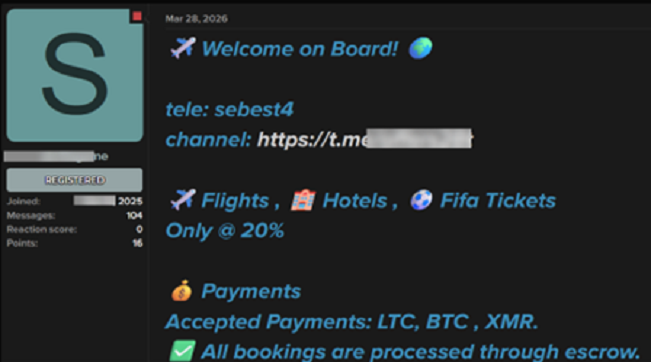
Some cybercriminals go “a level lower” and post their offers on the dark web. Kaspersky Digital Footprint Intelligence experts discovered a thread advertising such services, published on a shadow forum in March 2026.
The listings included offers for discounted airline tickets, hotel bookings, and match tickets, allegedly at 20% off the original price. These offers are designed to lure users and can be highly dangerous, ultimately resulting in victims losing both their money and any services they expected to receive.
Entrepreneurs and property owners also in the crosshairs
Cybercriminals are also targeting businesses and entrepreneurs at the intersection of the travel industry, which is also involved in the event. Given the high demand for short-term rentals during the tournament, property owners have become an attractive target for scams.
For example, a fake website was discovered requesting account credentials for a well-known platform. In this way, scammers attempt to gain access to property owner accounts, potentially resulting in unauthorised withdrawals and financial losses.
Another common scheme involves fraudsters attempting to extract money from organisations by posing as representatives of well-known airlines and offering fictitious business partnerships. In these emails, they claim to be launching new projects or business expansion initiatives and state that they are actively seeking suppliers or contractors.
If a company representative responds to such an offer, the scammers typically escalate the deception in a subsequent stage. To enhance credibility, they send forged documents for completion and signature, including supplier registration forms and non-disclosure agreements.
The ultimate objective of the fraudsters in this scheme is to induce the organisation to pay a so-called “deposit,” ostensibly required to secure a priority position in a partner selection list.
According to the claims made in the fraudulent communications, this payment would later be fully refunded once the partnership is formally established. In reality, this promise is entirely deceptive. The perpetrators simply appropriate the funds, and no reimbursement is ever made to the victim organisation.
“The travel sector, particularly when it intersects with major events, is a persistent target for a wide range of scams and fraudulent schemes. For end users, it is often difficult to distinguish at first sight between a legitimate website and a spoofed one, or between genuine marketing communications from a reputable service and scam emails.
“We therefore advise treating overly attractive offers with a high degree of caution in order to protect your personal data and financial resources,” says Anna Lazaricheva, senior spam analyst at Kaspersky.

Kaspersky Reveals NFC Relay Attacks on Smartphones Surged by 188% in 2026

Coscharis Technologies, Huawei Unveil IdeaHub S3 Interactive Board in Nigeria

Pope Calls for ‘Disarming’ of AI, Warns of “New Forms of Slavery”

NITDA Raises Alarm over Fake ‘CPM’ Platform Extorting Victims Using Agency’s Name

NBC Sets 2028 Deadline for Full Digital Switch-Over

MTN, VDT, Zoracom, Digital Realty Back 2026 Girls in ICT Campaign

Vitel Wireless Partners Fintechs to Expand Access to Services

FG Okays 112 as Toll-Free National Emergency Response Number

Opay Plans IPO in US, Targets $4Bn in Valuation

Elon Musk Launches XChat with Video Calling to Take on WhatsApp, Messenger




 Telecom2 days ago
NITDA Inaugurates Regulatory Sandbox Team to Drive Digital Innovation

 E-Financial1 day ago
Transfers Fail as Banks Suffer USSD Glitches

 Telecom2 days ago
Meet the 25 Media Professionals Chosen for MTN’s Elite Innovation Programme

 General News1 day ago
Court Orders FG to Reveal Identity of Local Contractors in $460m Abuja CCTV Project

 General News1 day ago
FG Classifies Ebola Importation into Nigeria as High Risk

 General News1 day ago
NCAA Suspends Services to Air Peace, Others over Debts

 News1 day ago
Legend Internet Repays N10Bn Commercial Paper

 News14 hours ago
Moniepoint Group Commits to Boost Hands-on, Entrepreneurship in Three Nigerian Universities with ₦3B Innovation Hubs