

E-Financial
Study Predicts 70% Rise in ATMs Running Multivendor Apps by 2020

_7.jpg)
By the end of 2015, approximately 1.2 million (40 percent) of the world’s 2.9 million bank-grade ATMs were running multivendor software applications.
By 2020, this number will grow to 2 million as banks invest in software to support omnichannel and branch transformation initiatives, according to “ATM Software 2016,” a new report from retail banking research and consulting firm RBR.
China was the leading market for multivendor software apps, followed by Brazil, reflecting the major banks’ longstanding practice of developing software in-house, the study found.
At a regional level, penetration of multivendor solutions is highest in the mature, concentrated banking markets of western Europe, RBR said.
“A single solution is crucial in rolling out new ATM technologies, like contactless transactions including Apple Pay and Android Pay,” said RBR Principal Tom Hutchings.
The RBR report also concludes that future growth will be broad‑based and that, by 2020, multivendor software will run on more than 40 percent of ATMs in all regions except the Middle East and Africa.
Providers of ATM software include both manufacturers and independent companies. Banks typically procure complete solutions that combine the transaction application with a middleware platform that enables operation on different manufacturers’ terminals.
Some financial institutions — as well as third-party software companies — source only the platform, and build their own applications on top of it.
According to the study, NCR Corp. is the largest provider of application software overall and for multivendor solutions, the latter thanks to a strong presence in China.
Wincor Nixdorf AG and Diebold Inc. have staked out the second and third largest shares. Together the two companies represent a market share roughly equal to that of NCR.
At the platform level, the largest independent software provider is KAL ATM Software.
The report also points out banks’ demand for integration with omnichannel initiatives that link ATMs with mobile banking and CRM systems, and branch transformation projects that demand extended functionality and integration capabilities.
“The rapid evolution of banks’ requirements creates opportunities for existing ATM software vendors and new market entrants alike,” Hutchings said.


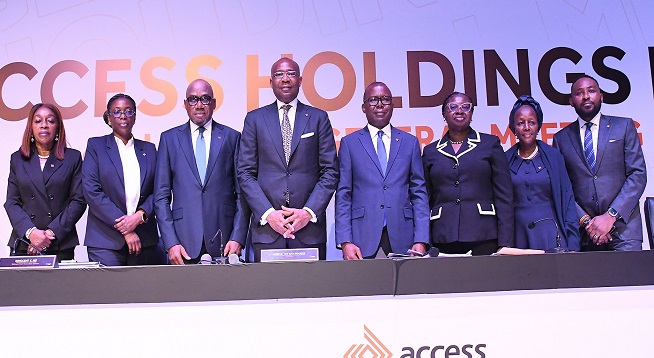
Access Holdings Plc has held its 4th Annual General Meeting (AGM), reaffirming its strategic transition towards long-term value creation, balance sheet resilience, and disciplined growth, even as it navigates a dynamic and evolving operating environment.

Speaking at the AGM, the Chairman, Aigboje Aig-Imoukhuede, CFR, emphasised that the defining test of a financial institution is not merely its capacity for growth, but its ability to grow profitably, sustainably, and with discipline over time.
He noted that Access Holdings’ performance in 2025 reflects a deliberate approach to strengthening the institution’s long-term fundamentals while maintaining strong financial performance.
The Group delivered Profit Before Tax of ₦1.007 trillion, underscoring the strength of its diversified platform and expanding earnings base across key markets. Total assets increased to ₦51.56 trillion, while customer deposits grew strongly, reflecting sustained franchise momentum and deepening customer trust.
The Chairman, however, stressed that these results must be viewed within the context of the Group’s prudent risk management actions during the year. Access Holdings accelerated provisions on legacy and regulatory forbearance credit exposures, resulting in elevated impairment charges.
He explained that the Group consciously prioritised balance sheet strength and long-term resilience over short-term earnings optimisation.
“Periods of economic uncertainty often reveal more about an institution than periods of uninterrupted growth. Our focus remains on building a business that is not only growing, but improving in the quality, resilience, and sustainability of its earnings,” he stated.
The AGM highlighted the Group’s continued evolution beyond traditional banking into a diversified financial services ecosystem, with growing contributions from investment management, insurance, pensions, consumer finance, and payments.
While banking remains the Group’s core earnings engine, emerging growth platforms, including Access ARM Pensions, Access Insurance Brokers, Oxygen X Finance, and Hydrogen Payments, are expanding its footprint across digital finance, consumer lending, retirement services, and payments, thereby strengthening the Group’s long-term earnings mix and scalability.
Looking ahead, the Chairman reiterated the strategic imperative underpinning the Group’s next phase of growth:
“Our strategy, From Scale to Value, reflects the natural evolution of our journey. Scale created opportunity; value creation is how we fully realise it.”
He noted that while the Group continues to generate strong returns, ensuring that earnings per share consistently exceed the cost of capital remains central to unlocking sustainable shareholder value. He also acknowledged the significant unrealised value embedded within the Group’s international subsidiaries and reiterated management’s focus on improving market recognition of that intrinsic value over time.
The Board also addressed shareholders’ concerns regarding dividend payments, clarifying that the temporary suspension of dividend distributions was a consequence of regulatory compliance requirements rather than any deterioration in the Group’s financial performance.
Aig-Imoukhuede reaffirmed that the Group’s earnings capacity remains strong and that the Board’s position reflects adherence to supervisory expectations and prudent capital management principles.
He assured shareholders of the Board’s commitment to resuming dividend payments as soon as the relevant regulatory conditions are satisfied.
“Our approach is clear: capital retained today must translate into greater value tomorrow and sustainable returns for our shareholders.”
Access Holdings further highlighted progress in strengthening governance and leadership continuity. During the year, Innocent C. Ike was appointed Group Managing Director/Chief Executive Officer, while the Board was reinforced through the appointment of Ibironke Adeyemi as an Independent Non-Executive Director.
Shareholders also expressed appreciation for the outstanding contributions of Bolaji Agbede, Executive Director, Business Development, who successfully led the management team as Acting Group Chief Executive Officer prior to the appointment of Mr. Ike.
The Chairman noted that the leadership transition was executed seamlessly, ensuring continuity of strategy, operational stability, and stakeholder confidence.
Despite continuing macroeconomic uncertainties across its operating markets, Access Holdings expressed confidence in its strategic positioning, underpinned by disciplined execution, a diversified business model, a strengthened capital base, and a clear focus on sustainable value creation.
Concluding his remarks, Aig-Imoukhuede reaffirmed the Group’s long-term commitment to shareholders: “Our responsibility is to justify the confidence of our shareholders by building an institution that endures, one defined by clarity of purpose, discipline of execution, and sustainable value creation over time.”

By Blaise Udunze
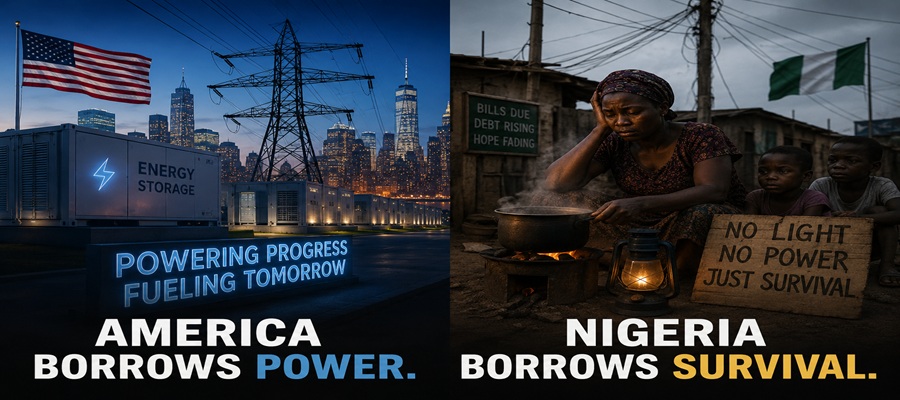
Findings show that the United States owes more than $36 trillion while Nigeria owes over N159.28 trillion, with external debt now standing at approximately $51.8 billion. At a first glance, when comparing the debt profiles of the world’s largest economy and Africa’s largest economy, it may though seem misplaced. America can borrow almost indefinitely because it issues the world’s reserve currency. Nigeria cannot. Yet both countries are confronting a similar worry. This has led to asking, when does debt cease to be a tool for development and become a permanent feature of national survival?

The difference is that while America may be testing the limits of how much debt a superpower can carry, Nigeria is testing how much debt a fragile developing economy can sustain before it begins to mortgage its future.
The latest proposal by the Federal Government to secure another $1.25 billion World Bank facility under the Nigeria Actions for Investment and Jobs Acceleration Programme has once again reignited a debate that refuses to disappear. What appears to be far from the daily lived experience of Nigerians over the years, is having government officials insisting that the loan will support investment, expand access to finance, improve electricity, enhance digital services, and create jobs. According to the claims, these are worthy objectives. But Nigerians have heard similar promises before.
The more important question is no longer whether Nigeria should borrow. Virtually every modern economy borrows. The real question which calls for critical concern, is what exactly Nigeria is borrowing for, and why the benefits of decades of borrowing remain largely invisible in the everyday lives of millions of citizens. This is where the national conversation becomes uncomfortable.
Funny enough over the years, successive governments have justified borrowing as a necessary response to development deficits. Yet despite rising debt levels, many Nigerians struggle to identify corresponding improvements in their lived experiences. This justification has kept many wondering as the roads remain dilapidated, public hospitals are overwhelmed, electricity supply also remains unreliable. Talk of the public education system, this has continued to deteriorate badly and unemployment remains stubbornly high. Inflation has eroded incomes with the cost of cooking gas hitting N2,400 per kg, while businesses struggle under the weight of high operating costs.
If borrowing is supposed to finance development, where is the development? The concern becomes even more urgent when and highly alarming when viewed against the backdrop of Nigeria’s worsening fiscal position. According to the Debt Management Office, public debt has climbed to over N159 trillion. With this outrageous figure, more troubling is the fact that debt servicing now consumes an alarming share of government revenue, which has continued to cripple economic growth and compromising the future. This development caught the attention of the Nigerian Economic Summit Group as it recently noted that Nigeria’s debt-service-to-revenue ratio remains among the highest in the world. In simple and practical terms, this implies that government is spending an increasingly large portion of what it earns paying creditors rather than investing in infrastructure, healthcare, education, security, or economic expansion.
This is the hallmark of a debt trap. The danger is not necessarily that Nigeria will default tomorrow. The danger is that the nation becomes trapped in a vicious cycle where governments borrow to finance deficits, then borrow again to service existing obligations, and then borrow even more to cover the consequences of previous borrowing. That cycle is already becoming visible.
Come to think of it, President Bola Tinubu’s administration has boldly defended borrowing as necessary to support reforms, cushion economic shocks, and stimulate growth. Yet critics have continued to point to the fact that since May 2023, borrowing has accelerated significantly.
According to economic analyst Dele Oye, the current administration has added approximately N65.9 trillion to Nigeria’s debt stock within just two years, a figure that exceeds several multiples of what Nigeria accumulated during its first five decades after independence.
Whether one agrees with the politics surrounding that claim is secondary. The underlying concern remains valid since debt is growing far faster than the visible capacity of the economy to generate sustainable revenue. This is why comparisons with the United States are useful.
America’s debt is enormous, but debt sustainability is not determined by the size of debt alone. It is determined by economic productivity. The United States supports its debt burden through a diversified economy, deep capital markets, technological innovation, globally competitive corporations, advanced research institutions, and an unmatched ability to attract global investment.
Debt is not what sustains America. Productivity does. Unlike Nigeria and by contrast, it continues to rely heavily on crude oil revenues, a narrow tax base, volatile foreign exchange earnings, and a fragile manufacturing sector. The critical difference is that every dollar borrowed by Nigeria therefore carries greater risks than every dollar borrowed by the United States.
When America borrows, it borrows largely in its own currency. When Nigeria borrows externally, it exposes itself to exchange-rate risks that can dramatically increase repayment costs whenever the naira weakens as this call for utmost caution. Every currency depreciation effectively inflates the burden of external obligations. What appears manageable today can become overwhelming tomorrow. This reality makes Nigeria’s current debt trajectory particularly concerning which is but the truth.
The World Bank itself has raised concerns about governance risks and structural weaknesses within Nigeria’s fiscal architecture. Even more troubling are recent revelations indicating that more than N34.5 trillion was reportedly deducted through pre-distribution mechanisms before revenues reached the Federation Account between 2023 and 2025. According to the findings, approximately 41 percent of government revenues were removed as first-line charges before distribution.
Whichever way it is viewed, perhaps as fiscal leakages, weak oversight, or institutional inefficiency, the implications are profound and of critical concern. If we must begin to tell ourselves the factual truth, a nation cannot continue borrowing aggressively while simultaneously failing to maximise the value of revenues it already generates.
This brings us to the central question confronting Nigeria today. The point is, are these loans building future productive capacity, or are they merely financing continuity?
Borrowing can be justified when it funds projects that expand economic output. Investments in power generation, transport infrastructure, agriculture, industrialisation, technology, and education can create long-term growth that eventually pays for the debt itself. In such cases, debt becomes a bridge to prosperity.
But it must be known that borrowing to fund recurrent expenditure, sustain bloated government structures, finance consumption, cover inefficiencies, or service previous debts transforms borrowing into a treadmill. The irony here is that the country runs harder every year but remains trapped in the same place. Unfortunately, much of Nigeria’s fiscal reality increasingly resembles the latter.
The tragedy is that this debt burden is not abstract. It is already affecting ordinary Nigerians. The adverse implication and critical point are that every naira directed toward debt servicing is a naira unavailable for schools, hospitals, security, electricity, or social protection. Every external loan increases future repayment obligations. Every missed opportunity to invest borrowed funds productively transfers today’s policy failures to future generations.
The consequences are visible everywhere. Businesses face prohibitively high borrowing costs. Today in Nigeria, it is no longer news that manufacturers struggle with energy expenses, which rob off adversely on the citizens. The same applies to youth unemployment, which remains widespread. Also, infrastructure deficits persist. Another, critical issue is that states remain heavily dependent on monthly allocations from federal level. With the developments, economic growth remains too weak to significantly improve living standards.
The result is a contradictory in which debt rises while prosperity stagnates. This is perhaps the greatest lesson Nigeria must learn from America’s debt experience.
The debate should not focus exclusively on how much debt a nation carries. The more important progressive question is whether the economy is productive enough to sustain that debt.
What every Nigerians should know is that Nigeria as a country cannot borrow its way to prosperity because it must first strengthen the foundations that generate sustainable growth. With the lingering challenging surrounding the borrowing and the mountain of debts, one key fact is that it cannot rely indefinitely on external creditors while neglecting domestic productivity. Also, it cannot continue to depend on oil revenues while failing to broaden its tax base. Another loosed end that has been a critical matter is that it cannot expect debt-financed development without strong institutions, transparency, accountability and effective project execution.
The solutions are neither mysterious nor impossible. This entails that Nigeria must aggressively expand domestic revenue mobilisation without suffocating businesses and ensure it must digitise tax administration, eliminate leakages, enforce fiscal responsibility laws. Also, it must reduce the cost of governance, strengthen public procurement systems while it ensures that every borrowed naira and kobo is linked to measurable economic outcomes.
Equally important, government must rebuild public trust. The truth is that citizens are more willing to support reforms when they can see tangible results. Some of the developments in the past that have continued to erode public trust are when subsidy savings are announced, people expect better roads, improved healthcare, reliable electricity, and enhanced security. When new loans are obtained, they expect visible projects and measurable returns but the reverse have been the case. Those at the helms of affairs of this country must understand that transparency is not merely good governance; it is an economic necessity. History offers a warning.
In 2006, under the leadership of Olusegun Obasanjo, Nigeria celebrated its exit from the Paris Club debt burden after securing one of Africa’s most significant debt relief achievements. Not too long but for a brief period, the country stood relatively free from the crushing obligations that had constrained development for decades. Two decades later, that achievement appears increasingly distant.
The danger is not simply that Nigeria is borrowing. The danger is that borrowing is becoming normalised as a substitute for difficult reforms.
A nation can borrow to build industries or borrow to pay bills. It can borrow to create future wealth or borrow to postpone present challenges. One path expands prosperity; the other compounds dependency.
America’s debt mountain demonstrates that even wealthy nations are not immune from the consequences of structural borrowing. Nigeria’s debt burden demonstrates how much more dangerous that reality becomes when economic productivity fails to keep pace. Borrowing can buy time. It cannot buy prosperity.
Sooner or later, every nation must generate the economic value necessary to justify the debts it accumulates. Nigeria’s future will depend not on how much it can borrow, but on how effectively it can produce, innovate, industrialise, and grow.
That is the lesson hidden underneath America’s debt mountain. It is also the lesson Nigeria ignores at its own peril.
Blaise, a journalist and PR professional, writes from Lagos and can be reached via: [email protected]

Fidelity Bank Plc, leading financial institution, has reaffirmed its commitment to advancing the growth and sustainability of Micro, Small and Medium-scale Enterprises (MSMEs), positioning itself as a trusted partner beyond traditional banking and financing.

This commitment was reiterated by the bank’s management during a keynote address delivered by the Executive Director, South, Mrs. Pamela Shodipo, at the recently held SME Quarterly Business Forum in Port Harcourt, Rivers State.
The Forum, themed “Scaling Trade and Distribution of Businesses for Sustainable Growth,” brought together entrepreneurs, business owners, industry experts and customers for insightful discussions on strategies for expanding businesses, strengthening distribution networks and unlocking sustainable growth opportunities in Nigeria’s evolving marketplace.
In her address, Shodipo reiterated Fidelity Bank’s commitment to supporting SMEs beyond traditional banking and financing. She stated, “Our objective is clear: to help Nigerian enterprises grow, become more competitive and create sustainable value in their communities and the wider economy. We want to be more than a provider of funds; we want to be your trusted partner in growth,” she said.
Further emphasising the strategic importance of the host city, the bank’s Executive Director described Port Harcourt as a critical economic hub, with significant influence across trade, logistics, marine services, manufacturing, agriculture, and the energy sector.
“Port Harcourt occupies a strategic place in the economic life of Nigeria. It is a major commercial hub, a gateway to the South-South and a city whose influence extends across trade, logistics, marine services, manufacturing, agriculture and energy. Businesses here understand what it means to operate in a dynamic environment, respond to market demand quickly and keep commerce moving,” she said.
Shodipo maintained that, the Forum’s theme was particularly relevant given the vital role trade and distribution businesses play in connecting producers to consumers, supporting supply chains, creating jobs and sustaining livelihoods.
“Trade and distribution businesses play a critical role in the Nigerian economy. They connect producers to consumers, support supply chains, create jobs and sustain livelihoods. In the South-South, this role is even more significant because the region remains one of the vital arteries of commerce in Nigeria, with strong links to ports, industrial activity, wholesale trade and regional distribution networks,” she remarked.
The bank’s Executive Director also highlighted initiatives such as the Fidelity Nigeria International Trade and Creative Connect (FNITCC), which connects businesses to international markets like the UK and US, as well as partnerships with the Nigeria Export Promotion Council (NEPC) and Lagos Business School through the Export Management Programme, alongside the Fidelity SME Hub for advisory support.
In her remarks, Mrs. Ugochi Osinigwe, Divisional Head, Small and Medium-scale Enterprises, Fidelity Bank Plc, said the forum was designed to provide business owners with actionable insights and valuable networking opportunities that can accelerate growth.
“SMEs remain the backbone of Nigeria’s economy, and at Fidelity Bank, we are deliberate about creating platforms that expose entrepreneurs to knowledge, innovation and opportunities that help them build resilient and scalable businesses. This forum reflects our ongoing commitment to supporting SMEs beyond banking by equipping them with the tools and connections needed to thrive in today’s competitive environment,” Osinigwe said.
She encouraged participants to leverage the Bank’s various SME-focused initiatives, advisory services and digital solutions to strengthen their operations and position their businesses for long-term success.
Participants at the forum commended Fidelity Bank for creating a platform that addresses real business challenges and provided practical solutions.
One of the participants, Mr. Andy Macozi, praised the initiative, saying, “The forum was timely and informative. The discussions addressed challenges many business owners face daily, and I believe more entrepreneurs will benefit if Fidelity Bank continues to organize such seminars and knowledge-sharing sessions.”
Also speaking, Chief Uche Aham, an oil and marine services entrepreneur, described the forum as insightful and impactful.
“I commend Fidelity Bank for bringing together business owners to learn and exchange ideas. The sessions were practical and insightful. It would also be helpful if participants could receive comprehensive materials from the forum for future reference and implementation,” he noted.
The Fidelity Bank SME Quarterly Business Forum is the latest of the bank’s initiatives aimed at empowering entrepreneurs, fostering innovation and driving sustainable economic development across Nigeria.
Ranked among the best banks in Nigeria, Fidelity Bank Plc is a full-fledged Commercial Deposit Money Bank serving over 10 million customers through digital banking channels, its 255 business offices in Nigeria and United Kingdom subsidiary, FidBank UK Limited.
The Bank is a recipient of multiple local and international awards, including the 2025 Development Bank of Nigeria (DBN) Innovation Award for MSME support; Best Retail and SME Bank Award from Independent Newspapers; Best Bank for Export & Trade Finance and Most Innovative Bank of the Year at the 2025 BusinessDay Banks and Financial Institutions (BAFI) Awards; and Nigeria’s Best Private Bank at the 2025 Euromoney Awards. The Bank also received the inaugural Most Improved Commercial Bank of the Year award by Nairametrics, the SME Bank of the Year award by NewsDirect, and the Straight-Through Processing (STP) Excellence Award by Citi Group, in addition to recognition by Global Brands Magazine for Excellence in Community Empowerment

UK, Nigeria Launch £15 million Growth Programme to Accelerate Economic Transformation

Haleon Introduces New Corporate Identity in Nigeria

NITDA Unveils Ambitious Strategy to Turn Southwest into Nigeria’s Next Innovation Powerhouse

Airtel Africa Foundation Publishes Inaugural Annual Report

Mobile Internet Gender Gap Widest in Africa – GSMA

CBN Extends PoS Geo-Fencing Enforcement Deadline to August 2026

Jumia Nigeria Records Strong Q1 2026 Growth as Technology-Led Strategy Drives Market Expansion

NCC Drafts New Rules for Virtual Mobile Operators

TD Africa, HPE Drive Conversations on the Future of Intelligent Networking

Anthropic Raises $65 Bn to Expand AI Research, Innovation




 E-Business2 days ago
Firm Discovered a New Corporate Phishing Technique using a Popular AI Web Development Platform

 E-Financial3 days ago
Senate Moves to Regulate Crypto Sector, Seeks Investor Protection

 Telecom2 days ago
No More Deleting and Reposting: Instagram Unveils Long-Awaited Profile Update

 General News3 days ago
IMF Warns Nigeria of Risks in $5Bn Swap Deal with First Abu Dhabi Bank

 Telecom2 days ago
Airtel Nigeria Launches Web Data Calculator to Give Customers Greater Visibility into Data Usage

 Telecom2 days ago
All Set for 2026 Nigeria DigitalSENSE Forum and Awards: NLNG, IHS, and others rally support

 Telecom2 days ago
NCC Board Reviews Telecom Sector, Notes Progress in Network Expansion, Consumer Compensation

 Broadcasting3 days ago
MTN Launches One TV with Free-to-View, Pay-as-You-Go