

E-Business
Innovation, Creativity on Display @ IBM “CogniHack Lagos 2016”

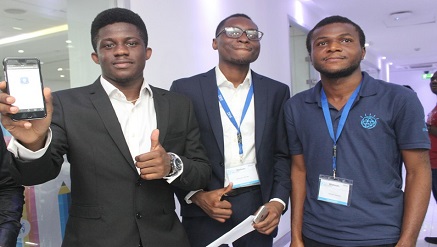
The abundance and quality of talent in the country’s local technology space was showcased recently to the friendly geeks at IBM.
Showcasing its ongoing investment in the local technology space, IBM chose Africa’s most populous city to convene “CogniHack Lagos 2016”, a software coding competition, specifically designed to brush up the cloud and cognitive computing skills of the software development community.
“CogniHack Lagos 2016”, the coding challenge assembled scores of pre-selected local talent – from idea generators, to app designers, freelance programmers, budding software designers and creative hacks.
They came from academia; independent software vendors from places as far as Ibadan, Abeokuta, Abuja, Gusau in Zamfara state, and Zaria in Kaduna state, including a coding teams from local start-ups Software Alliance, Relational Technologies, Andela (which recently got a multi-million-dollar boost from Facebook founder, Mark Zuckerberg), and United Kingdom-based team of Nigerian-born developers.
Their collective tasks was to collaborate on developing solutions for the financial services sector, using IBM’s BlueMix development platform, Watson Developer Cloud and other IBM and third party cloud-based tools.
Their resultant applications will be web and mobile ready. And they had less than 72 hours to come up with their mobile and web-based blueprints.
The young innovators were challenged to unleash their software design and coding skills on building software solutions around customer engagement and customer insights.
But before even getting them to work in teams at its Client and Innovation Center in Lagos (venue of the coding competition), it had curated a series of banking industry challenges and issues from local banks for the constructive teams (white hackers) to work on, pooling them into easily addressable hackathon prompts.
In layman’s terms these hackathon prompts reflect the current headaches of the Nigerian and regional banking industry. Contemporary mobile and electronic banking issues like customer service, money management, bill payments, storage, connecting farmers to sellers etc.
Two banking technology experts, Henry Ideozu and Victor Okigbo representing Heritage Bank and Access Bank respectively, also enriched the coding contest with their savvy technical expertise, retail banking use cases and insights.
Eventually, at the end of the competition, IBM found app designs from three teams worthy of commercial progression, based on the fact that “their ideas and solutions were viable, innovative, scalable and had a path to potential profitability for banking institutions.,” according to Tomi Akingbade, Associate Partner at IBM’s Watson Transformations team for the financial services sector.
“Team CogniBank” emerged tops, with the best software design, according to the CogniHack jury comprising of techies from IBM and banking industry.
Aimed primarily at improving customer satisfaction levels, their application deploys information retrieval concepts to support and optimize usage of the internet banking and mobile banking delivery channels.
The CogniBank application is built around IBM’s Watson Artificial Intelligence platform, enabling prompt and relevant response to customer queries.
After “Team CogniBank”, the second and third place teams were “Team Genie” and “Team Growphile” respectively. Interestingly both teams come from the stables of Andela.
“IBM promotes talent wherever it can be found. These days, we are focused on leveraging cognitive technologies to transform businesses…clearly with the right support and technology platform, the potentials of Nigeria’s digitally savvy youth can be unleashed to achieve positive impact,” Akingbade says.
IBM expects the software ideas from these innovative teams to blossom into winning solutions and successful enterprises, able to partner with IBM to deliver technology solution and services for humanity.
The three top teams, CogniBank, Genie and Growphile, will have the opportunity to co-present their solutions to business, technology and public sector leaders at the IBM Business Connect Nigeria 2016 event in Lagos later this week.
No doubt, the Nigerian technology space continues to develop at a fast pace thanks largely to progressive investments that breed successful collaboration between global corporations and indigenous IT institutions and individuals. IBM continues to raise the bar in technology innovation promotion and management with its interesting hackathons.
“CogniHack Lagos 2016” is IBM’s latest hackathon effort on Nigerian soil. About two years ago, the technology giant flagged off its pan-African hackathon series in Lagos with “IBM Lagos Hackathon”, a four-day technology training and ideas incubation programme which developed applications for Mobile Payments and Smarter Government Solutions.
IBM, a global leader cloud and cognitive computing company, currently invests over $6 billion annually in technology research and technology.
Notwithstanding Nigeria’s current harsh economic climate, the country’s IT ecosystem is a fertile ground for solid long term returns. The results of IBM’s ongoing investments in Nigeria’s IT space can only mean one thing – positive growth for the local IT economy.



Nigeria’s weak data protection guardrails may undermine the recent directive by Central Bank of Nigeria (CBN) to banks, fintech firms, and other payment service providers to store payment transaction data generated within the country local servers.

CBN said that the new rule will start from January 1, 2027, as part of new measures to strengthen oversight of the fast-growing digital payments ecosystem.
This will also provide the country greater control over critical data infrastructure, allowing authorities to easily access records, conduct audits, enforce compliance, and investigate, especially in cases where criminal offenses are involved, reducing delays often caused by intermediation between local and foreign entities.
Apart from data sovereignty, the CBN added that moving transaction records from foreign servers will help drive investments in local data centers and cloud storage capacity.
Though reliable estimates are hard to come by, it is believed that Nigeria loses over N60 billion in hosting data in foreign servers.
But a coalition of civil society organizations (CSOs), has raised concerns over safety measures in place to protect data of Nigerians, despite having data protection laws in place.
The coalition, comprising Media Rights Agenda, Paradigm Initiative, Digital Rights Lawyers Initiative, and Accountability Lab Nigeria, among others, released the “Protected From the State, Not By It: Nigeria’s Data Protection Crisis Is a Crisis of Implementation,” where they criticized regulators’ failure to effectively enforce data protection laws, which led to rising cases of digital fraud and rampant illegal sale of sensitive information.
There have been leaks of sensitive voter, financial, and personal records.
For instance, there was alleged unauthorized access to the Continuous Voter Registration (CVR) database of the Independent National Electoral Commission (INEC) during a nationwide CVR exercise.
INEC earlier released the preliminary findings of its investigation into the matter, saying that it found no external breach of its systems and that the personal information of over 90 million registered voters was not compromised.
Despite this, CSOs argued that the incident underscored the lack of oversight, adding that it showed that while data privacy laws are in place, sensitive information can be easily moved from a secure government database and into the hands of private political entities.
The coalition also pointed out regulators’ failure to conduct human rights impact assessments on public surveillance systems before related programs were deployed, urging the government to act on these issues by subjecting public institutions to the same compliance requirements as private organizations.
“This is the asymmetry at the heart of the crisis: citizens are under-protected from data abuse and over-exposed to state monitoring and punishment,” the CSOs stated.
Additional report by coingeek

Visa, a multinational firm into payment card services says Artificial intelligence enabled scams have emerged as the fastest-growing source of consumer payment fraud globally as cybercriminals increasingly target people.

Visa stated this in its Mid-year 2026 Biannual Threats Report released on Wednesday in Lagos.
The report said scammers were increasingly using AI tools and social engineering tactics to manipulate consumers into authorising fraudulent payments themselves.Premier League Fixtures
It indicated that from July to December 2025, Visa identified nearly one billion dollars in scam-related activity, making scams the largest category of consumer payment fraud.
According to the report, fraudsters now impersonate trusted brands and institutions, create a sense of urgency and deceive victims into completing seemingly legitimate transactions.
The report said stronger network-level security had reduced opportunities for direct system compromises, forcing criminals to shift their focus to exploiting human trust.
It revealed that fraud involving device tokens declined by 9.6 per cent between July and December 2025, compared with the same period in 2024.
The report identified accelerating scams, growing use of AI in fraud, migration of attacks from technology to people, and evolving ransomware trends as key developments shaping payment security.
It stated that global ransomware activity rose by 26 per cent during the review period compared with the corresponding period in 2024.
However, only 23 per cent of ransomware victims paid ransoms, the lowest level on record, reflecting improved resilience and recovery capabilities, according to the report.
Commenting, Mr Paul Fabara, chief Risk and Client Services officer, Visa, said that payments at network level continued to get safer, but threats were evolving faster than ever
Fabara said criminals were increasingly using deception, urgency and AI-enabled tools to exploit trust, requiring stronger collaboration across the payments ecosystem.
Also, Andrew Uaboi, vice president and Cluster head, Visa West Africa, said AI had significantly lowered the barriers to entry for fraudsters.
“What once required deep technical skill can now be executed with a prompt,” Uaboi said.
He said intelligence-driven defence and coordinated action across the ecosystem were becoming increasingly critical to protecting consumers from emerging threats.


Kaspersky has released its Sustainability Report for 2024–2025, outlining how the company is working toward a safer and more resilient digital future.

The report reflects Kaspersky’s broader commitment to responsible business — protecting people and organisations from cyberthreats, supporting law enforcement cooperation, investing in secure technologies, and helping strengthen the digital resilience of societies and economies.
In 2024-2025, the company continued advancing digital sustainability and strengthening global cyber resilience, reducing thedisruption, financial losses and social risks caused by cyber incidents, and enabling safer and more stable conditions for digital adoption across economies and societies.
Over the period, the number of detected advanced persistent threat (APT) groups and operations has increased significantly — by 74% compared to 2023, supported by intelligence gathered through five dedicated Expertise Centers.
Building a safer cyberworld
A significant part of Kaspersky’s social impact comes from the company’s cooperation with global law enforcement agencies. During the reporting period, the company contributed to joint operations with INTERPOL and AFRIPOL that resulted in the arrest of more than 2,600 suspected cybercriminals.
From a sustainability perspective, this shrinks the opportunities attackers can exploit — making digital environments safer for governments, businesses and individuals, and lowering the long-term economic and social costs associated with cyber incidents.
During the reporting period, Kaspersky formalised its collaborations with AFRIPOL, signing a five-year cooperation agreement, and delivered cybersecurity training to law enforcement representatives from 23 African countries, covering the fundamentals of Security Operations Center (SOC) operations and advanced threat hunting techniques.
This capacity-building work has a compounding effect: as local teams become more capable of independently detecting and responding to threats, the overall resilience of the digital ecosystem increases, while the cost and duration of cyber incidents decrease over time.
Implementing future tech
To effectively protect people, businesses and public institutions from evolving cyberthreats, Kaspersky constantly improves its security solutions and conducts cybersecurity research to stay one step ahead of attackers.
In 2024–2025 the company was granted 155 patents, including 135 AI-related ones. Its global R&D team of around 3,000 employees also produced 373 research publications. Together, these efforts help advance the baseline of secure technologies available to the market.
This reduces systemic vulnerability in digital infrastructure and supports more stable technological adoption at scale.
Responsible innovation frameworks further reinforce this effect. By joining the European Commission’s AI Pact and supporting the UN Global Digital Compact, Kaspersky has aligned its development practices with emerging global governance standards.
This contributes to sustainability by helping reduce the risks of unsafe AI deployment, such as misuse, bias or system exploitation, which could otherwise undermine trust in digital transformation.
The company’s Cyber Immunity approach, implemented through KasperskyOS, adds another layer of long-term sustainability impact by shifting security from reactive protection to architectural resilience.
Instead of repeatedly patching vulnerabilities, systems are designed to be inherently resistant to compromise, which reduces maintenance overhead, lifecycle risk and resource inefficiency in securing digital environments.
Among the new product launches, the Kaspersky eSIM Store expanded the company’s offering beyond cybersecurity into mobile connectivity. By reducing reliance on physical SIM cards and making global mobile access more seamless, the solution supports more sustainable travel and digital lifestyles.
Together with that, Kaspersky also released Kaspersky Cloud Workload Security for protecting cloud workloads wherever they reside: on servers or virtual machines, or in private, public, or hybrid clouds, etc.
“At Kaspersky, we see cybersecurity not only as a technology issue, but as a social one. Every day, people rely on digital services to work, communicate, study, receive services and manage their lives and they need to be able to do this safely.
“That is why our sustainability agenda starts with our core expertise: protecting people, organisations and critical systems from cyberthreats. But it also goes further — through responsible innovation, transparency, partnerships and support for communities.
“This report shows how our technologies, research and cooperation with partners translate into practical impact: fewer risks, stronger resilience and a safer digital environment for everyone,” said Maria Losyukova, Head of ESG & Sustainability at Kaspersky.

FCMB Turns Normal Banking into Rewards with New Mobile App Upgrade

Despite Warnings, FG Draws Down $1.5Bn as First Tranche of FAB $5Bn Loan Deal

PalmPay Strengthens Data Protection Culture with Employee Privacy Workshop and Privacy Champions Programme

Paystack Unveils AI-powered Payments Tools

NRS, CITN Deepen Partnership to Strengthen Tax Awareness

CBN Extends PoS Geo-Fencing Enforcement Deadline to August 2026

London Strengthens Global Investment Ties with Africa @ First Ever London-Africa Business Summit

FG Targets Alleged N3tn Capital Flight, Opens Airtime Credit Market to Nigerian Fintechs

Mobile Internet Gender Gap Widest in Africa – GSMA

Japan, UNESCO Boost Digital Learning in 15 CoEs with Donation of ICT Equipment




 Telecom2 days ago
6 Easy Ways to Enjoy the 2026 World Cup with Google and Gemini

 News2 days ago
MTN ASAP Enugu Stakeholders’ Conference Rallies More Action Against Youth Drug Abuse, Unveils N33Bn ASAP Impact
 E-Financial2 days ago
EFCC, CAC Raise Concerns over Unregistered PoS Operators

 E-Financial2 days ago
Providus, Unity Bank Begin Integration Phase after Supreme Court Nod

 E-Financial2 days ago
FG Proposes Africa-Wide Payment Card without Conversion through US Dollar

 Telecom2 days ago
NITDA, Meta Roll Out New Programme to Keep Nigerian Youths Safe Online
 E-Financial1 day ago
NRS, CITN Deepen Partnership to Strengthen Tax Awareness

 Telecom2 days ago
NCC Launches Maiden Women’s Leadership Mentorship Programme