

General News
ProSkool Turns Paperwork to Molehill


From whatever angle one looks at it, school records as documented evidence of what a school does is quite imperative in setting educational agenda.
These records contain valuable data and information about various aspects of a school’s operations, including data about its students, teachers, classes, facilities and finances.
The main purpose of typical schools records management system (SRMS) is to systematically record, store and update the school’s records.
The place of this process in governance can never be over emphasized because government functionalities, the legislature or donor agencies who are responsible for making education policy and for planning and managing the education system have come to understand that both the quantity and quality of data needed to support evidence-based decisions improve when schools systematically maintain and use school records.
For the schools involved, improving data and information management is crucial for decentralized management and accountability in the system.

And the implementation of a SRMS can help to distribute accountability throughout the school system, propelling the schools to better inform and cooperate with their local communities.
However, with the adoption of information communications technologies (ICT) as panacea in our daily living, ProSkool Communication’s complete school management software that helps schools take the tedium in managing records is worthy of our attention.
Result focused schools have seen it as a necessity. Afolabi Temilola, proprietress, High Gate School, Oshodi, had at a time attested that this software makes work efficient and helps teachers who are not computer literate to become literate.
What then is ProSkool? Ifeanyi Edward, managing director, Proxynet Communications, explained thus, “Our Software –
The ProSkool is complete school management software that has changed the DNA of many schools. It is a prescription that manages both students and staff records seamlessly, thus simplifying school management procedures”.
Beauty of this resource lies in its ability to simplify task and make records useful.
Having won rave reviews, and attention primarily due to its simplicity of use, scalability, customizability and variety of features and benefits it offers, ProSkool features searching or traversing of records by name, which is a partial listing of the users version.
The developers stated that it has been equipped with the facility for processing records by name rather than students or staff ID.
The software contains sections that can be traversed by name such as student’s data, billing, staff records, and staff payroll.
On child vaccination schedule, Proxynet made us to understand that this feature “enables the school management to ascertain how many students in the school that falls into one vaccination schedule or the other.
With this information, school management can easily follow-up each parents to know their children’s protection status against infections common to their age group”. It is very ideal for schools that have a Crèche to adopt this medium
Furthermore, it has an improved Billing System; through the fee configuration tab new fees can easily be added or removed at volition.
Confirming a student for billing will load all fees and the amount will automatically be indicated after specifying the fees as part of the bill payable by a student. Subsequent billing for students in the same class can therefore be achieved by loading and editing as appropriate.
Just like a pocket diary, Proxynet’s school records management board integration offers a centralized approach to meeting notices, happenings in the school, upcoming events and so forth and also allows for comments where necessary.
In a networked environment, each staff will obviously see all these on the Proskool notice board and track events without having to wait for any meeting time which is latitude to enhance productivity.
With Proskool V1.1 solution is even convenient to pre-format mails before sending them either over the intranet or internet. Some of these editing features are font name and style, font style, alignment, among others.
Again, Edward confirmed thus, “This ensures that all mails sent out are professionally done as the people’s perception of a school is very important. Internal Messaging (Chat): For real time sharing of information between staff, an internal messaging system has been included in this version. This further enhances work output as urgent information can be easily shared between staff. For instance, the Proskool administrator for each school can easily give support to new staff in the school on usage of modules in the Proskool software or any other form of support as might be needed by staff in an online realtime manner all geared towards enhancing productivity”.
Internally, there is also a mailing system added to provide off-line sending of mails within the school.
With this, sending mails between staff without the availability of internet access is achieved. Ultimately, it reduces the cost of printing and internet access subscriptions while ensuring that information is timely disseminated.
Time table generator appears to be one of the nucleuses because as the instructor section of Proskool it includes days and period an instructor will be handling or taking a particular subject.
This is done when allocating courses to instructor.
All the information provided here are then used by Proskool to auto-generate time table for the school.
This has the advantage of helping to know the instructors taking a class at a mouse click, irrespective of the staff force strength, course period and day or courses offered in the school.
The appealing display also contains a coinage Integrated Administrative Expenses. Under the arrangement the daily expenses provides means of keeping track of various school expenses on a daily basis.
The school expenses are categorized into five basic different sections which include transportation, entertainment, salary/wages, general office and others. In processing these expenses, a column is provided for extra details for description of expenses and amount spent.
Proskool was developed using PHP server-side scripting, MySQL and Apache web server and compliant with all web browser.
Of course, this will be critical in achieving the following eight activities sine qua non in records and information: records creation, storage, retrieval, usage, appraisal and retention archiving and disposal of records.
Its uniqueness lies in its ability to simplify task and make records more useful. If all school managers in your local area, district, province, or country are serious about their practices in school records management, and then supervisors from the States or Federal Ministry of Education up and doing, then what we have as mountain of paperwork must turn to molehills, hence education remains the only currency to buy a lucrative tomorrow.



Police in Abuja have uncovered a criminal group making fake diplomatic and government number plates.

Ahmed Sanusi, commissioner of Police FCT, stated this during a press briefing on Friday.
He explained that criminals use these fake plates to dodge security checks and enter restricted areas.
The investigation started soon after Sanusi took office.
He noticed too many unauthorized cars driving around with official government and diplomatic tags.
“I immediately ordered a comprehensive investigation into this disturbing trend,” Sanusi said. He noted that these individuals use the plates as a cover to commit crimes and avoid arrest.
The police have already arrested several people caught using the fake plates.
They have also figured out who is making them.
The manufacturers operate outside Abuja, and police are actively hunting them down.
Sanusi kept their names secret so they would not flee.
He stressed that this is a highly profitable illegal business.
Buyers pay between N500,000 and N1.7 million for a single fake plate.
“This will tell you that they are making such huge expenditure because they have an agenda,” Sanusi explained.
“Now they will face punishment that is bigger than both the cost they incur and the agenda they are planning.”
The commissioner urged residents to report any cars with suspicious diplomatic plates.
He reminded the public that real diplomatic tags follow a very specific format.
A diplomatic number plate in Nigeria is a special vehicle identification tag issued to foreign embassies, high commissions, and accredited international diplomats.

Gavi has approved $500 million to strengthen Nigeria’s immunisation programme, primary healthcare services and long-term vaccine financing.

The move followed high-level discussions between Professor Muhammad Ali Pate, coordinating minister of Health and Social Welfare, ]and Dr. Sania Nishtar, chief executive officer, Gavi in Abuja.
The funding, approved under the Gavi 6.0 programme, will support Nigeria’s efforts to accelerate routine immunisation, sustain polio eradication, expand HPV vaccination, strengthen primary healthcare services, and improve long-term vaccine financing.
Speaking during the meeting, Pate said Nigeria was strengthening its partnership with Gavi to accelerate immunisation, expand primary healthcare services, and ensure sustainable financing for vaccines.
He welcomed Gavi’s country-focused reforms, including the introduction of a predictable five-year funding envelope.
Pate said the US$500 million allocation will enable Nigeria to plan more effectively and deliver life-saving vaccines to more children and vulnerable populations.
The minister also revealed that quarterly visits to primary healthcare centreshad increased from about 10 million in 2023 to more than 45 million, reflecting significant progress in revitalising the country’s primary healthcare system.
Pate welcomed the announcement of a US$600 million pledge by the United States government to Gavi, describing it as a strong endorsement of the alliance’s leadership and the global value of vaccines.
He also commended Nishtar for prioritising Nigeria and praised the closer coordination among Gavi, World Health Organisation (WHO), UNICEF, World Bank, Gates Foundation, and other development partners, describing it as a model that has improved efficiency and aligned support with Nigeria’s health sector reforms.
The minister expressed appreciation to Gavi and its partners for their continued technical and financial support, while calling on state governments to invest more in healthcare and immunisation to complement federal efforts.

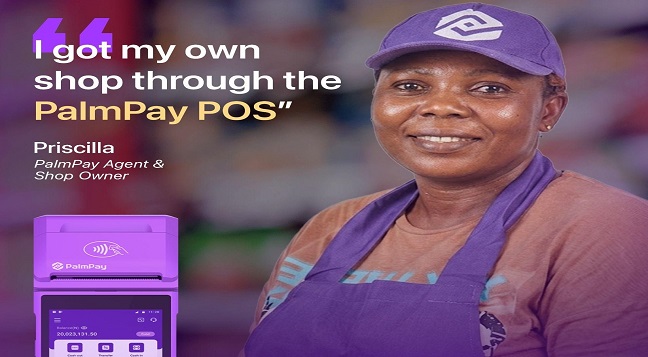
For many women, financial independence means the freedom to provide for their families and build a better future. Yet, this remains out of reach due to limited access to opportunities, business support, and secure payment solutions.

Like millions of women in Nigeria determined to be financially independent, Pricillia started with a single PalmPay POS terminal, and as an agent, every successful transaction provided a commission which brought her one step closer to achieving her dream.
Through consistency, discipline, and support from the payment platform, she reinvested her earnings and eventually opened her own provision store.
“I started as just a PalmPay agent with one POS. The consistency of the platform gave me the confidence to expand. With the income I earned, I was able to open my own provision shop.” Priscilla said.
For Priscilla, PalmPay was more than a payment platform. Its secure payment infrastructure gave her the confidence to serve her customers, build trust, and grow her income.
Today, Pricillia has joined the statistics of SMEs powering Nigeria’s economy and PalmPay continues to support her daily operations, helping her receive payments, as she works towards her next business milestone. Her journey is a reminder that when women have access to secure financial tools and opportunities, they can build lasting economic independence.
Speaking on Pricillia’s journey, Femi Hanson, Head of Marketing, PalmPay said: “Providing a secure platform that users can trust, whether for everyday payments or high-value transactions, is central to our vision of advancing financial inclusion. Priscilla’s story reflects our commitment to supporting the ambitions of Nigerians by providing a platform they can rely on to grow their finances. After all, seamless banking begins with security, and every successful transaction reinforces the trust our users place in us.”
Priscilla stands among thousands of PalmPay agents nationwide who are helping to expand financial access across Nigeria while earning commissions to create sustainable sources of income for themselves.
Every payment tells a story. It begins with trust, the confidence that your money is secure and that financial services are accessible. And when that opportunity reaches women, it creates ripple effects that transform families, strengthen communities, and drive economic growth.

Police Uncover Fake Diplomatic Number Plate Syndicate in Abuja

Davido Shares Past Suicidal Thoughts, Drops Oriadé Album

Gavi Okays $500m for Vaccines, PHCs in Nigeria

82% of Organizations Concerned about AI Risks Even as Adoption Accelerates – Survey Reveals

The Journey to Financial Freedom: Priscilla, a PalmPay Agent Now Owns a Store

NRC, Ponzi Scheme Collapses Resulting Loss of Billions of Naira

EFCC Busts NIS Visa Overstay Racket, Uncovers N700m in an Account

From Scarcity to Scale: What Africa Can Learn from India’s Agricultural Transformation

Tokenization, Blockchain Technology will Transform Financial Institutions – IMF

BON Establishes Six Ad Hoc Committees to Modernize Broadcasting




 E-Financial2 days ago
Access Bank Debunks Shutdown Report, Vows Action against Perpetrators

 E-Business2 days ago
Kaspersky Uncovers Cyber Threats Defining the First Half of 2026 in Nigeria, Others

 General News2 days ago
MENXTT TECH NG Offers Affordable Dell Laptops with Flexible Payment Plans

 Telecom2 days ago
ATU Summit Ends in Abuja with Landmark Declaration to Eradicate Continental Digital Divide

 Telecom2 days ago
Hon. Minister Dr. Kingsley T. Udeh and ASUS To Unveil First of a Kind Flagship Store in West Africa

 E-Financial2 days ago
$40Bn Net Reserves, Record Wealth, Relentless Poverty: Who Is Nigeria’s Economy Serving Today?

 General News2 days ago
EFCC Arraigns 4 over Alleged $5.3m Fraud Scheme

 E-Financial2 days ago
CBN Orders N19Bn Refunds to Customers as Complaints Rise