Connect with us

Telecom

InfraCos To Get Subsidies Soon— Danbatta

Published

on

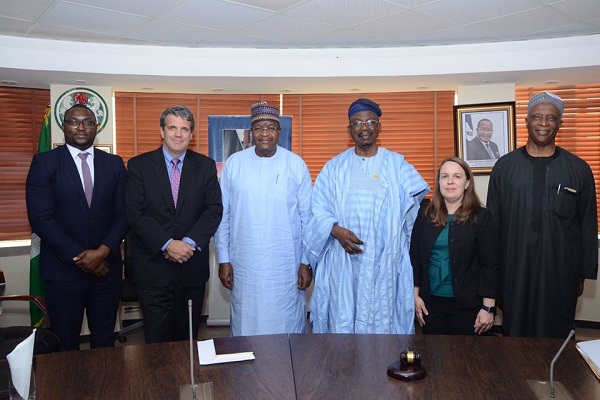
(L-R): Joshua Egba, Business Development Specialist West Africa, USTDA; Thomas Hardy, Acting Country Director, USTDA; Prof. Umar Garba Danbatta, Executive Vice Chairman, NCC; Senator Olabiyi Durojaiye, Chairman of the Board of Commissioners, NCC; Shannon Roe, Country Manager Sub-Saharan Africa, USTDA; Clement Omeiza Baiye, Commissioner, NCC
Kindly share this post

The Nigerian Communications Commission (NCC) says it has concluded process for the disbursement of subsidies to the six licensed Infrastructure Companies (InfraCos).

Prof. Umar Danbatta, executive vice chairman of NCC, disclosed this when delegates from the United States Trade and Development Agency (USTDA) paid him a courtesy visit at the commission’s headquarters.

Danbatta said that the planned disbursement was part of the commission’s strategies to boost broadband penetration and make it pervasive nationwide.

He said that it was part of the digital transformation agenda which NCC had put in place for actualisation, stressing that the subsidy would augment the InfraCos’ Capital Expenditure (CAPEX).

Danbatta said that the InfraCo scheme had a public-private partnership (PPP) arrangement, with a subsidy component that was being worked out for the licensees to fast-track deployment in their respective zones.

”The licensees are expected to play some roles and NCC too is to play some roles to encourage broadband infrastructure deployment by the licensees.

”Currently, we have seen the licensees’ CAPEX, we have negotiated the CAPEX and we have arrived at percentage of subsidies based on the negotiation that we have had with them.

”However, the subsidy will be paid to them by the commission upon attainment of reasonable milestones by the licensees in their zones of deployment,” he said in a statement on Sunday.

The chairman said that the six licensed InfraCos included: MainOne Ltd for Lagos Zone; Raeana Nigeria Ltd for South-South Zone, O’dua Infraco Resources Ltd for South-West Zone and Fleek Networks Ltd for North-West Zone.

Others are Brinks Integrated Solutions for North-East Zone and Zinox Technologies Ltd for the South-East Zone while the remaining seventh licence for North Central Zone is being processed.

Danbatta said that the idea of InfraCo was an auspicious initiative of the commission, as it will see licensees deploy their infrastructure for a period spanning five years.

He said that the InfraCos would provide wholesale services to other licensees to drive last-mile connectivity to people in the rural, under-served and unserved areas of the country.

”We are trying to build an intra-city and inter-city networks that will be able to connect citizens all over the country irrespective of where they are and what their circumstances are.

”To that extent, we have decided to provide access points in all the 774 local government areas in the country, trying to provide access to close to 190 million

Nigerians, a lot of whom live in rural communities,” he said. Danbatta said that the commission was adopting fixed and wireless broadband approaches to its broadband infrastructure development.

He, however, said that the InfraCo model was open to the use of combination of terrestrial, sub-terrestrial and aerial fibre optic deployment options and the use of Television White Space (TVWS) spectrum to provide connectivity in rural areas.

Sen. Olabiyi Durojaiye, chairman, Board of NCC,  called on USTDA to work with the commission towards addressing deployment challenges.

Durojaiye said that some InfraCo licensees in the South-South geo-political zone were faced with challenges due to the riverine, swampy nature of the region.

Thomas Hardy, acting country director, USTDA,  commended NCC for achieving and surpassing the country’s broadband penetration target of 30 per cent in 2018.

Hardy said that the agency’s mission was to see areas where it could help to support the digital transformation goals of the country.

He said that USTDA would work with NCC and other organisations to open up opportunity for greater trade, greater economic development and closer bilateral cooperation.

”As a small foreign sister agency of US, with a long-standing history in Nigeria, we support economic infrastructure projects.

”We help in the telecommunications, energy and transport sectors, where countries have identified their priority development goals in the area of infrastructure development.

”Through US companies, we develop an independent analysis of ways to meet your infrastructure goals,” he said.

The Management team of the United States Trade Development Agency (USTDA), led by its Acting Country Director, Thomas Hardy, paid a courtesy visit to the Nigerian Communications Commission’s (NCC) Head Office in Abuja.

The USTDA team was received by the Executive Vice Chairman and Chief Executive (EVC/CE) of NCC, Prof. Umar Danbatta. The chairman of NCC Board of Commissioners, Otunba Olabiyi Durojaiye, was also at the reception.

Prof. Danbatta recalled NCC’s accomplishments particularly in the area of broadband penetration, which target set for 2018 was met and surpassed before the end of that year.

The United States Trade and Development Agency links U.S. businesses to export opportunities by funding and supporting economic infrastructure projects, pilot projects and trade missions across developing nations.(NAN)


Kindly share this post

Ugo Onwuaso is an ICT enthusiast. He believes technology should be used for general good. He holds a Master of Public Administration (MPA) degree from the Lagos state University. Dear Reader, Your support matters. But we believe that technology makes life more exciting and helps improve the lives of people around Nigeria and indeed the world. That is why, we have devoted our energy to independent reportage of technology and finance and how they affect lives. Our incisive and analytical view of how technology news affects the daily life help individuals and organizations make up their minds. Quality journalism costs money. Today, we're asking that you support us to do more. Kindly support our effort to deliver technology and finance journalism to everyone in the world. Donate as little as N1,000. Bank transfers can be made to: UBA Plc 1017156876 Communication Week Media Ltd

Telecom

X Suspends Twitter Account for Rules Violation

Published

on

Kindly share this post

X, the social media platform formerly known as Twitter, has suspended the @Twitter account, replacing its profile with a standard notice citing violation of platform rules.

X Suspends Twitter Account for Rules Violation

Musk

The action, which occurred on Sunday, January 11, left users encountering the handle greeted by a bold “Account Suspended” message on a black screen, with no details provided on the specific rules broken or the duration of the suspension.

The development has sparked widespread confusion and nostalgia among users, given that Elon Musk rebranded Twitter to X in July 2023, approximately six months after acquiring the platform for $44 billion in late 2022.

The @Twitter handle had remained dormant since before Musk’s takeover, serving as a legacy remnant of the platform’s original branding, and its suspension appears to mark the final erasure of the Twitter name amid X’s ongoing efforts to combat spam, impersonation, and rule violations.

X’s official statement on the suspended page simply reads: “X suspends accounts that violate our rules,” without offering an appeal process or further explanation, unlike standard user suspensions.

Public reactions on social media ranged from humorous laments of “RIP Twitter” to speculation that the move resulted from automated moderation or a deliberate cleanup of legacy trademarks.

xAI’s Grok AI described it as a purposeful retirement of outdated elements rather than a genuine infraction, while neither Elon Musk nor X spokespeople issued any comment as of Monday morning.

This incident underscores the evolving identity of the platform under Musk’s ownership, which also saw a domain shift to x.com in 2024, further distancing it from its Twitter roots.

Industry observers note that while the suspension aligns with X’s stricter enforcement policies, the lack of transparency has fueled debates on consistency in applying rules to high-profile legacy accounts.


Kindly share this post
Continue Reading

Telecom

FG Plans to Invest $460m World Bank Loan in Fibre Infrastructure

Published

on

Kindly share this post

Federal Government plans to channel $460m World bank loan, representing about 92 per cent of a $500m, into the proposed fibre infrastructure company set up to deploy 90,000 kilometres of climate-resilient broadband fibre across the country.

This is contained in the Financing Agreement for the Building Resilient Digital Infrastructure for Growth project between the Federal Government and the International Development Association, the concessional lending arm of the World Bank.

Under the agreement, the World Bank approved a $500m concessional credit to support Nigeria’s drive to expand access to high-quality and climate-resilient broadband internet in unserved and underserved areas.

Of this amount, $460m is earmarked specifically for equity financing and capitalisation of a new Project Company that will drive the fibre rollout. The remaining $40m will cover goods, works, consulting and non-consulting services, training, operating costs, and the refund of a preparation advance used to develop the project framework.

According to the document, the proposed Project Company will be established “as an independent, majority privately-owned and managed special purpose vehicle-joint venture with the objective of the deployment of 90,000 kilometres of climate-resilient fibre infrastructure following a phased approach, limited to provision of wholesale, open access services to licensed telecommunications operators, and management of associated investments, including the carrying out of preparatory activities and provision of transaction advisory services, and provision of equity financing in and capitalization of the Project Company.”

The Federal Government will participate in the company as a shareholder through the Ministry of Finance Incorporated, which manages the government’s investment interests. However, the agreement explicitly caps the government’s shareholding at a maximum of 49 per cent, ensuring that the company remains majority privately owned.

The $460m equity injection is broken into four tranches, tied to strict performance and operational milestones. The first tranche of $150m will be released once the Project Company is incorporated as a joint venture with private partners selected through a process acceptable to the World Bank, and after its memorandum, articles of association, and shareholding agreement are approved.

A second tranche of $100m will only be disbursed after the company adopts fiduciary and administrative procedures approved by the lender and completes at least 5,000 kilometres of fibre deployment. The third tranche of $100m is linked to the completion of an additional 20,000 kilometres of network construction.

The final tranche of $110m will be released after the company launches wholesale open-access services through a published reference offer and completes a further 40,000 kilometres of fibre deployment, bringing the total rollout to at least 65,000 kilometres before the final equity drawdown.

Once each tranche is withdrawn, the agreement requires that the funds be transferred to the Project Company’s dedicated account within five working days, showing the equity nature of the financing rather than traditional budgetary spending.

The project will be implemented under the oversight of the Federal Ministry of Communications, Innovation and Digital Economy, and the Federal Ministry of Finance will receive semi-annual progress updates.

A dedicated Project Implementation Unit will manage day-to-day execution, with overall financial management handled by the Federal Project Financial Management Department in the Office of the Accountant General of the Federation.

Beyond the fibre rollout, the project also includes technical assistance to federal government agencies to support the use of high-quality broadband in targeted areas, as well as funding for project management, monitoring and evaluation, environmental and social safeguards, grievance redress mechanisms and independent audits.

The agreement places strong emphasis on environmental and social standards, requiring compliance with an Environmental and Social Commitment Plan. It also mandates the establishment of an accessible grievance mechanism for affected communities and strict reporting obligations to the World Bank.


Kindly share this post
Continue Reading

Telecom

Court Dismisses N1Bn Suit against MTN, Awards N3m Costs

Published

on

Kindly share this post

A Federal High Court in Lagos has dismissed a N1 billion lawsuit filed against MTN Nigeria Communications Plc by Walls and Gates Ltd and Okechukwu Udeichi, its managing director, over alleged copyright infringement, breach of confidentiality, and trademark violations arising from MTN’s 20th anniversary promotional campaign.

Court Dismisses N1Bn Suit against MTN, Awards N3m Costs

Delivering judgement on Tuesday, Justice Ayokunle Faji held that the plaintiffs failed to establish any legally protectable right in their proposal titled “20 for 20”, describing the action as frivolous, speculative, and vexatious.

The court dismissed the suit in its entirety and awarded N3m in costs against the plaintiffs.

The plaintiffs instituted the action under Suit No. FHC/L/CS/1935/2021, alleging that MTN unlawfully used their “20 for 20” proposal, which they claimed to have submitted to the telecoms company on 17 September 2019, ahead of MTN’s 20th anniversary celebration in 2021.

They argued that MTN’s anniversary promotion, in which 20 sport utility vehicles were given out to subscribers, emanated from their proposal and amounted to infringement of their copyright, confidential information, and trademark.

Based on those claims, the plaintiffs sought N1bn in damages or, alternatively, an order directing MTN to render an account of revenue generated from the promotion and remit 50 per cent of it to them.

MTN denied the allegations, contending that the proposal was an unsolicited business idea that imposed no contractual or confidential obligation on the company.

The telecoms firm maintained that its 20th anniversary programme was independently developed and that the plaintiffs’ document was merely a general business concept not protected under Nigerian copyright law.

MTN further argued that the plaintiffs lacked a valid registered trademark and failed to demonstrate access to or copying of any protected expression.

In resolving the dispute, Justice Faji noted that the plaintiffs conceded during oral submissions that they failed to prove their claim of trademark infringement, leaving only the issues of alleged breach of confidentiality and copyright infringement for determination.

On confidentiality, the court held that no confidential relationship existed between the parties.

Justice Faji observed that before sending the proposal to MTN, the plaintiffs had already submitted it to the Nigerian Copyright Commission and relied on it for a trademark application, thereby placing the document in the public domain.

The judge further noted that after transmitting the proposal to MTN, the plaintiffs admitted circulating it to other organisations, which extinguished any claim to confidentiality.

According to the court, MTN had no obligation to respond to an unsolicited proposal in the absence of a contractual, fiduciary, or business relationship, or a non-disclosure agreement.

On the allegation of copyright infringement, the court held that registration with the Nigerian Copyright Commission does not confer copyright, stressing that Nigerian law protects expressions, not ideas or business concepts.

Justice Faji ruled that the plaintiffs’ “20 for 20 Millennium Promotion” amounted to no more than an idea of rewarding customers during an anniversary celebration and lacked the originality and intellectual effort required for copyright protection.

He described the proposal as a bare business concept devoid of original qualities capable of attracting copyright. The judge also held that MTN’s use of the phrase “MTN 20th Anniversary” was a natural description of an anniversary event and did not originate from any protectable work of the plaintiffs.

He further relied on evidence showing that MTN affiliates in other jurisdictions had implemented similar anniversary reward ideas before the plaintiffs’ proposal.

Justice Faji characterised the suit as a “gold-digging exercise” aimed at forcing a commercial relationship on MTN. He criticised the plaintiffs for using MTN’s trademark in their proposal without authorisation and then seeking to ground a billion-naira claim on the same document, adding that the case wasted valuable judicial time.

While affirming that citizens should have access to the courts, the judge stressed that such access must be limited to suits with prima facie merit.

He therefore awarded N3m in costs in favour of MTN, holding that costs must follow the event.

The court accordingly dismissed the suit in its entirety and ordered the plaintiffs to pay the awarded costs to the defendant.

Credit: Punch


Kindly share this post
Continue Reading

Trending