

General News
PKI Will Authenticate Data from Nigeria-Omotoso

Bolanle Omotoso, country managing director/founder, Data Recovery Specialist Limited is is an experienced and highly skilled business technology consultant with specializations covering data availability, disaster recovery and prevention, digital forensic investigation services and consultancies, protection of information assets, and corporate fraud control.
Omotoso has led several turnkey ICT projects in Nigeria while heading the ICT department of his employers and as an entrepreneur.
He founded Data Recovery Specialist Limited in 2006 as the first professional data loss recovery company in Nigeria.
Omotoso spoke to peter ugwu on stakeholders’ expectations on Public Key Infrastructure (PKI) scheme campaigned for by the National Information Technology Development Agency (NiTDA).
Data Recovery Specialist Limited
Data Recovery Specialist Limited was established in 2006. What we have been doing centers on information security consultancy.

We are the West African foremost data recovery and computer forensic service company with accreditation to exclusively operate and carry on professional services as part of the Globally Networked Business offices of the world renowned, World-Best Repair & Service Company; Myung Information Technologies Company Limited, Korea.
I will make bold to say that with our state-of-the-art recovery laboratory in Lagos and the latest advanced recovery techniques, experienced technicians and the reliability clients would expect from a world class leader in recovery technology, we are the best in the industry.
We have been doing that through extensive research and development program; maintaining leading-edge expertise in all areas of recovery and computer forensics.
Developed Solutions
Data Recovery Specialist is internationally affiliated with other world renowned data recovery companies in USA, UK, India, South Africa & Russia.
We have live access to engineers in Korea every day, along with high-speed secured data communications link deployed for USA & European technical backup.
This allows us to tap into international resources and expertise 24 hours a day to effectively handle any data recovery, no matter the size or complexity.
Today, people talk about public key infrastructure (PKI), although it has been developed in Nigeria, but in our little way, we have been developing on that, helping companies achieve secured transaction processes.
PKI Concept and National Agenda
First of all, it is important that stakeholders support the National Information Technology Development Agency (NITDA), in the effort to have a national PKI blueprint.
When operational, PKI will register Nigeria’s presence in the comity of digital economies, drawing attention to Nigeria’s readiness to tackle security threats associated with cyberspace. Everything is digitally done now.
So, as a country, if you fail to do your homework to secure your space, the international community will blacklist you from performing certain transactions that incorporate cyberspace.
But when the PKI is operational, nobody will make gag of Nigeria again. It will seal the mouth of critics, because most companies at the international arena actually view their Nigeria counterparts’ processes as porous to attack and compromise.
PKI Implementation Channels
Anybody that does transaction, especially with international partners or a third party, needs PKI to move forward, achieve maximum authentication and security.
Whether you are in financial, telecom, oil and gas, shipping among other sectors, you need PKI.
The present Nigerian society is such that everything is going online; not just online, but on mobile, because the internet penetration is growing; the mobile money is there, cashless economy policy and host of other developmental agenda driven by information communications Technology (ICT).
All these things pass through certain levels of authentication. The reason sometimes somebody would want to send money to another person and it get diverted is because initially there was no authentication.
National Security Using PKI
National security management is all about identity management. It starts with being assured that the person you are dealing with at the other end is the right person.
For an instance, while leaving your home in the morning, right there at the gate you informed your younger brother that someone is coming to pick up a particular item. Probably, someone was eavesdropping and approaches your brother later requesting for the item.
If there were no concrete mode of identifying the real person, your brother is likely to make mistake of giving out the item to the wrong person.
So, what PKI does is to confirm or authenticate people or parties involved in a transaction; it will curtail certain outrageous claims and legal tussles that ensue, especially after financial transactions.
Data security is paramount in whatever process we found ourselves, PKI will also help in ensuring confidentiality of data or information.
Meanwhile, none of the parties will feel surcharged, because the process would have been done in a transparent manner.
If parties agreed on one percent I can turn around tomorrow to say that was never our agreement, but because right from the initiation of the transaction everything was protected, there would be nothing to hold unto, unless for people with dubious minds.
Outsourcing of National Data Capturing Projects to Foreign Companies
Frankly speaking, when you want to improve on any project you have embarked upon, one of the things you cannot avoid is talking to people who have the expertise, those who have done such thing in the past and can tell of their experiences.
The essence is for you to learn from them-the pains and gains.
Through that knowledge you can then perfect your system.
When you asked outsourcing national data capturing processes to foreign companies, maybe you were referring to the National Identity Management Commission (NIMC) project outsourced to MasterCard, whether we like it or not, we need to learn from others. Also, the people (Nigerians) working at the NIMC are professionals.
Those things you believe they have outsourced are based on the fact that they want the staff to learn from MasterCard. Not just that the company’s tools to carry out the project are based in Nigeria.
The systems they are using are made in Nigeria. That goes to show we believe in ourselves and products.
Even software, what you do not have, get it from whoever has it.
The lesson is for us now to focus our strengths on the developmental agenda that would grow innovations in the industry.
Today, we have an incubation centre for software developers; in the recent past there was nothing like that.
The country is on the right path to information development just that we need to speed up the process to meet with others. We have to learn how to develop our own.
Securing Nigeria
To secure Nigeria by way of making people become security conscious is very simple. If we take mobilization and advocacy attached to the HIV/AIDS scourge, one will discover that although it does not kill easily yet government at international and local fora harped on it.
Several NGOs came up as a result of the need to create HIV/AIDS awareness. Today, we have National Action Committee on AIDS and States have equivalent bodies, why not replicate that gesture in the issue of security consciousness.
We have to make such noise to enlighten people on security tips.
Some sectors are trying, but we need a national course on that. Banks are trying; they issue you with a Personal Information Number (PIN) code and warn you not to disclose it to another person.
There are nasty mistakes people make that can be corrected by way of security tips.
There is no message you get from banks without attached warning that you should not make available your PIN or password available to anybody.
Exiting Challenges
As we speak today, a lot of companies are rejecting data coming from Nigeria, just because they do not trust us.
The reason is not far-fetched; some of the data or mail that emanate from Nigeria are transferred in an unencrypted format and it gives the foreign partners concern.
Transferring information to that partner in an unencrypted format may reveal the data or information to the third party.
Those foreign companies are cautious about how their data are shared or circulated and would not permit any process that will compromise them.
Opening the channel to ‘unauthorized’ or ‘unwarranted’ party can lead to financial loss. Nigeria currently loses money to international organizations.
Why? During computer transactions you have to adopt solutions made abroad, even when such can be developed in Nigeria, which points to the none-existence of authorities that will regulate that in our country.
Solutions
What can be done is what NITDA is doing now, by coming up with a blueprint. I have gone through the document and it is a well elucidated document that makes bare how PKI operates.
The essential part of the project implementation should be on proper sensitization of stakeholders comprising users, businesses, organizations and others that will benefit from PKI scheme.
The next thing is for NITDA to table the document before the National Assembly for proper legislation.
Once the NASS is convinced that the business class has accepted it, it will receive accelerated hearing, because this is tied to the success of majority of the nation’s economic agenda, like the vision 20:2020.



Police in Abuja have uncovered a criminal group making fake diplomatic and government number plates.

Ahmed Sanusi, commissioner of Police FCT, stated this during a press briefing on Friday.
He explained that criminals use these fake plates to dodge security checks and enter restricted areas.
The investigation started soon after Sanusi took office.
He noticed too many unauthorized cars driving around with official government and diplomatic tags.
“I immediately ordered a comprehensive investigation into this disturbing trend,” Sanusi said. He noted that these individuals use the plates as a cover to commit crimes and avoid arrest.
The police have already arrested several people caught using the fake plates.
They have also figured out who is making them.
The manufacturers operate outside Abuja, and police are actively hunting them down.
Sanusi kept their names secret so they would not flee.
He stressed that this is a highly profitable illegal business.
Buyers pay between N500,000 and N1.7 million for a single fake plate.
“This will tell you that they are making such huge expenditure because they have an agenda,” Sanusi explained.
“Now they will face punishment that is bigger than both the cost they incur and the agenda they are planning.”
The commissioner urged residents to report any cars with suspicious diplomatic plates.
He reminded the public that real diplomatic tags follow a very specific format.
A diplomatic number plate in Nigeria is a special vehicle identification tag issued to foreign embassies, high commissions, and accredited international diplomats.
Gavi has approved $500 million to strengthen Nigeria’s immunisation programme, primary healthcare services and long-term vaccine financing.

The move followed high-level discussions between Professor Muhammad Ali Pate, coordinating minister of Health and Social Welfare, ]and Dr. Sania Nishtar, chief executive officer, Gavi in Abuja.
The funding, approved under the Gavi 6.0 programme, will support Nigeria’s efforts to accelerate routine immunisation, sustain polio eradication, expand HPV vaccination, strengthen primary healthcare services, and improve long-term vaccine financing.
Speaking during the meeting, Pate said Nigeria was strengthening its partnership with Gavi to accelerate immunisation, expand primary healthcare services, and ensure sustainable financing for vaccines.
He welcomed Gavi’s country-focused reforms, including the introduction of a predictable five-year funding envelope.
Pate said the US$500 million allocation will enable Nigeria to plan more effectively and deliver life-saving vaccines to more children and vulnerable populations.
The minister also revealed that quarterly visits to primary healthcare centreshad increased from about 10 million in 2023 to more than 45 million, reflecting significant progress in revitalising the country’s primary healthcare system.
Pate welcomed the announcement of a US$600 million pledge by the United States government to Gavi, describing it as a strong endorsement of the alliance’s leadership and the global value of vaccines.
He also commended Nishtar for prioritising Nigeria and praised the closer coordination among Gavi, World Health Organisation (WHO), UNICEF, World Bank, Gates Foundation, and other development partners, describing it as a model that has improved efficiency and aligned support with Nigeria’s health sector reforms.
The minister expressed appreciation to Gavi and its partners for their continued technical and financial support, while calling on state governments to invest more in healthcare and immunisation to complement federal efforts.

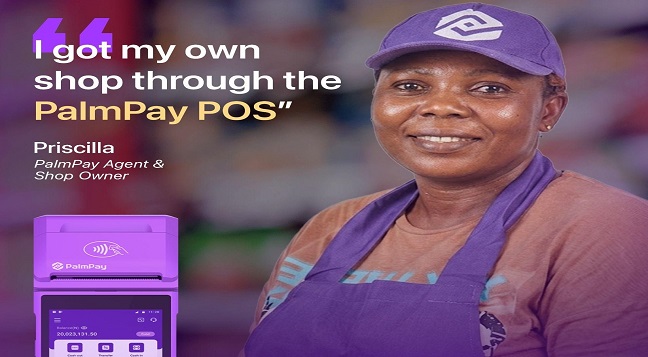
For many women, financial independence means the freedom to provide for their families and build a better future. Yet, this remains out of reach due to limited access to opportunities, business support, and secure payment solutions.

Like millions of women in Nigeria determined to be financially independent, Pricillia started with a single PalmPay POS terminal, and as an agent, every successful transaction provided a commission which brought her one step closer to achieving her dream.
Through consistency, discipline, and support from the payment platform, she reinvested her earnings and eventually opened her own provision store.
“I started as just a PalmPay agent with one POS. The consistency of the platform gave me the confidence to expand. With the income I earned, I was able to open my own provision shop.” Priscilla said.
For Priscilla, PalmPay was more than a payment platform. Its secure payment infrastructure gave her the confidence to serve her customers, build trust, and grow her income.
Today, Pricillia has joined the statistics of SMEs powering Nigeria’s economy and PalmPay continues to support her daily operations, helping her receive payments, as she works towards her next business milestone. Her journey is a reminder that when women have access to secure financial tools and opportunities, they can build lasting economic independence.
Speaking on Pricillia’s journey, Femi Hanson, Head of Marketing, PalmPay said: “Providing a secure platform that users can trust, whether for everyday payments or high-value transactions, is central to our vision of advancing financial inclusion. Priscilla’s story reflects our commitment to supporting the ambitions of Nigerians by providing a platform they can rely on to grow their finances. After all, seamless banking begins with security, and every successful transaction reinforces the trust our users place in us.”
Priscilla stands among thousands of PalmPay agents nationwide who are helping to expand financial access across Nigeria while earning commissions to create sustainable sources of income for themselves.
Every payment tells a story. It begins with trust, the confidence that your money is secure and that financial services are accessible. And when that opportunity reaches women, it creates ripple effects that transform families, strengthen communities, and drive economic growth.

Police Uncover Fake Diplomatic Number Plate Syndicate in Abuja

Davido Shares Past Suicidal Thoughts, Drops Oriadé Album

Gavi Okays $500m for Vaccines, PHCs in Nigeria

82% of Organizations Concerned about AI Risks Even as Adoption Accelerates – Survey Reveals

The Journey to Financial Freedom: Priscilla, a PalmPay Agent Now Owns a Store

NRC, Ponzi Scheme Collapses Resulting Loss of Billions of Naira

EFCC Busts NIS Visa Overstay Racket, Uncovers N700m in an Account

From Scarcity to Scale: What Africa Can Learn from India’s Agricultural Transformation

Tokenization, Blockchain Technology will Transform Financial Institutions – IMF

BON Establishes Six Ad Hoc Committees to Modernize Broadcasting




 Telecom3 days ago
Clydestone Ghana Sues MTN Over Mobile Money

 News3 days ago
IHS Nigeria Donates Business-Support Equipment to Empower People with Disabilities in Abuja Community

 News3 days ago
Africa Prudential Unveils Digital Growth Strategy

 E-Business3 days ago
Kaspersky Uncovers New Mirage Kitten Malware Used in Cyber-espionage Campaign Across Africa, Others

 E-Financial3 days ago
CBN Fines Banks N430m for Ignoring Customers’ Complaints

 E-Financial3 days ago
Afreximbank Raises $1.5b in Largest-ever Bond Issuance

 E-Financial3 days ago
SEC Begins Full e-Registration for Capital Market Operators

 E-Financial3 days ago
Elon Musk Launches Invite-only X Money with Visa Debit Card