

News
AfDB Launches First Africa-to-Africa (A2A) Investment Report


Opportunities for investment in Africa outweigh the obstacles, according to a report by leading African companies covered in the African Development Bank’s new Africa-to-Africa (A2A) Investment Report, the first ever report on inter-African trade published by the Bank.
The report unearths the realities African companies face when investing in the continent, the emerging trends in A2A investment and the steps African policymakers can take to accelerate intra-African investment.
Africa-to-Africa Investment Report: A first look, finds that more African companies are investing in Africa. These companies have confidence in the continent’s long-term growth potential; they are at the cutting edge of their industries, and are capitalizing on their knowledge of local markets to generate higher returns and impact.
In line with the Bank’s High 5s for transforming Africa and the African Union’s Agenda 2063, the A2A Report aims to take the conversation on investing in the continent a step further. It shows what African multinationals are doing to drive investments in Africa, d how they are expanding their African footprint, and gives insights into how to scale-up investments more widely.
“As global foreign direct investment to Africa falls, intra-African investments are picking up pace,” said Akinwumi A. Adesina, President of the African Development Bank Group. “Africa’s big companies are increasingly on the move and expanding their African footprint. It is through more investments that the continent can build inclusive, sustainable growth and development. We have made this our collective commitment in the High 5s”.

The A2A Report features eight publicly-listed and privately-owned African companies operating in consumer services, finance, industry, media and diversified portfolios and investment, with home bases in North Africa (Morocco), West Africa (Nigeria, Togo), East and Central Africa (Ethiopia, Kenya) and Southern Africa (Mauritius, South Africa).
Highlights from the Report’s intra-African investment stories include the importance of having a clear long-term vision, getting up-to-date investment facts, building local partnerships to deliver on the ground and tapping into talent in the local labour force.
The business case for A2A investment is strongly connected to the continent’s integration, growth and prosperity. Although challenges remain, the A2A Report is the start of a broader discussion to fast-track investments, move beyond the wish list and make deals happen.
The continent’s policymakers can inspire a greater level of confidence and promote A2A investments by highlighting their role as dependable business partners for African investors.
The Report is part of the Bank Group’s continued championing of investment across Africa, along with the first Africa Investment Forum (AIF), scheduled to take place in Johannesburg, South Africa from 7-9 November 2018.


Africa Prudential Plc has reaffirmed its commitment to sustainable growth and digital transformation after posting another strong half-year financial performance, driven by robust growth in its core registrar business, technology-driven solutions and increased activity in Nigeria’s capital market.

Speaking during the company’s H1 2026 Investor Call on Tuesday, the management outlined plans to deepen revenue diversification and accelerate innovation as part of efforts to reduce reliance on interest income and strengthen long-term profitability.
The company reported gross earnings of ₦4.28 billion for the first half of 2026, representing a 27 per cent increase from ₦3.34 billion recorded in the corresponding period of 2025.
Profit before tax rose by 22 per cent to ₦2.41 billion, while profit after tax climbed 18 per cent to ₦1.59 billion.
Net operating income also increased by 27 per cent to ₦4.21 billion, while total assets grew by 13 per cent to ₦46.53 billion. Shareholders’ funds similarly rose by 13 per cent to ₦12.52 billion.
According to the company, the impressive performance was driven by sustained growth in its registrar business, increased corporate actions across the Nigerian capital market, stronger treasury earnings supported by the prevailing interest rate environment and rising adoption of its technology-enabled products and services.African Mineral Wealth
Managing Director and Chief Executive Officer, Dr. Catherine Nwosu, said Africa Prudential is steadily evolving from a traditional share registrar into a diversified technology and business solutions provider serving the broader capital market ecosystem.
Addressing concerns from investors about the sustainability of earnings if interest rates decline, Nwosu said the company was deliberately expanding its non-interest income sources.
“Interest rates influence our treasury income positively, but that is why we are deliberately diversifying our revenue streams. Our strategy is to grow recurring fee-based business lines such as our digital solutions, Know Your Customer (KYC) services, AGM technology, probate services and the SabiVest mobile app. Over time, this will reduce our reliance on interest income and create a more balanced and resilient earnings mix,” she said.
She noted that increasing activity in the Nigerian capital market presents fresh opportunities for technology-driven solutions.
“With capital market activity nearly doubling over the past year, demand for seamless digital investor experiences, improved market efficiency and stronger compliance standards continues to grow. We are investing in technology-enabled solutions that position us to capitalise on these opportunities while delivering sustainable value to our shareholders,” she added.
Looking ahead, the company identified five strategic priorities for the second half of 2026, including driving sustainable growth through its core registrar business and new revenue streams, accelerating technology-led product innovation, strengthening brand leadership, investing in talent development and reinforcing corporate governance.
The investor call attracted institutional investors, shareholders, analysts, regulators and other capital market stakeholders, reflecting strong interest in Africa Prudential’s earnings outlook, revenue diversification strategy and long-term growth plans.
News
IHS Nigeria Donates Business-Support Equipment to Empower People with Disabilities in Abuja Community
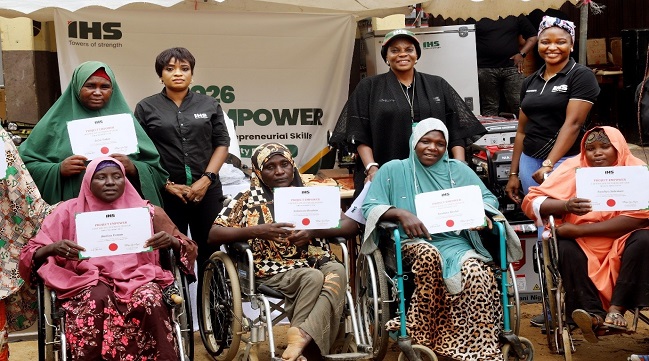
Communications infrastructure company, IHS Nigeria, has donated business support equipment to empower people with disabilities within the Karonmajiji community in the Federal Capital Territory, Abuja. This is part of the company’s commitment to drive inclusive community development and sustainable livelihood support under its Project Empower initiative.

The equipment was distributed to beneficiaries during a ceremony held in the community on Monday, July 27. The initiative was conceived following a community needs assessment and is designed to empower active traders by providing them with business tools rather than cash grants, thereby strengthening their businesses and ensuring long-term economic impact and accountability.
Speaking at the event, Director, Sustainability, IHS Nigeria, Titilope Oguntuga, described the initiative as a reflection of the company’s commitment to advancing inclusive development by equipping persons with disabilities with the tools and opportunities needed to build resilient livelihoods.
She explained that rather than providing short-term financial assistance, IHS Nigeria adopted an asset-based approach by donating 50 pieces of business support equipment, including sewing machines, freezers, generators and hairdressing kits, to the selected beneficiaries.
According to her, the intervention is designed to create lasting value by supporting entrepreneurship, promoting self-reliance and strengthening household incomes, while contributing to the achievement of the United Nations Sustainable Development Goals, particularly SDG 1 (No Poverty), SDG 8 (Decent Work and Economic Growth) and SDG 10 (Reduced Inequalities).
In his opening remarks, the Chief of the Karonmajiji Disabled Community, Alhaji Sulaiman Muhammed Katsina, represented by the Secretary of the Community, Alhaji Mohammed Dantani commended IHS Nigeria for its commitment to empowering persons with disabilities through practical and sustainable interventions.
He described the initiative as a demonstration of genuine partnership with the community and expressed appreciation for the company’s continued engagement with the Association, noting that the donation of the equipment was a significant investment in improving the livelihoods of persons with disabilities and would create meaningful economic opportunities for the beneficiaries and their families.
The event brought together traditional rulers, government representatives, leaders and members of the Karonmajiji Disabled Community Association, implementing partners, including Field of Skills and Dreams Vocational Technical and Entrepreneurship (FSD VTE) Training Institute and other community stakeholders, reaffirming a shared commitment to promoting inclusion and sustainable community development.
Project Empower reinforces IHS Nigeria’s commitment to advancing sustainable development through strategic partnerships that promote economic inclusion, strengthen community resilience and create opportunities for underserved communities.

The Chartered Institute of Bankers (CIBN) and the Association of Corporate Communication and Marketing Professionals in Banks (ACAMB) have enjoined banks to further deepen and prioritize financial inclusion, women’s empowerment and sustained growth through strategic mandates and frameworks, aimed at closing the financial gap and empowering more small, and medium enterprise (MSME) owners.

Both organisations made this call during a courtesy visit to the newly invested 24th President and Chairman of Council of the Chartered Institute of Bankers of Nigeria (CIBN), Dr. Dele Alabi, Ph.D, FCIB, as part of plans to congratulate him on his investiture as well as seek a stronger alliance between both bodies.
The visit followed Alabi’s investiture where he unveiled his “IMPACT” Vision, themed “Consolidating Our Local Impact, Enhancing Our Global Relevance.”
The vision rests on six pillars: Inclusion across geographic, gender, and generational lines; Membership growth and quality; Professionalism and ethics; Accountability; Competencies and skills development; Technology, automation, and innovation. Other areas of shared interest, include women empowerment, financial inclusion and literacy, as well as MSME clinics, all of which are top on his agenda.
Alabi explained that under him, the institute will be prioritising financial inclusion and women empowerment, because of its realisation that women are often the primary financial managers and caregivers in families. Access to savings, micro-credit, and insurance acts as a safety net during crisis and allows them to significantly improve living conditions.
He added that CIBN would be happy to drive joint knowledge sharing and exchange sessions with CBN and ACAMB across various platforms. “Educating the public through public awareness programmes, with ACAMB as the rallying point, is central to what we do,” he noted.
ACAMB President, Jide Sipe, who led the delegation, spoke in unison with the CIBN president, as he noted that, closing the inbalances in financial access help economies grow faster, reduces inequality, and encourages greater civic participation by all.

Nwokolo, Nollywood Actor Claims Internet Fraud is “Keeping Economy Afloat’

SEC Begins Full e-Registration for Capital Market Operators

Elon Musk Launches Invite-only X Money with Visa Debit Card

CBN Fines Banks N430m for Ignoring Customers’ Complaints

Kaspersky Uncovers New Mirage Kitten Malware Used in Cyber-espionage Campaign Across Africa, Others

NRC, Ponzi Scheme Collapses Resulting Loss of Billions of Naira

EFCC Busts NIS Visa Overstay Racket, Uncovers N700m in an Account

From Scarcity to Scale: What Africa Can Learn from India’s Agricultural Transformation

Tokenization, Blockchain Technology will Transform Financial Institutions – IMF

BON Establishes Six Ad Hoc Committees to Modernize Broadcasting




 News2 days ago
History as Lagos Becomes First Nigerian State to Launch Greenhouse Gas Registry

 E-Business2 days ago
UNN to Partner Firm on AI, Smart Mobility Innovation Centre

 Telecom1 day ago
Fact-Check: Elon Musk’s “Tesla Pi Phone” is Internet Rumor

 Telecom2 days ago
AI Investment Gap Threatens Africa’s Future Growth

 Telecom2 days ago
AMCON Puts ntel Up for Sale, Seeks Investors

 E-Financial2 days ago
Remita Raises Alarm Over Nigeria’s Digital Divide, Calls for More Investment

 Telecom2 days ago
Court Affirms NDPC’s Powers to Register Major Data Controllers, Processors

 E-Financial1 day ago
Malpass, Ex World Bank Chief Raises Alarm over Nigeria’s Secretive Debt Structures