

General News
AfriTECH 5.0: Chukwuemeka Mbabaie Champions Africa’s Digital Sovereignty Through Decentralized Systems

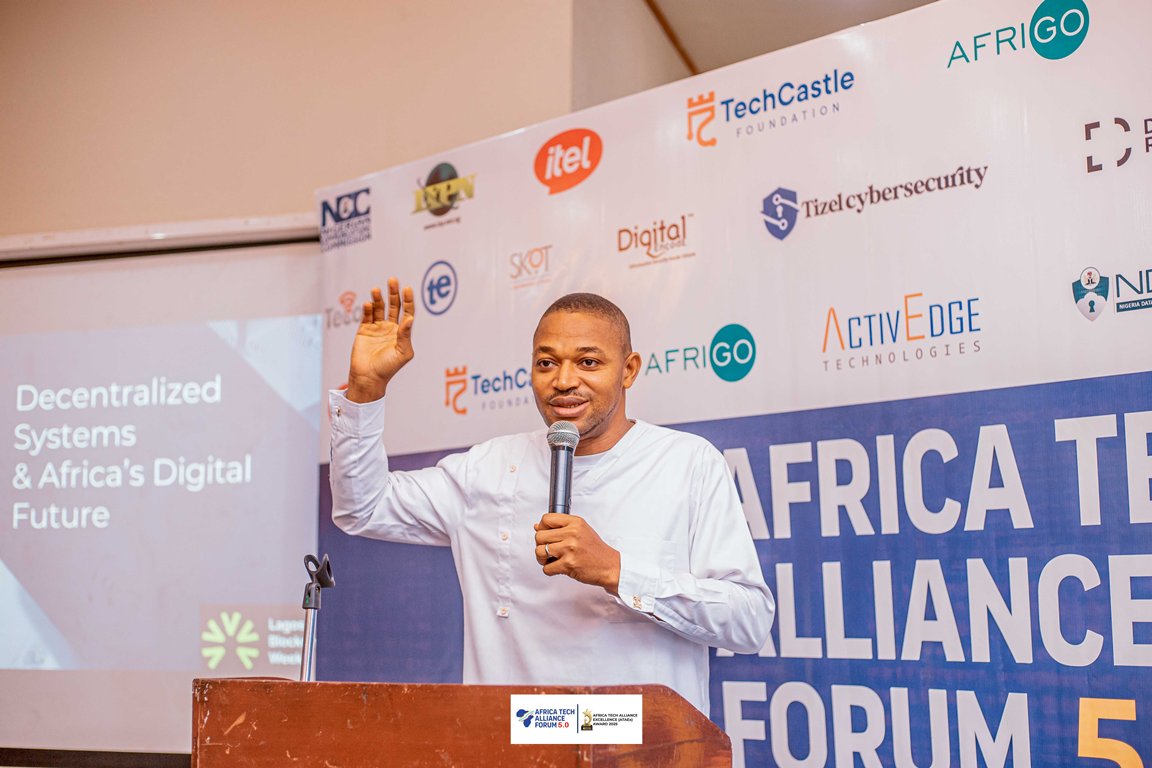
A powerful call for Africa to seize control of its digital future echoed through the hall at the 5th edition of the Africa Tech Alliance Forum (AfriTECH 5.0) in Lagos, as Lagos Blockchain Week Lead, Chukwuemeka Mbabaie, delivered a compelling presentation urging the continent to embrace decentralized systems as the foundation of a new, sovereign digital economy.

Mbabaie described the blockchain sector as a rapidly expanding “borderless, multi-billion-dollar industry,” already valued at more than $3 billion and growing at an unprecedented pace, and emphasized that Africans, particularly young Nigerians, must urgently position themselves to benefit from this global shift.
“You can be in Gombe or Makurdi and still earn globally. It’s a borderless environment,” he said, stressing that the blockchain ecosystem offers opportunities without the need for visas, relocation, or traditional entry barriers.
He explained that decentralized systems represent a fundamental redesign of digital infrastructure, one where no single corporation, government, or financial institution wields absolute control. Instead, authority is distributed across globally dispersed nodes and validators operating under transparent, verifiable rules enabled by blockchain and peer-to-peer technologies. This, he noted, stands in sharp contrast to Africa’s prevailing centralized systems.
While acknowledging the contributions of centralized platforms like Opay, Moniepoint, and M-Pesa in advancing financial inclusion, Mbabaie warned that their architectures leave millions vulnerable to outages, policy disruptions, and systemic failures.
He noted that blockchain networks, by comparison, rarely experience shutdowns due to their global distribution. “If a node in America goes down, the one in Gombe or China keeps the system running. That’s the beauty of space,” he said.
Beyond reliability, Mbabaie underscored digital sovereignty as decentralization’s most critical advantage. It enables financial transactions that cannot be arbitrarily blocked, digital identities that cannot be erased, and infrastructure that Africans themselves can build, own, and profit from.
“Africa owns the rails, not just rides the train,” he declared, urging stakeholders to envision a continent where Africans write the rules of their digital economy.
He broke down the foundational principles of decentralized systems, no gatekeepers, transparent rules, and universally distributed data, highlighting their superiority to traditional financial structures that can manipulate money or restrict access, adding that blockchain offers immutable transparency: “Any transaction can be seen. Any file can be tracked. Nothing disappears.”
Citing Bitcoin’s more than 200,000 active wallets and the resilience of decentralized internet initiatives like Wikipedia’s distributed network, Mbabaie argued that Africa must prepare for a future powered by smart contracts, AI-integrated protocols, and globally interoperable blockchain systems.
To fast-track this transition, he outlined three urgent policy actions for African governments and regional tech bodies:
· Data localization and mandatory interoperability to ensure critical digital infrastructure is hosted locally and free from vendor lock-in.
· A risk-based licensing regime for Virtual Asset Service Providers and a mandatory 90-day token classification window aligned with the VASPA framework.
· A ₦50 billion Sovereign Compute Fund to support the development of African-built Large Language Models (LLMs) and on-chain AI agents capable of competing in the global AI race.
Mbabaie praised Nigeria’s recent progress in establishing regulatory and compliance structures for blockchain adoption and reiterated that the nation still leads Africa despite earlier missed opportunities, and urged young innovators, policymakers, and industry players to act decisively.
“We are at a defining moment,” he said. “If Africa embraces decentralized systems now, we can unlock long-term economic empowerment, digital independence, and true global competitiveness.”



More than 45,000 jobs have been cut across the global technology sector in the first few months of 2026, according to data from RationalFX, signalling that the industry is still adjusting after a period of aggressive hiring rather than returning to a full growth phase.

“In 2025, automation, artificial intelligence, and sustained cost-discipline measures drove much of the downsizing, with entire departments restructured or eliminated in favour of leaner, AI-assisted workflows. This trend has continued full steam into 2026,” said Alan Cohen, analyst at RationalFX.
According to the report, if the current rate of redundancies is sustained, total layoffs in 2026 could surpass the 245,000 recorded in 2025.
The majority of these layoffs have been concentrated in the United States, with major companies continuing to trim their workforce despite stable core operations.
Amazon has announced approximately 16,000 job cuts this year, while Block has also reduced thousands of roles as it tightens operations and shifts focus towards artificial intelligence.
There are indications that further reductions may follow.
Meta is reportedly considering additional layoffs as it increases investment in AI infrastructure, while PayPal and Klarna are reassessing spending and hiring strategies amid ongoing uncertainty.
Established technology firms are also undergoing restructuring. Dell has reduced its workforce by around 11,000 over the past year as part of a broader reorganisation, while Salesforce has cut approximately 1,000 roles in 2026 while aligning its teams more closely with AI-driven products.
Outside the United States, layoffs have been smaller in scale but more geographically dispersed.
Australia has reported around 2,650 job cuts so far this year, followed by Sweden with roughly 1,923 and Netherlands with about 1,700.
Other markets have also been affected. Israel and India have recorded approximately 1,539 and 1,520 layoffs respectively, with Israel’s startup ecosystem particularly sensitive to tighter funding conditions, while in India, both startups and larger IT firms have reduced headcount as global client spending slows.
In Singapore, around 1,016 layoffs have been reported, reflecting a softer hiring environment across Asia’s major technology hubs, where companies are adopting a more cautious approach amid uneven demand.
Across Europe, job cuts have been comparatively limited but still noticeable.
The United Kingdom has recorded around 1,000 layoffs, while Czech Republic and Germany have seen smaller reductions.
The broader trend suggests that technology companies are shifting towards leaner operations and more defined priorities following years of expansion. Increasing investment in automation and artificial intelligence is also reshaping the types of roles in demand.
For employees, the impact is becoming increasingly visible, with hiring slowing and becoming more selective. While opportunities remain, companies are taking a more measured approach to recruitment compared to the rapid expansion seen in previous years.
Further credit… .storyboard18.com

Elon Musk, a billionaire internet entrepreneur, was held responsible by a federal jury in San Francisco for deceiving Twitter shareholders during his contentious $44 billion takeover of the social media site.

Elon Musk
Following a three-week trial in a federal court in California, the verdict was handed out on Friday.
It found that Musk had made false and misleading representations in tweets that were posted in May 2022.
The jury concluded that at a crucial point in the purchase process, these remarks caused Twitter’s share price to decline.
Investor Giuseppe Pampena filed the action on behalf of stockholders who sold their Twitter stock between mid-May and early October 2022, a time when Musk’s commitment to closing the purchase was questionable.
Jurors determined that Musk violated US securities laws prohibiting deceptive statements capable of influencing market prices.
Legal representatives for the plaintiffs estimate potential damages at approximately $2.6 billion, exposing Musk to a significant financial penalty if the ruling is upheld.
In order to give Musk leverage to renegotiate the purchase price or back out of the transaction, plaintiffs contended that the statements were meant to lower Twitter’s valuation.
Musk finished the transaction in October 2022 after Twitter filed a lawsuit to enforce the arrangement, despite early attempts to end it. Later, he changed the platform’s name to X.
The ruling has been disputed by Musk’s legal team, which has confirmed plans to appeal and described it as a temporary setback.
For Musk, who has won a number of well-known court cases, the decision represents a rare setback.
Meanwhile, he was cleared in a separate defamation case in Texas and had also won a similar shareholder lawsuit in 2023 related to his 2018 tweets about taking Tesla private.

Securities and Exchange Commission (SEC) and the National Youth Service Corps (NYSC) have formalised a strategic partnership aimed at embedding financial literacy and anti-Ponzi education into the national service programme.

This is in a move to shield young Nigerians from the growing menace of fraudulent investment schemes.
The collaboration, sealed through a Memorandum of Understanding (MoU) signed in Abuja, marks a significant step toward strengthening investor education at the grassroots level by targeting thousands of corps members annually.
The agreement was executed by Emomotimi Agama, director-general, SEC, and Olakunle Oluseye Nafiu, his NYSC counterpart, at the NYSC headquarters.
At the heart of the initiative is the integration of anti-Ponzi scheme campaigns into the NYSC’s Community Development Service (CDS), specifically under its Education and Enlightenment arm.
The move is designed not only to educate corps members on identifying fraudulent investment schemes but also to cultivate a culture of responsible and informed investing among Nigeria’s youth population.
Under the terms of the agreement, the SEC will spearhead the development of comprehensive educational materials and training modules covering capital market operations, safe investment practices, and strategies for identifying and avoiding Ponzi schemes.
The Commission will also fund and facilitate specialised training sessions for selected corps members and NYSC officials, who will, in turn, serve as facilitators within their host communities.
The NYSC, on its part, will ensure the seamless integration of these training modules into its existing CDS framework. This will include structured workshops, sensitisation campaigns during orientation camps, and continuous engagement throughout the service year.
By leveraging its nationwide presence across all local government areas, the scheme is expected to amplify awareness and significantly reduce the vulnerability of young Nigerians to financial fraud.
Both institutions also pledged to collaborate on extensive public awareness campaigns using a blend of traditional media, digital platforms, and grassroots outreach initiatives.
In addition, mechanisms will be established for data sharing and performance tracking to assess the impact and effectiveness of the programme over time.
Speaking at the signing ceremony, Agama underscored the SEC’s longstanding commitment to youth development through the NYSC scheme.
He revealed that the Commission currently hosts between 160 and 180 corps members, one of the highest among public institutions in the country.
“We have consistently demonstrated our belief in the capacity of young Nigerians by providing them with opportunities to learn and grow within the capital market ecosystem.
“These corps members are not just participants; we regard them as integral members of our workforce. By equipping them with the right knowledge and values, we are preparing them to become ambassadors of sound investment practices in society,” he said.
Agama further emphasised that the initiative aligns with the Commission’s broader mandate of investor protection and market development, noting that early education remains a critical tool in combating financial scams.
In his remarks, Nafiu described the partnership as a milestone achievement and a key performance indicator for both organisations.
He commended the SEC for its proactive role in promoting trust and participation in Nigeria’s capital market, noting that the collaboration would have far-reaching benefits for the nation.
“It is important to catch them young,” he said, referring to corps members. “By instilling the right financial habits at this stage, we can prevent them from falling prey to Ponzi schemes and other fraudulent ventures.”
He assured that the NYSC would remain fully committed to implementing the agreement, adding that the execution phase would be carried out diligently to ensure maximum impact on Nigerian society.
The initiative comes at a time when Nigeria continues to grapple with the proliferation of Ponzi schemes and unregulated investment platforms, many of which have resulted in significant financial losses for unsuspecting citizens.

Tech Firms Sack over 45,000 so Far in 2026

CBN Wins Central Bank of the Year Title @13th Global Awards

Jury Finds Elon Musk Liable for Misleading Twitter Investors

FG Taps Quest Merchant Bank for Advisory on 90,000km Fibre Project

TEF-Backed Entrepreneurs Generate $4.2Bn, Create 1.5m Jobs across Africa

Kaspersky Discovers New Phishing Campaign Exploiting Google Tasks Notifications to Steal Corporate Credentials

esentry 2025 Report Shows Healthcare, Financial Services and Telecoms as Staging Grounds for Increased Cyberattacks in Africa

AfDB, UNDP Launch $10Bn AI Initiative for Africa

MultiChoice Suspends Yearly DStv Price Hike as Canal+ Pushes Growth

MTN Nigeria Posts Record N1.70 Trillion Pre‑Tax Profit, Declares N20 Dividend for 2025




 News2 days ago
African Tech Start-ups to Receive $46m of Speedinvest Africa Fund

 Telecom2 days ago
Court Bans Kenyan Telcos from Recycling SIM Cards

 E-Financial2 days ago
Providus Bank Fully Meets CBN Capital Requirement, Sets Record Straight

 E-Financial2 days ago
UBA UK, BII Sign Letter of Intent to Slash Africa’s $80Bn Trade Finance Gap

 Telecom2 days ago
Binance Earn: Simple Way to Earn Rewards on Idle Crypto Holdings

 News2 days ago
UK, Nigeria Unveil Three-Year Plan to Combat Immigration Crime

 News2 days ago
U.S. Charges Three in $2.5 Billion Plot to Smuggle Nvidia AI Chips to China

 General News2 days ago
Court Jails ‘Colonel’, ‘Major’ of Global Money-Laundering Ring