

Telecom
Angry Nigerians Reject New Tax on Phone Calls, Pay Tv


Nigerians have reacted angrily to the proposed communications service tax describing it as another way of exploiting the struggling consumers.
Nigeria CommunicationsWeek had earlier this month reported that communication service subscribers may pay additional tax if a new Bill now being introduced by the National Assembly is enacted into law.
The categories of communication services liable to the tax include voice calls, SMS, MMS, Data and Pay TV.
But ThisDay which spoke to a number of Nigerians reported the subscribers have vowed to reject the tax.
Abimbola Akanbi, a subscriber told the newspaper that the development was one which sought to stifle communications and impose further hardship on poor subscribers.

Akanbi who urged the government to seek other alternative ways to generate revenue said such bills if passed into law may bring about double taxation as the phone companies would hike their charges as a result of the cost they would incur in complying with the law and filing returns.
Another subscriber Chidi Obinna, said the government had indirectly chosen another way to revive the social media bill.
“The implication of this is that Nigerians will have to pay more for communications services including data bundle to access social media. Should we pay more for these services, then there will be limit to how we visit these platforms because of fear of exorbitant charges.”
Also reacting, The Association of Telecommunications Companies of Nigeria (ATCON) said the bill should not be made to stand considering the inconvenience it would foist on subscribers.
According to Ajibola Olude, executive secretary of ATCON, “Already, Nigerians are complaining of economy hardship, imposing another tax on them will add to their burden and in effect, reduce communications growth.
“As far as we acknowledge that it is a trying period for the economy, that is not to say that we should transfer the burden on consumers who are also strongly affected by the harsh economy status. Already, subscribers are already paying high for telecommunications services compared to what is obtainable in other countries. Asides this, telecommunication business will be largely affected because subscribers will reduce their interaction with telecommunications services and in turn affect the overall profits of service providers.” Olude noted.
Nigeria CommunicationsWeek had earlier reported a Bill, titled ‘Communication Service Tax Bill (“CST” or the “Bill”) 2015’, seeks to impose, charge and collect Communication Service Tax (CST) and will be levied on service fees payable by users of electronic communication services at 9% and will be borne by the customers.
The rate of the CST, which is proposed at 9 per cent of the service charge for the use of communication service charged by service providers, is seen by fiscal experts as amongst other taxes being imposed by government to shore up its revenue base as the whirlwinds in the international oil market continue its depreciative impact on accruable earnings by the country from crude oil exports.
According to a ‘Tax Alert’ publication by PricewaterHouseCoopers (PwC), Nigeria, if the Bill is enacted into law, it will mandate service providers to file monthly tax returns with the FIRS with strict penalties for non-compliance.
For instance, Section 2 of the Bill listed the chargeable services to include, Voice calls, SMS, MMS, Pay per View TV stations, data usage from telecommunication services providers and internet service providers.
While the Federal Inland Revenue Service (FIRS) will be responsible for the collection of the tax and its payment together with any interest and penalty into the Federation Account, the Federal Government will be responsible for the administration and management of the funds.
The Bill provided that all service providers are to file tax returns and pay the tax due not later than the last working day of the month immediately after the month to which the payment relates. Failure to comply with this provision will attract stiff financial penalties on erring entities


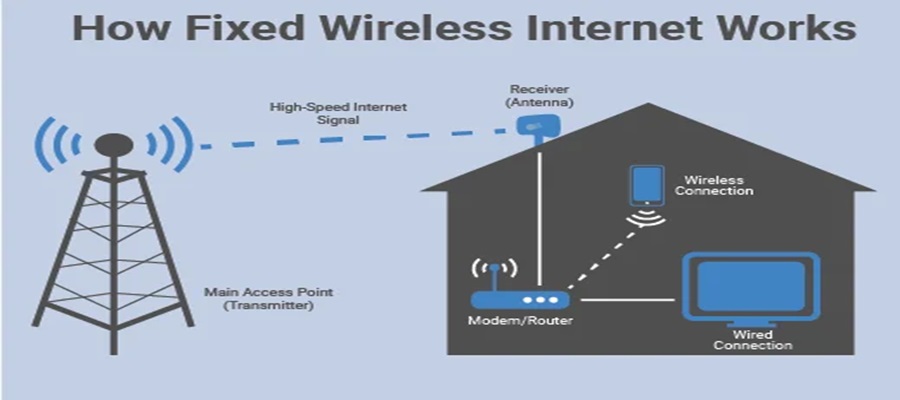
Nigeria has exactly 156,662 active fixed wired internet subscriptions as of mid-2026.

This is a tiny fraction compared to mobile GSM networks, which dominate the market with over 154 million subscribers.
The fixed wired market primarily consists of homes and offices using direct physical cables like fiber optics.
Fixed wired services use physical cables, like glass fiber or copper wire, to bring internet directly into a building.
It is like a dedicated, private water pipe for your home. It provides very fast speeds, unlimited data, and is reliable.
In contrast, mobile GSM uses radio waves transmitted from tall towers to phones, acting more like a sprinkler that sprays a signal across an entire neighborhood.
Because laying physical cables across cities is expensive and hard to do, these subscriptions are very rare.
However, the market has seen recent growth, driven largely by Fiber-to-the-Home (FTTH) services.
The top players are: MTN FibreX with 110,564 subscribers, which is roughly 88.7 per cent of the entire market.
SWIFTNG accounts for about 13,945 connections.
The others are ipNX and 21st Century Technologies which make up the number.

Nigerian Communications Commission (NCC) has said that it was strengthening collaboration with state governments and industry players to develop a transparent, cost-based pricing framework for sharing telecom ducts as part of efforts to speed up broadband expansion across Nigeria.

Ayuba Shuaibu, director of Policy, Competition and Economic Analysis, NCC, disclosed this at the Stakeholders’ Forum in Abuja.
Shuaibu said the initiative was designed to build consensus among all parties.
“The primary purpose of this forum is to ensure seamless synergy between the Commission and all stakeholders,” he said.
The director said the consultation was prompted by longstanding complaints over permits, levies and other charges imposed by different levels of government.
He said bringing together state commissioners, telecom operators, tower companies and representatives of the Nigeria Governors’ Forum had helped improve understanding of the issues.
“This engagement is a work in progress. We expect more input from stakeholders before presenting the outcome to the Nigeria Governors’ Forum,” he added.
Dr Helen Adeneye, commissioner for Innovation, Science and Technology, Kogi State. welcomed the consultation, saying Nigeria needs a harmonised policy that clearly defines the responsibilities of both the federal and state governments.
“We need a harmonised policy that allows states to collaborate better with telecom operators and creates a more business-friendly environment,” she said.
Dr Adeneye added that adopting the Dig-Once policy would establish a uniform pricing system and help resolve disputes over charges for telecom infrastructure deployment.
Chidi Ajuzie, chief executive officer, WTES Projects Limited, whose firm is conducting the consultancy study, said the proposed framework would introduce a common cost structure for duct sharing to support broadband investment and economic growth.
“The study is designed to create a uniform pricing model that will drive broadband growth, economic development and wider adoption across the country,” he said.
Ajuzie explained that the consultants had developed preliminary floor and ceiling prices to guide operators while allowing flexibility within the approved range.
He added that the recommendations remain open to industry input before the NCC finalises the framework.
The Dig-Once Policy is designed to reduce the cost and disruption of deploying broadband infrastructure by requiring fibre ducts to be installed whenever roads are constructed or rehabilitated.
The NCC is developing a cost-based pricing framework for sharing these ducts to promote fair pricing, reduce duplication of infrastructure and encourage investment.
The proposed model is expected to support the Federal Government’s broadband expansion targets while improving collaboration between telecom operators and state governments.
Telecom
MUSON Graduates Shine at 2026 Concert as MTN Foundation Celebrates 20 Years of Music Scholarships


Emeka Nwodike, acting director of the MUSON School of Music, conducted the institution’s graduating class in a grand finale performance, bringing the 2026 graduation concert to a memorable close. The concert took place on July 7 at the Shell Hall of the MUSON Centre, Onikan, Lagos.

The event celebrated students who successfully completed the MUSON Diploma Programme through the MTN Foundation Scholarship Programme.
The graduating students delivered a rich choral repertoire that reflected the breadth of their musical training, performing Italian Salad by Richard Genee, My Song by Eriks Esenvalds, Obi Dimkpa by Laz Ekwueme, and an ABBA Medley arranged by Goran Bejstam. Under the Acting Director’s baton, the choir demonstrated technical precision, vocal maturity and artistic expression before an audience of family members, music enthusiasts and industry stakeholders.
The concert formed part of the long-running partnership between the MTN Foundation and the Musical Society of Nigeria (MUSON), which has, since 2006, provided scholarships for hundreds of talented young Nigerians to receive formal music education through the MUSON Diploma School. The programme continues to serve as one of the country’s foremost platforms for developing professional musicians and strengthening Nigeria’s creative economy.
Speaking at the close of the concert, Nwodike expressed appreciation to the MTN Foundation for its sustained support of the scholarship programme over the past two decades. He also thanked the Director of the MUSON Centre, faculty members, mentors and other stakeholders whose dedication has contributed to the school’s continued success.
“For nearly 20 years, the MTN Foundation has remained a steadfast partner in our mission to nurture young musical talent. We are deeply grateful for that commitment. I also want to thank the Director of the MUSON Centre, our faculty, mentors and everyone whose dedication has helped the MUSON School of Music continue to grow and thrive. Their support has made this programme what it is today, and our graduates are a testament to that collective effort,” he said.

Court Adjourns Alleged Binance Tax Evasion Case over Settlement Talks

Fixed Wired Internet Market Lags as Mobile Gains Ground

Xenophobic Attacks: OYC Threatens to Picket MTN Nigeria Offices

New NIMC Act Strengthens Data Protection, Privacy – Director

BON Establishes Six Ad Hoc Committees to Modernize Broadcasting

NASENI Moves to Digitize CCB’s 5m Assets Declaration and Operations

Mobile Internet Gender Gap Widest in Africa – GSMA

Nigeria Launches FreeTV Nationwide

CANAL+ Partners Samsung to Pre-Load DStv Stream on New Samsung TVs In Nigeria, Other African Countries

Lebara Nigeria Launches Lebara Play, Africa’s First Telecom-Owned Micro-Drama Platform




 News2 days ago
NRC, Ponzi Scheme Collapses Resulting Loss of Billions of Naira

 News2 days ago
NSITF Partners South African Insurer on Digital Transformation

 E-Financial2 days ago
FCT-IRS Unveils New Digital Platform, Taxporta

 General News2 days ago
KPMG Urges Africa’s Most Innovative Tech Entrepreneurs to Enter the Global Tech Innovator 2026 Competition

 E-Business2 days ago
FG Suspends New Internet Regulations to Prevent Overlapping Rules
 E-Business2 days ago
NIN Enrollment Hits over 136m as New ID Law Takes Effect

 E-Business2 days ago
Plateau PCC Collects Nigerians’ Data without Privacy Policy – FIJ

 General News2 days ago
Court Declares ARCON’s N60Bn Fine against Facebook Nigeria Illegal