

Telecom
Apple Leads Samsung, Huawei at the Worldwide Smartphone Market


Worldwide Smartphone Market statistics has shown that Apple has overtaking Samsung to the Top Position of Smartphone Market, While Overall Shipments Decline 6.3% in the Fourth Quarter of 2017.
A slower than expected 2017 holiday quarter closed out the year bringing minimal change to the worldwide smartphone market when compared to 2016.
According to International Data Corporation (IDC) preliminary data from the Worldwide Quarterly Mobile Phone Tracker, smartphone vendors shipped a total of 403.5 million units during the fourth quarter of 2017 (4Q17), resulting in a 6.3% decline when compared to the 430.7 million units shipped in the final quarter of 2016.

For the full year, the worldwide smartphone market saw a total of 1.472 billion units shipped, declining less than 1% from the 1.473 billion units shipped in 2016.
Developed markets such as China and the United States both witnessed a decline during the quarter as consumers appeared to be in no rush to upgrade to the newest generation of higher-priced flagship devices.
Anthony Scarsella, research manager, Mobile Phones at IDC, said “The latest flock of posh flagships may have had consumers hitting the pause button in the holiday quarter”.
“With ultra-high-end flagships all the rage in 2017, many of these new bezel-less wonders proved to be more of a luxury than a necessity among upgraders.
Even though we have seen new full-screen displays, advanced biometrics, and improved artificial intelligence, the new and higher price points could be outweighing the benefits of having the latest and greatest device in hand.”
Jitesh Ubrani, senior research analyst with IDC’s Worldwide Mobile Device Trackers, said “In the presence of ultra-high-end flagships, the still high-priced flagships from the previous generation seemed far more palatable to consumers in 2017.”
“Many high-profile companies offered their widest product portfolio ever in hopes of capturing a greater audience.
“Meanwhile, brands outside the top 5 struggled to maintain momentum as value brands such as Honor, Vivo, Xiaomi, and OPPO offered incredible competition at the low end, and brands like Apple, Samsung, and Huawei maintained their stronghold on the high end.”
Smartphone Vendor Highlights shows that Apple experienced a slight downturn from the previous holiday quarter as iPhone volumes reached 77.3 million units, a year-over-year decline of 1.3%.
Volumes were still enough to push Apple past Samsung and back into first place in the smartphone market, largely because of iPhone 8, 8 Plus, and iPhone X.
Apple continues to prove that having numerous models at various price points bodes well for bringing smartphone owners to iOS.
Although demand for the new higher priced iPhone X may not have been as strong as many expected, the overall iPhone lineup appealed to a wider range of consumers in both emerging and developed markets.
Apple finished second for the full year in 2017 shipping 215.8 million units, up 0.2% from the 215.4 million units shipped in 2016.
Samsung remained the overall leader in the worldwide smartphone market for 2017 despite losing out to Apple in the fourth quarter.
The Korean giant shipped 74.1 million units in 4Q17, down 4.4% compared to the 77.5 million units from last year.
Samsung finished the year with 317.3 million shipments, up 1.9% from the 311.4 million shipments in 2016.
Despite the failure of the Note 7 combined with the endless collective pressure from Chinese players along with Apple, Samsung has managed to remain on top through thick and thin.
The pending arrival of their next flagship, the Galaxy S9, may represent the brand’s best chance of winning over both new and current customers in 2018.
Huawei continues to hold the number three position despite intensified competition from growing Chinese players such as OPPO and Vivo.
Huawei shipped 41.0 million units, down 9.7% from the 45.4 million shipped in the fourth quarter of 2016.
The 2017 results look much better for the Chinese giant as the Honor brand helped pushed sales both inside and outside of China.
Huawei shipped 153.1 million units, up 9.9% from the 139.3 million unit shipped in 2016.
The Mate series and Honor sub-brand continued to drive crucial volume in numerous markets, while the Y series thrived at the low-end.
Recent aspirations for breaking into the U.S. market are on hold as both AT&T and Verizon recently cut ties to bring Huawei flagships to the U.S.
Entering the U.S. through an official carrier remains critical for Huawei if it wishes to eventually dethrone market leaders Apple and Samsung.
Xiaomi managed to double its share to 7% from 3.3% during the holiday quarter last year.
This comes as no surprise since the company has continued to focus on growth outside China, with India and Russia being two of its largest markets.
The company has been expanding its number of Mi Stores and Mi Service Centers, with fast buildout coming in markets like Indonesia.
It also appointed Lazada to be the official online store and partnered with Indosat to offer a telco bundling package, where consumers can get Xiaomi’s smartphone for free by purchasing a data package for a one-year period.
In India, Xiaomi also launched Redmi Y-series in India and roped in Bollywood celebrity Katrina Kaif to endorse the selfie-centric smartphone series as its first product endorser.
The Redmi 5A, which was launched at US$78, saw more than a million devices being sold within a month.
The brand continued to expand its retail presence by adding more preferred partners, launching new Mi stores, and partnering with large format retail stores.
OPPO dropped one place to the 5th position as the company shipped 27.4 million smartphones while managing to maintain 12% growth for the full year, amounting to 111.8 million smartphones.
Like Xiaomi, OPPO has also managed to move beyond the domestic Chinese market and gain a foothold in other Asian countries like India, Indonesia, and Vietnam.
In Indonesia, it launched the new F5 series in 4Q17 and also announced its partnership with AOV, a MOBA game.
It ran a “selfie campaign” tour in many big cities in Indonesia to promote the AI feature in its selfie camera.
In India, it continued to invest in celebrity endorsements and events.
However, it faced a slight decline as it made some changes to its channel strategy by being more selective about its retail partners.


Airtel Nigeria has secured a fresh 10-year renewal of its spectrum licence from the Nigerian Communications Commission (NCC), reinforcing the telecom operator’s long-term commitment to expanding broadband connectivity and improving digital access across the country.

The renewed licence covers Airtel’s spectrum holdings, which are critical to the delivery of voice and high-speed data services, providing regulatory certainty for continued investments in network expansion, capacity upgrades and improved customer experience.
According to the company, the renewal underscores confidence in Nigeria’s telecommunications sector and will support its ongoing efforts to bridge the country’s digital divide by extending quality connectivity to more underserved communities.
Sunil Taldar, chief executive officer, Airtel Africa, said the renewal provides the company with the confidence to continue investing in Nigeria’s digital infrastructure.
He said, “The spectrum renewal reaffirms our long-term commitment to Nigeria, our largest market. It gives us the certainty required to continue investing in network expansion, improve service quality and accelerate digital inclusion for millions of Nigerians.”
Taldar added that Airtel remains focused on expanding broadband access and supporting Nigeria’s digital economy agenda through sustained investments in telecommunications infrastructure.
He further said, “We appreciate the Nigerian Communications Commission and the Federal Government for their continued support in creating an enabling environment for investment. We remain committed to delivering reliable and affordable connectivity while contributing to Nigeria’s socio-economic development.”
Meanwhile, Industry observers said the licence renewal removes regulatory uncertainty and allows Airtel to pursue long-term capital investments, including the expansion of 4G and 5G networks, as demand for mobile data and digital services continues to grow across Nigeria.
The renewal comes as telecom operators continue to invest heavily in broadband infrastructure to meet rising data consumption and support government efforts to achieve Universal digital access.
Furthermore, It also aligns with the NCC’s objective of ensuring efficient spectrum management while encouraging sustained private sector investment in the country’s telecommunications industry.
Telecom
GSMA Supports Abuja Declaration on Meaningful Connectivity for Africa, Joins Partners to Launch ATLAS Umoja

The GSMA supports the Abuja Ministerial Declaration on Meaningful Connectivity for Africa by Ministers and Heads of Delegation at the African Telecommunications Union (ATU) Conference of Plenipotentiaries (CPL-2026), describing it as an important milestone in strengthening Africa’s digital future through evidence-based policy, investment and regional collaboration.

The Declaration commits African governments to advancing policies that promote meaningful connectivity, digital inclusion, technology-neutral regulation, resilient digital infrastructure and locally relevant digital services. It also reinforces the importance of collaboration between governments, industry and development partners to close the continent’s connectivity and usage gaps.
Throughout the conference, the GSMA has worked alongside governments, regulators and industry leaders to support these shared ambitions through practical policy engagement, evidence-based research and new collaborative initiatives designed to accelerate Africa’s digital transformation.
Speaking during the ATU-GSMA African ICT Regulatory Leaders’ Forum, policymakers and regulators explored how stronger evidence-based regulation, greater regulatory harmonisation and future-ready policy frameworks can create an enabling environment for investment, innovation and sustainable digital growth across Africa. Drawing insights from the GSMA’s Digital Africa Index, participants also examined future-ready approaches to satellite regulation, highlighting how technology-neutral licensing frameworks can support innovation while extending connectivity to underserved communities.
Caroline Mbugua, Senior Director, Public Policy, Africa, GSMA, said: “The Abuja Ministerial Declaration sends an important signal that African governments share a common vision for delivering meaningful connectivity through modern, evidence-based and investment-friendly policy. Its emphasis on digital inclusion, technology-neutral regulation, resilient infrastructure and stronger regional collaboration reflects the practical policy foundations needed to accelerate Africa’s digital transformation.”
Launching ATLAS Umoja AI
Supporting the ambitions set out in the Abuja Declaration, the GSMA, Nigeria’s Ministry of Communications, Innovation and Digital Economy, Togo’s Ministry of Digital Economy and Transformation, Kenya’s Ministry of information, Communications and the Digital Economy, Namibia’s Ministry of Information and Communication Technology, Benin’s Ministry of Digital Transformation and Innovation, Awarri, Zindi, Pawa AI and Mozisha today announced ATLAS Umoja AI –a new pan-African initiative to strengthen collaboration on African language AI.
Designed to complement national AI programmes, ATLAS Umoja will bring together governments, industry and researchers to share expertise, datasets and best practice, helping develop trusted, scalable AI that better reflects Africa’s languages, cultures and development priorities. The initiative aims to accelerate innovation, attract investment and scale African language AI across the continent.
The launch builds on the momentum of the newly established AI for Good Global Commission. Ministers from Nigeria, Namibia and Togo, who serve on the Commission, have committed to support Africa Umoja, demonstrating how African leaders are turning global ambitions for trusted and inclusive AI into practical regional collaboration.
Angela Wamola, Head of Africa, GSMA, said: “Africa’s AI future must reflect Africa’s own languages, communities and development priorities. ATLAS Umoja brings together governments, industry, researchers and innovators to build African language AI at scale. By making AI and digital services available in the languages people speak every day, the initiative will help tackle two of the biggest barriers to internet adoption – digital literacy and locally relevant content – supporting efforts to close Africa’s usage gap and expand meaningful connectivity across the continent.”
Dr. Bosun Tijani, Honourable Minister of Communications, Innovation and Digital Economy of Nigeria said:“Artificial Intelligence will be a defining technology for Africa’s future, but its benefits must be built on our own languages, cultures and knowledge systems. Nigeria is proud to have taken the first step through N-ATLAS and is equally proud to see that vision evolve into the continental ATLAS Umoja AI.
“By working together with governments, researchers and ecosystem partners across Africa, we can build AI that is more inclusive, locally relevant and accessible to millions of people, while strengthening Africa’s digital sovereignty and creating new opportunities for innovation, education and economic growth.”
Silas Adekunle, Founder & CEO, Awarri added: “Awarri is proud to support The ATLAS Umoja AI and contribute lessons from N-ATLAS, which has demonstrated what is possible when African language data, local technical talent and practical AI applications are brought together. This is an important opportunity to help build AI systems that work for African languages and communities.”
Celina Lee, CEO & Co-Founder, Zindi concluded: “Africa’s AI future will be built by the people who best understand its languages, cultures and communities. Through ATLAS Umoja AI, we have an opportunity to empower local researchers, data scientists and developers to solve meaningful challenges, strengthen national AI capabilities and ensure African language AI is developed by Africans, for Africans.”
Alongside the launch of ATLAS Umoja AI, the GSMA continued discussions with policymakers at the ATU Conference on future-ready regulatory frameworks, including satellite connectivity, spectrum policy and technology-neutral licensing.
Drawing on the GSMA Satellite Regulatory Playbook, discussions explored how modern regulation can encourage investment, expand meaningful connectivity and support the ambitions of the Abuja Declaration.
Together, the Abuja Declaration, ATLAS Umoja and continued collaboration between governments, regulators and industry represent an important step towards expanding meaningful connectivity, accelerating digital inclusion and supporting Africa’s digital transformation.
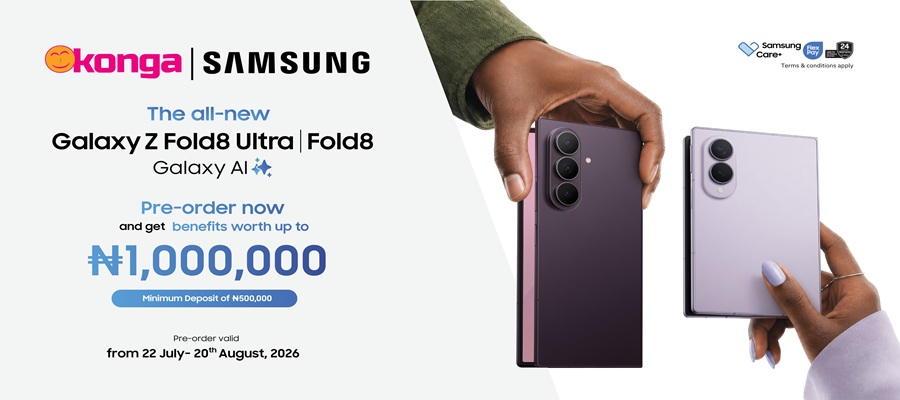
Samsung has unveiled its most advanced foldable smartphone lineup yet, the Galaxy Z Fold8 Ultra, Galaxy Z Fold8, and Galaxy Z Flip8. The tech conglomerate now sets a new benchmark for premium mobile innovation.

Konga
Nigerian customers can now pre-order the new devices on Konga, Samsung’s trusted e-commerce partner, and stand a chance to receive Samsung gift items worth up to ₦1 million, making this one of the most rewarding smartphone launches of the year.
Designed for productivity, creativity, and everyday convenience, the new Galaxy Z series introduces Samsung’s most refined foldable experience to date.
The Galaxy Z Fold8 Ultra combines an expansive display with AI-powered productivity, a powerful 200MP camera, an ultra-thin design, and enhanced durability for users who demand the very best.
The Galaxy Z Fold8 delivers immersive entertainment and seamless multitasking in a lighter, wider form factor, while the Galaxy Z Flip8 elevates self-expression with its sleek design, smarter FlexWindow, and intelligent Galaxy AI features for effortless interaction on the go. Powered by Samsung’s latest AI experiences, the new devices redefine how users create, communicate, and stay productive.
The availability of the new Galaxy Z Fold8 series on Konga further reinforces the long-standing partnership between Samsung and Konga, built on trust, authenticity, and a shared commitment to delivering genuine technology to Nigerian consumers. Through Samsung’s official store on Konga, customers are assured of authentic products, reliable after-sales support, and a seamless shopping experience.
The pre-order offer is available for a limited period. To be one of those who get to experience the new device, tech enthusiasts are encouraged to visit Konga’s Samsung Official Store to reserve their preferred Galaxy Z Fold8 or Z Flip8 device and qualify for exclusive Samsung gifts worth up to ₦1 million, while stocks last.

HURIWA, CLO Protests Bill Asking Social Media Firms’ to Open Shops Nigeria

Anambra Govt Bans Graduation Ceremonies in Anambra Schools

Airtel Secures Another 10-year Spectrum Renewal in Nigeria

Moniepoint as a Key Driver in Expanding Financial Access for Businesses in Nigeria

Nigeria, Israel Strengthen Research, Technology Collaboration

NRC, Ponzi Scheme Collapses Resulting Loss of Billions of Naira

NASENI Moves to Digitize CCB’s 5m Assets Declaration and Operations

EFCC Busts NIS Visa Overstay Racket, Uncovers N700m in an Account

Tokenization, Blockchain Technology will Transform Financial Institutions – IMF

From Scarcity to Scale: What Africa Can Learn from India’s Agricultural Transformation




 E-Financial3 days ago
FG Says Rumours, Fear, Can Crash Banks

 Telecom3 days ago
Court Dismisses Pan African Towers’ Bid to Halt Ex-CEO’s Suit, Awards ₦500,000 Costs

 E-Business3 days ago
Kaspersky Warns of a Phishing Campaign Abusing Microsoft Authentication Mechanism

 News3 days ago
IMF Sees 4% AI Growth Boost for Africa

 Telecom3 days ago
Telcos Seek Clear Regulatory Framework on Airtime Credit Services

 Telecom3 days ago
MTN Nigeria Announces 2026 mPulse Spelling Bee, Opens Entries for Students Nationwide

 E-Financial3 days ago
EU Debunks Fake Compensation Scheme Targeting West African Bank Customers

 Telecom3 days ago
MTN Warns Customers against Fake Promo