

Telecom
ATCON Visits LASIMRA, Seeks 95% Slash on RoW Charges

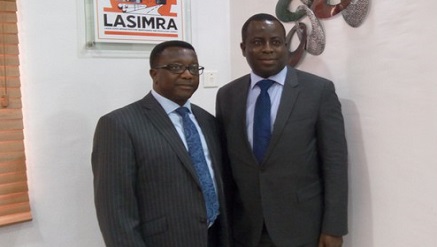
The Association of Telecommunications Company of Nigeria (ATCON) has called on the Lagos State Government to consider its request for a slash on Right or Way (RoW) charges by 95%.
Mr. Olusola Teniola, president of the Association of Telecommunication Companies of Nigeria (ATCON), stated this while leading ATCON’s NEC on visit to the Lagos State Infrastructure Maintenance and Regulatory Authority (LASIMRA) on Thursday.
Teniola said, aside the 95% reduction on RoW charges, the present economic realities are taking huge tolls on the members hence the need for the Governor Akinwunmi Ambode led administration to also consider 60% reduction on telecoms levies in the State.
“I would like to thank the General Manager/chief executive officer of Lagos State Infrastructure Maintenance and Regulatory Agency for creating the opportunity for the National Executive Council of the Association of Telecommunication Companies of Nigeria to meet with the management of LASIMRA.
Concerns and Recommendations
The ATCON’s President expressed the members’ delight over the positive development in the industry, which has been identified as the fastest growing sector of the Nigerian economy and which presently contributes more than 8% to the nation’s GDP.
“This success”, he said, “is not without the slash in telecoms levies by over 40 percent and charges on right of ways 90 percent which your organization, LASIMRA supported and we are pleased to report some sort of relief to our members that are operating in Lagos State.
“We also want to appreciate the professional way in which LASIMRA has been regulating the industry. We thank the LASIMRA for being steadfast and being professional. We particularly thank the new management of LASIMRA for sustaining the tradition of excellence in the organisation. Inspite of these positive developments, our association has some concerns, some of which are listed below:
Unstable Foreign Exchange Rates Takes Toll on Telcos
– The free fall of Naira against Dollar has constituted a serious source of worry to our sector and as a matter of fact our member companies have tried to make sure that Lagosians and Nigerians as a whole have access to qualitative communications service but the continuous depreciation of the Naira is not encouraging from a CAPEX roll out perspective
Telcos’ Revenue Decline
“Revenue Derived from Voice is seriously being challenged – To worsen the situation we are as an industry, the telecommunication companies are barely making any money from voice (due to ARPU rates dropping considerably) and the direct implication of this is that the revenue that is generated from data is now being challenged by the cost of operating the business which is increasing on a daily basis and may lead to laying off (of further) staff.
Unified Duct System Proposal
“Nervousness about the implications of the introduction of this system in place of RoW and work already achieved in setting a NGN500 / linear meter rate with Lagos State Government; our members would like to be fully engaged in the process to avoid prohibitive charges creeping back in!
He said, “Generally, our request is for a further slash in telecoms levies by over 60 percent and charges on rights of ways by 95 percent. This would enable our members to build more base stations and accelerate the roll out of much needed fibre (ICT passive infrastructure) for the good of all Lagosians and by extension, Nigerians.
On his response, Mr Babajide Odekunle, general manager/CEO, LASIMRA said he was very glad to receive the National Executive Council of the Association of Telecommunications Companies of Nigeria under the leadership of Mr Olusola Teniola, President ATCON.
He further said that he is set to bring some transformation and innovation to how Lagos State Infrastructure Maintenance and Regulatory Agency carries out its activities.
According to the LASIMRA boss, aside the traditional mandates that established LASIMRA, the Lagos State Government under the leadership of Governor Ambode, the agency has also been charged with the responsibility of overseeing other public utilities (Power and Oil and Gas).
He also made the NEC understand that the Association of Licence Telephone Operators of Nigeria (ALTON) and Internet Service Providers Association of Nigeria (ISPAN) were meant to be sub-group under ATCON.
He said the agency is currently carrying out and audit exercise of the numbers of masts and towers that are in Lagos State with the aim of granting some investors right of ways to build ducts and he said he would be willing to work with ATCON in order to work out sensible and fair prices for the would be investors.



Federal Competition and Consumer Protection Commission (FCCPC) has dismissed widespread claims that it banned airtime borrowing and data advance services in Nigeria, describing the reports as false and driven by vested interests seeking to mislead the public.

In a statement issued on Friday, the commission said it neither cancelled nor prohibited such services, contrary to viral social media posts and some media reports suggesting otherwise.
The clarification follows a wave of public concern triggered by viral social media posts and some media reports suggesting that the Commission had shut down telecom-based credit services widely used by millions of Nigerians.
Recall that in separate notices, Airtel and MTN Nigeria announced the temporary suspension of their airtime and data credit services, which previously allowed eligible prepaid customers to borrow airtime or data and repay on their next recharge.
But FCCPC, said no such directive was issued, stressing that consumers remain free to access lawful telecom value-added services.
Ondaje Ijagwu, director of Corporate Affairs, FCCPC, said that “The attention of the Federal Competition and Consumer Protection Commission has been drawn to a series of newspaper publications and a viral anonymous post on social media seeking to create the impression that the Commission cancelled, shut down, or banned airtime borrowing and data advance services in Nigeria. Those claims are incorrect.
“The Commission has not prohibited airtime borrowing or data advance services, and no directive was issued preventing consumers from accessing lawful telecom value-added services,” the statement partly read.
Rather than a regulatory ban, the FCCPC attributed recent disruptions in some of these services to the failure of certain operators to comply with its Consumer Lending Regulations introduced in July 2025.
According to the Commission, the regulations were developed following a surge in consumer complaints over exploitative practices in the digital lending and advance-services space.
“Following a deluge of consumer complaints bordering on opaque charges, unexplained deductions, aggressive recovery practices, poor disclosure standards, and inadequate accountability in segments of the digital lending and advance-services market, the Federal Competition and Consumer Protection Commission issued the DEON Consumer Lending Regulations in July 2025.
“The Regulations were introduced, among other reasons, to curb the excesses of abusive service providers whose practices had generated persistent consumer harm and undermined confidence in the market,” it stated.
The agency said the framework was designed to sanitise the market and protect consumers by enforcing transparency, accountability, and fair competition.
“The primary aim is to promote a fairer and more transparent system by mandating proper registration, responsible lending conduct, clear disclosure of fees and terms, accessible consumer complaint channels, data protection safeguards, stronger accountability for third-party partners, and effective regulatory oversight,” the FCCPC explained.
Providing a deeper insight into the telecom sector, the Commission revealed that some operators had been engaged in anti-competitive practices, including exclusionary arrangements with third-party service providers.
“In the telecom sector, our findings indicated that some operators engaged in exclusionary third-party technical arrangements in clear disobedience to the provisions of the Federal Competition and Consumer Protection Act, 2018. The Regulations sought to unlock the market to allow local participants alongside foreign partners, in line with free market principles,” it said.
It added that the new regulations were also intended to open up the market to more participants, including local players, in line with free market principles.
Despite giving operators ample time to comply, the FCCPC said several companies failed to align with the new regulatory framework.
Related News
“These measures benefit Nigerians by reducing abusive practices, improving transparency, strengthening consumer choice, and encouraging responsible innovation by legitimate operators. At the commencement of the framework in July 2025, affected operators were granted an initial 90-day compliance period to regularise their products, structures, and operations. That opportunity was not utilised within the prescribed timeframe,” the statement noted.
The Commission said it extended the deadline to January 5, 2026, but compliance remained unsatisfactory.
“Despite that further extension, the necessary compliance steps were still not completed by the relevant operators,” it added.
The regulator stressed that any temporary suspension or restriction of services should be seen as a business decision by non-compliant operators rather than a government-imposed ban.
“Any temporary suspension, restriction, or operational change introduced by service providers should therefore be understood as a business or compliance decision by those operators, not a ban imposed by the FCCPC,” it said.
The Commission also accused certain interest groups of deliberately spreading false information to undermine reforms.
“We are aware that some vested interests and their foreign collaborators are opposed to the creation of safe markets and fair competition, therefore resorting to a campaign of disinformation,” it stated.
Describing such narratives as “mischievous,” the FCCPC urged Nigerians to disregard sensational claims and rely on verified information.
“It is inaccurate to attribute avoidable disruption to regulation where regulated entities had adequate notice and sufficient opportunity to comply. Nigerians deserve accurate information, not sensational claims.
“The FCCPC is fully committed to protecting consumers, promoting fair competition, encouraging responsible innovation, ensuring transparent digital financial practices, and working constructively with sector regulators and service providers in the public interest,” the statement added.
Airtime borrowing and data advance services have become critical tools for millions of telecom subscribers in Nigeria, allowing users to access credit for calls and internet services with repayment deducted upon recharge.
However, the segment has long been plagued by complaints over hidden charges, automatic deductions, unclear repayment terms, and aggressive recovery mechanisms.
The FCCPC’s intervention through the Consumer Lending Regulations marked one of the most significant attempts to regulate digital micro-lending and telecom-based credit services in the country.
The rules align with broader efforts by the Federal Government to strengthen consumer protection, enhance transparency in digital financial services, and curb exploitative practices in Nigeria’s rapidly expanding fintech and telecom ecosystem.
Friday’s clarification signals a push by the regulator to reclaim the narrative, reassure consumers, and shift responsibility to operators who have yet to fully comply with the law.
The Commission reaffirmed its commitment to protecting consumers while fostering innovation and fair competition in the sector, noting that regulatory compliance remains non-negotiable for all service providers operating in the Nigerian market.


Airtel Nigeria has announced the temporary suspension of its airtime and data credit services. The affected services allowed eligible prepaid customers to borrow airtime or data and repay on their next recharge.

However, the company noted that customers will continue to enjoy uninterrupted access to airtime and data purchases through its existing channels.
Airtel Nigeria also indicated that the temporary suspension is not expected to have a material impact on its service standards across the country.
Commenting on the development, Airtel Nigeria Director of Marketing Ismail Adeshina, said:
“This is a necessary and responsible step as we align our operations with evolving requirements. Airtel Nigeria remains committed to the highest standards of compliance, transparency, and consumer protection, while continuing to innovate responsibly within Nigeria’s digital ecosystem.”
The company added that it will provide updates on the status of the service in due course.


National Information Technology Development Agency (NITDA) has urged young Nigerians to take the lead in developing home-grown artificial intelligence (AI) solutions to address the country’s socio-economic challenges.

The Director General of National Information Technology Development Agency, Kashifu Inuwa, represented by Mrs. Udoka Mannie of the Digital Literacy and Capacity Building Department, delivered the keynote address at the Artificial Intelligence Hackathon organised by the Agency in partnership with VibeCode Africa in Abuja.
Kashifu Inuwa, director-general of NITDA, made the call at an Artificial Intelligence Hackathon organised by the agency in partnership with VibeCode Africa in Abuja.
Inuwa, who was represented by the Acting Director of Digital Literacy and Capacity Building, Dr Ahmed Tambuwal, and delivered through Mrs Udoka Mannie, said Nigeria’s youthful population presents a significant opportunity for innovation and digital transformation.
He noted that with over 60 per cent of Nigerians under the age of 25, the country is well positioned to benefit from emerging technologies such as AI.
“As you can see, this room is filled with young people. This represents a powerful opportunity for innovation and digital skills development,” he said.
Inuwa stated that the hackathon provided a strategic platform for participants from diverse backgrounds to collaborate and develop practical AI-driven solutions tailored to Nigeria’s realities.
He observed that artificial intelligence is already transforming economies, governance systems and societies globally, stressing that Nigeria must decide whether to shape the technology for national development or remain a passive consumer.
According to him, NITDA’s mandate is to regulate and develop information technology in Nigeria while ensuring it serves as a driver of economic growth.
He explained that the agency’s Digital Literacy and Capacity Building Department is focused on building a digitally skilled population capable of competing in the global digital economy.
The Director-General highlighted the Digital Literacy for All initiative (DL4ALL) as a flagship programme aimed at equipping millions of Nigerians with essential digital skills, in line with the Federal Government’s target of achieving 95 per cent digital literacy by 2030.
“Beyond literacy, we are now moving into capability. It is one thing to use technology, but another thing entirely to build with it. Today, we are challenging you to build,” he said.
Inuwa urged participants to prioritise impact-driven innovation, identifying sectors such as healthcare, agriculture, education, financial inclusion, public service delivery and misinformation as areas where AI can drive meaningful change.
He also stressed the importance of ethics, inclusion and data protection in the development of AI solutions.
“As we explore AI, we must be mindful of ethics, data protection and inclusion. Building responsibly is just as important as building brilliantly,” he said.
Inuwa commended VibeCode Africa for partnering with NITDA, describing such collaborations as vital for scaling innovation across the country.
He encouraged participants to collaborate, experiment and innovate, adding that Nigeria’s AI future would be driven by local talent.
“The future of AI in Nigeria will not be imported. It will be built by people like you in rooms like this,” he said.
In her remarks, the founder of VibeCode Africa, Lola Adey, urged participants to harness AI to solve real-life challenges within their communities.
Adey said the hackathon was designed to move beyond theory by encouraging participants to identify problems they personally experience and develop practical solutions.
“We want you to dig deep into yourselves. What are the problems you are facing? What are the issues you notice when you walk around?” she said.
She cited challenges such as electricity shortages, insecurity and gaps in social services as areas where innovation could make a difference.
Adey added that the initiative aims to create opportunities for entrepreneurship, employment and global exposure for young Nigerians.
“With artificial intelligence, you now have something in your hand that you can use to actually solve problems. You don’t have to wait for anybody anymore,” she said.
She urged participants to remain focused, collaborative and open to learning, noting that the platform could connect them to future partners, investors and employers.

FCCPC Denies Banning Airtime Borrowing, Blames Cartel for Misinformation

Court Suspends Enforcement of FCCPC’s Reform on Loan Apps

FG Rules Out Borrowing from IMF’s $50Bn Support Fund
CBN Introduces Overnight Financing Rate to Compete with US, EU

AfriStakes Unveils Platform to Connect SMEs with Investors

Canal+ to Cut Jobs as Part Sweeping Restructuring

NBC Boss Urges Content Ceators to Participate in DSO

NITDA Takes Over National Digital Architecture System

DLM SPV PLC Lists ₦9.00bn AAA-Rated Medium-Term Notes on FMDQ Exchange, Sets Benchmark in Corporate Bond Market

FG Shifting Focus to “Meaningful Connectivity” to Drive Inclusion – Minister




 News2 days ago
Lagos Targets Vulnerable Residents in Expanded Social Register

 E-Business2 days ago
CAC Urges Users to Secure Accounts after Cyberattack Scare

 E-Financial2 days ago
IMF Downgrades Nigeria’s GDP Outlook, Warns of Rising Risks

 E-Financial2 days ago
CBN Proposes 30-Member Mediation Panel for Loan Disputes

 E-Financial2 days ago
NDIC Seeks Court Nods to Liquidate 89 Failed Banks

 News2 days ago
Study Shows 38% of Northern Women Lack Access to Financial Services

 E-Financial2 days ago
SEC Sets N7.5Bn Capital Floor to Shield Investors in FTZE Public Offerings
 Telecom1 day ago
MTN Suspends Data, Airtime Borrowing Service over New FCCPC Lending Rules