

News
Babachir Lists Buhari’s Expectations from ICT Professionals

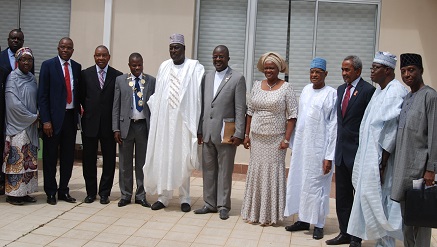
Federal government has disclosed her readiness to partner the ICT sector in building applications to tackle multifaceted challenges facing the economy.
Engineer Babachir Lawal, secretary to the Government of the Federation (SGF), made the remark during a courtesy call on him in his office, by a delegation of the Nigeria Computer Society (NCS) led by the President, Professor Adesola Aderounmu.
The SGF’s message was re-echoed by Mrs. Ibukun Odusote, permanent secretary (Political) at the Presidency, during Aderounmu’s investiture as the 13th President of the Society held in Lagos at the weekend.
According to the Permanent Secretary, the SGF, who is also a member of the NCS, had told the delegates that in the era of change, the federal government believes that any economy not IT driven is primitive, hence every aspect of the nation’s economy and endeavour requires IT applications for productivity.
She said, “The President believes as a person, he might not have the capacity, but he has articulate people to rely on in driving the change mantra in four key areas including building an economy all of us will be proud of; fight corruption to a standstill; provide security and create employment opportunities for our teeming youths. The FG is looking at these directions with IT as major solution.
“There are many areas of governance that require IT interventions. Now, the federal government is not looking at individual solutions, rather a collective or industry constituted solutions.
In other words, it is the body like the Nigeria Computer Society (NSC) that the Federal Government hopes to work with due to the integrity it has created for itself over the years”.
On the headship of the Ministry of Communication Technology, Odusote said the SGF unequivocally informed the NCS delegation that, although nomenclature is not the problem, however, there is need for reinventing the Ministry’s set objectives for improved contributions to the economy.
Mrs Ibuku on her part urged the IT professionals to start engaging their brains and ensure youths are given adequate representations in future engagements, conferences and programmes.
“It is important we start engaging our brains and think of how to make best use of the opportunity we have now to engage the government for national development. At the same time, we the youths deserve adequate representation at least 45% representation during conferences and programmes organized by NCS because the future of the industry and the country deepens on them. NCS has golden opportunity,” the Permanent Secretary Said.
During the visit, Professor Adesola Aderounmu, president of NCS reiterated the members’ readiness to partner with the FGN in putting the country more firmly in the global IT map.
“This meeting is therefore an opportunity to immediately lay emphasis on a few critical issues for the benefit of our dear country:
Professionalism In Governance
“SGF Sir, as a professional to the core with immense experience in private and public sectors, we welcome your appointment which is in furtherance of our belief that the much awaited change is here.
“The Communication Technology Ministry, with other IT agencies in Nigeria, if well managed, is able to resolve Nigeria job crises and further create wealth for the nation similar to the IT revolution going on in India.
“Hence there is the urgent need for the Federal Government of Nigeria under the leadership of President Muhammadu Buhari to:
*Consider the appointment of seasoned IT professionals (registered members of NCS and CPN) to head the Ministry of Communication Technology and other IT agencies in the country;
*Give priority to the use of registered local IT professionals and registered local IT companies to execute IT jobs;
*Appoint seasoned IT professionals on the boards of MDAs to maximize and deepen the benefits of electronic governance and digital transformation in Nigeria;
*Direct BPP to amend the pre-qualification requirements for IT projects to include Evidence of registration with CPN and NCS in addition to the newly introduced pre-qualification requirements such as evidence of registration with PENCOM, and evidence of remittance of fund to ITF;
*Mandate MDAs to appoint IT professionals as directors of IT, direct all MDAs to establish IT career structure if not yet in place, implement the use of CPN registration as a condition to employ IT professional staff in MDAs to level 10 as approved and gazetted by the Federal Government of Nigeria (the Federal Government already implemented this condition for professionals in Engineering, Health, etc.);
*Mandate NCS in collaboration with NITDA to supervise all IT projects to be implemented in Nigeria.
IT Penetration
Aderounmu said NCS believes there is an urgent push for comprehensive broadband access all over the country; implementation and monitoring of local content policy to encourage MDAs to patronize indigenous software and hardware; establishment of IT parks using Public-Private-Partnership models and establishment of Digital Centres in all the 774 LGAs in collaboration with the State Governments.
Security
He said that NCS concurs with President Mohammadu Buhari on the harmonization of the national database for Nigeria.
“In addition we call for: Urgent deployment of IT to tackle Boko Haram and terrorism in Nigeria (NCS is ready to provide practical solutions using IT to solve the problem), and collaboration of critical stakeholders with NCS in pushing the details and implications of the cybercrime Act into the public domain, and begin full implementation,” he said.
He said the role of professional bodies in the attainment of economic development in Nigeria cannot be overemphasised.
“National policies, political, economic or financial, can only make the desired impact and make our dear country great, if implemented by qualified persons. We assure you that at Nigeria Computer Society, our doors are perpetually opened towards achieving the above briefly discussed issues of Professionalism in Governance, IT Penetration and Security,” the NCS President said.



The Nigeria Customs Service (NCS) has rolled out an artificial intelligence (AI) driven capacity-building programme to improve revenue generation and reconciliation across its operations.

The initiative, unveiled during a three-day training event in Abuja, aims to transition the agency toward data-driven administration as Nigeria seeks to boost non-oil revenue.
The adoption of AI will enable the service to better manage complex trade systems, detect anomalies and reduce revenue leakages, says Bashir Adewale Adeniyi, comptroller-general of the NCS.
AI-powered tools are already being integrated into risk management and cargo scanning systems to allow for real-time analysis of trade patterns.
The technology marks a transition from manual, reactive processes to predictive and automated decision-making, Adeniyi adds.
The programme also reflects a shift in the relationship between the NCS and the National Assembly toward a collaborative framework focused on transparency and efficiency.
The training is a strategic intervention to address persistent gaps in revenue management, says Kikelomo Adeola, deputy comptroller-general of the NCS.
AI applications, ranging from automated data analysis to predictive intelligence, will significantly enhance the integrity of public financial systems, she says.
The initiative aligns with broader efforts to modernise governance and improve compliance across revenue-generating agencies, says Bamidele Salam, chairman of the House Public Accounts Committee.
Lawmakers and fiscal authorities at the event underscored the urgency of adopting advanced technologies amid rising budgetary pressures.
This move comes as the federal government increases scrutiny over revenue leakages and audit discrepancies.
The partnership between the NCS and the legislature is critical to strengthening fiscal discipline and ensuring all revenue due to the federation is accurately captured, Adeniyi concludes.


Lagos State Government has intensified efforts to strengthen its social protection framework with a fresh push to update the state’s Single Social Register.

Babajide Sanwo-Olu, Governor, Lagos
This was contained in a press statement on the government’s Facebook page on Wednesday.
The initiative, led by the Lagos State Ministry of Economic Planning and Budget, formed the focus of a strategic engagement held on Monday with Community-Based Targeting teams, local government coordinators and field enumerators across the state’s 57 Local Government Areas and Local Council Development Areas.
The meeting, themed “Closing the Gap: Accelerating Lagos State Single Social Register Update,” took place at the Radio Lagos Multipurpose Hall in Agidingbi, Ikeja.
Officials said the exercise is aimed at improving the accuracy and reach of the register, which serves as a critical tool for planning and delivering targeted social interventions, including financial support, healthcare and education services.
Speaking at the session, Ope George, commissioner for Economic Planning and Budget, commended field workers for their commitment while urging them to scale up their efforts.
He called on participants to be “more intentional by intensifying their commitment,” reaffirming the government’s resolve to “continuously strengthen and refine the Register to reflect evolving realities.”
Also speaking, Olayinka Ojo, permanent secretary in the ministry, described the register as central to effective governance and service delivery.
She said “it remains a cornerstone for effective planning and delivery of social intervention programmes,” adding that the ongoing update is designed to “further enhance data reliability, coordination, and service delivery outcomes.”
Ojo noted that sensitisation efforts would be expanded across all councils to ensure wider inclusion of residents, stating that “the advocacy and sensitisation will scale throughout the 57 LGAs and LCDA to give more to Lagos residents.”
According to the government, the updated register is expected to expand access to social protection programmes and improve the targeting of interventions for the most vulnerable populations.
The engagement also provided a platform for stakeholders to strengthen collaboration, improve data quality and reinforce transparency in grassroots data collection.
The state government reiterated its commitment to leveraging accurate data and partnerships to drive inclusive development, reduce vulnerability and improve living standards across Lagos.

A new study by Bayero University, Kano, has found that 38 per cent of women in Northern Nigeria do not have access to financial services.

The study, carried out by the Aminu Kano Centre for Democratic Studies of the university, was supported by the Gates Foundation. It examined how social norms and behavioural factors influence financial inclusion across the 19 Northern states.
The report, titled “Understanding Influence and Behaviour in Northern Nigeria” and unveiled in Abuja on Wednesday, stated that while 52 per cent of women are financially served, only 45 per cent access formal financial services through deposit money banks, merchant banks, interest-free banks and microfinance institutions.
It stated that “38 per cent of women across the region lack access to financial services. “52 per cent of women are financially served, while 45 per cent access formal financial services through Deposit Money Banks, merchant banks, interest-free banks and microfinance institutions. An additional seven per cent utilise other formal non-bank financial products, including insurance services. ”
Speaking at the unveiling, the Director of Academic Planning at Bayero University, Prof. Yusuf Garba, who represented the Vice Chancellor, Prof. Haurna Musa said the research was designed to uncover why the region lags in financial access.
“This study, which started in 2024, aims to examine how social norms influence attitudes and behaviour of various groups across Northern Nigeria, particularly to find out why states in the region fall behind in access and use of financial services,” he said.
Garba explained that the research, conducted over 18 months, produced two volumes detailing how influence structures, trust hierarchies, gender norms, and religious considerations shape decisions around finance, health and education.
He added, “The report is structured into volumes to provide a unified explanation of how social norms, authority structure, and trust shape financial behaviour across Northern Nigeria.”
On the findings, the Principal Investigator, Prof. Ismael Zango, said the data aligns with figures from the National Bureau of Statistics, particularly on poverty and unemployment.
According to him, “unemployment in the region stands at about 37 per cent,” while “poverty levels average about 80 per cent across Northern Nigeria, with Sokoto State recording the highest rate at over 80 per cent.”
Zango stressed that addressing financial exclusion requires more than temporary interventions.
“Economic empowerment must go beyond token financial support,” he said, adding that “sustainable development requires equipping women and youths with relevant, market-driven skills.”
He cited women-led initiatives such as groundnut processing groups in Kebbi State and the Women in Agriculture programme in Kano State as practical models.
“These initiatives should be scaled up to bring more people into productive economic activities and reduce poverty,” he said.
In her remarks, the Chief Executive Officer of Enhancing Financial Inclusion and Advancement, Mrs. Foyinsolami Akinjayeju, described financial inclusion as both an ethical and economic imperative.
Akinjayeju called for stronger collaboration among stakeholders, including government, financial institutions and development partners, as well as policy reforms to address existing gaps.
“Everyone has a role to play, but commitment must come from the top,” she said.
The findings come amid growing concerns over low financial inclusion rates in Northern Nigeria, driven by poverty, unemployment, and entrenched social norms that limit women’s economic participation.

MTN Suspends Data, Airtime Borrowing Service over New FCCPC Lending Rules

Nigeria Customs Deploys AI to Cover Revenue Leaks

Top 7 Reliable Virtual Cards for Running Ads in Nigeria

Nokia, Orange Partner on AI-native 6G Networks

NDPC Issues Critical Advisory as Hackers Target Nigeria’s Key Digital Systems

Kuda MFB Increases Kuda for Her Business Grants to ₦10 Million

Canal+ to Cut Jobs as Part Sweeping Restructuring

Nigeria tops global rankings for USDT, USDC ownership

NBC Boss Urges Content Ceators to Participate in DSO

NITDA Takes Over National Digital Architecture System




 General News2 days ago
Guinness Nigeria Surpasses ₦1Trillion Market Capitalisation, Signalling Strong Investor Confidence and Sustained Value Creation

 News2 days ago
CISA Asks NDPC, Police to Act on Alleged Data Breach by NIPSS

 E-Financial2 days ago
FG Investigates ‘Sharp Sharp’ Loan Operators over Alleged Privacy Violations

 Telecom2 days ago
Amazon Satellite to Challenge Starlink in Africa with Globalstar Acquisition

 E-Financial2 days ago
Ecobank Delivers Strong Results, Posts $801m in Pre-Tax Profit for 2025

 News2 days ago
Tinubu Tasks NRS to Restore Public Trust Amid Fiscal Changes

 Broadcasting2 days ago
Fela Makes History as First African to be Inducted into Rock and Roll Hall of Fame

 News2 days ago
Kaspersky Reports Online Scam Exposure Remains Widespread Despite High Levels of Self-assurance