

E-Financial
Banks Cash Out, Economy Loses Out: How Nigerian Banks’ N5.05Trn Government Securities Boom is Stifling Real Growth

By Blaise Udunze
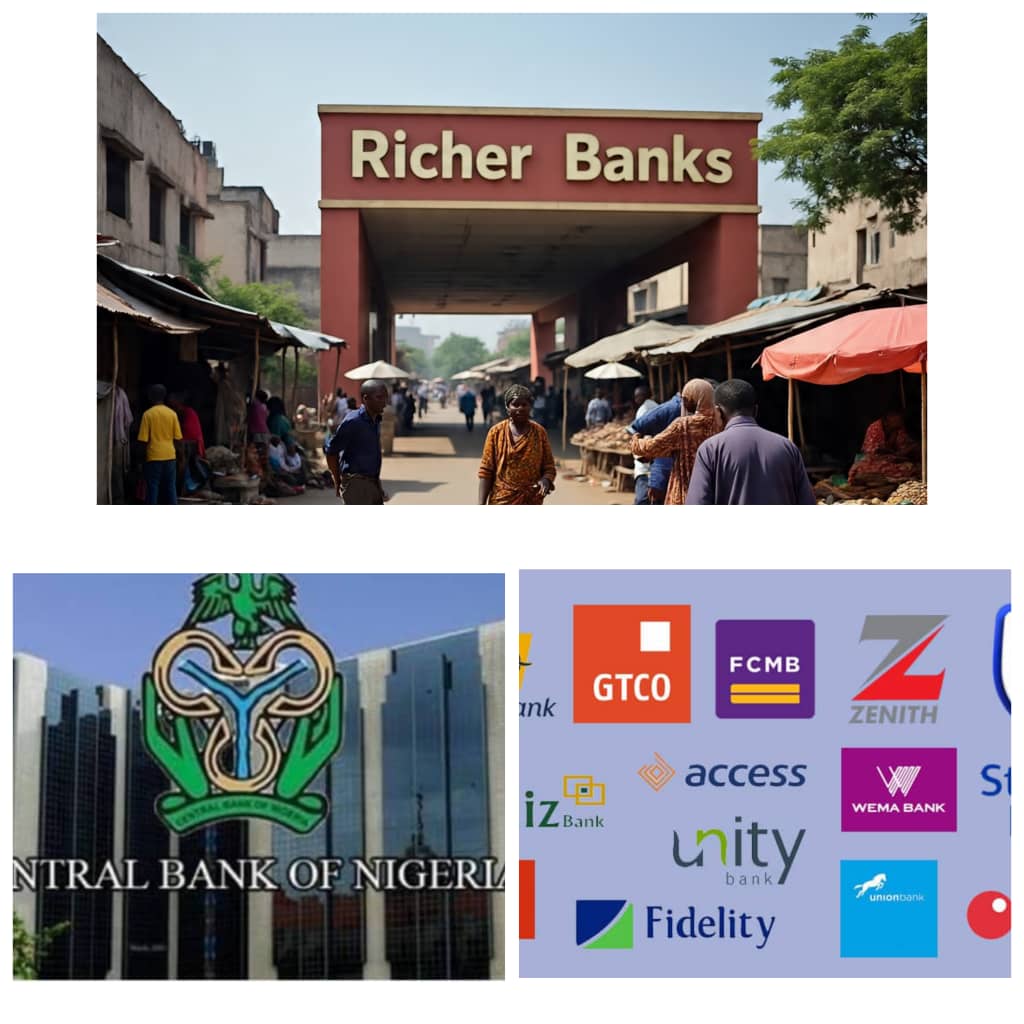
In a year when Nigeria’s economy continues to groan under the weight of inflation, unemployment, and weak purchasing power, the banking sector has once again recorded a massive windfall, not from lending to the real economy or financing innovation, but from investing in government securities.

According to data compiled by MoneyCentral, Nigerian Tier-1 banks collectively realized N5.05 trillion in income from investment securities in the first nine months of 2025 represents a staggering 42.28 percent increase over the N3.55 trillion recorded in the same period of 2024.
At first glance, this performance might seem like a testament to the banking industry’s resilience and financial ingenuity. But beneath the lustrous profit sheets lies a deeper economic dilemma that reveals how Nigeria’s banks are making more money by lending to government than by lending to people, small businesses, and industries which are the very arteries that sustain productive economic life.
It is no secret that Nigeria’s commercial banks have long found comfort in the safe, predictable yields of government securities such as treasury bills, bonds, and promissory notes. These instruments are virtually risk-free, backed by sovereign guarantees, and often deliver attractive returns in a high-interest-rate environment. For the banks, it is a perfect business model where depositors’ funds flow in at low cost, and those funds are easily parked in high-yield government paper with minimal risk or operational hassle. There is no need to worry about non-performing loans, credit analysis, or the painstaking process of supporting small and medium enterprises (SMEs).

But for the economy, it is a tragedy of misaligned priorities. While the banks luxuriate in “safe profits,” the productive sectors like agriculture, manufacturing, transport, housing, and creative industries remain starved of credit. Nigeria’s SMEs, which account for over 80 percent of employment and nearly half of GDP, face prohibitive interest rates, limited access to capital, and chronic underfunding. The result is economic stagnation disguised as stability.
The data below tells the story clearly:
– Zenith Bank realized N1.14 trillion from income from short-term government securities, which is 55.49 percent higher than 2024’s N734.14 billion.
– Access Bank made N1.13 trillion income from investment securities as at September 2025 which is 36 percent higher than 2024’s N838.14 billion.
– GTCO realized N547.77 billion income from government bonds, which is 45.68 percent higher than 2024’s N376 billion.
– United Bank for Africa (UBA) saw its income from short-term government securities rise 29.77 percent to N973.12 billion in the period under review, up from N750.48 billion the previous year.
– FirstHoldco’s income from investment securities increased 33.70 percent to N720.15 billion in September 2025, from N538.59 billion in September 2024.
Collectively, these numbers paint a clear picture of the real economy struggling to breathe, while the financial sector is growing fat on sovereign debt. This is not banking as development finance; it is banking as arbitrage. And the scale of this investment obsession is enormous. In the past teo years alone, the top 10 listed banks have channeled at least N20.4 trillion into investment securities and this huge capital could have financed millions of jobs, supported thousands of small businesses, and accelerated growth in Nigeria’s productive sectors.
This has now caught the attention of Nigeria’s tax authorities. The Federal Inland Revenue Service (FIRS) recently directed banks, stockbrokers, and other financial institutions to deduct a 10 percent withholding tax on interest earned from investments in short-term securities. Prior to this directive, short-term bills were tax-exempt to boost returns for investors. The new rule requires tax to be deducted at the point of payment on instruments such as treasury bills, corporate bonds, promissory notes, and bills of exchange.
It remains unclear how much the government expects to generate from this withholding tax. However, the FIRS clarified that investors will receive tax credits for the amounts withheld unless the deduction represents a final tax. Notably, interest on federal government bonds remains exempt from the levy. “All relevant interest-payers are required to comply with this circular to avoid penalties and interest as stipulated in the tax law,” FIRS Executive Chairman Zacch Adedeji said in the official notice.
Yield-hungry investors including banks are likely to be the most affected by this directive. In the first half of 2025 alone, Nigeria’s biggest banks realized N3.03 trillion in income from treasury bills, which represents a 60.40 percent increase from N1.89 trillion recorded in the corresponding period of 2024. GTCO, Zenith Bank Plc, United Bank for Africa Plc, Access Holdings Plc, FirstHoldco Plc, FCMB Plc, Fidelity Bank Plc, and Stanbic IBTC Holdings Plc have been in the habit of buying up domestic government bonds that offer among the highest yields in emerging markets.
By introducing this withholding tax, the FIRS aims to reduce excessive speculative investment in short-term securities and redirect liquidity into more productive parts of the economy. Whether this policy shift achieves that goal remains to be seen. In theory, taxing government securities could make lending to the private sector relatively more attractive. In practice, unless accompanied by broader structural reforms such as reducing credit risk, improving collateral enforcement, and stabilizing the macroeconomic environment, banks may simply adjust their margins and continue business as usual.
Nigeria is witnessing a growing disconnect between financial growth and economic growth. On one side is the booming financial economy, driven by banks’ trading gains, FX revaluation, and investment returns. On the other side is the struggling real economy, where factories close, youth unemployment rises, and SMEs collapse under the weight of credit starvation. The banks’ balance sheets may glitter, but the nation’s balance of welfare is grim.
As inflation eased slightly to 18.02 percent in September 2025, the Central Bank of Nigeria (CBN) cut the Monetary Policy Rate (MPR) from 27.5 percent to 27 percent. While this move signals a dovish tone, it does little to change the fact that the cost of credit remains astronomically high. Commercial lending rates hover between 25 percent and 35 percent, which is completely out of reach for most small businesses. Meanwhile, banks can earn double-digit, risk-free returns on treasury bills. Faced with that choice, which banker would lend to a farmer or manufacturer?
Beyond the figures, this trend has human consequences. Every SME denied a loan represents jobs not created, taxes not paid, and innovations never realized. Every startup that shuts down for lack of funding represents a family’s dashed hopes. Every manufacturer operating below capacity because of working capital shortages translates into lost exports and higher import dependence. When banks turn away from development finance, the ripple effect touches every household ranging from the market woman running a petty trade to the tech entrepreneurs across the country.
Several factors explain why banks prefer the comfort of government securities to the challenge of real-sector lending. Many SMEs operate informally, without proper records or collateral, making them unattractive to traditional lenders. Nigeria’s judicial system often makes loan recovery slow and uncertain, discouraging risk-taking. Exchange rate instability and inflation distort business forecasts, making long-term lending risky. Banks also find it easier to meet liquidity and capital adequacy ratios by holding government paper. Executive bonuses and performance metrics are tied to quarterly profits, not long-term economic impact. These factors form an entrenched ecosystem of incentives that rewards speculation over production, in a system where financial stability comes at the cost of real growth.
If Nigeria must break free from this cycle, a paradigm shift is needed, one that redefines the purpose of banking in national development. The CBN and fiscal authorities must create differentiated incentives for banks that channel a higher percentage of their loan portfolio to productive sectors such as agriculture, manufacturing, renewable energy, and technology. Tax rebates, lower cash reserve ratios, or credit guarantees can help de-risk these loans. Nigeria’s collateral registry, credit bureaus, and bankruptcy laws need modernization to reduce perceived risk, while the legal system must guarantee faster resolution of credit disputes.
Government, through the Bank of Industry (BOI) or similar agencies, can establish a blended-finance vehicle that matches public capital with private lending, allowing banks to co-finance SME projects with shared risk. Many small businesses fail to access credit because they lack proper documentation or business plans. A coordinated financial literacy program, supported by banks and chambers of commerce, could improve their readiness for formal credit. Ultimately, change must come from the top. Bank CEOs and boards must see themselves not just as profit managers but as nation builders. The sustainability of their profits depends on the health of the economy that surrounds them.
If this imbalance persists, Nigeria risks becoming a country where banks thrive and industries die. The long-term cost is profound. Economic growth will remain consumption-driven rather than production-led. Unemployment will worsen as SMEs fold up. Government borrowing will continue to crowd out private investment. The naira will weaken due to import dependence and weak export diversification. Financial capitalism, without developmental conscience, will only deepen inequality and discontent.
The time has come for Nigeria’s banking industry, regulators, and policymakers to make a collective choice: between easy profits and enduring prosperity. It is not enough to celebrate trillion-naira incomes if the nation remains trapped in jobless growth. It is not enough to report record balance sheets while millions of Nigerians remain unbanked and unemployed. True financial innovation lies not in exploiting yields, but in empowering people. The banks that will define the next decade are those that look beyond treasury bills, especially those that find value in the dreams of Nigerian entrepreneurs, in the resilience of its farmers, and in the creativity of its youth.
The story of Nigeria’s N5.05 trillion securities income is not just about numbers; it is about choices and their consequences. It reveals a financial system that has lost sight of its developmental mission, a government too dependent on debt, and an economy where growth has become disjointed from human progress. Yet, it is not too late to change course. The recent 10 percent tax on short-term securities should be the first step toward a deeper reform as one that forces a reallocation of capital from paper to people, from speculation to production.
As yields fall and monetary policy adjusts, the smart banks will be those that read the writing on the wall knowing that the future of finance in Nigeria lies not in government debt, but in the real economy because it is the only economy that truly matters. Because in the end, a nation cannot prosper when its banks are rich and its people are poor.
Blaise, a journalist and PR professional writes from Lagos, can be reached via: [email protected]



Mastercard and TeamApt Ltd., a subsidiary of Moniepoint Inc. and a provider of financial infrastructure and payment solutions, have entered a strategic collaboration to strengthen digital payment capabilities for businesses and financial institutions across Africa.

As part of this collaboration, TeamApt will operate directly on Mastercard’s global payments network as a non-bank acquirer, enhancing its ability to onboard credible and licensed entities to deliver seamless payment acceptance, transaction processing and acquiring services. This will further expand its card acceptance infrastructure, allowing more merchants to accept Mastercard payments across in-store, online and mobile channels.
The collaboration integrates TeamApt’s switching infrastructure with Mastercard’s network to facilitate secure, high-volume transactions across online and in-store channels. With Nigeria being home to more than 40 million micro, small, and medium-sized enterprises (MSMEs), and small businesses identifying digital solutions as vital to scaling, according to Mastercard’s 2026 SME Confidence Index, expanding payment acceptance remains an important opportunity for growth.
By combining TeamApt’s deep local market expertise with Mastercard’s global scale, businesses and individuals will benefit from more reliable transactions, stronger security and faster, safer and more accessible digital payment experiences.
“Expanding digital payment acceptance is one of the fastest ways to support small businesses across Africa to compete, grow, and reach more customers. By working with TeamApt, we are equipping MSMEs and informal sector businesses in Nigeria with robust, secure infrastructure to seamlessly process transactions across multiple channels. This collaboration brings more businesses into the digital economy, unlocking vital new opportunities for growth, credit access, and cross-border trade,” said Folasade Femi-Lawal, country manager, West Africa at Mastercard
“This collaboration with Mastercard represents an important step forward in our commitment to removing barriers within the payments ecosystem. For years, TeamApt has focused on building infrastructure that helps financial institutions and businesses grow with confidence. By working closely with Mastercard, we are extending those capabilities, enabling businesses to accept payments more seamlessly and giving users the freedom to transact securely both locally and internationally,” said Dennis Ajalie, Chief Executive Officer of TeamApt.
The collaboration also delivers international value, enabling Mastercard cards supported by TeamApt’s infrastructure to be used across millions of merchant locations worldwide. Customers gain the convenience of secure global payments, while merchants can more easily serve both local and international customers.
A Central Bank of Nigeria (CBN)-licensed switching and processing company, TeamApt has, for over a decade, built and operated critical financial infrastructure that powers banks, fintechs and other institutions. The company’s technology supports secure and reliable transaction processing across multiple payment channels, enabling businesses and consumers to participate more easily in the digital economy.
This collaboration further underscores the strength of Moniepoint’s ecosystem. With operations and agent coverage across all 774 local government areas in Nigeria, Moniepoint has established one of the nation’s most extensive financial services networks, positioning the group to drive meaningful scale and adoption of digital payment solutions.
Securities and Exchange Commission (SEC) has directed capital market operators to immediately freeze the assets of six individuals and three entities designated as terrorism financiers by the Nigeria Sanctions Committee.

The directive was contained in a circular signed by the SEC management on June 26, 2026, and published on the commission’s website on Wednesday.
The SEC said the Nigeria Sanctions Committee designated the individuals and entities under the Terrorism Prevention and Prohibition Act (TPPA), 2022, and subsequently added them to the Nigeria Sanctions List.
The designated individuals are Babangida Muhammed Adamu Hammajam, Abdullahi Umar Usman, Ibrahim Abubakar, Adamu Chiroma, Muktar Muhammad Adamu and Yakubu Ogirima Ibrahim.
The three entities are Nine to Nine BDC Ltd, Generation Currency BDC Ltd and Abbal Bako & Sons Bureau de Change.
The commission directed all capital market-regulated entities to immediately identify and freeze, without prior notice, all funds, assets and other economic resources belonging to the designated individuals and entities.
“Immediately, identify and freeze, without prior notice, all funds, assets, and any other economic resources in their possession, belonging to the designated individuals and entities and report same to the Secretariat of the Nigeria Sanctions Committee,” the commission said.
The SEC also directed operators to report all frozen assets and other actions taken in compliance with the sanctions, including attempted transactions involving the designated individuals and entities.
The commission further instructed capital market operators to file suspicious transaction reports with the Nigerian Financial Intelligence Unit (NFIU) for analysis.
Operators were specifically directed to report “all cases of name matching in financial transactions prior to or after receipt of this Sanctions List” as suspicious transaction reports to the NFIU.
The commission prohibited capital market operators from dealing with the designated individuals and entities and ordered them to maintain continuous monitoring of transactions involving them.
“Take Note that at all times, any unusual or suspicious transactions MUST be promptly reported to the Nigerian Financial Intelligence Unit (NFIU),” the SEC said.
The directive takes immediate effect.
The commission warned that failure to comply with the directive would constitute a violation of the Investments and Securities Act, 2025, as well as its Anti-Money Laundering and Countering the Financing of Terrorism Rules and Regulations.
“Such violation would attract appropriate regulatory sanctions, including fines, suspension of operations, or revocation of registration,” the SEC said.
The commission said Hammajam was listed on June 18 for alleged involvement in terrorism financing and support for the Islamic State West Africa Province (ISWAP).
It said Usman was designated for allegedly providing material support to a designated terrorist organisation through repeated financial transactions, while Ibrahim was listed over alleged involvement in terrorism financing and membership of ISWAP.
According to the SEC, Chiroma was allegedly involved in terrorism financing through the use of bureau de change and related corporate entities to facilitate the movement of funds linked to terrorist activities.
The commission said Adamu was listed on June 15 for allegedly providing financial support and facilitating transactions linked to the financing network of the ISWAP Okene cell.
Ogirima Ibrahim, according to the SEC, was listed on June 18 for allegedly providing material and financial support to the ISWAP Kogi cell.
The three bureau de change companies were also listed on June 15 over their alleged involvement in facilitating or channelling funds connected to the ISWAP Okene financing network.
The SEC said the directive formed part of broader measures by Nigerian and international authorities to disrupt suspected terrorism-financing networks.
On June 23, the United States announced sanctions against three individuals and six entities allegedly linked to Islamic State financing, including three bureau de change operators.
Two days later, the Central Bank of Nigeria also directed banks to freeze accounts belonging to customers linked to terrorism financing.
The latest SEC directive reinforces the regulatory focus on preventing Nigeria’s capital market and financial system from being exploited to finance terrorism and other illicit activities.


Securities and Exchange Commission (SEC) has issued an urgent directive requiring all capital market-regulated entities (CMREs) to immediately subscribe to Nigeria’s Sanctions (NigSac) Alerts system.

Effective immediately, failure to comply with this, or other AML/CFT regulations, may result in severe fines, suspension of operations, or revocation of registration.
This follows fresh designations by both local and international authorities of individuals and Bureau de Change operators for alleged direct involvement in terrorism financing and material support to the Islamic State West Africa Province (ISWAP).
The directive, according to three circulars issued by the apex capital market regulator, requires a mandatory compliance measure with threats of fines, operational suspension, or outright registration revocation for non-compliance.
The directive, pursuant to the implementation of Financial Action Task Force (FATF) statements on high-risk jurisdictions, signals an escalation in Nigeria’s anti-money laundering and counter-terrorism financing regime.
The SEC’s broader circular implementing FATF high-risk jurisdiction statements reflects Nigeria’s heightened exposure to international scrutiny. SEC, in line with directives from Central Bank of Nigeria (CBN), now requires CMREs to terminate all correspondent banking relationships with listed high-risk jurisdictions, business entities and individuals.
“In line with the provisions of the Terrorism Prevention and Prohibition Act (TPPA), 2022, the Nigeria Sanctions Committee (NSC) has designated six (6) Individuals and three (3) Entities as terrorist financiers and subsequently added them to the Nigeria Sanctions List,” SEC stated in circular to all market operators.
The circular mandated all capital market regulated entities and individuals to do the following:
“Immediately, identify and freeze, without prior notice, all funds, assets, and any other economic resources belonging to the designated persons and entities in their possession and report same to the Secretariat of the Nigeria Sanctions Committee;
“Report to the Secretariat of the Nigeria Sanctions Committee any assets frozen or actions taken in compliance with the designation, including attempted transactions;
“Immediately file a suspicious transactions report to the Nigerian Financial Intelligence Unit (NFIU) for further analysis on the financial activities;
“Report as a suspicious transactions report to the NFIU, all cases of name matching in financial transactions prior to or after receipt of this Sanctions List;
“Subsequently prohibit dealings with the designated persons and entities; and continue to check for transactions relating to the designated persons and entities and report findings to the Nigeria Sanctions Committee through [email protected]”, SEC stated.
“Take Note that at all times, any unusual or suspicious transactions shall be promptly reported to the NFIU,” SEC warned.
According to the capital market apex regulator, the circular takes immediate effect and failure to comply with the directives constitutes a violation of the Investments and Securities Act, 2025, and the SEC AML/CFT Rules and Regulations and such failure would attract appropriate regulatory sanctions, including fines, suspension of operations, or revocation of registration.
The directive implies that capital market operators should immediately audit their AML/CFT technology stacks to ensure NigSac Alerts subscription and automated flagging capability.
CMREs are required to file suspicious transactions reports with the Nigerian Financial Intelligence Unit (NFIU) for any name matching with designated individuals and entities, whether such matches occur pre- or post-transaction.
The obligation extends to reporting all funds frozen and actions taken in compliance with designations to the NSC Secretariat via [email protected].
The designations also create secondary compliance obligations: CMREs must now maintain watchlists that incorporate designations from both the NSC and US Treasury, as regulatory expectations implicitly track international sanctions coordination.
For institutional investors and fund managers, this translates to enhanced due diligence on counterparty relationships, particularly where transactions flow through informal financial infrastructure or jurisdictions flagged under FATF increased monitoring status.

Airtel Nigeria Adds Over 1,000Cell Sites in Nationwide Expansion to Surpasses 17,000

MacOS Users Report More Cyber Threats than Windows Users – Survey Reveals

Mastercard, TeamApt Collaborate to Expand Digital Payments Across Africa

Access Holdings Sets New Benchmark in Nigeria’s Finance Talent Pipeline

ESUT Workers Get N82,000 Minimum Wage as Enugu Approves Fresh Salary Increase

EFCC Busts NIS Visa Overstay Racket, Uncovers N700m in an Account

Fact-Check: Elon Musk’s “Tesla Pi Phone” is Internet Rumor

NBC Tasks Broadcasting Stations over 2028 DSO Global Deadline

NBC Scraps Annual Digital Access Fee on DSO

Glo Sponsored African Voices to Feature Netflix’s “The Polygamist” Stars




 Telecom3 days ago
ipNX Joins Calls for Innovation-Friendly Ecosystem and Stronger Local Opportunities at Regenesys AI Summit

 E-Business3 days ago
NDPC Probes UNILAG, Lotus Bank, Hackerbella over Alleged Students’ Data Misuse

 E-Financial3 days ago
KudiWave Asks for Clarification over N750m Transfer from PalmPay Account

 News3 days ago
PalmPay Reinforces Commitment to Youth Empowerment on International Youth Day

 Telecom3 days ago
NCC Reports over 5,000 Fibre Cuts in 6 Months

 Telecom3 days ago
Google Selects Six Nigerian News Creators for Emerging Voices Growth Lab

 E-Financial3 days ago
Nigerians Borrow More to Buy Homes as Mortgage Demand Climbs – CBN

 General News3 days ago
NUPRC Warns of Counterfeit, AI-Generated Appointment Letters