

E-Financial
Banks Must Seek CBN Approval to Sack Workers- Bankers Committee

Banks cannot terminate the employment of more than five staff without a prior notice to the Central Bank of Nigeria (CBN), a communique released by the Bankers Committee after its meeting on Friday, in Abuja has announced.

The committee, in a circular signed by Mrs Angela Sere-Ejembi, director, Financial Markets Department, CBN, said that all banks should send sample of Contract Letter issued to outsourced staff + A service-Level Agreement (SLA), a commitment between a service provider and a client, with the company being used to run outsourced staff.
“Banks should note and be guided by the CBN circular in respect of laying off staff that is more than five. This requires apex bank’s notification and approval going forward,” the communique said.
The Bankers’ Committee had said the mass sacking in banks which had often occurred at will, would be reduced in the shortest time possible with its intervention.
The committee noted that while it was working on how to reduce the level of job losses in the sector, there would always be reasons people would have to be sacked from their workplaces.
It explained that while the decision to sack bank workers had elicited a lot of sentiments from both the public and private sectors of the economy, the banks understood the implications of having to relieve workers of their jobs in view of the current economic situation in the country.
According to the National Bureau of Statistics (NBS), the staff strength of banks reduced in the third quarter of 2019 as 2,929 staff were relieved of their work. Latest figures show that there are a total of 101,435 staff in deposit money banks as against the 104,364 recorded in the second quarter of the year. This represents a 2.81 percent decrease.



As conversations around money become more complex in a fast-evolving digital world, the need to Building Financially Smart Future and equip young people with the right financial knowledge, has never been more urgent.

Polaris Bank
From spending habits to saving culture, digital transactions, and entrepreneurial thinking, financial literacy is increasingly becoming a life skill, not just a nice-to-have.
It is against this backdrop that Polaris Bank is participating in this year’s Global Money Week (GMW), a global financial awareness campaign which kicked off from Tuesday, April 7 through Thursday, April 30, 2026.
Global Money Week is an annual initiative led by Child and Youth Finance International in collaboration with key stakeholders, including financial service providers and government institutions, to inspire children and young people to learn about money management, livelihoods, and entrepreneurship.
During the 2025 edition Polaris Bank reached and impacted directly 3,372 students, across 35 secondary schools in 36 states across Nigeria.
With the 2026 theme, “Smart Money Talks,” this year’s campaign shines a spotlight on the importance of making informed financial decisions in an increasingly digital environment. It also reinforces the value of critical thinking, emotional intelligence, and sound financial judgement in helping young people navigate today’s financial realities.
For Polaris Bank, participation in Global Money Week goes beyond fulfilling a statutory obligation. It reflects the Bank’s broader commitment to advancing financial literacy, promoting inclusion, and empowering the next generation with practical knowledge that can shape better financial behaviour and long-term economic wellbeing.
In line with the directive of the Central Bank of Nigeria (CBN) through the Financial Literacy Secretariat, Polaris Bank will conduct Financial Literacy Sessions in schools across states where it maintains branch presence. These sessions will provide students and young adults with useful insights into key areas such as; saving, budgeting, responsible use of financial products, digital financial services, and entrepreneurship.
The initiative also presents an important opportunity for the Bank to engage directly with young people at a formative stage in their lives, helping them build confidence in money matters and make more informed choices as they grow into financially active adults.
At a time when financial decisions are increasingly shaped by technology, peer influence, and instant access to digital tools, Polaris Bank believes that early education is critical to helping young people distinguish between impulse and intention, trend and truth, convenience and responsibility.
By taking financial literacy conversations into schools, the Bank is not only supporting a national mandate but also contributing to the development of a generation that is better informed, more financially aware, and more capable of making smart choices for the future.
Polaris Bank remains committed to initiatives that create meaningful impact, strengthen communities, and empower individuals through knowledge-driven engagement.


Central Bank of Nigeria (CBN) is implementing stricter Bank Verification Number (BVN) regulations, including limiting phone number changes to only once in a lifetime.

This will take effect from May 1.
Also, mobile apps will be restricted to one device, a 24-hour temporary watch-list for suspicious transactions will be enforced, and enrollment is restricted to individuals aged 18 and above.
Other key changes are:
One Device Policy: Mobile banking apps will be restricted to one device, with automatic logout when accessing another device.
Fraud Watchlist: BVNs linked to suspicious activity will be placed on a 24-hour, temporary, or permanent blacklist, temporarily freezing accounts.
Age Restriction: Enrollment for BVN is now restricted to individuals aged 18 and above.
Data Correction: Changes to BVN profile details (Name, DOB) are also heavily restricted, allowing only one-time corrections to data.
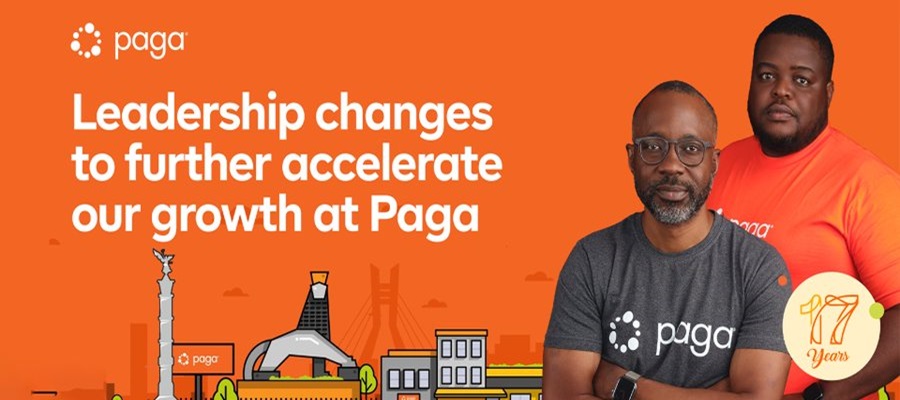
Paga Group has announced a major leadership restructuring, marking 17 years of operation and signalling a strategic shift toward deeper financial infrastructure development, emerging technologies, and expansion across Africa.

Tayo Oviosu, founder (front) and Ope Oyinloye, Group COO and CEO of Paga Nigeria
With the restructuring, Tayo Oviosu, founder, is now the Group CEO, while Ope Oyinloye has been appointed Group COO and CEO of Paga Nigeria, in an acting capacity, pending regulatory approval from the Central Bank of Nigeria (CBN).
Oviosu will also serve as executive chairman of the Group Board and non-executive chairman of Paga Nigeria.
He will be leading Paga Labs, driving geographic expansion, and overseeing fundraising efforts.
The fintech company said the changes represent a transition from its foundational phase into a new growth chapter, known as ‘Act 2’, focused on connecting Africans to global financial systems, scaling innovation, and entering new markets.
To support this transition, the company announced key leadership changes. advertisement
Jay Alabraba, co-founder, has been appointed group director of Special Projects, where he will initially lead the company’s expansion into lending and support new market entry initiatives.
Speaking on the transition, Oviosu said the company’s mission remains unchanged but its approach continues to evolve.
“Act 1 proved that we could build a profitable, high-growth infrastructure business that the world’s leading companies trust. Act 2 is about taking that infrastructure to its full potential—connecting Africans to global financial rails, moving into new markets, and leading the next wave of financial technology,” he said.
Oyinloye added that his focus will be on sustaining operational excellence while scaling the company’s next phase of growth.
With the new structure in place, Paga is positioning itself to play a more significant role in shaping the future of financial services across Africa, particularly as digital payments, blockchain technologies, and AI-driven solutions gain traction across the continent.
Paga has since evolved into a full-stack financial services infrastructure provider. Its offerings now span enterprise solutions through Paga Engine, consumer services via the Paga app, and merchant tools under Doroki.
The company’s first phase delivered significant growth. Between 2021 and 2025, total transaction value processed increased 17-fold to $11 billion across 169 million transactions in 2025 alone, with more than $1.5 billion processed monthly.
Net revenues grew five times within the same period, underscoring the scalability of its model.
Paga also expanded its enterprise footprint, with over 265 clients which include global firms such as PayPal, Meta, Amazon, LemFi, Tencent, Pesa, and Verto building on its infrastructure.
The company was further recognised by the Financial Times and Statista as one of Africa’s fastest-growing companies for three consecutive years from 2023 to 2025.
As part of its new strategic direction, Paga outlined three priorities which are strengthening its financial infrastructure to connect local and global payment systems; advancing emerging technologies such as stablecoins, cryptocurrency, and artificial intelligence through its innovation arm, Paga Labs; and expanding into new African markets.

Nigeria Demands Cloud Sovereignty to Anchor Africa’s Digital Independence

Digital Encode Sponsors PAFON 3.0 as CVO Prof. Adewale Set to Deliver Keynote on Cybersecurity and Trust

Polaris Bank Targets Youth with Financial Literacy Drive

As Nigerians Struggle to Save, Mutual Benefits Highlights Power of Structured Financial Planning

NITDA Boss Warns of AI Threat Shift @ GITEX Africa

Spotify’s Loud & Clear Report Reveals Over ₦60Bn Revenue for Nigerian Artists in 2025

Why JustMarkets Is a Strong Choice for Gold Trading

Kuda MFB Increases Kuda for Her Business Grants to ₦10 Million

Canal+ to Cut Jobs as Part Sweeping Restructuring

Nigeria tops global rankings for USDT, USDC ownership




 Telecom3 days ago
From Import Dependency to Local Capacity: Nigeria’s Tech Manufacturing Journey

 E-Financial2 days ago
How Unethical Deals Triggered CBN Takeover of Union Bank -Forensic Report

 E-Financial1 day ago
How Sterling Bank Is Empowering 1m Women with ₦500Bn

 E-Financial2 days ago
BVN Database hits 68.6m – NIBSS

 E-Business2 days ago
Kaspersky Warns of Digital Medicine Risks on the Occasion of World Health Day

 Broadcasting2 days ago
Multichoice Bleeds Customers in South Africa, Loses 580,000 Subscribers

 Broadcasting2 days ago
Broadcast Station Owners Reject IBAN’s Threat to Boycott Wike’s Media Engagements

 General News2 days ago
FG Asks MDAs to Halt New Policies Until Full Compliance with RIA