

General News
Banks Should not Manage Risks Alone – Agu

Mr. George Agu is chief executive officer of ActivEdge Technologies Limited, a Pan African Information Technology Company, focused in development, Integration and Support of a wide range of Strategic and Transformational IT solution for the public and private sector. Prior to founding ActivEdge Technologies in Nigeria, George was the managing director of Neptune Software in the West African where he achieved remarkable success in over 2 years. He spoke to chike onwuegbuchi on the drive for the company and other issues.
IT Capacity
Nigeria is our country and we all share a responsibility of giving it the best possible. It is not a dumping ground and we must all wake up from our slumber to attend to issues bothering on value realization and optimization from every investment and spending particularly IT investments. Government is investing in IT, the private sector is investing in IT, each of these parties are investing with a mindset that certain set of values and objectives will be achieved. Our portion in the entire equation is to ensure that values are realized and optimized out of every cent spent by the stakeholders on projects. We must move from an environment where everyone can play to an environment where only well qualified and vetted experts can play which is why we would rather start by representing industry leaders and ultimately learning from it to built world class products.
If you look at the list of our partners which include ContinutySA, Avalon Biometrics, Experian, Mincom, Shaya Infosec, you would have formed a certain picture of reputation and quality in your mind, picture of achievements and authorities in various areas. The various partner companies are authorities in their own fields and there is only one reason for that: Projects are meant to succeed and they are not meant to be used as a learning ground.
These partners have made tremendous success in their various fields of specialization. ContinuitySA with over 21 years of leadership in BCM is the largest and foremost Business Continuity Management Company in Africa and to date, the only African based company who Exco sits on the board of BCI in the UK; Experian Decision Analytics with over 30 years of operations has over 20 credit bureaux globally, over 2000 customers, assist over 2 billion credit decisions yearly. Similarly, Avalon Biometrics are behind many voter registration projects, a simple example will include their projects in Philippines, Bangladesh and several others handled for the UNDP, the EU, and so on. We have chosen to operate this way because if it works out well in Nigeria, we are an immediate beneficiary in every way.
We want to leverage on the pedigree, the proven skill set, the capabilities, and the track record of those who have tried it and succeeded many times in delivering certain IT projects. We do not want to experiment with projects because projects are not toys, it must succeed. The purpose of projects, particularly government or private projects is economic development. In other words, success must rob off on the investment made and touch the lives of people for whom these investments have been made.
The success of projects must be felt by the stakeholders above and beyond reports and sign offs by the vendors and stakeholders; it must be felt. If the results are not felt, then you cannot really say that there is project success’.
Use of Biometrics
Biometrics has a wide range of uses and applications from homes, medicals, schools, telecoms, elections to anything because you cannot beat what it brings if well applied. Biometrics also comes in different forms, be it fingerprints, finger vein, palm vein, iris, thumbprints, retina scan, DNA, typing patterns, hand geometry, among others. Many countries have for example attained credible elections in recent times, thanks to Biometrics technology. According to Bruce Schneider, ‘Biometrics is seductive. Your voiceprint unlocks the door of your house. Your iris scan lets you into the corporate offices. You are your own key. Unfortunately, the reality isn’t that simple. Biometrics is hard to forge: it’s hard to put a false fingerprint on your finger, or make your iris look like someone else’s. Some people can mimic others’ voices, and
Hollywood can make people’s faces look like someone else, but these are specialized or expensive skills. When you see someone sign his name, you generally know it is he and not someone else’.
Focus of the Company
Active Edge Technologies is a is a multi faceted, multi expert IT company that is specialized in a wide range of solutions including Business Continuity Management, Risk Assessment and Analytics, Managed Security Services and Patch Management, Business Process Management and Biometrics.
Our role in this economy can be considered transformational. In business continuity management for instance, we have developed a short term, medium term and long term strategic plan aligned with goals for addressing BCM requirements of medium to large sized organizations. Failure to implement BCM by organizations can amount to reputation loss, increased operational costs and values; these are the issues that we intend to address. We are currently engaging organizations to provide information on the benefit of this exercise. I need to clarify that BCM and Basel2 share some common characteristics both in gain and deployment models. I say this because in most cases organizations embark on the two exercises due to regulation. In the same way, implementing BCM with a mindset of leveraging its benefits gives you a different result from implementing it because the regulatory authority has issued an order that compels organizations to do so.
So, we are engaging several organizations, banks, insurance companies, etc and providing them with as much information as we possibly can. We also use the same opportunity to know their various stages of implementation of BCM and where we can be of help. This will be followed by a training program which will be driven mainly by ContinuitySA. They will also be providing advisory, consulting and training services to individual organization based on request.
Our long term plan which we share with ContinuitySA is to build a world class business continuity management facility in Nigeria capable of hosting as many as 15 to 20 banks together should a disaster incidence occur. In the event of such an incident, we should be able to take host of these clients to the tune of 3,000 staff in a place. This facility once built should be able to have conference centres, contact centres, IT recovery centres, work areas recovery centres and so on. When you bring banks together and make them share a common business continuity management facility, what you have done is to save them from individually investing in houses, generators and people. This simply reduces their overall operational cost. This plan is a replica of a similar facility built by ContinuitySA in South Africa and a few other countries. They have operated it for several years now and they have the requisite skills to replicate the same facility here. We are very confident to work with ContinuitySA because they are the largest in that space in Africa today and they well understand some sensitive issues integrity and confidentiality of customer information mean.
Risk Analytic and Assessment System
Experian is the leading global information services company, providing data and analytical tools to clients in more than 65 countries. The company helps businesses to manage credit risk, prevent fraud, target marketing offers and automate decision making. Experian also helps individuals to check their credit report and credit score, and protect against identity theft. With over 30 years, Experian has developed its best practice analytical, consulting and product capabilities to support organizations to manage and optimize risk; prevent, detect and reduce fraud; reduce debt; meet regulatory obligations; and gain operational efficiencies throughout the customer relationship. We are working with Experian purely on account of our evaluation and assessment of the value that they can bring to the financial institutions in particular at this crucial time.
The work performed by most Risk Managers entails managing existing Risks. In that situation, less effort is invested in predictive Risk Assessment and Analytics, which ensures that new risks are detected and prevented from onset. A unique offering from Experian us is to give banks and other organization that grant any form of credit: Telcos, Insurance, etc a solution that ensures that they are able to detect and prevent risks even before it becomes part of the organizations and if they must allow it, they will have controls in place to be able to manage and control it. This is simply the strength of Experian’s Decision Analytics.
Vision for ActiveEdge Technologies
We want to be a recognized IT leader in Africa and beyond, an industry leader that delivers quality services and result to its customers. We want to be a choice organization for both customers and employees. A company that advances the capabilities, skills and employability of its staff, a company that benefits the social society, which is a dream that we have and where we are headed. We want to start from the point of representing industry leaders to innovating our own solutions and services. A few years from now, we are looking at having some unique products that will be patented on the African continent and globally. We want to look back and see real automation done in Nigerian, not just computerization. We would like to see more automation in the payment space, in the invoicing space, in the biometrics and identification space, in the banking space, in the finance and insurance space and the infrastructure space. These are our aspirations.



Police in Abuja have uncovered a criminal group making fake diplomatic and government number plates.

Ahmed Sanusi, commissioner of Police FCT, stated this during a press briefing on Friday.
He explained that criminals use these fake plates to dodge security checks and enter restricted areas.
The investigation started soon after Sanusi took office.
He noticed too many unauthorized cars driving around with official government and diplomatic tags.

“I immediately ordered a comprehensive investigation into this disturbing trend,” Sanusi said. He noted that these individuals use the plates as a cover to commit crimes and avoid arrest.
The police have already arrested several people caught using the fake plates.
They have also figured out who is making them.
The manufacturers operate outside Abuja, and police are actively hunting them down.
Sanusi kept their names secret so they would not flee.
He stressed that this is a highly profitable illegal business.
Buyers pay between N500,000 and N1.7 million for a single fake plate.
“This will tell you that they are making such huge expenditure because they have an agenda,” Sanusi explained.
“Now they will face punishment that is bigger than both the cost they incur and the agenda they are planning.”
The commissioner urged residents to report any cars with suspicious diplomatic plates.
He reminded the public that real diplomatic tags follow a very specific format.
A diplomatic number plate in Nigeria is a special vehicle identification tag issued to foreign embassies, high commissions, and accredited international diplomats.
Gavi has approved $500 million to strengthen Nigeria’s immunisation programme, primary healthcare services and long-term vaccine financing.

The move followed high-level discussions between Professor Muhammad Ali Pate, coordinating minister of Health and Social Welfare, ]and Dr. Sania Nishtar, chief executive officer, Gavi in Abuja.
The funding, approved under the Gavi 6.0 programme, will support Nigeria’s efforts to accelerate routine immunisation, sustain polio eradication, expand HPV vaccination, strengthen primary healthcare services, and improve long-term vaccine financing.
Speaking during the meeting, Pate said Nigeria was strengthening its partnership with Gavi to accelerate immunisation, expand primary healthcare services, and ensure sustainable financing for vaccines.
He welcomed Gavi’s country-focused reforms, including the introduction of a predictable five-year funding envelope.
Pate said the US$500 million allocation will enable Nigeria to plan more effectively and deliver life-saving vaccines to more children and vulnerable populations.
The minister also revealed that quarterly visits to primary healthcare centreshad increased from about 10 million in 2023 to more than 45 million, reflecting significant progress in revitalising the country’s primary healthcare system.
Pate welcomed the announcement of a US$600 million pledge by the United States government to Gavi, describing it as a strong endorsement of the alliance’s leadership and the global value of vaccines.
He also commended Nishtar for prioritising Nigeria and praised the closer coordination among Gavi, World Health Organisation (WHO), UNICEF, World Bank, Gates Foundation, and other development partners, describing it as a model that has improved efficiency and aligned support with Nigeria’s health sector reforms.
The minister expressed appreciation to Gavi and its partners for their continued technical and financial support, while calling on state governments to invest more in healthcare and immunisation to complement federal efforts.

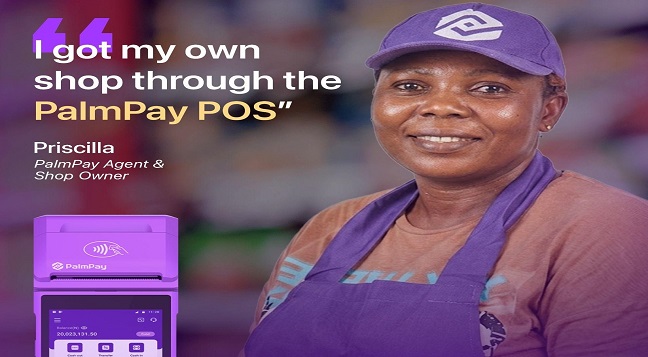
For many women, financial independence means the freedom to provide for their families and build a better future. Yet, this remains out of reach due to limited access to opportunities, business support, and secure payment solutions.

Like millions of women in Nigeria determined to be financially independent, Pricillia started with a single PalmPay POS terminal, and as an agent, every successful transaction provided a commission which brought her one step closer to achieving her dream.
Through consistency, discipline, and support from the payment platform, she reinvested her earnings and eventually opened her own provision store.
“I started as just a PalmPay agent with one POS. The consistency of the platform gave me the confidence to expand. With the income I earned, I was able to open my own provision shop.” Priscilla said.
For Priscilla, PalmPay was more than a payment platform. Its secure payment infrastructure gave her the confidence to serve her customers, build trust, and grow her income.
Today, Pricillia has joined the statistics of SMEs powering Nigeria’s economy and PalmPay continues to support her daily operations, helping her receive payments, as she works towards her next business milestone. Her journey is a reminder that when women have access to secure financial tools and opportunities, they can build lasting economic independence.
Speaking on Pricillia’s journey, Femi Hanson, Head of Marketing, PalmPay said: “Providing a secure platform that users can trust, whether for everyday payments or high-value transactions, is central to our vision of advancing financial inclusion. Priscilla’s story reflects our commitment to supporting the ambitions of Nigerians by providing a platform they can rely on to grow their finances. After all, seamless banking begins with security, and every successful transaction reinforces the trust our users place in us.”
Priscilla stands among thousands of PalmPay agents nationwide who are helping to expand financial access across Nigeria while earning commissions to create sustainable sources of income for themselves.
Every payment tells a story. It begins with trust, the confidence that your money is secure and that financial services are accessible. And when that opportunity reaches women, it creates ripple effects that transform families, strengthen communities, and drive economic growth.

Police Uncover Fake Diplomatic Number Plate Syndicate in Abuja

Davido Shares Past Suicidal Thoughts, Drops Oriadé Album

Gavi Okays $500m for Vaccines, PHCs in Nigeria

82% of Organizations Concerned about AI Risks Even as Adoption Accelerates – Survey Reveals

The Journey to Financial Freedom: Priscilla, a PalmPay Agent Now Owns a Store

NRC, Ponzi Scheme Collapses Resulting Loss of Billions of Naira

EFCC Busts NIS Visa Overstay Racket, Uncovers N700m in an Account

From Scarcity to Scale: What Africa Can Learn from India’s Agricultural Transformation

Tokenization, Blockchain Technology will Transform Financial Institutions – IMF

BON Establishes Six Ad Hoc Committees to Modernize Broadcasting




 E-Financial2 days ago
Access Bank Debunks Shutdown Report, Vows Action against Perpetrators

 E-Business2 days ago
Kaspersky Uncovers Cyber Threats Defining the First Half of 2026 in Nigeria, Others

 General News2 days ago
MENXTT TECH NG Offers Affordable Dell Laptops with Flexible Payment Plans

 Telecom2 days ago
ATU Summit Ends in Abuja with Landmark Declaration to Eradicate Continental Digital Divide

 Telecom2 days ago
Hon. Minister Dr. Kingsley T. Udeh and ASUS To Unveil First of a Kind Flagship Store in West Africa

 E-Financial2 days ago
$40Bn Net Reserves, Record Wealth, Relentless Poverty: Who Is Nigeria’s Economy Serving Today?

 General News2 days ago
EFCC Arraigns 4 over Alleged $5.3m Fraud Scheme

 E-Financial2 days ago
CBN Orders N19Bn Refunds to Customers as Complaints Rise