

E-Financial
Billions in Nigeria’s Reserves, But Where is the Growth?

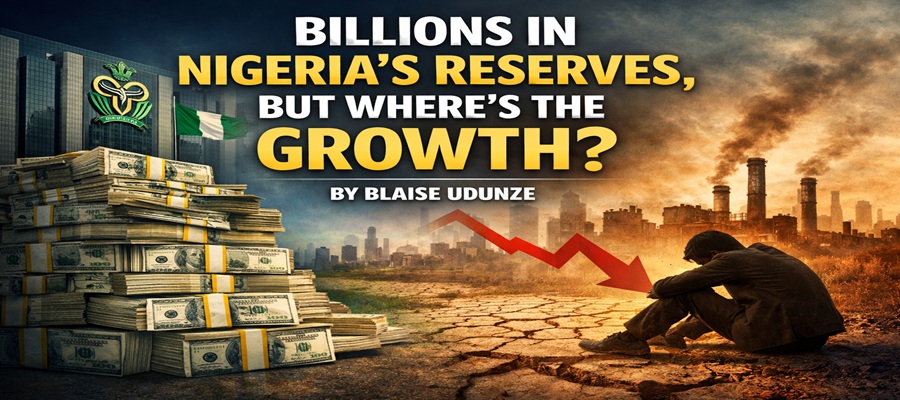
By Blaise Udunze
The moment the Governor of the Central Bank of Nigeria (CBN), Olayemi Cardoso, recently announced that Nigeria’s foreign reserves had inched to $49 billion as of February 5, 2026, the news was received with understandable enthusiasm.

He described the development as “a very important statistic” when speaking at the 2nd National Economic Council (NEC) Conference in Abuja, while noting a 4.93 per cent increase and emphasising that Nigeria had moved from being a net seller to a net buyer of foreign exchange. He cited improved remittance inflows, a narrowing gap between official and parallel market exchange rates, and greater confidence in the naira as evidence that reforms were working.
On the surface, the numbers are reassuring. The premium between official and parallel market rates has reportedly fallen to under 2 percent. Remittances have improved following deliberate engagement with the diaspora. Nigerians can increasingly rely on naira cards for international transactions. It can be said that investors are earning positive real returns, banks are recapitalising, equity markets are recovering, and macroeconomic indicators such as GDP growth of 3.98 per cent, a current account surplus of $3.42 billion in the third quarter of 2025, and a reported moderation in inflation to 15.15 percent are presented as signs of stabilisation.
So far, beyond the celebratory headlines lies a deeper and more consequential question, in the form of, what does the fixation on foreign reserves really tell us about the underlying strength of the Nigerian economy?

History and economic logic suggest that when a central bank repeatedly elevates foreign reserves as a central achievement, it often signals that the true engines of growth are either weak or underdeveloped. Strong reserves are not built through declarations, press conferences, or defensive monetary manoeuvres. They are built through systems that generate value, exports, productivity, and trust. Countries with durable reserve positions did not chase reserves; they built economies that produced them naturally.
This distinction matters greatly for Nigeria.
Foreign reserves are important, but they are not a development strategy. They are a buffer, not a foundation. They are an outcome of economic vitality, not a substitute for it. When reserves become the centrepiece of economic storytelling, there is a risk that policymakers mistake statistical comfort for structural strength.
Even Nigeria’s celebrated $49 billion reserve figure requires closer scrutiny, which appears to be more of sexing up the figures. Gross reserves make headlines, but net usable reserves are what protect a currency in moments of stress. A significant portion of reported reserves is often tied up in swaps, forward commitments, and external obligations. When these are stripped out, the net buffer available to defend the naira is far smaller than the headline figure suggests. The gap between gross and net reserves is too large to justify unqualified confidence about currency stability, especially in an economy that remains import-dependent and structurally fragile.
The danger of over-fixating on reserves is not unique to Nigeria, but it is particularly acute here because of the economy’s narrow production base, which subliminally calls for sexing up the figures. Despite decision-makers prematurely applauding the reserves’ growth, the apex bank must rethink its approach. The reserves are not generated through production-based or stronger export means but rather largely from borrowing (sales of Eurobonds) or through government loans, which come in as dollars to the CBN that temporarily boost dollar inflows. This points to the fact that Nigeria still exports little beyond crude oil, imports most manufactured goods, and relies heavily on volatile capital inflows. In such a context, reserves require constant defence rather than organic replenishment. Tight monetary policy, FX restrictions, and moral persuasion may buy time, but they do not solve the underlying problem of insufficient foreign exchange generation.
By contrast, countries with strong reserve positions followed a very different path. Unlike Nigeria, countries like Saudi Arabia, with foreign reserves of about $410 billion, paired subsidy reforms with visible reinvestment in infrastructure, social welfare, and alternative energy systems. Indonesia, with reserves of roughly $153 billion, combined fiscal reforms with expanded social assistance and a shift toward targeted household support, ensuring that reform pain was offset by tangible benefits. Reserves are mainly meant to grow from productive economic activities like Singapore, whose reserves stood at approximately $397 billion at the end of 2025, as it built its position through decades of disciplined industrial policy, export competitiveness, domestic savings, and institutional credibility. In all these cases, reserves were not the objective; they were the by-product of deliberate economic architecture.
In most successful developmental states, public expenditure plays a catalytic role in growth. Unlike Nigeria’s, most countries’ expenditures It crowds in private investment, expand infrastructure, lower transaction costs, and build productive capacity. Over time, this deepens domestic capital formation, drives industrial productivity, supports export diversification, and strengthens external balances. Nigeria’s recent experience, however, appears to diverge from this model.
Rather than deploying fiscal policy aggressively to stimulate productive capacity, government financing has increasingly leaned on the domestic capital market. While this approach has attracted foreign capital inflows, much of this capital has been short-term portfolio investment into treasury bills, government bonds, and money market instruments. A fact that is well established is that these inflows can temporarily stabilise liquidity and support the exchange rate, but their multiplier effects on the real economy are minimal. In the absence of strong productive investment for a country like Nigeria, the giant of Africa, this pattern resembles constructing a skyscraper on weak foundations, which is impressive in appearance, but structurally fragile.
This fragility is evident in the broader economy. Especially this kind of growth is associated with Nigeria in 2025, which portrays a country that is increasingly survival-led rather than productivity-driven. The underlying challenge today is that households, small businesses and even industrial firms are left with no option but to adapt to rising costs and shrinking real incomes by expanding low-productivity activities. Industrial depth remains shallow. Domestic capital accumulation is weak. Export capability outside oil is limited. Labour productivity continues to lag. These are not the conditions under which reserves become self-sustaining.
This is why the central bank’s strategic focus must extend far beyond reserve accumulation. If the CBN genuinely seeks to grow the economy and build reserves sustainably, it must prioritise the mechanisms that generate foreign exchange organically. The most important of these is productive credit expansion. Central banks around the world are expected to shape economies not only through interest rates but through the direction of credit. Prolonged monetary tightness may suppress inflation at the margins, but it also suppresses investment, output, and employment, as is the case in Nigeria. Contrary to Nigeria’s lived experience, countries that successfully built reserves deliberately channeled affordable, long-term credit to manufacturing, agro-processing, and export-oriented sectors, but the same cannot be said of Nigeria. Nigeria cannot tighten its way into prosperity.
Closely linked to this is the need for a serious export-led industrial strategy. Nigeria’s trade challenge is often framed as an import problem, but it is fundamentally an export deficiency. Banning imports or rationing foreign exchange does not create competitiveness. Export growth does. Sustainable reserves come from selling more to the world than one buys, particularly in manufactured goods and tradable services. Oil exports may still matter, but they are volatile and finite. Value-added exports are repeatable, scalable, and employment-intensive.
Exchange rate stability, too, must be approached through supply rather than fear. Currency pressure reflects insufficient FX supply more than excessive demand. Strengthening real economic fundamentals, which calls for expanding non-oil exports, formalising remittance channels, and attracting long-term productive capital, will do more to stabilise the naira than administrative controls mixed with sexing up figures. Predictability matters, and for this reason, investors may tolerate risk, but they may be forced to withdraw when policies are inconsistent.
Infrastructure financing is another critical missing link. No economy exports competitively without reliable power, efficient transport, and functional logistics. While infrastructure is often treated as a purely fiscal responsibility, central banks in many emerging economies have played catalytic roles in financing industrial infrastructure. Supporting industrial parks, logistics hubs, processing zones, and energy projects would address one of the root causes of Nigeria’s weak export performance and fragile reserves.
Equally important is the mobilisation of domestic savings. Strong reserves are easier to build when a country funds its development internally. One of its domestic savings that has been lying fallow is that Nigeria’s pension and insurance funds remain under-deployed in productive sectors. For a country that is truly angling for growth and with the right regulatory frameworks, these long-term pools of capital can support infrastructure, manufacturing, and export industries, reducing dependence on volatile foreign inflows.
Inflation control must also be re-examined. This is one grey area with Nigeria’s system as its inflation is largely cost-driven, fueled by energy costs, logistics bottlenecks, FX shortages and insecurity. It must be understood that addressing it solely through interest rate hikes risks shrinking output in terms of economic production and growth while prices remain elevated, as is the case today. The policy-makers in Nigeria must understand that supply-side interventions that reduce production costs and stabilise input availability are more likely to deliver durable price stability and stronger reserves than monetary tightening, especially in the case of raising interest rates alone.
The CBN has projected that GDP growth could reach 4.49 percent, inflation could moderate to 12.9 percent, and reserves could exceed $50 billion. These projections are presented as evidence of consolidation. Yet many economists caution that macroeconomic stability, while necessary, is not synonymous with sustainable growth. Even if the provided official statistics may suggest that the economy is improving, the reality is that the majority of the populace are not experiencing the benefits, as is the case in Nigeria, where the unemployment rate is high, wages aren’t keeping up with costs and many households are barely making ends meet.
To further drive the point, Gbenga Olawepo-Hashim has argued that the true measure of economic performance is not headline figures but the living conditions of citizens. This is to say that economic growth is meaningless if it doesn’t create jobs, purchasing power, and opportunity, cannot sustain political or social stability, nor can foreign reserves grow sustainably.
Going forward, it is advisable that the foreign reserves, therefore, should be read for what they are, as a reflection of deeper economic health. When production expands, exports diversify, infrastructure improves, capital deepens, and trust is restored, reserves grow quietly and sustainably. When these foundations are weak, reserves require constant defense and loud celebration.
Today, Nigeria is at a critical point where it must make a major decision, either the choice is between managing reserves endlessly or building an economy that earns them effortlessly. The former offers headlines and is unsustainable. The latter offers prosperity, and it is sustainable in the long term.
Blaise, a journalist and PR professional, writes from Lagos and can be reached via: [email protected]



Federal Capital Territory High Court has ordered Stanbic IBTC Bank Limited to pay N15 million in damages to two former customers after finding that the bank unlawfully retained and processed their personal information after they had terminated their banking relationship.

In a judgment delivered on July 29, Justice Kayode Agunloye also directed the bank to erase all personal data belonging to the claimants that it is not legally required to retain and restrained it from further processing or using such information without lawful authority or the customers’ consent.
The court held that the bank breached the Nigeria Data Protection Act (NDPA) 2023, the claimants’ constitutional right to privacy under Section 37 of the 1999 Constitution (as amended), and provisions of the Federal Competition and Consumer Protection Act (FCCPA).
The suit, marked CV/2190/25, was filed by David Ogundipe and Salami Tolulope Ibrahim, who argued that Stanbic IBTC continued to process their personal data for marketing purposes even after they had closed their corporate account with the bank.
According to the claimants, the account was shut following unresolved issues with the bank.
Despite the closure, they alleged that Stanbic IBTC continued sending promotional emails and text messages to their personal and corporate email addresses as well as their telephone numbers.
The customers said their solicitors later wrote to the bank demanding that all marketing communications cease and that their personal data should no longer be processed for promotional purposes.
Although the bank reportedly acknowledged the request and assured them that the messages would stop, the unsolicited communications allegedly continued, prompting them to seek judicial intervention.
In his ruling, Justice Agunloye held that once the banking relationship had ended and the customers had withdrawn their consent, the bank no longer had any lawful basis to process their personal data for marketing activities.
The judge ruled that the continued use of the claimants’ information amounted to an infringement of their constitutional right to privacy and constituted an unfair trade practice under the FCCPA.
The court consequently ordered Stanbic IBTC to delete all personal information relating to the claimants that it is not legally required to retain and to cease every form of data processing except where permitted by law or regulatory obligations.
Justice Agunloye also granted a perpetual injunction restraining the bank, its officers and agents from retaining, processing, transmitting or using the claimants’ personal data for marketing, promotional or any other unauthorised purpose.
While the claimants sought N250 million as damages, the court awarded N15 million as general damages, describing the amount as adequate compensation for the persistent unsolicited communications, the bank’s failure to honour requests for data erasure and the violation of the customers’ privacy rights.
The bank was further ordered to pay N500,000 as the cost of the suit, while the claim for N7 million as litigation expenses was dismissed for lack of sufficient proof.
Justice Agunloye directed that all monetary awards would attract 10 per cent post-judgment interest annually until fully settled.
However, the court declined to order the complete deletion of every record relating to the claimants, holding that banks remain under statutory obligations to retain certain customer records in compliance with financial regulations and anti-money laundering laws.
Reacting to the verdict, counsel to the claimants, O.E. Oluwadamisi of Earnest Attorneys LP, described the decision as a landmark judgment for data protection in Nigeria.
He said the ruling reinforces the mandatory nature of compliance with the Nigeria Data Protection Act and makes it clear that organisations cannot continue processing customers’ personal information after consent has been withdrawn unless authorised by law.
One of the successful claimants, David Ogundipe, welcomed the judgment, saying it represented a victory not only for the litigants but also for millions of Nigerians whose personal information is held by corporate organisations.
He expressed hope that the ruling would encourage institutions across the country to strengthen compliance with data protection laws and place greater respect on customers’ privacy rights.

The number of Bank Verification Numbers (BVNs) on the Nigerian banking industry’s fraud watchlist reached 13,117, according to the Central Bank of Nigeria (CBN).

This is coming as banks strengthen efforts to detect and prevent financial crimes.
According to the CBN’s 2025 Annual Report and Statement of Accounts, the number of BVNs on the banking industry’s fraud watchlist increased from 9,476 in 2024 to 13,117 in 2025. This represents a 38.4 per cent increase.
The apex bank explained that commercial banks, including Access Bank, Zenith Bank, United Bank for Africa (UBA), and other financial institutions, added 3,641 new BVNs to the watchlist during the year.
The report said the increase reflects stronger fraud monitoring, improved compliance, better risk management, and enhanced systems for detecting suspicious transactions.
It added that the higher number does not necessarily mean fraud has increased, but shows banks are becoming more active in identifying and blocking suspicious activities.
The report also revealed that consumer lending declined for the first time since 2019.
Outstanding consumer credit dropped by 19.89 per cent, falling from N4.72 trillion in 2024 to N3.78 trillion in 2025.
The CBN attributed the decline to high interest rates, which made borrowing more expensive for many Nigerians.
Personal loans recorded the biggest drop, falling to N1.85 trillion.
However, retail loans rose by 63.77 per cent to N1.94 trillion, making them the largest category of consumer credit for the first time in several years.

Central Bank of Nigeria (CBN), has ordered banks to refund a total N19.12 billion to customers for illegal deductions and poor complaint handling.

This is coming as bank customers lodged 23,129 complaints against financial institutions in 2025, representing 11 per cent increase over the previous year.
The apex bank also imposed N1.69 billion in penalties on financial institutions for regulatory breaches, poor complaint handling and failure to comply with its directives, according to its 2025 Annual Report.
The CBN attributed the increase in complaints to growing public confidence in its consumer protection framework rather than a deterioration in banking services.
The report stated: “The Bank received a total of 23,129 complaints from consumers of financial services in 2025, a rise of 10.53 per cent above the 20,925 in 2024. The trend reflected increased awareness and improved confidence in the Bank’s consumer complaint resolution process.”
The apex bank added: “A total of 18,824 complaints were resolved, indicating a 9.36 per cent increase over the 17,213 complaints resolved in 2024.”
On the value of disputed transactions, the CBN said: “Total claims in local currency increased to N40.61 billion from N17.13 billion in 2024. Foreign currency claims also rose, reaching $344.2 million compared with $1.06 million in the preceding year.”
According to the report, “Based on the resolved complaints, the sums of N19.12 billion and $329.3 million were refunded in 2025, compared with N9.66 billion and $0.67 million in 2024.”
The CBN said it strengthened enforcement against erring financial institutions during the year.
It stated: “During the review period, the Bank imposed 11 penalties on financial institutions totalling N1.26 billion for infractions ranging from regulatory breaches and failure to respond to regulatory queries.”
The report further disclosed: “In addition, the Bank imposed 21 penalties on financial institutions to the tune of N430 million for infractions ranging from delays in resolving customer complaints to failure to comply with the Bank’s directives.”

SERAP Asks Tinubu to Probe Alleged N6.79Bn Missing Police Funds, Firearms

FCT Court Awards Ex-Customers N15m against Stanbic IBTC over Data Privacy Breach

CBN Exposes over 13,000 BVNs Tied to Fraud as Banks Tighten Security

Atte, Nigerian Develops AI Algorithm for Hair Transplants

Dare Tackles Onaiyekan over Criticism of Tinubu, Says Economic is Working

NRC, Ponzi Scheme Collapses Resulting Loss of Billions of Naira

EFCC Busts NIS Visa Overstay Racket, Uncovers N700m in an Account

From Scarcity to Scale: What Africa Can Learn from India’s Agricultural Transformation

BON Establishes Six Ad Hoc Committees to Modernize Broadcasting

Tokenization, Blockchain Technology will Transform Financial Institutions – IMF




 Broadcasting2 days ago
Davido Shares Past Suicidal Thoughts, Drops Oriadé Album

 E-Business2 days ago
How Temu Helped a Madagascan Vanilla Family Business Sell Direct to Consumers Across Europe

 General News2 days ago
MTN Nigeria Posts N707.5bn H1 Profit, Declares N26 Interim Dividend

 News2 days ago
Cisco Explores AI for Nigeria Farmers

 General News2 days ago
Gavi Okays $500m for Vaccines, PHCs in Nigeria

 News2 days ago
AfCFTA Urges Africa to Stop Exporting Raw Materials

 E-Business2 days ago
82% of Organizations Concerned about AI Risks Even as Adoption Accelerates – Survey Reveals

 General News2 days ago
Police Uncover Fake Diplomatic Number Plate Syndicate in Abuja