

E-Financial
Capital Market Operators Get April 30 Deadline to Renew Licences

Securities and Exchange Commission (SEC), has given Capital Market Operators, CMO, April 30, 2021, as deadline to renew their operation licences.

Mr. Lamido Yuguda, director general of SEC, who briefed journalists on the outcome of the first quarter Capital Market Committee meeting held virtually said licence renewals will now be periodical.
He explained that the “rationale for this is to ensure that operators in the market are fit and proper at all times and to strengthen the supervision and monitoring activities of the Commission. The renewal process is electronic and the deadline for 2021 renewal is 30th April, 2021”.
Speaking on the controversy over restriction placed on trading in digital currencies and other digital assets, the DG said the lack of access to commercial banking accounts as a result of ban imposed by the Central Bank of Nigeria means the market no longer exists.
According to him, “The Commission recognizes the impact of FinTechs on capital market activities, and wishes to assure the public that we remain accommodative of this development. We shall continue to engage players and support them to cooperate lawfully. Our aim is to ensure the delivery of safe products and services without stifling innovation, I therefore encourage FinTech firms to approach the Commission for due registration and desist from operating illegally”.
Giving details during questions and answers, he said: “In the area of cryto assets, you know that with the recent prohibition by the CBN of access to Nigerian banking accounts by the crypto exchanges that market has been disrupted.
“The truth of the matter is that while the SEC has issued guidelines in September 2020 aimed at regulating this market, for now, for all intent and purposes because these exchanges do not have access to commercial banking accounts in Nigeria, the market now does not exist.
“We are in discussion with the CBN towards better understanding and better regulations for this market. We would be able to come back at some point later to tell of the result of our engagement but because of the lack access to commercial banking accounts, we have to suspend our circular of September 2020.
“The implementation of that circular is suspended until these operators are able to have access to Nigerian banking accounts”, he added.
Yuguda therefore advised all registered CMOs to “refrain from providing any form of support to unregistered entities operating unlawfully within our market, as such action would not be condoned.
Furthermore, we urge CMOs to improve on their level of compliance, timeliness and correctness of disclosures and other filings made to the Commission”.
He disclosed that at April 8, 2021, there were still 4,012,311 accounts with incomplete know your customers, KYC, information, reminding CMOs to update their KYC information.
“This exercise is critical to deepening the participation of retail investors and we direct all CMOs to accord it the highest level of priority”, he added.
He also stated that the Nigerian Stock Exchange has concluded the Demutualization process.
“As a result of this, the Organization would now be known as the Nigeria Exchange, (NGX), Group Plc. While NGX has informed us that a formal launch of the Group would be made at the end of April, we used the platform of the meeting to congratulate the new management of the Group. The Shares of NGX Plc have also been admitted on the NASD platform for trading.
“As part of measures to support the development of the commodities ecosystem, the Central bank of Nigeria (CBN) revalidated its 59.9% holding in the Nigerian Commodities Exchange (NCX) to ensure its appropriate positioning for effectiveness. This addressed the funding problem plaguing the NCX and several engagements are ongoing with relevant authorities to promote trading on the Exchange”.



Central Bank of Nigeria (CBN) is implementing stricter Bank Verification Number (BVN) regulations, including limiting phone number changes to only once in a lifetime.

This will take effect from May 1.
Also, mobile apps will be restricted to one device, a 24-hour temporary watch-list for suspicious transactions will be enforced, and enrollment is restricted to individuals aged 18 and above.
Other key changes are:
One Device Policy: Mobile banking apps will be restricted to one device, with automatic logout when accessing another device.
Fraud Watchlist: BVNs linked to suspicious activity will be placed on a 24-hour, temporary, or permanent blacklist, temporarily freezing accounts.
Age Restriction: Enrollment for BVN is now restricted to individuals aged 18 and above.
Data Correction: Changes to BVN profile details (Name, DOB) are also heavily restricted, allowing only one-time corrections to data.
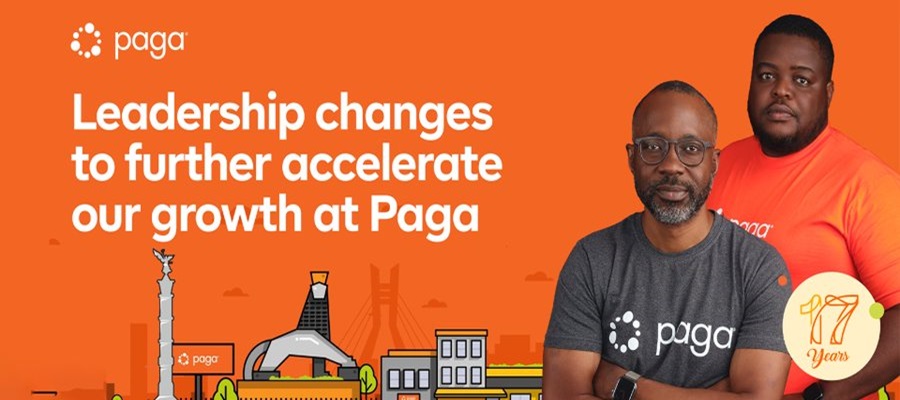
Paga Group has announced a major leadership restructuring, marking 17 years of operation and signalling a strategic shift toward deeper financial infrastructure development, emerging technologies, and expansion across Africa.

Tayo Oviosu, founder (front) and Ope Oyinloye, Group COO and CEO of Paga Nigeria
With the restructuring, Tayo Oviosu, founder, is now the Group CEO, while Ope Oyinloye has been appointed Group COO and CEO of Paga Nigeria, in an acting capacity, pending regulatory approval from the Central Bank of Nigeria (CBN).
Oviosu will also serve as executive chairman of the Group Board and non-executive chairman of Paga Nigeria.
He will be leading Paga Labs, driving geographic expansion, and overseeing fundraising efforts.
The fintech company said the changes represent a transition from its foundational phase into a new growth chapter, known as ‘Act 2’, focused on connecting Africans to global financial systems, scaling innovation, and entering new markets.
To support this transition, the company announced key leadership changes. advertisement
Jay Alabraba, co-founder, has been appointed group director of Special Projects, where he will initially lead the company’s expansion into lending and support new market entry initiatives.
Speaking on the transition, Oviosu said the company’s mission remains unchanged but its approach continues to evolve.
“Act 1 proved that we could build a profitable, high-growth infrastructure business that the world’s leading companies trust. Act 2 is about taking that infrastructure to its full potential—connecting Africans to global financial rails, moving into new markets, and leading the next wave of financial technology,” he said.
Oyinloye added that his focus will be on sustaining operational excellence while scaling the company’s next phase of growth.
With the new structure in place, Paga is positioning itself to play a more significant role in shaping the future of financial services across Africa, particularly as digital payments, blockchain technologies, and AI-driven solutions gain traction across the continent.
Paga has since evolved into a full-stack financial services infrastructure provider. Its offerings now span enterprise solutions through Paga Engine, consumer services via the Paga app, and merchant tools under Doroki.
The company’s first phase delivered significant growth. Between 2021 and 2025, total transaction value processed increased 17-fold to $11 billion across 169 million transactions in 2025 alone, with more than $1.5 billion processed monthly.
Net revenues grew five times within the same period, underscoring the scalability of its model.
Paga also expanded its enterprise footprint, with over 265 clients which include global firms such as PayPal, Meta, Amazon, LemFi, Tencent, Pesa, and Verto building on its infrastructure.
The company was further recognised by the Financial Times and Statista as one of Africa’s fastest-growing companies for three consecutive years from 2023 to 2025.
As part of its new strategic direction, Paga outlined three priorities which are strengthening its financial infrastructure to connect local and global payment systems; advancing emerging technologies such as stablecoins, cryptocurrency, and artificial intelligence through its innovation arm, Paga Labs; and expanding into new African markets.


By John Kokome
In the fast-evolving fintech ecosystem, capital is no longer the only currency that determines success. Increasingly, reputation has emerged as a powerful, if intangible, asset that can accelerate growth, attract investment, and secure customer loyalty, or conversely, trigger rapid decline when mismanaged. In a sector built on trust, speed, and innovation, reputation is not just complementary to business performance; it is foundational.

Fintech, by its very nature, operates at the intersection of finance and technology, two industries where trust is paramount. Traditional financial institutions spent decades, even centuries, building credibility through regulatory compliance, customer relationships, and institutional stability. Fintech startups, however, often attempt to compress this trust-building process into a few years, sometimes even months. This compressed timeline makes reputation both more fragile and more critical.
At the core of fintech’s reputation economy is trust. Users are asked to hand over sensitive personal data, link bank accounts, and transact digitally, often without ever stepping into a physical office. In markets like Nigeria, where scepticism around digital financial services can still linger due to fraud and system inefficiencies, trust becomes even more valuable. A single breach, whether data-related, operational, or ethical, can erode years of goodwill in hours.
Yet, reputation in fintech extends beyond security. It encompasses reliability, transparency, customer experience, and regulatory alignment. Downtime during peak transaction periods, unclear fee structures, or delayed dispute resolution can quickly escalate into reputational crises. Social media has amplified this risk. A dissatisfied customer’s complaint can go viral within minutes, shaping public perception far more rapidly than traditional media ever could.
Conversely, a strong reputation can be a growth multiplier. Fintech companies that consistently deliver seamless user experiences and communicate transparently often benefit from organic word-of-mouth marketing. In a crowded market with low switching costs, users tend to gravitate toward platforms they perceive as dependable. Reputation, in this sense, becomes a competitive moat.
Investors, too, are increasingly factoring reputation into their decision-making. Beyond financial metrics, venture capitalists and institutional investors are scrutinising governance structures, compliance culture, and public perception. A fintech with strong fundamentals but a tainted reputation may struggle to raise capital, while one with a solid reputation can command premium valuations. In this way, reputation directly influences access to funding and long-term sustainability.
Regulators also play a significant role in shaping reputational outcomes. In many emerging markets, regulatory frameworks are still evolving to keep pace with fintech innovation. Companies that proactively engage regulators, adhere to guidelines, and demonstrate a commitment to consumer protection often earn a reputational advantage. On the other hand, those that attempt to bypass regulations or operate in grey areas risk not only sanctions but also public distrust.
Importantly, reputation is not built solely through marketing. While branding and communications are essential, they must be rooted in authentic operational excellence. There is a growing disconnect between perception and reality in some fintech narratives where aggressive marketing promises outpace actual service delivery. In the long run, this gap is unsustainable. Reputation must be earned through consistent performance, not manufactured through messaging.
For fintech companies, managing reputation requires a deliberate, strategic approach. This includes investing in robust cybersecurity infrastructure, maintaining transparent communication channels, prioritising customer support, and embedding compliance into the organisational culture. It also involves proactive crisis management, anticipating potential risks and preparing clear response frameworks before issues arise.
Leadership plays a crucial role in this equation. Founders and executives are often the public face of fintech brands, and their actions, statements, and values significantly influence perception. Ethical leadership, accountability, and responsiveness can strengthen trust, while opacity or defensiveness can quickly damage credibility.
Ultimately, in the fintech ecosystem, reputation functions much like currency; it can be accumulated, spent, and, if mishandled, depleted. Unlike financial capital, it is far more difficult to rebuild once lost. As competition intensifies and the industry matures, fintech companies must recognise that their most valuable asset may not be their technology or funding, but the trust they earn and sustain.
In a world where digital transactions are instantaneous and information travels even faster, reputation is not just a byproduct of success; it is a prerequisite.
John Kokome is the Corporate Communications Manager at FlashChange, a fintech platform redefining secure digital asset exchange. With experience across fintech, cryptocurrency, telecoms, and development communications in Africa. He currently leads strategic storytelling, reputation management, and stakeholder engagement initiatives at the company, focusing on building trust, transparency, and financial literacy in the digital assets space. John’s work sits at the intersection of policy, technology, and public perception, with a strong emphasis on Africa-first narratives and responsible innovation. He has contributed opinion pieces and thought leadership articles on governance, youth empowerment, branding, and Nigeria’s evolving digital economy.

See Key Changes in BVN Rule from May 1 by CBN

INEC Warns Broadcasters against Misinformation ahead of 2027 Polls

Paga Group Rejigs Leadership as Oviosu, Founder Becomes Group CEO

Reputation: The Real Currency Powering Fintechs

Jumia Expands Nationwide Footprint, Deepens Reach Across Underserved Nigerian Cities

Spotify’s Loud & Clear Report Reveals Over ₦60Bn Revenue for Nigerian Artists in 2025

China Threatens to Shut Nigeria’s Satellite Over $11.44m Unpaid Debt

Why JustMarkets Is a Strong Choice for Gold Trading

Kuda MFB Increases Kuda for Her Business Grants to ₦10 Million

Canal+ to Cut Jobs as Part Sweeping Restructuring




 E-Business3 days ago
Nigeria Cyberattacks: Stronger Collaboration as a Panacea

 Telecom3 days ago
Airtel Becomes World’s Second Largest Telco as Global Customer Base Surpasses 650 Million

 General News3 days ago
NIBSS Says 28 Percent of Nigerians have Registered for BVN

 Telecom2 days ago
From Import Dependency to Local Capacity: Nigeria’s Tech Manufacturing Journey

 E-Business3 days ago
CBN Slams Custodian Investment with N419m Fines over Rule Breaches

 General News3 days ago
NITDA DG Urges Stronger Collaboration to Drive Nigeria’s Digital Economy

 General News3 days ago
Ogun Set for Direct London Flights as Gateway Airport Gains Momentum

 News3 days ago
Lagos Govt Drags Top Firms to Court Over Billion-Naira Tax Debts