

E-Financial
CBN to Sack Bank Chiefs over Bad Loans


A new Code of Corporate Governance approved by the Central Bank of Nigeria (CBN) has stipulated that bank directors with non-performing loans (NPLs) are to either quit or be sacked.
Adedapo Adeleke, director, Bank Examination Department at the Nigeria Deposit Insurance Corporation (NDIC), said the new code was instituted to address the rising cases of insider bad loans, which not only represent a conflict of interest, but are against the prudential guidelines for the industry.

Adeleke described corporate governance as an essential pillar in financial system stability.
He said: “Banks’ assets have depreciated in the last three years, with provisions for NPLs hitting N856.9 billion, due to the drop in crude oil prices. A large part of these bad loans is owed by bank directors and are in most cases unsecured.
“Besides, the economic recession showed that the financial industry still harbours weaknesses in governance, as seen in insider non-performing loans, unreported losses, huge exit packages for directors, over-domineering executive management, contravention of regulatory/prudential guidelines and lending limits, poorly appraised credits and weakening of shareholders’ funds, among others.
“The Corporate Governance Code for Bank Directors is signed by all bank directors at the point of their appointment, and has a section that empowers the banks’ boards to remove any director with insider non-performing loans.
“That section says: ‘If you are having non-performing loans, you will be removed. It is already being enforced except that the regulators are not being dramatic in publishing the names of affected directors,’” Adeleke said.
He added that delay or non-payment of workers’ salaries by government and private companies is worsening the level of non-performing loans in the industry.
Adeleke further lamented the rate of non-performing loans saying, “NPLs are in excess of 20 per cent as against the five per cent regulatory threshold.”
The NDIC director said when salaries are delayed, workers who have borrowed from banks, especially through consumer loans, always find it difficult to pay back. “If the economy is improving, and government can help to fulfill its responsibilities, including prompt payment of salaries, the level of non-performing loans in the industry will drop,” he said.
“If people working in companies that are troubled borrowed from banks, it is important that the loans be provided for when their employers can no longer pay salaries,” he said.
He, however, expressed confidence that the current rise in crude oil prices will impact positively on the banking industry and businesses and help reduce the rising cases of bad loans in the industry.



Kuda Microfinance Bank partnered with Lovers & Frnds for a Valentine’s edition event on Sunday, February 15, at Space Hub Lekki, Lagos, redefining celebrations around love, friendship, and social connections beyond romance.

Kuda Bank
The R&B-themed gathering drew couples, friend groups, and solo attendees with music sets from DJs like TGarbs, games, gift exchanges, and colour-coded tags—red for relationships, yellow for mingling singles, orange for non-minglers—to spark easy interactions.
Kuda activated a branded photo booth, merchandise giveaways, prize activities, and complimentary drinks for Premium loyalty tier customers, while vendors used Kuda Business POS terminals for seamless cashless payments.
Senior Brand Manager Emmanuel Femi-Adejobi said: “We partner with experiences matching our customers’ lifestyles in music and entertainment, creating spaces they genuinely connect with—we’ll keep supporting how they live and celebrate.”
By Mathew Anthony, Market Analyst at FXTM
In another positive development for Nigeria, the CBN has proceeded with 50-basis points rate cut.

FXTM Logo
With favourable fundamental forces at play, it was always a question of how much rather than if rates will be cut in February.
Although some were expecting a hefty 100-basis point cut, this was still a positive move by the CBN, mirroring the dovish strategy of other major banks on the continent.
Interest rates were slashed thanks to cooling inflationary pressures, a stronger Naira and rising FX reserves.
This move is likely to boost confidence over the economic outlook ahead of the Q4 GDP report scheduled for release later this month.
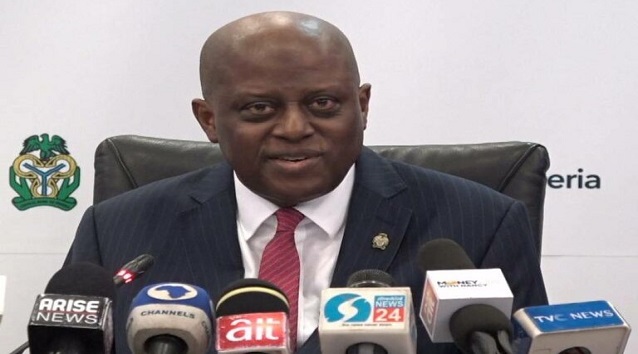
Central Bank of Nigeria (CBN) has lowered its Monetary Policy Rate (MPR) by 50 basis points to 26.50 percent from 27 percent, a unanimous decision announced by Governor Olayemi Cardoso at the end of the 304th Monetary Policy Committee (MPC) meeting in Abuja on Tuesday.

CBN
Cardoso cited 11 straight months of decelerating headline inflation—reaching 15.10 percent in January 2026 per National Bureau of Statistics—as key, driven by prior tightening lags, naira stability, food supply gains, steady petroleum prices, export earnings, remittances, and balance of payments strength.
Liquidity ratio stays at 30 percent, CRR unchanged at 45 percent for commercial banks (16 percent merchant banks) and 75 percent non-TSA public deposits; standing facilities corridor now +50/-450 basis points around MPR.
The MPC retained other parameters, welcoming Executive Order 09 redirecting oil/gas revenues to the federation account for fiscal boost, last cutting rates in September 2025 after November’s hold.

SERAP Says Phone Tapping Law Violates Human Rights, Calls for Withdrawal

MultiChoice Suspends Yearly DStv Price Hike as Canal+ Pushes Growth

Microplastics Found in 90 Percent of Prostate Cancer Samples

Lotus Bank, REA Seal N100Bn Deal to Power Rural Nigeria

DG NITDA Reaffirms FG Commitment to Responsible, Inclusive AI
Nigeria’s 9 Top FinTech Firms Valued at $10.6Bn in January 2026

CBN Upgrades Licences of Opay, Moniepoint, Kuda, Palmpay, Paga to National Status

NITDA, NBC Explore Strategic Collaboration on Digital Transformation, Media Regulation

Kaspersky Launches OT Calculator to Align Cybersecurity Investments with Business Goals

Why the Future of PR Depends on Healthier Client–Agency Partnerships




 General News3 days ago
Zinox Technologies and TD Africa Forge Strategic Partnership to Revolutionize African Tech Ecosystem

 Telecom3 days ago
Uwaje Pays Tribute to Leo Stan Ekeh @70

 Telecom2 days ago
Cyber Immunity Emerges as Shield for Nigerians Amid Rising Scams

 E-Financial2 days ago
$214Bn Missing, Institutions Silent: Is Accountability Dead in Nigeria?

 General News2 days ago
NITDA, Abia Partner on Enterprise Architecture Reform

 E-Business2 days ago
Interswitch Partners Abia to Digitise Public Hospitals

 E-Business2 days ago
WIEG 2026 Summit Shifts to April 22-23 for Maximum Impact

 News1 day ago
NITDA Urges Stronger State Partnerships as Key to Digital Economy Goals @ South-South Stakeholders Forum