

News
CIBN Presents Accreditation Certificate to Ecobank Nigeria Academy


The Chartered Institute of Bankers of Nigeria (CIBN) has officially presented certificate of accreditation to the ultra-modern, state of the art Ecobank Nigeria Academy with a call to other financial institutions in the country seeking accreditation of their training school to emulate Ecobank Nigeria.
Speaking at the event, Uche Olowu, CIBN President, said the accreditation of Ecobank Nigeria Academy was based on the report of its Capacity Building and Certification Committee that the training school has met all the parameters of measurement, stressing that it was a manifestation of the importance the Management of the bank place on capacity building of its workforce.
According to him, “As an Institute, we congratulate Ecobank for the accreditation of its Academy. This comes after rigorous accreditation processes by members of our Capacity Building and Certification Committee which showed that Ecobank has complied with and satisfied the provisions and requirements of the Competency framework for the Nigerian Banking Industry as mandated by the Central Bank of Nigeria (CBN) through CIBN.
“The Academy was found to have scored above the minimum threshold on all the parameters of measurement. We firmly believe this accreditation would not only enable Ecobank comply with the provisions of the Competency Framework but also strengthen the intellectual resources and capabilities available in the Bank.”
He disclosed that the Institute has so far accredited 18 bank academies, 20 Educational Training Service Providers (ETSPs) and currently executing linkage agreements with 65 tertiary institutions, stressing that apart from addressing competency challenges and enthroning a minimum standard for practitioners in the industry, it is also furthering its mandate as the sole accreditation agency for the implementation of the Competency Framework in the industry.
Responding, Patrick Akinwuntan, managing director, Ecobank Nigeria, said the accreditation of the Academy re-enforces the bank’s commitment to empowering its entire workforce for the Millennial age, stressing that it would further enable the Bank to take up its rightful position in the industry as the Bank of choice. According to him, ‘I must salute our Human Resources team and my colleagues in the management team for this landmark step.
This underscores the importance we attach to staff training, skills development and capacity building as we seek to transform our Bank to deliver value to customers and shareholders.
There is no substitute to knowledge. We will continue to upgrade the standard of the Academy to meet with fresh and modern-day industry challenges.”
The Managing Director further explained that Ecobank Nigeria is a member of Pan African bank, Ecobank Transnational Incorporated (ETI) based in Togo which operates in 36 countries in Africa and with representative offices in Paris, Beijing, Dubai, Johannesburg and London, stating specifically that Ecobank Nigeria has made many pioneering achievements and ‘firsts’ across various products and digital platforms in the country.
He specifically commended CIBN for the various initiatives targeted at raising standards, promoting ethics and positioning the financial services industry to meet with the new challenges such as digital banking and financial technology (Fintech), adding that the Institute is also contributing meaningfully towards the economic development of the country through its various activities in African Continental Free Trade Area (AfCFTA).
He reiterated that Ecobank would continue to partner with the Institute in promoting integrity, professionalism, innovation and ethics in the banking and finance industry. Commenting, Manager, Learning and Development,
Ayotunde Opeoluwa, Ecobank Nigeria, said the accreditation of the Academy is an attestation of the Bank’s commitment to its roadmap to industry leadership goals through people development, stressing that Ecobank will continuously seek improvement in ensuring that its curriculum is dynamic and meet global standards.
Opeoluwa, who is also the Head of the Academy further said “This is a good news for us as a bank. It reinforces our people centric strategy to equipping our staff with the right skills and competence in line with global practices.
“Let me use this opportunity to thank our Management for the great support and members of our internal faculty for their dedication toward achieving this milestone. We will continue to seek improvement to maintain industry and global standards.”



National Agency for Food and Drug Administration and Control (NAFDAC) has alerted Nigerians on counterfeit and unregistered Cerelac Mixed Fruits and Wheat products being sold in Lagos.

NAFDAC said Nestle Nigeria, the genuine Marketing Authorisation Holder of the product, received a complaint of suspected counterfeit purportedly manufactured by Nestlé Spain, bearing Batch Code 308002910.
It said that Nestle Nigeria reported that the complainant described that the counterfeit product emitted an odour suggestive of possible contact with fuel.
NAFDAC said that preliminary review of the product by Nestle Nigeria indicated that it had expired, in spite of the container displaying an expiry date of 10-2026, which suggested that the date coding had been tampered with (revalidated).
Nestle Cerelac Mixed Fruits and Wheat is a nutritious infant cereal, designed to be a delicious first food for infants.
NAFDAC said that its post-marketing surveillance’s directorate officers in Lagos conducted a surveillance visit to Maxland Shopping Centre, 193 Ago Palace, Okota, where the product was purchased by the complainant.
It added that the suspected counterfeit and unregistered Cerelac were found on sale at the premises and subsequently mopped up, while Nestle assisted in identifying the distinguishing features between registered and unregistered product.
According to the regulatory agency, Nestle revealed that the unregistered product used a hyphen (-) to separate the day from the year, while the registered product used a slash (/) to separate the day from the year.
“It is important to note that Nestle Nigeria is not aware of the channels through which the products are supplied into the country.
“Healthcare professionals and consumers are advised to report any suspicion of the sale of substandard and falsified regulated products to the nearest NAFDAC office, call 0800-162-3322, or send an email to [email protected],” NAFDAC said.
The agency warned that counterfeit formula often lacked essential nutrients, vitamins and minerals, leading to stunted growth or developmental issues.
It said that such formula might also contain contaminants that might lead to severe health consequences to infants or even death.
NAFDAC reiterated its commitment to safeguarding public health adding that it would continue surveillance activities to ensure the quality, safety, and efficacy of all NAFDAC-regulated products circulating in Nigeria.
It said that all zonal directors of the agency and state coordinators had been directed to carry out surveillance and mop up the revalidated product, if found within the zones and states.
The agency urged distributors, retailers, healthcare professionals, and caregivers to exercise caution and vigilance within the supply chain, to avoid the distribution, sale, and use of fake products.
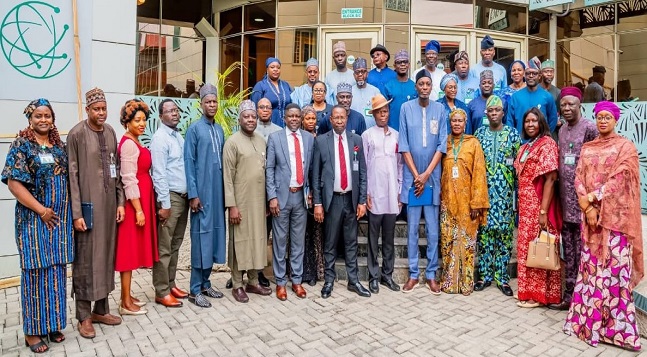
The National Information Technology Development Agency (NITDA) has reinforced its commitment to advancing Nigeria’s digital transformation agenda through strengthened collaboration with key strategic institutions, as it hosted the Director General of the National Institute for Policy and Strategic Studies (NIPSS), Professor Ayo Omotayo, alongside participants of the Senior Executive Course (SEC) 48, 2026.

The visit, which builds on an earlier strategic study tour, provided a platform for in-depth engagement on the role of digital innovation in driving sustainable economic growth, with particular focus on the Orange Economy.
Representing the Director General of NITDA, Kashifu Inuwa CCIE, the Director of Stakeholder Management and Partnerships, Dr Aristotle Onumo, highlighted the Agency’s commitment to fostering a vibrant digital ecosystem through inclusive policies, strategic partnerships, and capacity development initiatives.
“NITDA is committed to creating an enabling environment where innovation can thrive by bringing together government, private sector, academia, and creatives to drive Nigeria’s digital economy,” he stated.
Inuwa underscored the growing importance of the Orange Economy, describing it as a critical driver of innovation and economic value through intellectual property. He identified sectors such as digital content creation, film, animation, and digital art as key contributors to national development.
“The Orange Economy represents a powerful opportunity to transform our rich cultural heritage and creativity into sustainable economic growth,” he noted.
He further highlighted Nigeria’s unique advantage, particularly its youthful and creative population, while calling for stronger collaboration among stakeholders to fully harness the sector’s potential.
“With our youthful population and rich cultural assets, Nigeria is well-positioned to become a global leader in the Orange Economy if we deepen collaboration and investment across the ecosystem,” he added.
During the engagement, NITDA also presented its strategic initiatives aimed at supporting the digital and creative sectors, including digital infrastructure development, promotion of digital literacy, and implementation of policies that enable startups and innovators to scale.
Addressing challenges facing the sector, Inuwa pointed to issues such as limited access to funding, infrastructure gaps, weak intellectual property protection, and ecosystem fragmentation, while emphasising the need for coordinated action.
“Addressing challenges such as funding gaps, infrastructure deficits, and intellectual property protection is critical to unlocking the full potential of Nigeria’s creative economy,” he said.
The Agency reiterated its target of achieving 70 per cent digital literacy by 2027, noting that ongoing programmes are equipping millions of Nigerians with essential digital skills, including those in underserved and informal sectors.
In his remark, Professor Omotayo described the visit as an important opportunity to deepen understanding of how digital technologies are reshaping economic sectors, particularly the creative industry. He noted that the insights gathered would contribute significantly to policy recommendations aimed at strengthening Nigeria’s economic framework.
Participants of the SEC 48 programme engaged actively during the session, raising questions on capacity development, access to tools, and frameworks for protecting digital content. NITDA highlighted its ongoing collaborations with industry stakeholders to provide training, innovation hubs, and access to digital tools for young Nigerians.
The engagement concluded with a renewed commitment from both NITDA and NIPSS to strengthen collaboration in research, policy development, and capacity building, aimed at positioning Nigeria as a globally competitive force in the digital and creative economy.

Nigeria Revenue Service (NRS) has assumed responsibility for collecting mineral royalties from mining operators nationwide, following new tax laws effective January 1, 2026.

NRS
The shift emerged from a Thursday meeting between Solid Minerals Development Minister Dele Alake and NRS Chairman Dr. Zacch Adedeji. Their joint statement, endorsed by both, confirms NRS now administers all federally collectible revenues, including royalties.
Enacted by President Bola Tinubu on June 26, 2025, the Nigeria Tax Laws 2025 empower this transition. The Ministry of Solid Minerals Development remains a key partner, supplying pricing data, geological insights, and sector coordination.
NRS Special Adviser Dare Adekanmbi’s statement outlines collaborative steps: a nationwide sensitization program for operators on filing and payments; development of a digital royalty system; and regular joint technical sessions to address issues.
Both agencies pledge orderly, transparent implementation to boost the mining sector. Operators must comply with obligations and join upcoming programs.
The move aims to streamline revenue collection while fostering mining growth.

Offset Communications Slams N50m Suit against Qore Technologies for Alleged Copyright Infringement

Compensation for Poor Service Quality is Automatic- NCC

SERAP Sues CCB over Electoral Act, New Tax law

Tinubu Approves N3.3 Trillion Payment Plan to Boost Power Supply

NDPC Investigates Remita, Others over Alleged Data Breaches

Spotify’s Loud & Clear Report Reveals Over ₦60Bn Revenue for Nigerian Artists in 2025

Madonna University Taps Tech Guru Adote for Strategic Board Role

China Threatens to Shut Nigeria’s Satellite Over $11.44m Unpaid Debt

Healthcare Under Attack: Why Cybersecurity is Now Critical Care

Why JustMarkets Is a Strong Choice for Gold Trading




 General News3 days ago
FG, Others Say Nigeria Wastes 38m Tonnes of Food Annually

 E-Financial3 days ago
CBN, Banks, Fintechs Launch PSPC to Boost Nigeria’s Payment System

 News3 days ago
NITDA Strengthens Collaboration with NIPSS to Drive Digital Innovation, Orange Economy Growth

 E-Financial3 days ago
CycleFlow, IFC Launch Supply Chain Finance Platform in Nigeria

 E-Financial3 days ago
Anchor Gets Nigerian, Canadian Licences as Transactions Crosses $2.5Bn

 E-Financial3 days ago
Ecobank Assures of Seamless Easter Banking Services

 News3 days ago
NRS Takes Over Mineral Royalties Collection Under New Tax Laws

 E-Financial2 days ago
N4.65 Trillion in the Vault, but is the Real Economy Locked Out?