

E-Financial
CIMA Mulls Centre to Boost Accounting Research in Nigeria

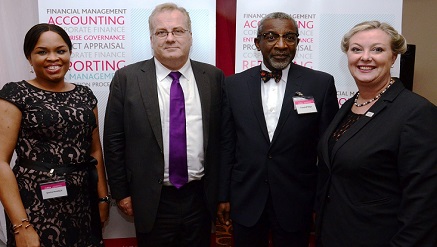
The Chartered Institute of Management Accountants has disclosed plans to establish a CIMA Centre of Excellence in Nigeria aimed at developing the field of management accountancy in Nigeria.
Andrew Harding, managing director of CIMA, the Chartered Institute of Management Accountants disclosed this at the inaugural members’ dinner for CIMA members resident in Nigeria held in Lagos recently.
He said that it is expected the centre will provide platform for academics in Nigeria to conduct research into management accounting and help CIMA members stay at the cutting edge of business evolution
Harding described Nigeria as a vibrant country, and Nigerians as intelligent, dynamic and truly inspiring entrepreneurial people that must have cutting edge management accounting expertise to enhance its position as Africa’s leading economy.
The MD noted that the dinner is a milestone in the history of the world’s largest professional body of management accountants.
He said the dinner is in line with CIMA’s tradition of celebrating the great skills and dedication of CIMA members in the 177countries where the global management accounting body has an active presence.
“Tonight is another milestone in CIMA’s history. We are not only celebrating the great skills and dedication of CIMA members in this country for the first time but also the recent launch of CIMA Nigeria’s new office in this vibrant city. Now that CIMA has a base in Nigeria, the institute is looking forward to developing the country’s talent base and further enhancing its position as a leading African economy,” he said.
Speaking further on the proposed Centre, he said, “Such expertise is essential if Nigeria is to achieve its goal of becoming one of the top 20 economic nations by 2020.”
The CIMA MD explained that being a CIMA member means being a good corporate citizen and thinking about the long term as well as putting professionalism at the heart of every activity. “I am very proud of the institute’s emphasis on ethics and sustainability,” he said.
This emphasis, he said, is the value offered by Chartered Global Management Accountants (CGMAs) and a growing number of organisations are beginning to understand that employing CIMA members to build ethics and sustainability into their strategy makes good business sense. “With Nigeria’s economy in the ascendance and a wealth of young talent eager to be developed, management accounting has a key role to play in ensuring that this dynamic nation not only survives future economic turbulence but thrives from public and private sector organisations that are both successful and sustainable.”
According to him, the world gives Nigeria a lot of bad press which is at variance with his experience.
He disclosed that his trip to Nigeria has been an unexpectedly wonderful experience of meeting with dynamic, intelligent and truly inspiring entrepreneurial people.
On their part, CIMA fellows at the dinner led by Chief Kola Jamodu, Chairman, Nigeria Breweries Plc; Folusho Phillips, Executive Chairman, Phillips Consulting Group; and Peter Crabb, Senior Consultant, Associated Consultants and Investment Limited, urged CIMA to make its sought-after professional development programmes readily accessible across Nigeria to empower young professionals and Nigerian businesses to build great opportunities in management.



Nigerian fintech giant, Paystack has taken its boldest step yet beyond payments, acquiring Ladder Microfinance Bank. The fintech giant has quickly rebranded its new acquisition as Paystack Microfinance Bank (MFB) in a strategic shift that could reshape how African businesses access credit, deposits, and embedded financial services.

After nearly a decade building the backbone of online payments in Nigeria, the deal gives Paystack regulatory cover to hold deposits, lend directly to businesses and offer banking-as-a-service products.
More importantly, Paystack’s chief operating officer, Amandine Lobelle, highlighted that it allows the company to exert greater control over the trillions of naira that already flow through its platform every month, turning transaction data into a powerful engine for credit and treasury products.
“After 10 years of building payment infrastructure and going deep, we realised that businesses needed more than just getting paid to grow. We wanted to leverage the expertise that we have built over the last decade to continue to address some of the pain points that businesses have,” said Lobelle.
Paystack MFB will operate as a sister company to its payments business, initially focusing on working capital loans, merchant cash advances, overdrafts and term loans for small and medium-sized enterprises.
By using real-time payment data to underwrite loans, Paystack believes it can offer faster approvals and more accurate risk pricing than traditional lenders, directly tackling Nigeria’s estimated $32 billion small business financing gap.
For Paystack, founded in 2016 and acquired by Stripe in 2020, the move marks a strategic evolution from being just a payments processor to becoming a core part of the financial operating system for African businesses.
Today, Paystack supports more than 300,000 businesses across Nigeria, Ghana, and South Africa and has become one of Africa’s most trusted fintech infrastructure providers.
The banking licence is a game-changer as payments, once Paystack’s main growth engine, are increasingly commoditised across Africa. Lending, deposits and treasury services offer deeper margins, stickier relationships and long-term sustainability.
By layering banking services on top of payments, Paystack is betting that infrastructure depth will outperform flashy consumer scale.
However, the move also throws the Nigerian-born fintech giant into fierce competition with digital -first lenders and neobanks such as Moniepoint, Kuda, OPay and PalmPay, which already operate at massive scale. Still, Paystack’s strength lies in its merchant-first focus and developer-friendly APIs.


Federal Government has suspended the issuance of implementation guidelines for the new tax laws due to lingering doubts about their final version, Taiwo Oyedele, Chairman of the Presidential Tax Reform Committee, disclosed on Wednesday.

Speaking in Lagos after delivering a keynote address on the 2026 Economic Outlook, organised by the Institute of Chartered Accountants of Nigeria (ICAN) under the theme ‘ICAN@60: Accountability as the Bedrock for National Development,’ Oyedele said he directed the Nigeria Revenue Service (NRS) and Joint Revenue Board (JRB) to hold off on guidelines.
He explained that his team purchased a printed copy from the government printer to verify authenticity, only to learn the National Assembly had seized all copies pending completion of its review. “The Acts Authentication Act says whatever the government printer publishes is the evidence of the law. But lawmakers said it’s not what they passed,” Oyedele stated.
Efforts by Nigeria CommunicationsWeek to reach Senate spokesman, Senator Yemi Adaramodu (APC, Ekiti South), and House of Representatives spokesman, Akin Rotimi, yielded no response, as calls went unanswered and messages unread.
Oyedele acknowledged legislative review as standard but stressed the access restriction reintroduces uncertainty. He instructed his staff to persistently follow up in person at the printer.
Oyedele dismissed allegations of significant alterations to the gazetted versions of the National Revenue Service (Establishment) Act, Joint Revenue Board of Nigeria (Establishment) Act, Nigeria Tax Administration Act, and Nigeria Tax Act, which took effect January 1.
He insisted minor discrepancies do not impact key elements like tax rates, burdens, or filing deadlines. In December, Rep. Abdussamad Dasuki (PDP, Sokoto) raised a privilege matter at the House plenary, highlighting differences between passed versions and gazetted copies after comparing them with Votes and Proceedings.
The House formed a seven-man probe committee, which reported by December 25. On January 3, the National Assembly released Certified True Copies (CTCs) affirming the original passed texts and rejecting the controversial gazettes.
Oyedele decried opposition to reforms, including paid protests and misinformation. “We’ve seen people paid N30 million to protest; the deal broke during sharing, and some spoke to media,” he revealed.
He cited a November 2025 incident where fake news triggered panic sales, wiping N4.6 trillion off the stock market despite exemptions for turnover up to N150 million annually. “That fake news led to real losses, even for pensioners via PFAs,” he warned.
Linking to the event theme, Oyedele called accountability the bridge from reforms to results, urging trust-building, knowledge-seeking, and execution focus.
Panelists advocated coordinated efforts. LCCI Director-General Dr. Chinyere Almona called for inter-agency engagement, technology, and centralised monitoring to resolve policy conflicts.
MAN Director-General Segun Ajayi-Kadir sought inclusive growth without hurting competitiveness, noting manufacturing’s sub-10% GDP share, sector challenges, and N2 trillion in unsold inventory.
Session chair Mohammed Hayatudeen described 2026 as a pivotal year post-2023/2024 turbulence, with stabilised inflation, exchange rates, and reserves, but persistent high poverty. He questioned if tax policy ambition matches administrative capacity.
ICAN President Mallam Haruna Nma Yahaya welcomed guests, emphasising accountability for economic stability amid fragile recovery. He highlighted 2025 gains: GDP growth over 4% in Q2, inflation easing to mid-14s, forex reserves at multi-year highs, trade surpluses, and PMI at 57.6.
Yet, he cautioned fragility without discipline. “Accountability is an economic imperative,” Yahaya said, citing global evidence on strong institutions, and urged practical solutions for governance.

Federal Government has directed all banks and fintech companies to begin collecting and remitting a 7.5 per cent Value Added Tax (VAT) on specific electronic banking services, effective Monday, January 19, 2026.

Tax
Payment platforms issued email notices to customers on Wednesday, with Moniepoint sharing details that the VAT applies to electronic banking charges such as mobile money transfers, USSD transaction fees, and card issuance fees. For instance, a N100 transfer fee will attract N7.50 VAT, charged solely on the service fee and not the principal amount transferred.
The Nigeria Revenue Service (NRS), formerly the Federal Inland Revenue Service (FIRS), mandated commercial banks, microfinance banks, and electronic money operators to comply by the deadline. Moniepoint clarified the levy as a statutory obligation rather than a price hike, with VAT to appear separately on transaction statements.
Services like interest earned on deposits and savings remain exempt from the tax. Other operators are expected to notify customers soon, standardising collection across Nigeria’s digital economy to boost revenue.
This follows December notices from commercial banks about reclassifying the N50 Electronic Money Transfer Levy (EMTL) as stamp duty on transfers of N10,000 and above, now a one-off fee under the new Tax Act. The measures align with ongoing tax reforms amid uncertainty over final laws, as noted by Taiwo Oyedele last week.
Customers can expect clear itemisation of VAT on statements, supporting government efforts to enforce uniform rules on digital transactions.

Paystack Expands Beyond Payments into Banking

DalaHill, BoA Partner on $100,000 ACF Climate Finance Initiative

How to Stay Safe Online During Sales Periods

FG Directs Banks, Fintechs to Remit VAT on Service Fees

Nigeria Targeted with 4,622 Cyber-attacks Per Week in December 2025

Banks quietly move to enforce new ₦50 transfer levy from Jan. 1

FIRS says NIN, CAC Numbers to Serve as Tax IDs from 2026

Nigeria Takes the Lead in the Global WSIS+20 Digital Agenda

Nigeria Police Arrest Okitipi, Nigerian Allegedly Linked to Microsoft 365 Hack

PalmPay Launches N400 Million World Travel Carnival, Rewarding Users with Free Global Trips




 General News2 days ago
PalmPay, Premier Cool to Reward 10,000 Nigerians with ₦100m in “10k for 10k Campaign”

 News3 days ago
Nigeria, Others Lag Behind as Egypt Tops Africa in AI Readiness

 E-Financial2 days ago
Ecobank Joins Trillion-naira Club for the First Time in 20 Years

 E-Business2 days ago
Kaspersky Warns Telecom Threats from 2025 will Carry into 2026 as New Technology Adds New Risk

 E-Business2 days ago
Nigerian Terra Industries Secures $11.8m for Expansion

 Telecom2 days ago
SHELT Named in Prestigious 2025 MSSP 250 List for Cybersecurity Excellence

 E-Financial1 day ago
Angst as FG Demands 7.5 Percent VAT on Mobile Bank Transfers, USSD

 News1 day ago
Moniepoint Launches Second Cohort of DreamDevs Initiative to Double Down on Africa’s Tech Talent Pipeline